UniDeploy
UniDeploy is an AI-powered DevOps command-line agent that runs on a user's machine and manages cloud infrastructure through natural-language commands.
What UniDeploy is
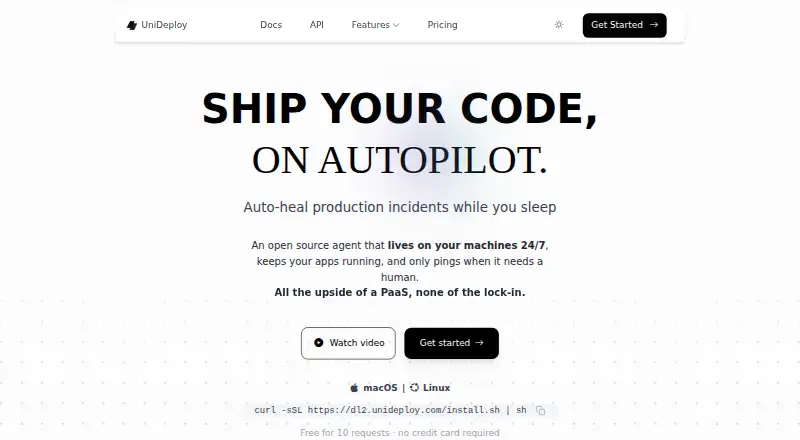
UniDeploy is an AI-powered DevOps command-line agent that runs on a user's machine and manages cloud infrastructure through natural-language commands. A single CLI supports AWS, Azure, and GCP, with tools for EC2, Lambda, S3, CloudWatch, and RDS. Its cost optimizer identifies unused Elastic IPs, unattached volumes, and idle resources, while its security scanner checks security groups for vulnerabilities and exposed ports and suggests actions. It can run commands on EC2 through AWS Systems Manager without SSH access. UniDeploy connects with ServiceNow and Jira for incident management and works with models including Bedrock, Anthropic, OpenAI, Gemini, and Ollama. Its MCP server lets compatible clients such as Claude Desktop invoke DevOps tools. The CLI supports Linux, macOS, and Windows WSL. The free plan provides 10 AI requests and community support; the $15/month paid plan lists unlimited usage, email support, and 24/7 infrastructure monitoring. Users provide their own model and pay its provider directly for usage.
Good
- One CLI supports AWS, Azure, and GCP
- Finds unused and idle cloud resources
- Scans security groups and recommends actions
- Runs EC2 commands through Systems Manager without SSH
- MCP server supports compatible clients
Watch out
- Free plan is limited to 10 AI requests
- Users pay model providers directly
- Free plan lists community support
Who it suits
UniDeploy may suit infrastructure teams managing AWS, Azure, or GCP who want to issue cloud operations through a CLI. Its local execution and model choice may appeal to users who want to keep secrets in their own environment.
Verdict
UniDeploy combines cloud operations, resource checks, and incident tools in a local CLI. Its free request limit and separate model-provider charges are worth weighing against the paid plan's listed unlimited usage.
Plans and prices
From UniDeploy's own pricing page, checked 30 Sep 2026.
| Plan | Price | What it gives you |
|---|---|---|
| Free /forever | Free | 10 free AI requests · bring your own model · full CLI access · community support · no credit card required |
| Most Popular | $15 a month | Unlimited AI requests · bring your own model · full CLI with 30+ DevOps tools · 24/7 infrastructure monitoring · email support · cancel anytime · $15 /month |
The facts
Each one read from UniDeploy's own pages, with the date it was checked.
What it does
- Autopilot
- The paid plan includes 24/7 infrastructure monitoring, and the site describes the agent as able to auto-heal incidents.checked 30 Sep 2026
- Cloud operations
- The listed tools manage EC2 instances, Lambda functions, S3 storage, CloudWatch logs and metrics, and RDS databases.checked 30 Sep 2026
- Cloud providers
- It supports AWS, Azure, and GCP through one CLI.checked 30 Sep 2026
- Integrations
- The site names ServiceNow and Jira for incident management and says it works with AI models including Bedrock, Anthropic, OpenAI, Gemini, and Ollama.checked 30 Sep 2026
- MCP integration
- The documentation says UniDeploy runs an MCP server that lets MCP-compatible clients, including Claude Desktop, call its DevOps tools.checked 30 Sep 2026
- Payment for model usage
- The site says users bring their own model and pay the model provider directly for usage.checked 30 Sep 2026
- Product
- UniDeploy describes itself as an AI-powered DevOps agent CLI that runs on your machine and manages cloud infrastructure through natural-language commands.checked 30 Sep 2026
- Remote commands
- It can execute commands on EC2 instances through AWS Systems Manager without SSH access.checked 30 Sep 2026
- Security
- The site says UniDeploy is built in Rust, uses mTLS encryption, runs on users’ machines, and keeps secrets in the user’s environment.checked 30 Sep 2026
- Security scanning
- Its security scanner checks security groups for vulnerabilities and open ports and provides recommendations.checked 30 Sep 2026
- Support
- The free plan lists community support and the paid plan lists email support.checked 30 Sep 2026
- Supported environments
- The site says the CLI works on Linux, macOS, and Windows WSL.checked 30 Sep 2026
- Usage limits
- The free plan includes 10 AI requests; the paid plan is listed with unlimited usage.checked 30 Sep 2026
Money
- Cost optimization
- Its cost optimizer finds unused Elastic IPs, unattached volumes, and idle resources.checked 30 Sep 2026
The full review of UniDeploy
UniDeploy is a local, AI-powered DevOps CLI for controlling cloud infrastructure with natural-language commands. It is aimed at operators managing more than one cloud, especially those who also need cost checks, security review, and incident tooling. The main trade-off is between a tightly capped free tier and a $15 monthly plan whose model costs remain separate.
Overview
UniDeploy puts AWS, Azure, and GCP operations behind one command-line interface that runs on your own machine. That makes it a practical fit for engineers who switch providers or want a consistent operational workflow instead of separate consoles. Teams committed to a single cloud may find less reason to add another control layer.
The local design is a meaningful security choice: the software is built in Rust, uses mTLS encryption, runs on the user’s machine, and keeps secrets in the user’s environment. Those properties suit organizations that do not want credentials centralized in a hosted control plane, although they also leave local installation and environment management with the user.
Key features
The CLI covers EC2 instances, Lambda functions, S3 storage, CloudWatch logs and metrics, and RDS databases. Its cross-cloud scope is the strongest reason to consider it, particularly for mixed AWS, Azure, and GCP estates. It also supports Kubernetes, infrastructure troubleshooting, runbook automation, and both deployment and incident-response workflows.
Cost controls identify unused Elastic IPs, unattached volumes, and idle resources. These findings can focus cleanup efforts and expose waste that is easy to miss in routine operations. The security scanner checks security groups for vulnerabilities and open ports and supplies recommendations, making it useful for review and prioritization rather than a substitute for a full security program.
For AWS incidents, UniDeploy can execute commands on EC2 instances through AWS Systems Manager without SSH access. That is valuable when direct access is restricted or unavailable. ServiceNow and Jira integrations connect the CLI to named incident-management workflows.
The documentation also describes an MCP server, allowing MCP-compatible clients such as Claude Desktop to call UniDeploy’s DevOps tools. Model support includes Bedrock, Anthropic, OpenAI, Gemini, and Ollama. The paid tier adds 24/7 infrastructure monitoring, and the agent is described as capable of auto-healing incidents; organizations should treat that as an automation feature requiring suitable operational controls, not as a guarantee that every failure resolves itself.
Pricing
| Plan | Price | Includes |
|---|---|---|
| Free / forever | free | 10 free AI requests, bring your own model, full CLI access, community support, no credit card required |
| Most Popular | $15 a month | Unlimited AI requests, bring your own model, full CLI with 30+ DevOps tools, 24/7 infrastructure monitoring, email support, cancel anytime |
The free plan is suitable for a short evaluation or occasional commands, but 10 AI requests is a hard ceiling for regular operations. The $15 monthly plan removes that request cap and adds monitoring, a larger stated tool set, and direct email support. Both plans require users to bring their own model and pay the model provider directly for usage, so the subscription is not the complete AI cost. There are no seat limits stated, and the paid plan can be cancelled at any time.
Platforms
UniDeploy is offered through an API and runs on Linux, macOS, and Windows via WSL. Its local deployment mode suits command-line environments and supports the security model of keeping secrets on the user’s machine.
Who it's for
Choose UniDeploy if you operate across AWS, Azure, and GCP and want one natural-language interface for provisioning, troubleshooting, cost hygiene, security checks, and incidents. It is also a good match for teams already using MCP-compatible clients or needing Systems Manager commands without SSH.
It is less suitable when you need a generous free tier, bundled model usage, or a provider-specific experience that goes deeper than a cross-cloud abstraction. Small teams should budget for model-provider charges alongside the subscription.
Pros and cons
Pros
- Cross-cloud CLI: AWS, Azure, and GCP support reduces context switching for multi-cloud operators.
- Useful operational coverage: Resource management, cost findings, security-group checks, runbooks, Kubernetes, and incident tools share one interface.
- Local security posture: Rust, mTLS, local execution, and environment-held secrets limit dependence on a hosted control plane.
- SSH-free response: Systems Manager command execution helps during restricted-access incidents.
Cons
- Very small free allowance: Ten AI requests is insufficient for sustained daily use.
- Separate model billing: Users pay providers directly, making total cost depend on model consumption.
- Paid tier required for monitoring: 24/7 monitoring and the stated autopilot capabilities are not part of the free plan.
Alternatives
incident.io is the better choice for teams centered on Slack or Microsoft Teams incident response, single-team on-call, status pages, and incident automation.
Hermes Agent suits users seeking a broader AI agent with free models and a $20 monthly Plus plan rather than a cloud-operations-specific CLI.
Plural is worth considering when a 14-day platform trial and a self-hosted option matter more than UniDeploy’s per-user command workflow.
TalkOps fits buyers wanting free, open-source operation with no license or seat fees, while model tokens and cloud infrastructure remain separate costs.
K8sGPT is the focused alternative for an open-source Apache 2.0 Kubernetes assistant.
TigerOps targets hosted monitoring with explicit host, retention, log, synthetic-check, and seat quotas.
HealR is an alternative for agentic war rooms and data-source integrations in a self-hosted or hosted setup.
Kestrel suits teams wanting topology, inventory, audit, SDK, CLI, and MCP capabilities, with a separate paid Cloud AI Copilot.
Verdict
UniDeploy is a strong fit for multi-cloud operators who want natural-language control plus cost, security, and incident workflows in a local CLI. Its broad provider coverage and $15 unlimited-request plan are the main reasons to choose it. Look elsewhere if ten free requests will not cover evaluation, if bundled AI usage is essential, or if your needs are limited to Kubernetes, monitoring, or incident management alone.
Alternatives to UniDeploy
- 1
Plural
Free planOpen sourceWebAPILinuxmacOS8.2From $450 a month - 2

incident.io
Free planAndroidiOSWebAPI7.6From $15 a month - 3

Akmatori
Free planOpen sourceWebAPILinuxmacOS7.5Free plan - 4

HealR
Free planWebAPISelf-hosted7.3From $199 a month - 5

Rootly
AndroidiOSWebAPI7.1From $20 a month - 6

FireHydrant
Free planWebAPI6.8From $25 a month