K8sGPT
K8sGPT scans Kubernetes clusters and explains problems in plain English using SRE-grade analyzers.
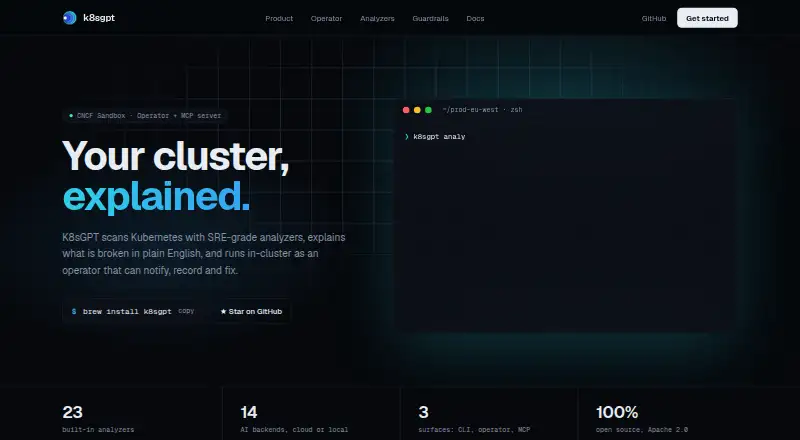
What K8sGPT is
K8sGPT scans Kubernetes clusters and explains problems in plain English using SRE-grade analyzers. It provides a CLI, an in-cluster operator, and an MCP interface for AI assistants. The project lists 23 built-in analyzers, custom analyzers over gRPC, and 14 cloud or local AI backends, including OpenAI, Azure OpenAI, Amazon Bedrock, Google Vertex AI, Ollama, and LocalAI. Documented integrations include Prometheus, Trivy, Kyverno, KEDA, and AWS. Analysis without the --explain option can run without an AI backend; explanations require one. For local or air-gapped operation, it can use Ollama, LocalAI, or a custom REST backend. The --anonymize option masks names and identifiers before a prompt is sent and restores them in the answer. Operator auto-remediation is opt-in and controlled by a configurable risk threshold. CLI, Docker, and operator installation paths require a reachable Kubernetes cluster and kubeconfig; the operator path also requires Helm 3. K8sGPT is free and open source under Apache 2.0. Windows binaries and macOS and Linux installation options are listed.
Good
- Lists 23 built-in analyzers and custom analyzer support.
- Offers cloud and local AI backend options.
- Can operate locally or in air-gapped setups.
- Anonymization masks identifiers before prompts are sent.
- Free and open source under Apache 2.0.
Watch out
- Explanations require an AI backend.
- Installation paths require a reachable cluster and kubeconfig.
- Operator installation requires Helm 3.
Who it suits
K8sGPT suits Kubernetes operators seeking cluster analysis through a CLI, operator, or AI-assistant interface. Teams considering explanations should account for the AI backend requirement and cluster access prerequisites.
Verdict
K8sGPT offers several interfaces, analyzers, and backend options for Kubernetes analysis, including local-operation choices. Check its cluster prerequisites and backend needs, especially if you want generated explanations or the operator.
Plans and prices
From K8sGPT's own pricing page, checked 7 Oct 2026.
| Plan | Price | What it gives you |
|---|---|---|
| K8sGPT | Free | Open source · Apache 2.0 |
The facts
Each one read from K8sGPT's own pages, with the date it was checked.
What it does
- AI backends
- The site lists 14 cloud or local AI backends, including OpenAI, Azure OpenAI, Amazon Bedrock, Google Vertex AI, Ollama, and LocalAI.checked 7 Oct 2026
- Analyzers
- The site lists 23 built-in analyzers and says users can add custom analyzers over gRPC.checked 7 Oct 2026
- Backend requirement
- Analysis without the --explain option works without an AI backend; explanations require an AI backend.checked 7 Oct 2026
- Cluster access
- The installation guide requires a reachable Kubernetes cluster and kubeconfig for CLI, Docker, and operator paths.checked 7 Oct 2026
- Integrations
- Documented integrations include Prometheus, Trivy, Kyverno, KEDA, and AWS.checked 7 Oct 2026
- Interfaces
- K8sGPT offers a CLI, an in-cluster operator, and an MCP interface for AI assistants.checked 7 Oct 2026
- Local operation
- K8sGPT can use Ollama, LocalAI, or a custom REST backend for local or air-gapped operation.checked 7 Oct 2026
- Operating systems
- The installation guide lists Windows binaries, macOS and Linux Homebrew support, and Linux packages in .deb, .rpm, and .apk formats.checked 7 Oct 2026
- Operator installation
- The guide lists Helm as the installation method for the in-cluster operator and requires Helm 3 for that path.checked 7 Oct 2026
- Privacy
- With the --anonymize option, names and identifiers are masked before a prompt is sent and restored in the answer.checked 7 Oct 2026
- Purpose
- K8sGPT scans Kubernetes clusters with SRE-grade analyzers and explains problems in plain English.checked 7 Oct 2026
- Remediation
- Operator auto-remediation is opt-in and gated by a configurable risk threshold.checked 7 Oct 2026
- Support
- The site points users to community office hours and Slack.checked 7 Oct 2026
The full review of K8sGPT
K8sGPT is a Kubernetes troubleshooting tool that combines analyzer-driven checks with optional plain-English explanations. It suits platform and SRE teams that want cluster analysis in command-line, in-cluster, or AI-assistant workflows. Its free, open-source model is compelling for teams able to operate their own cluster access and AI backend, but it is not a hosted incident-response platform.
Overview
K8sGPT scans Kubernetes clusters with SRE-grade analyzers and turns findings into understandable explanations when an AI backend is configured. The three interface choices are practical rather than cosmetic: the CLI fits scripted operations, the in-cluster operator keeps analysis near the workload, and the MCP interface connects findings to AI assistants. This makes it a good match for Kubernetes-focused operations, while organizations wanting a fully managed service will find more infrastructure responsibility here.
Key features
The 23 built-in analyzers provide substantial initial coverage, and custom analyzers over gRPC give engineering teams a way to add checks specific to their environment. Documented integrations with Prometheus, Trivy, Kyverno, KEDA, and AWS help place cluster analysis alongside monitoring, security, policy, autoscaling, and cloud operations. The breadth is useful, although it remains centered on Kubernetes rather than broad application incident management.
Fourteen cloud and local AI backends are supported, including OpenAI, Azure OpenAI, Amazon Bedrock, Google Vertex AI, Ollama, and LocalAI. Running analysis without --explain does not require an AI backend, so teams can use analyzer results without sending prompts elsewhere. Explanations do require a backend, and that dependency matters when planning credentials, network access, and operating cost.
For privacy-sensitive or disconnected environments, Ollama, LocalAI, or a custom REST backend support local or air-gapped operation. The --anonymize option masks names and identifiers before a prompt is sent, then restores them in the answer, reducing exposure when a cloud backend is used. The operator's automatic remediation is opt-in and controlled by a configurable risk threshold. That gate is a sensible control for production clusters, but teams still need governance around which remediations they permit.
Pricing
K8sGPT: free (open source, Apache 2.0). There are no license fees for the software itself, making it suitable for individual operators, laboratories, and organizations standardizing on self-managed tooling. The free plan does not remove operational prerequisites: explanations depend on an AI backend, and any external service or infrastructure used for that backend is a separate consideration. Teams must also provide cluster access and maintain the chosen deployment path.
Platforms
K8sGPT is offered for API use, Linux, macOS, self-hosted deployments, and Windows. The installation guide lists Windows binaries, macOS and Linux Homebrew support, and Linux packages in .deb, .rpm, and .apk formats. CLI, Docker, and operator paths require a reachable Kubernetes cluster and kubeconfig. The in-cluster operator is installed with Helm and requires Helm 3, so it is best suited to teams already managing Kubernetes tooling rather than casual desktop users.
Who it's for
Choose K8sGPT if your work centers on Kubernetes diagnosis, you want analyzer results available through several interfaces, or you need the option to keep AI processing local. It is especially appropriate for platform teams supporting AWS, Microsoft Azure, or Google Cloud Kubernetes environments and for operators who want opt-in remediation controls. It is a weaker fit for teams without a reachable cluster, for users seeking a turnkey hosted experience, or for organizations whose primary need is cross-system incident coordination.
Pros and cons
Pros
- Free and open source: Apache 2.0 licensing removes software license cost and supports self-managed deployment.
- Broad analyzer base: 23 built-in analyzers plus gRPC extensions give teams both immediate coverage and a customization route.
- Flexible AI choices: Fourteen cloud and local backends, including Ollama and LocalAI, accommodate different architecture and privacy requirements.
- Controlled automation: Opt-in remediation with a configurable risk threshold limits unintended production changes.
- Privacy option: Anonymization masks identifiers before prompts are sent and restores them in responses.
Cons
- Infrastructure responsibility: CLI, Docker, and operator use require a reachable cluster and kubeconfig.
- Explanations need a backend: Natural-language output adds an AI dependency that analyzer-only operation avoids.
- Operator setup is Kubernetes-specific: Helm 3 is required, adding a prerequisite for the in-cluster route.
- Not a general incident platform: Its core value is cluster analysis, not a managed, broad incident-response service.
Alternatives
For a managed incident workflow with a free team plan, incident.io is the better choice; its Basic plan includes Slack or Microsoft Teams incident response, single-team on-call, a status page, and essential automation. Hermes Agent suits readers wanting a broader AI agent with free models and standard rate limits, with paid access at $20.00 per month. Pick Plural when you want a platform trial and a paid platform path rather than a purely open-source analyzer. TalkOps is an alternative for free, open-source operations without seat or feature gates, though LLM tokens and cloud infrastructure are billed separately by providers. UniDeploy fits users seeking a CLI with 10 free AI requests and bring-your-own-model support. TigerOps is aimed at hosted monitoring with a five-host free tier, while HealR offers agent chat and war-room sessions. Kestrel is the alternative for topology, inventory, integrations, audit logs, and SDK, CLI, and MCP access.
Verdict
K8sGPT is a strong choice for Kubernetes operators and platform teams that want open-source analyzer coverage, optional AI explanations, and local-operation flexibility without a software license fee. Choose it when you can provide cluster access and manage the required backend or deployment components. Look elsewhere when you need a hosted incident-response service or a broader operations platform rather than focused Kubernetes analysis.
Alternatives to K8sGPT
- 1
Plural
Free planOpen sourceWebAPILinuxmacOS8.2From $450 a month - 2

incident.io
Free planAndroidiOSWebAPI7.6From $15 a month - 3

Akmatori
Free planOpen sourceWebAPILinuxmacOS7.5Free plan - 4

HealR
Free planWebAPISelf-hosted7.3From $199 a month - 5

Rootly
AndroidiOSWebAPI7.1From $20 a month - 6

FireHydrant
Free planWebAPI6.8From $25 a month