
TalkOps
TalkOps is an open-source multi-agent framework for planning, generating, validating, and troubleshooting infrastructure code, Kubernetes manifests, and obse…
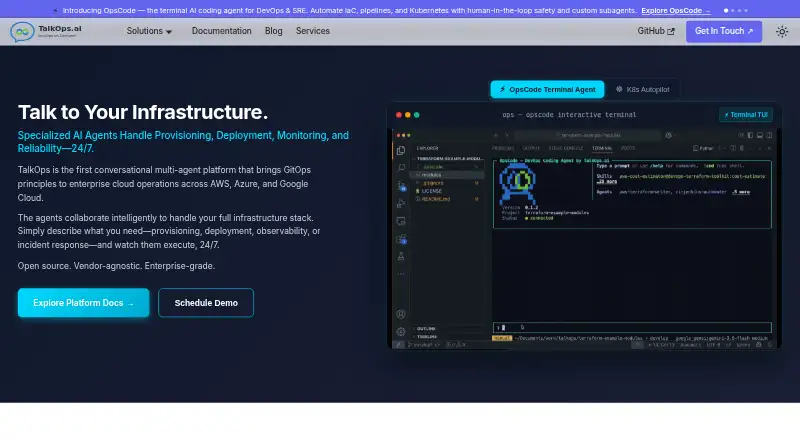
What TalkOps is
TalkOps is an open-source multi-agent framework for planning, generating, validating, and troubleshooting infrastructure code, Kubernetes manifests, and observability pipelines. It also supports Kubernetes operations and Terraform module generation for AWS, Azure, and Google Cloud. Its observability capabilities include Prometheus, Alertmanager, OpenTelemetry, Loki, and Tempo, and it supports more than 20 language-model providers, including Anthropic, OpenAI, AWS Bedrock, Azure OpenAI, Ollama, vLLM, and LocalAI. Listed safety controls include role-based permissions, approval gates, resource and query limits, bash scanners, and structured trace logs. Agents can commit changes to Git and open pull requests that provide an approval point, audit trail, and rollback mechanism. TalkOps, its agents, and MCP servers are distributed under the Apache 2.0 License. The framework can be inspected, modified, self-hosted, and deployed for commercial or non-commercial use. There are no license or seat fees; model API tokens and cloud infrastructure are billed separately by their providers. TalkOps is designed for DevOps, platform engineering, and Site Reliability Engineering teams.
Good
- Apache 2.0 licensed, with no license or seat fees
- Supports more than 20 model providers
- Agents open Git pull requests for approval and rollback
- Includes role-based permissions and approval gates
- Supports Kubernetes and Terraform module generation
Watch out
- Model API tokens are billed by providers
- Cloud infrastructure is billed by providers
Who it suits
TalkOps is designed for DevOps, platform engineering, and Site Reliability Engineering teams working with infrastructure code, Kubernetes, or observability pipelines. It also suits teams that want to inspect or self-host an open-source framework.
Verdict
TalkOps brings infrastructure-code and Kubernetes workflows together with listed safety controls and Git-based approvals. Its framework has no license or seat fees, but model tokens and cloud infrastructure are provider-billed.
Plans and prices
From TalkOps's own pricing page, checked 3 Oct 2026.
| Plan | Price | What it gives you |
|---|---|---|
| Free and open source | Free | No license fees · no seat fees · no feature gates · LLM API tokens and cloud infrastructure billed separately by providers |
The facts
Each one read from TalkOps's own pages, with the date it was checked.
What it does
- Cloud and infrastructure
- TalkOps supports Kubernetes operations and Terraform module generation for AWS, Azure, and GCP.checked 3 Oct 2026
- GitOps workflow
- The maker says agents generate changes, commit them to Git, and open pull requests that provide an approval gate, audit trail, and rollback mechanism.checked 3 Oct 2026
- Integrations
- The maker lists Kubernetes, Terraform, ArgoCD, Helm, GitHub, GitLab, Jenkins, Prometheus, Grafana, PagerDuty, Slack, AWS, Azure, and GCP as integrations.checked 3 Oct 2026
- License
- TalkOps, its agents, and its MCP servers are distributed under the Apache 2.0 License.checked 3 Oct 2026
- Model providers
- It supports more than 20 LLM providers, including Anthropic, OpenAI, Google Cloud, AWS Bedrock, Azure OpenAI, Ollama, vLLM, and LocalAI.checked 3 Oct 2026
- Observability
- Its listed observability capabilities include Prometheus, Alertmanager, OpenTelemetry, Loki, and Tempo.checked 3 Oct 2026
- Safety controls
- TalkOps describes role-based permissions, approval gates, resource and query limits, AST bash scanners, and immutable structured trace logs.checked 3 Oct 2026
- Self-hosting
- The maker says users may inspect, modify, self-host, and deploy TalkOps in commercial and non-commercial environments.checked 3 Oct 2026
- Slack integration
- The Kubernetes agent can work in Slack threads and presents approval cards for state-modifying actions, with Slack user IDs mapped to TalkOps RBAC policies.checked 3 Oct 2026
- Support
- The FAQ directs users to GitHub for issues and contributions, Discord for community discussion, and TalkOps Services for dedicated enterprise deployment support.checked 3 Oct 2026
- What it does
- TalkOps is an open-source multi-agent framework that plans, generates, validates, and troubleshoots infrastructure code, Kubernetes manifests, and observability pipelines.checked 3 Oct 2026
- Who it is for
- TalkOps is designed for DevOps, platform engineering, and Site Reliability Engineering teams.checked 3 Oct 2026
Where it runs
- Platforms
- The OpsCode CLI is installable on Linux, macOS, and Windows through WSL; the maker also documents a conversational web UI.checked 3 Oct 2026
The full review of TalkOps
TalkOps is an open-source framework for planning, generating, validating, and troubleshooting infrastructure code and operational workflows. It is best suited to DevOps, platform engineering, and SRE teams that want agents working through existing cloud and GitOps processes. Its broad provider support and approval controls are compelling; the trade-off is that teams still pay providers for model tokens and cloud infrastructure.
Overview
TalkOps brings infrastructure-as-code, Kubernetes operations, and observability workflows into one multi-agent framework. It can generate Terraform modules for AWS, Azure, and Google Cloud, work with Kubernetes manifests, and support pipelines involving Prometheus, Alertmanager, OpenTelemetry, Loki, and Tempo. That makes it a better fit for teams looking to connect several operational tasks than for buyers seeking a narrowly focused incident-response tool.
Its agents, MCP servers, and framework use the Apache 2.0 License. Teams can inspect, modify, self-host, and deploy it in commercial or non-commercial environments. That flexibility is meaningful for organizations that need control over deployment and code, though running it still depends on provider-billed model tokens and cloud infrastructure.
Key features
Provider and infrastructure coverage
TalkOps supports more than 20 LLM providers, including Anthropic, OpenAI, Google Cloud, AWS Bedrock, Azure OpenAI, Ollama, vLLM, and LocalAI. The range gives teams room to choose a hosted or local model setup. Its infrastructure focus includes Kubernetes operations and Terraform module generation for AWS, Azure, and GCP, with integrations spanning tools such as ArgoCD, Helm, GitHub, GitLab, Jenkins, Grafana, PagerDuty, and Slack.
Approvals and operational safeguards
Role-based permissions, approval gates, resource and query limits, AST bash scanners, and immutable structured trace logs address the risks of letting agents act on infrastructure. In its GitOps workflow, agents commit changes and open pull requests, creating an approval point alongside an audit trail and rollback mechanism. In Slack, the Kubernetes agent can work in threads and show approval cards for state-changing actions; Slack user IDs map to TalkOps RBAC policies. These controls make it more appropriate for governed team workflows than for unattended changes without review.
Pricing
The Free and open source plan costs nothing. It has no license fees, seat fees, or feature gates, so teams do not have to budget for per-user access or reserve features for a higher tier. Model API tokens and cloud infrastructure are billed separately by their providers, which means the framework is free but operating it is not necessarily cost-free.
There is one stated plan, rather than a paid tier with additional features or seats. That suits teams comfortable managing their own deployment and provider costs. Organizations that want dedicated enterprise deployment support can turn to TalkOps Services; the plan does not state a separate support price.
Platforms
TalkOps supports API, Linux, macOS, self-hosted, web, and Windows. Its deployment mode is both, and the framework can be self-hosted, giving teams deployment flexibility across these environments.
Who it's for
TalkOps is aimed at DevOps, platform engineering, and Site Reliability Engineering teams. Its combination of infrastructure troubleshooting, incident response, Kubernetes support, runbook automation, and AWS, Azure, and Google Cloud coverage is most relevant to teams that want agent workflows inside established infrastructure and observability systems. It is a weaker fit for buyers who want a packaged service with a fixed all-in price rather than a framework whose model and infrastructure costs remain provider-billed.
For help, the project directs users to GitHub for issues and contributions, Discord for community discussion, and TalkOps Services for dedicated enterprise deployment support. That gives users community and specialist routes, but not a stated included enterprise support plan.
Pros and cons
- Pros: Apache 2.0 licensing and self-hosting allow inspection, modification, and commercial deployment.
- Pros: More than 20 model providers and support for major cloud platforms give teams flexibility in how they build agent workflows.
- Pros: Approval gates, RBAC, trace logs, and pull-request-based changes create review and rollback points for infrastructure work.
- Cons: “Free” excludes model tokens and cloud infrastructure, so operating costs depend on the providers a team uses.
- Cons: GitHub and Discord are the stated general support routes; dedicated enterprise deployment support is a separate service path.
Alternatives
Explore AI DevOps Assistants to compare tools in the category. Kestrel is worth considering if you want an always-free plan with a topology map, cloud inventory, audit log, and SDK, CLI, and MCP, or a separately priced Cloud AI Copilot plan.
TigerOps may suit teams seeking a free monitoring plan with explicit caps: five hosts, one user seat, 1 GB of logs per day, and one-day log and metric retention. HealR is another free option, with its Starter plan capped at one data source integration, 100 Agent Chat queries per month, three Agentic War Room sessions per month, and seven-day data retention.
Open DevOps Agent is an alternative for Windows, macOS, and Linux. OpenAna is a paid alternative with API and web access and a Basic plan that includes basic integrations, a shared instance, community support, standard security features, and a basic analytics dashboard. UniDeploy may appeal to users who want a free-forever CLI plan with 10 AI requests and the option to bring their own model; its listed Most Popular plan costs 15.00 USD.
incident.io is a better match for teams prioritizing native Slack or Microsoft Teams incident response, single-team on-call, a status page, and essential incident automation on its free Basic plan. Resolve AI uses credit-based pricing for defined agent work, including chats, alert triage, investigations, incidents, background tasks, and other production workflows.
Verdict
TalkOps is a strong choice for DevOps, platform engineering, and SRE teams that want an open-source, self-hostable framework to connect infrastructure agents to Git-based approvals and operational safeguards. Its main reason to choose is the breadth of model and infrastructure support without license or seat fees. Look elsewhere if you need a fixed total operating cost: provider-billed tokens and cloud infrastructure remain part of the bill.
Alternatives to TalkOps
- 1
Plural
Free planOpen sourceWebAPILinuxmacOS8.2From $450 a month - 2

incident.io
Free planAndroidiOSWebAPI7.6From $15 a month - 3

Akmatori
Free planOpen sourceWebAPILinuxmacOS7.5Free plan - 4
HealR
Free planWebAPISelf-hosted7.3From $199 a month - 5

Rootly
AndroidiOSWebAPI7.1From $20 a month - 6

FireHydrant
Free planWebAPI6.8From $25 a month