
Kestrel
Kestrel uses AI agents to automate incident response, cloud provisioning, CI/CD, security and developer requests for platform engineering.
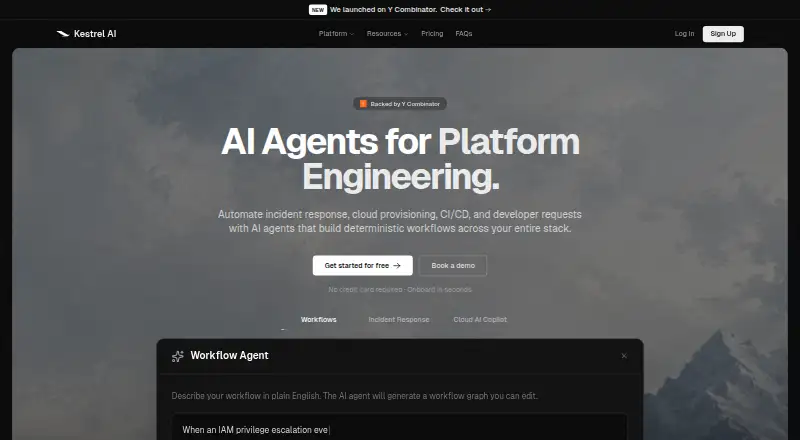
What Kestrel is
Kestrel uses AI agents to automate incident response, cloud provisioning, CI/CD, security and developer requests for platform engineering. Teams can create workflows with natural language, a visual editor, the CLI, Python SDK or MCP. Once configured, a workflow runs its defined code without a model in the runtime loop. Kestrel offers more than 40 integrations, as well as custom HTTP APIs and webhook triggers. It detects Kubernetes, cloud infrastructure and application incidents, including CrashLoopBackOff, OOMKilled, failed rollouts, IAM changes and cost anomalies. The platform is available as cloud or self-hosted software, including fully air-gapped deployments on AWS, GCP, Azure and OCI. Security controls include SAML/OIDC SSO, MFA, workflow-level RBAC, approval gates and immutable audit logs. Kestrel says tenant data is isolated, customer data is not used to train AI models, and integrations are read-only by default. Its 14-day trial requires no credit card and includes up to 100 workflow executions per day, one Incident Response unit and up to 10 Cloud AI Copilot chats per day. An always-free plan is listed; Cloud AI Copilot costs $100 a month and Incident Response costs $200 a month.
Good
- Workflows can be built with natural language or code tools.
- More than 40 integrations, plus custom APIs and webhooks.
- Supports cloud, self-hosted and air-gapped deployment.
- Trial lasts 14 days and requires no credit card.
- Integrations are read-only by default, according to Kestrel.
Watch out
- Trial limits executions to 100 per day.
- Trial includes only one Incident Response unit.
- Cloud AI Copilot costs $100 a month.
- Incident Response costs $200 a month.
Who it suits
Kestrel suits platform engineering teams automating infrastructure operations, incident response or developer requests. It offers cloud and self-hosted deployment, including air-gapped options.
Verdict
Kestrel combines incident detection and workflow automation with cloud and self-managed deployment options. Consider the trial allowances and listed plan costs when assessing its fit.
Plans and prices
From Kestrel's own pricing page, checked 1 Oct 2026.
| Plan | Price | What it gives you |
|---|---|---|
| Always free | Free | Topology Map · Cloud Inventory · Integrations · Audit Log · SDK, CLI & MCP · Always free |
| Cloud AI Copilot | $100 a month | Up to 150 messages/month, then $1/message · dashboard + Slack access · community support · $100/mo |
| Incident Response | $200 a month | 1 Kubernetes cluster + 1 cloud account · 24/7 AI monitoring & detection · community support · $200/mo |
| Workflows | — | 200+ pre-built actions · 40+ integrations · unlimited workflows · ~$0.50/ execution avg; example 200 blocks / month $38.00/mo |
The facts
Each one read from Kestrel's own pages, with the date it was checked.
What it does
- Access controls
- The platform provides SAML/OIDC SSO, MFA, RBAC per workflow, approval gates, and immutable audit logs.checked 1 Oct 2026
- Deployment
- Kestrel is available as cloud or self-hosted software, including fully air-gapped deployments on AWS, GCP, Azure, and OCI.checked 1 Oct 2026
- Deterministic execution
- After configuration, workflows execute the exact defined code without a model in the runtime loop.checked 1 Oct 2026
- Incident detection
- Kestrel detects Kubernetes, cloud infrastructure, and application incidents including CrashLoopBackOff, OOMKilled, failed rollouts, IAM changes, and cost anomalies.checked 1 Oct 2026
- Integrations
- Kestrel provides 40+ integrations and supports custom HTTP APIs and webhook triggers.checked 1 Oct 2026
- Privacy
- Kestrel's privacy policy describes Kestrel AI as an AI-native Kubernetes security platform that detects, analyzes, and remediates Kubernetes infrastructure risks.checked 1 Oct 2026
- Purpose
- Kestrel automates incident response, cloud provisioning, CI/CD, security, and developer requests with AI agents for platform engineering.checked 1 Oct 2026
- Security
- Kestrel states that it is SOC 2 compliant, isolates tenant data, does not use customer data to train AI models, and keeps integrations read-only by default.checked 1 Oct 2026
- Setup
- Kestrel says setup takes under five minutes using its Kubernetes operator installed via Helm, cloud account connections, and integrations.checked 1 Oct 2026
- Support
- Incident Response and Cloud AI Copilot list community support.checked 1 Oct 2026
- Workflow creation
- Workflows can be built with natural language, a visual editor, the CLI, Python SDK, or MCP.checked 1 Oct 2026
Money
- Trial
- The 14-day trial requires no credit card and includes up to 100 workflow executions per day, one Incident Response unit, and up to 10 Cloud AI Copilot chats per day.checked 1 Oct 2026
The full review of Kestrel
Overview
Kestrel is an AI-agent platform for platform engineering, spanning incident response, cloud provisioning, CI/CD, security and developer requests. It is best suited to teams that want to automate Kubernetes and cloud operations while retaining control over deployment and workflow execution. Its strongest case is the combination of broad workflow-building options and cloud or self-hosted operation; buyers should weigh that against the paid plans’ stated caps and the execution-based cost of Workflows.
Key features
Teams can create workflows with natural language, a visual editor, the CLI, Python SDK or MCP. That range accommodates both engineers who want code-level control and teams that prefer a visual or conversational starting point. Once configured, a workflow runs its defined code without a model in the runtime loop, a useful distinction for teams that want execution to follow an established definition rather than depend on ongoing model calls.
Kestrel offers more than 40 integrations, custom HTTP APIs and webhook triggers. Its incident detection covers Kubernetes, cloud infrastructure and applications, with examples including CrashLoopBackOff, OOMKilled, failed rollouts, IAM changes and cost anomalies. That breadth makes it relevant to teams tying detection to operational responses, rather than looking only for a Kubernetes alerting tool.
Security controls include SAML/OIDC single sign-on, MFA, per-workflow role-based access, approval gates and immutable audit logs. Kestrel says tenant data is isolated, customer data is not used to train AI models, and integrations are read-only by default. These are meaningful safeguards for operational workflows; approval gates and read-only defaults also help constrain automation with potential infrastructure impact.
Kestrel can run in the cloud or self-hosted, including fully air-gapped deployments on AWS, GCP, Azure and OCI. Setup is described as taking under five minutes using a Kubernetes operator installed via Helm, cloud account connections and integrations. The combination will appeal to teams with strict deployment requirements, though a short setup claim should not be confused with the ongoing work of designing and governing useful workflows.
Pricing
Kestrel has an Always free plan at no cost, billed Always free. It includes Topology Map, Cloud Inventory, Integrations, Audit Log, and SDK, CLI and MCP. This is a useful no-cost starting point for exploring the platform’s inventory and developer tooling, but it does not include the named paid Copilot or Incident Response allowances.
Cloud AI Copilot costs $100 a month, billed $100/mo. It allows up to 150 messages per month, then charges $1/message, with dashboard and Slack access and community support. Teams should account for the overage rate if they expect regular use beyond the included messages.
Incident Response costs $200 a month, billed $200/mo. It covers one Kubernetes cluster and one cloud account, with 24/7 AI monitoring and detection and community support. That scope may suit a focused environment, but teams with more clusters or cloud accounts should assess whether the included coverage fits before choosing it.
Workflows has custom pricing, billed at about $0.50 per execution on average; an example of 200 blocks per month costs $38.00/mo. It includes more than 200 pre-built actions, more than 40 integrations and unlimited workflows. Unlimited workflow count does not mean unlimited execution: teams should model costs around expected runs and the example usage.
The 14-day trial requires no credit card and includes up to 100 workflow executions per day, one Incident Response unit and up to 10 Cloud AI Copilot chats per day. Those daily limits make it possible to evaluate several core capabilities, but the trial is not an indication of the paid Copilot message allowance or the longer-term cost of high-volume workflow use.
Platforms
Kestrel is available via API, web and self-hosted deployment. Its cloud coverage includes AWS, GCP, Azure and OCI, with fully air-gapped deployment supported across those providers. This is a strong fit for teams that need deployment flexibility; it is not presented as a desktop or mobile app.
Who it's for
Kestrel is most compelling for platform engineering teams managing Kubernetes and cloud operations that want incident detection connected to repeatable workflows. It also suits organizations that need access controls, auditability or self-hosted and air-gapped deployment. Teams seeking only a low-cost incident tool, or whose needs exceed the stated cluster, account or usage allowances, should compare plan scope and alternatives carefully.
Pros and cons
- Pro: Workflows can be authored through five routes, from natural language to Python SDK, making the platform adaptable to different engineering practices.
- Pro: Deterministic execution after configuration avoids a model in the runtime loop for defined workflows.
- Pro: More than 40 integrations, custom APIs and webhook triggers pair with incident detection across Kubernetes, cloud and applications.
- Pro: Cloud, self-hosted and air-gapped deployment options combine with SSO, MFA, workflow-level roles and audit logs.
- Con: Copilot includes only 150 monthly messages before $1/message overages, so usage can raise the monthly bill.
- Con: Incident Response covers one Kubernetes cluster and one cloud account at $200 a month, which may constrain larger environments.
- Con: Workflows is execution-priced, so costs depend on run volume even though workflow count is unlimited.
- Con: Incident Response and Cloud AI Copilot list community support, which may not suit teams expecting another support model.
Alternatives
For a wider comparison, browse AI DevOps Assistants.
Choose TalkOps if an open-source option with no license or seat fees is the priority; LLM API tokens and cloud infrastructure are billed separately by providers. TigerOps is another freemium option, with a free plan capped at five hosts, one user seat, 1 GB of logs per day and one-day log and metric retention. Consider HealR for a free Starter plan with one data-source integration, 100 Agent Chat queries per month and three Agentic War Room sessions per month.
Open DevOps Agent is a free option for Windows, macOS and Linux. OpenAna is a paid API and web alternative with Basic and Professional plans. UniDeploy offers a free tier with 10 AI requests, bring-your-own-model support and full CLI access, while incident.io has a free Basic plan centered on Slack or Microsoft Teams incident response, single-team on-call, status pages and essential incident automation. Resolve AI is another web-based paid option.
Verdict
Choose Kestrel if your platform team needs configurable incident and infrastructure workflows, especially when deterministic execution or self-hosted and air-gapped deployment matters. Its broad authoring choices and operational controls are the main reasons to pick it. Look elsewhere if the one-cluster Incident Response scope, Copilot message cap or execution-based Workflows cost does not fit your expected scale or budget.
Alternatives to Kestrel
- 1
Plural
Free planOpen sourceWebAPILinuxmacOS8.2From $450 a month - 2

incident.io
Free planAndroidiOSWebAPI7.6From $15 a month - 3

Akmatori
Free planOpen sourceWebAPILinuxmacOS7.5Free plan - 4

HealR
Free planWebAPISelf-hosted7.3From $199 a month - 5

Rootly
AndroidiOSWebAPI7.1From $20 a month - 6

FireHydrant
Free planWebAPI6.8From $25 a month