
Akmatori
Akmatori turns production alerts into AI-assisted incident response workflows for SRE, platform, and DevOps teams.
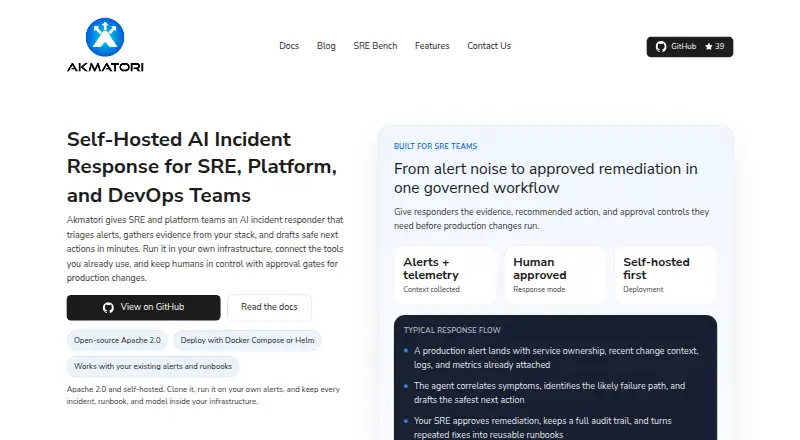
What Akmatori is
Akmatori turns production alerts into AI-assisted incident response workflows for SRE, platform, and DevOps teams. Its agents gather logs, metrics, deployment context, and runbook knowledge to investigate incidents and recommend next steps. It accepts alerts from Alertmanager, PagerDuty, Grafana, Datadog, and Zabbix, and can monitor Slack channels. Agents can reach infrastructure through SSH, Kubernetes, scripts, and API clients, while risky proposed actions require approval in the web UI or Slack before execution. Akmatori is open source under Apache License 2.0 and can be deployed using Docker Compose or Helm, including fully on-premises with local models for air-gapped setups. It supports providers including OpenAI, Anthropic, Google, OpenRouter, NVIDIA NIM, MiniMax, and OpenAI-compatible endpoints. Scheduled investigations can run as cron jobs with configured prompts and tool allowlists, then post results to Slack. The maker says incident data stays in the customer’s infrastructure unless an external provider is configured. Its REST API documents incident operations, health checks, authentication, webhooks, and an OpenAPI 3.0 specification.
Good
- Open source under Apache License 2.0
- Supports several alert sources and Slack monitoring
- Risky actions require approval before execution
- Can deploy on-premises with local models
- Scheduled investigations can post results to Slack
Watch out
- Proposed risky actions require approval
- Incident data may go to external providers if configured
Who it suits
Akmatori suits SRE, platform, and DevOps teams that want incident investigations connected to alerts, infrastructure tools, and runbooks. Its on-premises deployment option may suit teams with air-gapped setups.
Verdict
Akmatori combines alert intake, incident investigation, and controlled remediation proposals. Teams should account for the provider configuration when considering where incident data goes.
Plans and prices
From Akmatori's own pricing page, checked 7 Oct 2026.
| Plan | Price | What it gives you |
|---|---|---|
| Open-source | Free | Apache 2.0 · Self-hosted deployment |
| Vendor pricing | Priced on request | Pricing supplied by vendor on request · Capterra lists no free trial · Capterra lists no free version |
The facts
Each one read from Akmatori's own pages, with the date it was checked.
What it does
- Agent investigations
- Each incident runs a full agent session that gathers logs, metrics and context, with subagents for runbook lookup and cross-incident memory.checked 15 Oct 2026
- Alert ingestion
- It accepts alerts from Prometheus Alertmanager, PagerDuty, Grafana Alerting, Datadog, Zabbix, Slack channels and scheduled cron jobs.checked 15 Oct 2026
- Alert integrations
- It accepts alerts from Alertmanager, PagerDuty, Grafana, Datadog, and Zabbix, and can monitor Slack channels.checked 7 Oct 2026
- API
- The REST API documents incident operations, health checks, JWT and API key authentication, webhooks, and an OpenAPI 3.0 specification.checked 7 Oct 2026
- API authentication
- Most API requests require JWT or API-key authentication, with X-API-Key, Authorization: ApiKey and Bearer formats accepted.checked 15 Oct 2026
- Architecture
- The stack uses API server, PostgreSQL, agent worker, MCP gateway and web UI containers, with network isolation and no database access for the agent worker.checked 15 Oct 2026
- Context files
- Reference documents can be uploaded as context files for agent incident analysis.checked 15 Oct 2026
- Credential handling
- Tool credentials are encrypted at rest, resolved by the MCP gateway at execution time and kept away from the AI agent; executions are logged for audit.checked 15 Oct 2026
- Data control
- The maker says incident data stays in the customer’s infrastructure unless an external provider is configured.checked 7 Oct 2026
- Data residency
- Self-hosted deployments keep incident data inside the operator's infrastructure, and local-model mode avoids external AI egress.checked 15 Oct 2026
- Deployment
- Akmatori can be deployed with Docker Compose or Helm, including fully on-premises with local models for air-gapped setups.checked 7 Oct 2026
- GitHub activity
- The main public repository shows 42 stars, 8 forks and 1,046 commits on the reviewed page.checked 15 Oct 2026
- Infrastructure tools
- Agents can access infrastructure through SSH, Kubernetes, scripts, and API clients.checked 7 Oct 2026
- Investigation
- Its agents gather logs, metrics, deployment context, and runbook knowledge to investigate incidents and recommend next actions.checked 7 Oct 2026
- License
- The source code is licensed under the Apache License 2.0.checked 15 Oct 2026
- Limit: independent feedback
- GetApp reports zero user reviews and assigns zero feature ratings for data aggregation, IT monitoring and root-cause analysis.checked 15 Oct 2026
- Limit: pricing transparency
- Capterra says buyers must contact the vendor for pricing rather than showing a public price.checked 15 Oct 2026
- LLM providers
- Supported providers include OpenAI, Anthropic, Google, OpenRouter, NVIDIA NIM, MiniMax, Ant Ling and custom OpenAI-compatible endpoints.checked 15 Oct 2026
- Monitoring tools
- Built-in tool types include SSH, Zabbix, VictoriaMetrics, Grafana, PagerDuty, Kubernetes and declarative HTTP connectors.checked 15 Oct 2026
- On-prem models
- The documentation supports on-prem or air-gapped operation with local OpenAI-compatible models such as Ollama, vLLM, GLM, Kimi, Mistral and LLaMA.checked 15 Oct 2026
- OpenAPI and SDKs
- Every installation serves interactive Swagger documentation and an OpenAPI 3.1 YAML contract; the reviewed documentation does not list official language SDKs.checked 15 Oct 2026
- Organization details
- The Akmatori GitHub organization identifies itself as AI-Powered Incident Management, lists the United States of America and shows two public Go repositories.checked 15 Oct 2026
Where it runs
- Approval workflows
- Risky remediation actions become proposals that an operator can approve in the web interface or Slack before execution.checked 15 Oct 2026
Money
- Limit: trial availability
- Capterra lists no free trial and no included free version.checked 15 Oct 2026
Alternatives to Akmatori
- 1
Plural
Free planOpen sourceWebAPILinuxmacOS8.2From $450 a month - 2

incident.io
Free planAndroidiOSWebAPI7.6From $15 a month - 3

HealR
Free planWebAPISelf-hosted7.3From $199 a month - 4

Rootly
AndroidiOSWebAPI7.1From $20 a month - 5

FireHydrant
Free planWebAPI6.8From $25 a month - 6
Hermes Agent
Free planAndroidWebLinuxmacOS6.8From $20 a month