
Tombstack
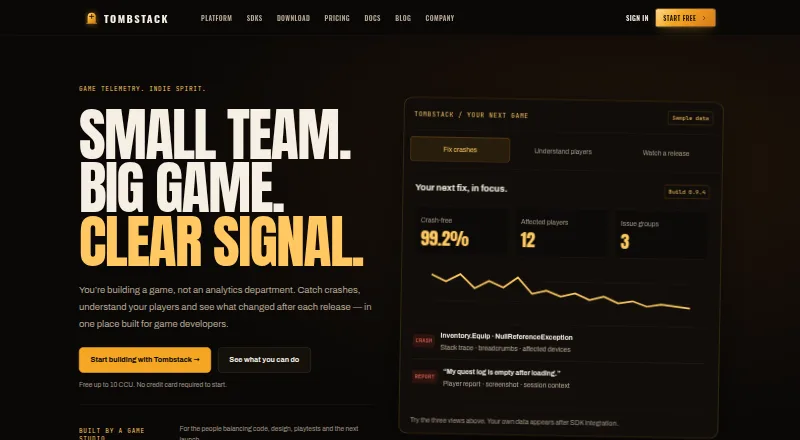
Tombstack brings game crash reporting, player analytics, retention cohorts, and release health into one workspace.
What Tombstack is
Tombstack brings game crash reporting, player analytics, retention cohorts, and release health into one workspace. Crash reports group recurring failures and include stack traces, breadcrumbs, player reports, and session context. Teams can compare D1, D7, and D30 retention by country, operating system, device, or build. Dashboards can use selected layouts and widgets, with options to save, rearrange, duplicate, and undo changes. Listed SDKs cover Unity, Web/TypeScript, Godot 4, and native C/C++; Unreal is supported through the C ABI. The company says data resides in Paris, can be exported, and supports one-click player erasure for GDPR. An optional hosted MCP server offers 37 tools for compatible AI assistants. The free plan includes up to 10 peak CCU and 30-day retention; paid pricing starts at $1/mo for usage above the free allowance, with graduated rates by band. Tombstack is made by AnkleBreaker Studio, which presents it for independent developers, studios, publishers, and live-service teams.
Good
- Crash reports include stack traces, breadcrumbs, and session context.
- Compares D1, D7, and D30 retention.
- Free plan allows up to 10 peak CCU.
- Raw data can be exported at any time.
- Includes one-click player erasure for GDPR.
Watch out
- Free-plan retention is 30 days.
- Godot addon does not automatically intercept GDScript errors.
- Dedicated Unreal plugin is listed as a roadmap item.
- Automatic campaign attribution requires a separate integration.
Who it suits
Tombstack may suit solo developers and game teams that need crash context alongside retention comparisons and release monitoring. Its listed SDKs and pricing tiers give smaller teams and enterprise users different options.
Verdict
Tombstack combines crash investigation and retention analysis for game teams, with a free tier and paid usage-based rates. Review the engine-specific limits and separate campaign-attribution integration if those matter to your workflow.
Plans and prices
From Tombstack's own pricing page, checked 29 Sep 2001.
| Plan | Price | What it gives you |
|---|---|---|
| Free | Free | Up to 10 peak CCU · 30-day retention · 1.68M rows per fixed 30-day window · unlimited team seats · Forever |
| Studio | $1 a month | Everything in Free · configurable 30–90-day retention · symbol upload and storage from CI · Slack/Discord spike alerts · hosted MCP add-on +€20/mo or $22/mo · Monthly peak CCU above the free allowance; graduated rates by band |
| Enterprise | Priced on request | Self-hosted or dedicated VPC · extended retention · SSO/SAML and audit logs · console cert support · dedicated success engineer · uptime SLA · Scoped per engagement; not self-serve |
The facts
Each one read from Tombstack's own pages, with the date it was checked.
What it does
- AI integrations
- Tombstack offers an optional hosted MCP server for compatible AI assistants, with 37 MCP tools described on its site.checked 29 Sep 2001
- Analytics
- It supports retention comparisons by country, OS, device, and build, including D1, D7, and D30 results.checked 29 Sep 2001
- Attribution
- Automatic advertising-campaign attribution is a separate integration; Tombstack says date comparisons alone do not establish campaign causation.checked 29 Sep 2001
- Crash reports
- The platform groups recurring crashes and shows stack traces, breadcrumbs, and player bug reports with session context.checked 29 Sep 2001
- Dashboards
- Users can choose dashboard layouts, search a widget library, save views, rearrange widgets, duplicate dashboards, and undo changes.checked 29 Sep 2001
- Data location
- The company page states that data residency is in Paris (eu-west-3) and that users can export raw data at any time.checked 29 Sep 2001
- Engine limits
- Godot does not provide automatic script-error interception through its GDScript addon, and a dedicated Unreal plugin and server-side native symbolication are listed as roadmap items.checked 29 Sep 2001
- Intended users
- The company describes Tombstack as a tool built by a game studio for independent teams, solo developers, small studios, publishers, and live-service teams.checked 29 Sep 2001
- Privacy
- The company page says Tombstack supports one-click player erasure for GDPR.checked 29 Sep 2001
- Product
- Tombstack combines game crash reporting, player analytics, retention cohorts, and release health in one workspace.checked 29 Sep 2001
- Support
- Enterprise pricing includes a dedicated success engineer and an uptime SLA.checked 29 Sep 2001
- Supported integrations
- The site lists SDKs for Unity, Web/TypeScript, Godot 4, and native C/C++, with Unreal supported through the C ABI.checked 29 Sep 2001
The company
- Founded
- 2026checked 23 Sep 2001
- Headquarters
- Le Pecq, Francechecked 23 Sep 2001
- Maker
- Tombstack is made by AnkleBreaker Studio, the team behind the Unity game Mithrall.checked 29 Sep 2001
The full review of Tombstack
Overview
Tombstack is a game-focused workspace for crash reporting, player analytics, retention cohorts, and release health. It suits teams that want crash investigation and player trends together; its engine-specific limitations make a closer fit for some development stacks than others.
Made by AnkleBreaker Studio, the team behind the Unity game Mithrall, it targets solo developers, independent teams, studios, publishers, and live-service teams. Paris (eu-west-3) data residency, raw-data export, and one-click player erasure for GDPR add useful controls for teams managing player data. For category comparisons, see Game Crash Reporting Software.
Key features
Crash investigation and retention
Tombstack groups recurring crashes and brings together stack traces, breadcrumbs, and player bug reports with session context. That gives teams more to work with when investigating repeat failures than crash counts alone. Retention comparisons by country, OS, device, and build, including D1, D7, and D30 results, connect release and audience trends to the same workspace. A crash-free users metric is also supported.
Configurable dashboards and integrations
Teams can select dashboard layouts, search a widget library, save views, rearrange and duplicate dashboards, and undo changes. This flexibility helps organize monitoring around different team priorities without requiring a single fixed view.
SDKs are available for Unity, Web/TypeScript, Godot 4, and native C/C++; Unreal is supported through the C ABI. The Godot GDScript addon does not automatically intercept script errors, while a dedicated Unreal plugin and server-side native symbolication are roadmap items. Those limits matter if automatic coverage of those errors is essential.
An optional hosted MCP server provides 37 tools for compatible AI assistants. Automatic advertising-campaign attribution is a separate integration; Tombstack cautions that date comparisons alone do not prove campaign causation.
Pricing
The free plan costs nothing, billed Forever. It allows up to 10 peak CCU, 30-day retention, 1.68M rows per fixed 30-day window, and unlimited team seats. The seat allowance is generous for a free tier, but the CCU, retention, and row caps set clear boundaries for growing or longer-running projects.
Studio costs $1 a month, billed monthly for peak CCU above the free allowance, with graduated rates by band. It adds configurable 30–90-day retention, symbol upload and storage from CI, and Slack/Discord spike alerts. Hosted MCP is an add-on at +€20/mo or $22/mo. This plan fits teams that have outgrown the free caps or need longer retention and operational alerts, though usage-based CCU charges mean the listed starting price is not a flat total.
Enterprise has custom pricing, scoped per engagement, and is not self-serve. It adds self-hosting or a dedicated VPC, extended retention, SSO/SAML, audit logs, console certification support, a dedicated success engineer, and an uptime SLA. Those controls and support suit organizations with deployment or service requirements beyond the self-serve plans.
Platforms
Tombstack supports Linux, macOS, web, and Windows. Its integrations span Unity, Web/TypeScript, Godot 4, native C/C++, and Unreal through the C ABI, with the engine-specific caveats noted above.
Who it's for
Tombstack is a strong candidate for game teams that want crash context and retention analysis in one place, particularly those using Unity or web technologies and needing flexible dashboards. Teams relying on automatic Godot script-error capture or a dedicated Unreal plugin should weigh the current gaps. Studios that need campaign attribution should also plan for the separate integration rather than treating date comparisons as causal evidence.
Pros and cons
- Pros: Crash groups include stack traces, breadcrumbs, and session context, helping teams investigate recurring failures.
- Pros: Retention comparisons by country, OS, device, and build combine useful player analysis with crash reporting.
- Pros: Free plan includes unlimited team seats and up to 10 peak CCU, making it practical for small teams starting out.
- Cons: The free plan is capped at 30-day retention and 1.68M rows per fixed 30-day window.
- Cons: Godot's GDScript addon does not automatically intercept script errors, and dedicated Unreal tooling remains on the roadmap.
- Cons: Studio charges by peak CCU above the free allowance, so its $1 a month entry price does not describe total usage cost.
- Cons: Campaign attribution requires a separate integration.
Alternatives
Choose BugSplat if its free tier's 15,000 crashes per month, 100GB storage, one-month retention, and three user logins better match your reporting needs; it also offers a free trial.
Backtrace is worth comparing for teams seeking a free developer plan capped at 25,000 monthly errors, with one month of retention and 10 GB storage.
Pick Breakpad if an open-source crash-reporting library and tool suite with self-built and self-hosted components is preferable.
Playloop is another freemium option for web and API platforms, with a free plan offering unlimited games and 5 GB storage.
AccelByte Development Toolkit may suit teams focused on build distribution, playtests, and issue reporting, with unlimited basic seats on its free plan.
BugSnag offers a free plan with one user, 7.5K events, and 1M spans per month, making it a comparison point for teams evaluating event and span limits.
KSCrash is a free, MIT-licensed open-source framework for Apple platforms.
NHN Cloud Log & Crash Search uses custom quotes based on the features selected.
Verdict
Choose Tombstack if your game team wants crash investigation and retention analysis together, plus a free tier with unlimited seats and a usage-based route to longer retention and alerting. Look elsewhere if automatic Godot script-error capture or a dedicated Unreal plugin is central to your workflow, or if campaign attribution must be built into the same integration.
Alternatives to Tombstack
- 1
Countly
Free planOpen sourceAndroidiOSWebAPI8.6From $175 a month - 2
GameAnalytics
Free planAndroidiOSWebAPI8.2From $49 a month - 3

Unity Version Control
Free planWebAPILinuxmacOS8.1Free plan - 4
AppMetrica
Free planOpen sourceAndroidiOSWebAPI8.0Free plan - 5

BugSplat
Free planAndroidiOSWebAPI8.0From $37 a month - 6

Embrace
Free planAndroidiOSWebAPI8.0From $0.80 a month