
BugSplat
BugSplat captures and groups crashes, errors, and other software issues, then symbolicates reports so development teams can investigate them.
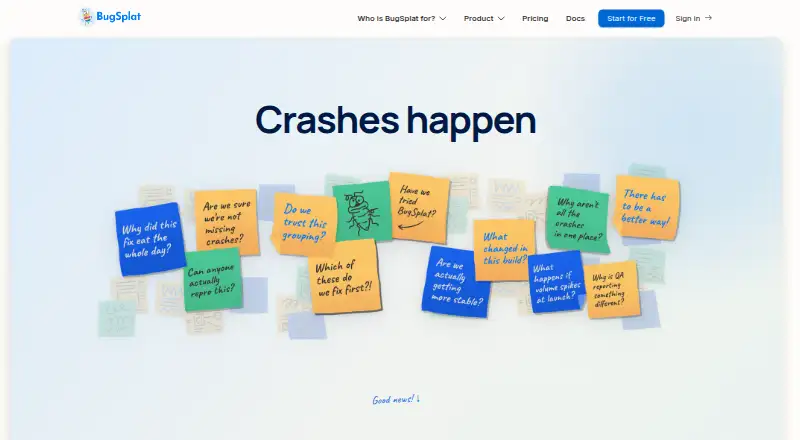
What BugSplat is
BugSplat captures and groups crashes, errors, and other software issues, then symbolicates reports so development teams can investigate them. Reports can include call stacks, thread state, memory, operating system, GPU, build version, and user impact. Volume-weighted grouping brings issues affecting more users forward, while release tracking automatically flags regressions. The service supports desktop, cross-platform, game, mobile, and web development, including Windows, macOS, Linux, iOS, and Android. Listed integrations include GitHub, GitLab, Jira, Slack, Azure DevOps, Discord, Monday, and Teams. BugSplat offers a free plan with three logins, 100GB storage, 15,000 crashes per month, and one-month retention. Team is $37 a month, billed annually, and includes 10 logins, 250GB storage, 25,000 crashes per month, three-month retention, integrations, and alerts. A 14-day full-featured trial requires no credit card. BugSplat states that it is SOC 2 Type II audited and GDPR compliant; listed security features include SSO, MFA, per-database access, and PII obfuscation.
Good
- Crash reports can include detailed system and user context.
- Volume weighting surfaces issues affecting more users.
- Tracks stability across releases and flags regressions.
- 14-day full-featured trial requires no credit card.
Watch out
- Free plan retains reports for one month.
- Team plan is billed annually at $37 a month.
- Team excludes additional and self-hosted symbol servers.
Who it suits
BugSplat suits teams tracking crashes across desktop, mobile, game, and web projects. Its free plan is described for side projects and prototypes, while Team is aimed at production apps with a small team.
Verdict
BugSplat combines crash investigation details, issue prioritization, and release stability monitoring. The free plan has defined usage and retention limits, while symbol server options beyond the included scope require Business.
Plans and prices
From BugSplat's own pricing page, checked 14 Oct 2001.
| Plan | Price | What it gives you |
|---|---|---|
| Free | Free | 3 user logins · 100GB storage · 15,000 crashes/month · 1-month retention · forever free |
| Team | $37 a month | 10 user logins · 250GB storage · 25,000 crashes/month · 3-month retention · integrations and alerts · billed annually |
| Business | $208 a month | 20 user logins · 500GB storage · 50,000 crashes/month · 6-month retention · self-hosted symbol servers · API and MFA · PII obfuscation · billed annually |
| Enterprise | Priced on request | unlimited users · custom crash limits · private support channel and SLA · console support · 1TB+ storage · up to 1-year retention |
The facts
Each one read from BugSplat's own pages, with the date it was checked.
What it does
- API client
- The public @bugsplat/js-api-client is a TypeScript/JavaScript client for the BugSplat API, supports browser and Node ESM/CommonJS, and requires Node 18 or newer.checked 14 Oct 2001
- Availability claim
- The pricing page advertises 99.99% uptime.checked 14 Oct 2001
- Cloud operation
- BugSplat runs ingestion, symbol storage and processing for customers, so customers do not need to operate crash infrastructure.checked 14 Oct 2001
- Crash context
- Crash reports can include full call stacks, thread state, memory, OS, GPU, build version, and user impact.checked 29 Sep 2001
- Crash grouping
- Reports are grouped by stack signature while filtering operating-system and runtime noise.checked 14 Oct 2001
- Documentation
- The documentation covers quick starts, platform SDK guides, production practices, integrations, web services API and administration.checked 14 Oct 2001
- Documentation depth
- Exact matching symbol files are required for function names and line numbers, and external HTTP, Azure Blob, AWS S3 or SymSrv-compatible symbol stores are supported.checked 14 Oct 2001
- Independent review score
- WorldMetrics gives BugSplat 7.2 out of 10 overall, with 7.3 for features, 7.3 for ease of use and 6.9 for value.checked 14 Oct 2001
- Integrations
- Documented integrations include Jira, GitHub, GitLab, Azure DevOps, Slack and Microsoft Teams, with more than 25 integrations advertised.checked 14 Oct 2001
- Intended users
- The pricing page describes Free for side projects and prototypes, Team for production apps with a small team, Business for production teams, and Enterprise for custom limits and compliance reviews.checked 29 Sep 2001
- Issue workflows
- BugSplat supports automatic issue creation, assignments, statuses, annotations and two-way Jira synchronization.checked 14 Oct 2001
- Limit: associated game crashes
- Company of Heroes 3 Steam users reported repeated crashes that trigger BugSplat, including one March 2025 report claiming 50–80% of games crashed.checked 14 Oct 2001
- Limit: listing freshness
- SaaSHub warns that its primary BugSplat details were not verified within the last quarter and may be outdated.checked 14 Oct 2001
- Limit: workflow breadth
- WorldMetrics says BugSplat is less end-to-end than broader exception suites and that deep triage dashboards can require configuration.checked 14 Oct 2001
- MCP extension
- An MCP server can query crash data, retrieve traces and create defects from Cursor or Claude Code.checked 14 Oct 2001
- Notable news: January 2026 updates
- January 2026 changelog entries include web fixes for symbol names and Slack links, JavaScript API URI encoding changes and Unreal SDK mobile support.checked 14 Oct 2001
- Notable news: outage
- BugSplat reported intermittent slowdowns and errors from an AWS us-east-1 outage on October 20, 2025, with recovery the same day.checked 14 Oct 2001
The company
- Company ownership
- BugSplat describes itself as independent, bootstrapped and fully remote, with roots in a 2005 side project.checked 14 Oct 2001
- Company profile
- LinkedIn lists BugSplat as a privately held Boulder, Colorado software company founded in 2003 with 11–50 employees.checked 14 Oct 2001
- Founded
- 2005checked 23 Sep 2001
- Headquarters
- Boulder, Colorado, United Stateschecked 23 Sep 2001
Where it runs
- Notable news: Windows SDK
- A December 16, 2025 release of Windows SDK 7.0.0 unified Windows and Xbox support, added a Windows Error Reporting callback and dropped x86 support.checked 14 Oct 2001
- Platforms
- Supported targets include Windows, macOS, Linux, web, Android, iOS, React Native, Unity, Unreal, Electron, Xbox, PlayStation and Nintendo Switch 2.checked 14 Oct 2001
Money
- Plan limit
- Additional and self-hosted symbol servers are not included in Team and are available in Business.checked 29 Sep 2001
The full review of BugSplat
BugSplat is crash and error reporting software for teams shipping desktop, mobile, web, and game applications. It best suits developers who need release-level stability tracking alongside crash investigation. Its main trade-off is that usage, retention, and symbol-server options depend on the plan.
Overview
Founded in 2005 and headquartered in Boulder, Colorado, BugSplat captures, symbolicates, and groups crashes, errors, and other issues. Symbolication and detailed reports can give developers useful context for tracing a failure, while grouping helps prevent repeated reports from obscuring the underlying issue.
Reports can include call stacks, thread state, memory, operating system, GPU, build version, and user impact. BugSplat also tracks stability across releases and flags regressions, making it relevant to teams that want to catch reliability changes after shipping an update. Volume-weighted grouping prioritizes issues affecting more users, a practical way to direct attention when a product generates many reports.
Key features
Investigation and prioritization
The combination of symbolication, broad crash context, and automatic grouping supports investigation without treating every occurrence as a separate problem. Volume weighting is useful for prioritizing widespread failures, though teams should still assess the severity of less frequent issues themselves.
Release monitoring and integrations
Automatic regression flags give teams a way to identify stability declines between releases. Direct integrations include GitHub, GitLab, Jira, Slack, Azure DevOps, Discord, Monday, and Teams, which can connect issue handling and alerts to tools teams already use.
Security and support
BugSplat states that it is SOC 2 Type II audited and GDPR compliant. Its pricing page lists SSO, MFA, per-database access, and PII obfuscation as built-in security features, although some of these are associated with higher-tier plans. BugSplat also says customers can contact the small team that builds and operates the product directly.
Pricing
BugSplat has a free plan, paid plans from $37/mo, and a 14-day full-featured trial that requires no credit card. The Free plan costs nothing, billed forever free, and includes 3 user logins, 100GB storage, 15,000 crashes/month, and 1-month retention. That is a useful starting point for side projects and prototypes, but the crash cap and short retention may constrain production use.
Team costs $37 a month, billed annually; the page also shows “billed monthly.” It allows 10 user logins, 250GB storage, 25,000 crashes/month, 3-month retention, and integrations and alerts. This fits a small team running a production app, but it does not include additional or self-hosted symbol servers.
Business costs $208 a month, billed annually; the page also shows “billed monthly.” It raises the limits to 20 user logins, 500GB storage, 50,000 crashes/month, and 6-month retention, and adds external or self-hosted symbol servers, API access, MFA, and PII obfuscation. Production teams needing those capabilities or more capacity have a clear reason to step up, though the higher price is substantial.
Enterprise uses custom pricing. It offers unlimited users and custom crash limits, 1TB+ storage, up to 1-year retention, a private support channel and SLA, and console support. It is aimed at teams with custom limits or compliance reviews rather than buyers seeking a fixed-price tier.
Platforms
BugSplat supports Android, iOS, Linux, macOS, web, and Windows, as well as API access. Its development coverage includes desktop, cross-platform, game, mobile, and web projects; Unity, Unreal, and source maps are supported. That breadth makes it a plausible option for teams managing crashes across several application types.
Who it's for
Choose BugSplat if your team needs crash diagnostics, user-impact prioritization, and release stability monitoring across supported platforms. The free plan is suited to prototypes; Team is sized for small production teams; Business is a better match when higher quotas, longer retention, or external and self-hosted symbol servers matter. Teams needing unlimited or custom limits can consider Enterprise. It is less suitable when the free-plan caps are too restrictive and a paid tier does not fit the budget.
Pros and cons
- Useful diagnostic context: Reports can combine call stacks and system state with build and user-impact information.
- Release-focused prioritization: Volume-weighted grouping and regression flags help teams focus on widespread issues and stability declines.
- Broad development coverage: Support spans desktop, mobile, web, and game development, including Unity and Unreal.
- Meaningful free-plan limits: The free tier provides 100GB storage and 15,000 crashes/month, but only 3 user logins and 1-month retention.
- Important symbol-server restriction: Additional and self-hosted symbol servers require Business, so Team may not suit workflows that depend on them.
Alternatives
For a broader comparison, see Game Crash Reporting Software.
- Tombstack is another freemium option, with Linux, macOS, web, and Windows support and a free plan listing up to 10 peak CCU and 30-day retention.
- Backtrace offers a free Developer plan for a single developer, with up to 25k monthly errors, 1-month retention, and 10 GB storage; consider it if those limits and its listed mobile, PC, and game-console coverage suit your needs.
- Breakpad is a free, open-source crash-reporting library and tool suite with self-built and self-hosted components, for teams that prefer to assemble and operate their own setup.
- Playloop is a freemium option with a free plan and web and API platforms.
- AccelByte Development Toolkit has a free Basic users plan with unlimited basic seats for build transfers, playtests, and issue reporting.
- BugSnag has a free plan listing 1 user, 7.5K events and 1M spans per month, 50+ platforms, and 30+ third-party integrations; compare it if those event and integration terms better fit your requirements.
- KSCrash is a free, MIT-licensed open-source framework for Apple platforms.
- NHN Cloud Log & Crash Search uses custom quotes based on selected features.
Verdict
BugSplat is a strong fit for development teams that need detailed crash reports, user-weighted issue ordering, and automatic release regression flags across multiple platforms. Its free tier makes evaluation accessible, while Team and Business offer a clear progression in capacity and retention. Look elsewhere if you need additional or self-hosted symbol servers without paying for Business, or if the plan caps do not match your workload.
Getting started
- Open the BugSplat website
- Start with the Free plan or the 14-day full-featured trial
- Choose Team, Business, or Enterprise for production requirements
- Connect listed tools such as GitHub, Jira, Slack, or Teams
Limits worth knowing
The Free plan allows three user logins, 100GB storage, 15,000 crashes per month, and one-month retention. Team allows 10 logins, 250GB storage, 25,000 crashes per month, and three-month retention; additional and self-hosted symbol servers are available in Business.
Questions
Does BugSplat have a free plan?
Yes. Free is listed as free, billed forever free, with three user logins, 100GB storage, 15,000 crashes per month, and one-month retention.
How much does BugSplat cost?
Team is $37 a month when billed annually; the pricing page also shows monthly billing. Business is $208 a month when billed annually, while Enterprise pricing is set through the team.
Is there a free trial?
Yes. BugSplat offers a 14-day full-featured trial with no credit card required.
Which platforms does it support?
Listed platforms include Android, API, iOS, Linux, macOS, web, and Windows. Supported development areas include desktop, cross-platform, game, mobile, and web projects.
What integrations are listed?
Direct integrations include GitHub, GitLab, Jira, Slack, Azure DevOps, Discord, Monday, and Teams.
Does BugSplat provide security controls?
BugSplat states SOC 2 Type II auditing and GDPR compliance. Listed security features include SSO, MFA, per-database access, and PII obfuscation.
Alternatives to BugSplat
- 1

Countly
Free planOpen sourceAndroidiOSWebAPI8.6From $175 a month - 2

GameAnalytics
Free planAndroidiOSWebAPI8.2From $49 a month - 3

Unity Version Control
Free planWebAPILinuxmacOS8.1Free plan - 4

AppMetrica
Free planOpen sourceAndroidiOSWebAPI8.0Free plan - 5

Embrace
Free planAndroidiOSWebAPI8.0From $0.80 a month - 6

Unity
Free planAndroidiOSWebLinux7.8Free plan