
Backtrace
Backtrace manages crashes and exceptions across platforms for software development, support, and QA teams.
What Backtrace is
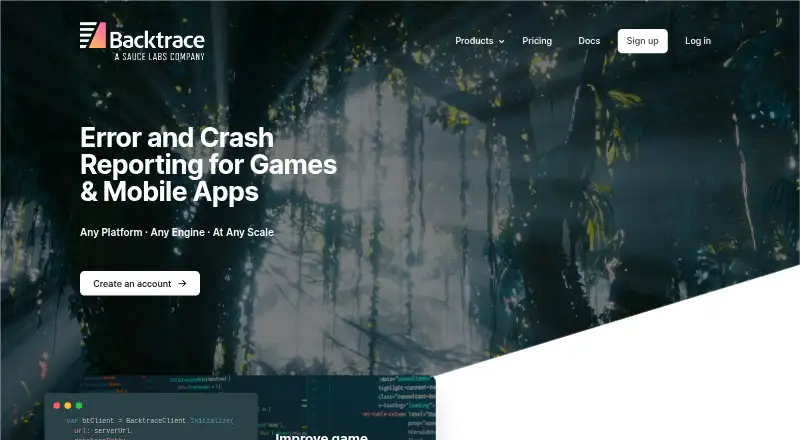
Backtrace manages crashes and exceptions across platforms for software development, support, and QA teams. It turns panics, core dumps, minidumps, and runtime errors into structured, searchable reports, then uses automated analysis to surface signals that can help engineers investigate causes. Teams can query error data and custom attributes to examine frequency, priority, and trends across projects. The product includes a web debugging interface, symbol management, and automated classifications. Deployment options include multi-tenant or dedicated hosting and on-premises use. Submitted dumps can be scrubbed of personal information in execution paths, memory, environment variables, and register values; dump files and metadata can have separate retention schedules. Integrations named on the site include Slack, Jira, PagerDuty, Datadog, Microsoft Teams, GitHub, and Discord. The free Developer plan is for one developer and allows up to 25k monthly errors, one-month retention, and 10 gb storage. Standard Mobile costs $600 a year per user; Mobile and PC costs $900 a year per user, and Mobile, PC, Game Consoles, and Servers costs $1,200 a year per user.
Good
- Searches error data and custom attributes across projects.
- Offers scrubbing of personal information from submitted dumps.
- Dump files and metadata can have separate retention schedules.
- Free Developer plan includes up to 25k monthly errors.
Watch out
- Free Developer plan is limited to one developer.
- Free plan includes one-month retention and 10 gb storage.
- Standard plans charge per user per year.
Who it suits
It suits development, support, and QA teams that need to capture and investigate software crashes across supported environments. Teams can choose hosted or on-premises deployment.
Verdict
Backtrace brings crash capture, searchable error data, and debugging tools together with hosted and on-premises deployment options. The free tier has defined user, retention, and storage limits, while Standard pricing varies by supported platform scope.
Plans and prices
From Backtrace's own pricing page, checked 29 Sep 2026.
| Plan | Price | What it gives you |
|---|---|---|
| Developer | Free | Single developer · up to 25k monthly errors · 1 month retention · 10 gb storage · Mobile, PC, Game Consoles, and Servers |
| Standard — Mobile | $600 a year | Per user · up to 1 million monthly errors · 3 months retention · 100 gb storage · Additional error capacity and storage available · $600 / user / year |
| Standard — Mobile and PC | $900 a year | Per user · up to 1 million monthly errors · 3 months retention · 100 gb storage · Additional error capacity and storage available · $900 / user / year |
| Standard — Mobile, PC, Game Consoles, and Servers | $1,200 a year | Per user · up to 1 million monthly errors · 3 months retention · 100 gb storage · Additional error capacity and storage available · $1200 / user / year |
| Professional | Priced on request | Unlimited errors · custom retention · on-prem or chosen cloud provider and region · priority support · dedicated technical account manager and security reviews available |
The facts
Each one read from Backtrace's own pages, with the date it was checked.
What it does
- Analysis
- Automated analysis surfaces signals intended to help engineers find crash root causes.checked 29 Sep 2026
- CI/CD
- For CI/CD pipelines, Backtrace says it automatically captures failures and relevant artifacts for team response.checked 29 Sep 2026
- Data scrubbing
- It can scrub personal information from submitted dumps, including execution paths, memory, environment variables, and register values.checked 29 Sep 2026
- Debugging
- The product provides a web debugging interface, symbol management, and automated classifications.checked 29 Sep 2026
- Deployment
- Backtrace offers multi-tenant or dedicated hosting and on-premises deployment.checked 29 Sep 2026
- Error capture
- It generates structured, searchable error reports and processes panics, core dumps, minidumps, and runtime errors.checked 29 Sep 2026
- Integrations
- Backtrace integrates with workflow systems for source control, alerting, ticket tracking, and messaging; its site names Slack, Jira, PagerDuty, Datadog, Microsoft Teams, GitHub, and Discord.checked 29 Sep 2026
- Purpose
- Backtrace manages cross-platform crashes and exceptions for software development, support, and QA teams.checked 29 Sep 2026
- Retention
- Dump files and metadata can be managed on separate retention schedules.checked 29 Sep 2026
- Search and prioritization
- Its query engine searches error data and custom attributes to show error frequency, priorities, and trends across projects.checked 29 Sep 2026
- Security
- Sauce Labs documentation says Backtrace uses TLS for data in transit and offers 256-bit AES encryption at rest as an Enterprise feature.checked 29 Sep 2026
- Support
- The Professional plan includes priority support, and the contact page directs customers needing technical assistance to the support team.checked 29 Sep 2026
- Supported environments
- The product page lists Windows, Linux, macOS, Android, iOS, FreeBSD, and technologies including Unity, Unreal Engine, Xbox, and PlayStation.checked 29 Sep 2026
The company
- Company history
- Backtrace says it was founded in 2014 and joined the Sauce Labs family in July 2021.checked 29 Sep 2026
- Founded
- 2014checked 28 Sep 2026
The full review of Backtrace
Backtrace is a crash and exception management platform for teams shipping software across devices and operating systems. It suits development, support, and QA groups that need to investigate failures across projects, especially game teams and organizations with deployment or data-handling requirements. Its breadth of crash analysis and hosting choices is compelling, but the free tier is tightly capped and paid Standard plans charge per user each year.
Overview
Backtrace turns panics, core dumps, minidumps, and runtime errors into structured reports that teams can search. Automated analysis and classifications help surface likely root-cause signals, while a query engine can sort error data and custom attributes by frequency, priority, and trends. That combination is useful when a team needs to identify recurring or urgent failures across projects rather than review isolated crash reports.
A web debugging interface and symbol management support investigation. Backtrace can scrub personal information from submitted dumps, including execution paths, memory, environment variables, and register values. Dump files and metadata can follow separate retention schedules, giving teams more control over how long each kind of data remains.
Deployment spans multi-tenant and dedicated hosting as well as on-premises installations. Workflow integrations cover source control, alerting, ticket tracking, and messaging, with named connections including Slack, Jira, PagerDuty, Datadog, Microsoft Teams, GitHub, and Discord. Backtrace also says its CI/CD integrations automatically capture pipeline failures and relevant artifacts for team response.
Key features
- Crash capture and search: Structured reports cover several dump and runtime-error types, and searchable custom attributes help teams assess patterns and priorities.
- Debugging and release context: The product includes a web debugging interface, symbol management, frontend monitoring, release tracking, source-map support, and session replay.
- Data controls: Personal-data scrubbing and distinct dump-file and metadata retention schedules are useful for teams with different privacy and retention needs.
- Broad environment coverage: Listed environments include Windows, Linux, macOS, Android, iOS, and FreeBSD, as well as Unity, Unreal Engine, Xbox, and PlayStation technologies.
- Security: TLS protects data in transit; 256-bit AES encryption at rest is an Enterprise feature.
Pricing
The Developer plan is free for one developer, with up to 25,000 monthly errors, one month of retention, and 10 GB of storage. It covers mobile, PC, game consoles, and servers, making it a useful starting point for an individual or small evaluation, but its single seat and short retention limit its fit for a team workflow.
Standard plans are billed annually per user and allow up to 1 million monthly errors, three months of retention, and 100 GB of storage. Additional error capacity and storage are available. Standard — Mobile costs $600 per user per year; Standard — Mobile and PC costs $900 per user per year; and Standard — Mobile, PC, Game Consoles, and Servers costs $1200 per user per year. These tiers scale platform scope, not the stated error, retention, or storage allowances, so teams should choose based on the platforms they need and account for each user seat in the annual cost.
Professional has custom pricing. It includes unlimited errors, custom retention, on-premises deployment or a chosen cloud provider and region, and priority support. A dedicated technical account manager and security reviews are available. This is the stronger fit for organizations needing flexible deployment, higher-volume handling, or closer support, though the custom price makes it harder to compare costs upfront. Professional includes priority support; technical assistance is directed to Backtrace's support team.
Platforms
Backtrace supports Android, iOS, Linux, macOS, Windows, and web, with self-hosted deployment also available. Its listed supported environments extend to FreeBSD and game platforms and engines such as Xbox, PlayStation, Unity, and Unreal Engine. The range makes it relevant to cross-platform product teams, particularly those managing game crashes alongside mobile or desktop software.
Who it's for
Backtrace is best suited to development, support, and QA teams that need searchable crash data across multiple platforms, or game developers handling failures across consoles and engines. Its deployment options and dump scrubbing also make it worth considering for organizations with specific hosting or data-handling requirements. A solo developer with modest crash volume can start on the free plan; teams that need more than one seat, longer retention, or higher quotas should weigh the per-user annual Standard cost.
Pros and cons
- Pro: Processes several crash and dump formats and adds search, prioritization, and automated analysis, supporting investigation across projects.
- Pro: Hosting choices, data scrubbing, and separate retention schedules offer useful operational and data controls.
- Pro: Platform coverage includes mobile, desktop, servers, and game consoles, with integrations for common workflow categories.
- Con: The free plan is limited to one developer, 25,000 monthly errors, one month of retention, and 10 GB of storage.
- Con: Standard pricing is per user per year, and its three scope-based prices retain the same stated quota and storage limits.
- Con: Professional uses custom pricing, so teams cannot determine its cost from the listed plan terms alone.
Alternatives
For a different error-monitoring option, compare Error Monitoring Software. Teams focused specifically on game failures can browse Game Crash Reporting Software, while broader game QA needs may suit Game Testing Software.
- BugSnag is another freemium option with a free plan, free trial, and listed support across Android, iOS, Linux, macOS, web, Windows, and self-hosted environments. Its free tier is described with one user, 7.5K events and 1M spans per month.
- Airbrake may suit a developer seeking a lower-cost paid entry point: its Dev + errors plan is $17.00 per month billed annually for 25,000 errors, one user, and one team.
- Rollbar is another freemium error-monitoring choice, with its Essentials plan describing 10K–50M occurrences per month, 1K–10M replays per month, and up to 90 days.
- Firebase Cloud Messaging is a no-cost option for teams seeking cloud messaging rather than Backtrace's crash-management focus.
- Measure is worth considering for teams prioritizing open-source software; it describes its source code as publicly available on GitHub.
- Sentry Continuous Profiling is another freemium option for teams comparing performance-tooling products.
- GlitchTip is a freemium alternative created by Burke Software and Consulting, a small software-development and consulting team that supports open-source software.
- elmah.io may suit a team willing to pay for its Small Business plan, priced at $26.00 per month for three users, unlimited applications, and 10,000 messages per month.
Verdict
Choose Backtrace if your team needs to capture and investigate crashes across varied platforms and values flexible hosting, searchable prioritization, and data controls. Its strongest case is the combination of broad crash handling with deployment options; the main reason to look elsewhere is cost predictability, since Standard is an annual per-user commitment and Professional pricing is custom.
Getting started
- Visit the Backtrace website.
- Choose the free Developer plan or a Standard plan for the relevant platform coverage.
- Select multi-tenant or dedicated hosting, or an on-premises deployment.
- Connect relevant workflow systems such as source control, alerting, ticket tracking, or messaging.
- For CI/CD use, configure the pipeline to capture failures and relevant artifacts.
Limits worth knowing
The free Developer plan is for one developer and allows up to 25,000 monthly errors, one-month retention, and 10 GB storage. Standard plans allow up to one million monthly errors, three months of retention, and 100 GB storage; additional error capacity and storage are available.
Questions
Is Backtrace free?
Yes. Its Developer plan is free for one developer, with up to 25,000 monthly errors, one-month retention, and 10 GB of storage.
How much do the Standard plans cost?
Standard Mobile costs $600 a year per user. Mobile and PC is $900 a year per user, and Mobile, PC, Game Consoles, and Servers is $1,200 a year per user.
What platforms and environments does Backtrace support?
The listed platforms include Android, iOS, Linux, macOS, self-hosted, web, and Windows. The product page also lists FreeBSD, Unity, Unreal Engine, Xbox, and PlayStation.
Can Backtrace be deployed on-premises?
Yes. Backtrace offers multi-tenant or dedicated hosting and on-premises deployment.
Which integrations are named?
Backtrace names Slack, Jira, PagerDuty, Datadog, Microsoft Teams, GitHub, and Discord among its workflow integrations.
Alternatives to Backtrace
- 1

Embrace User Session Insights
Free planAndroidiOSWebAPI8.1Free plan - 2

Sankofa Catch
Free planAndroidiOSWebAPI8.0From $9 a month - 3

BugSnag
Free planAndroidiOSWebAPI7.8Free plan - 4

Airbrake
Free planAndroidiOSWebAPI7.6From $17 a month - 5
elmah.io
AndroidiOSWebAPI7.3From $26 a month - 6

Measure
Free planAndroidiOSWebAPI7.2From $50 a month