
ThinLinc
ThinLinc is a remote desktop solution available on Linux, macOS, Windows, and web browsers.
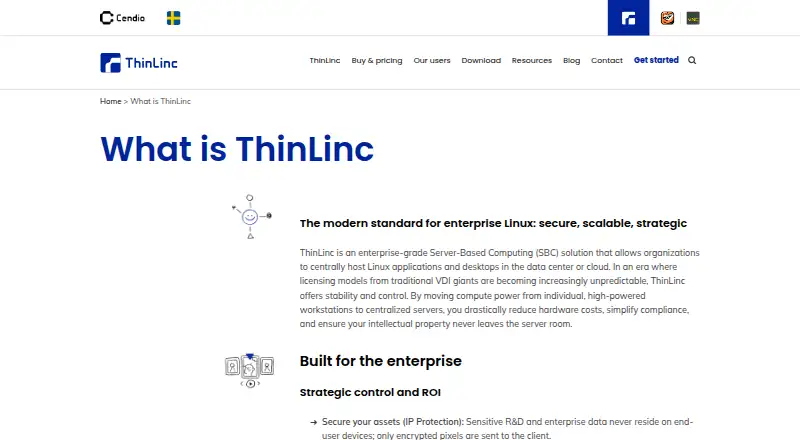
What ThinLinc is
ThinLinc is a remote desktop solution available on Linux, macOS, Windows, and web browsers. It has a free plan for up to 10 concurrent users, along with paid Standard and Premium subscriptions. Standard costs $122 a year per user, billed in advance for a 12-month period, and applies to subscriptions for 1–10 users. Premium costs $168 a year per user, also paid in advance for a 12-month period for 1–10 users. ThinLinc is made by a company founded in 1992 and headquartered in Linköping, Sweden. The listed supported platforms cover desktop operating systems and web browsers; no mobile apps are listed. The plan details give prospective users the free concurrent-user allowance and the terms and prices for the two paid annual options. ThinLinc’s listed pricing model is freemium, so users can consider the free option or choose a paid subscription based on their needs.
Good
- Supports Linux, macOS, Windows, and web browsers
- Free plan allows 10 concurrent users
- Standard and Premium annual plans are listed
Watch out
- No mobile apps are listed
- Paid subscriptions cover 1–10 users
- Subscriptions are paid in advance
Who it suits
ThinLinc may suit people who need remote desktop access from Linux, macOS, Windows, or a web browser. The free plan is listed for up to 10 concurrent users.
Verdict
ThinLinc provides a free option and two specified annual subscription plans across desktop systems and browsers. People needing a mobile app should note that none is listed.
Plans and prices
From ThinLinc's own pricing page, checked 15 Oct 2026.
| Plan | Price | What it gives you |
|---|---|---|
| Community license | Free | Up to 10 concurrent users · No official support |
| Free | Free | 10 concurrent users · community support · full featured software · upgrades |
| ThinLinc Standard (500+ users) | $66 a year | 500+ concurrent users · Standard subscription · 12 months, paid in advance |
| ThinLinc Premium (500+ users) | $91 a year | 500+ concurrent users · Premium subscription · 12 months, paid in advance |
| ThinLinc Standard (11–49 users) | $103 a year | 11–49 concurrent users · Standard subscription · 12 months, paid in advance |
| ThinLinc Standard (1–10 users) | $122 a year | 1–10 concurrent users · Standard subscription · 12 months, paid in advance |
| ThinLinc Premium (11–49 users) | $142 a year | 11–49 concurrent users · Premium subscription · 12 months, paid in advance |
| ThinLinc Premium (1–10 users) | $168 a year | 1–10 concurrent users · Premium subscription · 12 months, paid in advance |
| Standard | $49,122 a year | 1 to unlimited users · support tickets answered within two business days · upgrades · per user and year |
| Premium | $68,168 a year | 1 to unlimited users · prioritized support within one business day · scheduled calls with support engineers · upgrades · per user and year |
The facts
Each one read from ThinLinc's own pages, with the date it was checked.
What it does
- Administration
- ThinLinc provides web-based administration and command-line administration tools.checked 15 Oct 2026
- Authentication
- The feature list includes password, one-time password, public key, smart card, and Kerberos ticket authentication.checked 7 Oct 2026
- Authentication integrations
- ThinLinc uses normal Linux system authentication and can integrate with eDirectory, Active Directory and NIS.checked 15 Oct 2026
- Deployment model
- The server converts a regular Linux distribution into a centralized remote-desktop system and can run standalone or in a cluster.checked 15 Oct 2026
- Developer and IT controls
- The tlclient command supports server, username, configuration-file and other command-line controls, while tlctl manages cluster sessions, load and licenses.checked 15 Oct 2026
- Documentation depth
- Cendio publishes a versioned Administrator’s Guide covering installation, clients, command-line tools, clustering, configuration and troubleshooting.checked 15 Oct 2026
- Graphics acceleration
- The server lists VirtualGL integration for server-side OpenGL acceleration.checked 15 Oct 2026
- High availability
- The server supports failover, clustering and load balancing for Linux deployments.checked 15 Oct 2026
- Installation
- The server is installed from a downloaded bundle with install-server and configured through tl-setup, including master or agent cluster roles.checked 15 Oct 2026
- Licence
- ThinLinc is proprietary software licensed per concurrent user; its EULA separately identifies third-party open-source components and their own licences.checked 15 Oct 2026
- Limit: gaming and frame rate
- A Reddit sysadmin discussion reports that ThinLinc prioritizes image quality and can show frame skips or weaker game performance for demanding interactive use.checked 15 Oct 2026
Where it runs
- Client device support
- Native clients support Windows, macOS and Linux, while browser access supports modern browsers and mobile devices.checked 15 Oct 2026
- Client platforms
- Client downloads are offered for Windows, Mac, and Linux, while the feature list also includes browser access.checked 7 Oct 2026
- Limit: macOS multi-monitor experience
- A Software Advice reviewer reported that the macOS client feels less native and that its full-screen multi-monitor handling is awkward.checked 15 Oct 2026
- Mac support
- The Mac client runs natively on Intel chips and works with Apple chips through Rosetta.checked 7 Oct 2026
The company
- Company adoption
- Cendio says more than 500 organizations use ThinLinc and more than 120,000 end users access Linux desktops through it each day.checked 15 Oct 2026
- Company and audience
- Cendio says it was founded in 1992 and that its customers are mainly in the industrial, educational, and healthcare sectors.checked 7 Oct 2026
- Company headquarters and size
- LinkedIn lists headquarters in Linköping, Sweden and a company size of 11–50 employees.checked 15 Oct 2026
- Company history
- Cendio says it was founded in 1992 by students from Linköping University and changed its legal name to Cendio AB in 2003.checked 15 Oct 2026
- Company legal name
- Crunchbase identifies the maker’s legal name as Cendio Aktiebolag, also known as Cendio AB.checked 15 Oct 2026
- Founded
- 1992checked 28 Sep 2026
- Headquarters
- Linköping, Swedenchecked 28 Sep 2026
Money
- Free plan
- Yeschecked 20 Sep 2026
- Free usage
- The server includes three community licences by default and can be raised to ten concurrent users with a separate community licence file.checked 15 Oct 2026
The full review of ThinLinc
ThinLinc is remote access software for centrally hosted Linux desktops and applications. It suits organizations running demanding Linux workloads for distributed users. Its strongest case is Linux-focused delivery with server-side resilience features; the main trade-off is that its free tier is capped and mobile apps are absent.
Overview
ThinLinc places Linux applications and desktops in a data center or cloud so users can access them remotely. That approach is a sensible fit for organizations that want to centralize compute-intensive EDA or CAD workloads rather than put them on each user’s device. Cendio says its customers are mainly in industrial, educational, and healthcare sectors.
Traffic passes through SSH tunnels and TLS, and clients receive encrypted pixels. The server feature set includes high availability, fail-over, clustering, load balancing, multiple sessions per user, and single-application publishing. Those capabilities favor managed multi-user environments; ThinLinc is less compelling for a person who simply wants to control a single computer remotely.
Key features
- Remote Linux delivery: Users can reach centrally hosted Linux desktops and applications from different locations, including demanding EDA and CAD workloads.
- Resilience and session management: Clustering, load balancing, high availability, and fail-over suit deployments where service continuity matters. Multiple sessions per user and single-application publishing give administrators options beyond providing every user a full desktop.
- Authentication choices: Password, one-time password, public key, smart card, and Kerberos ticket authentication let organizations use different access methods.
- Open-source components: ThinLinc includes TigerVNC, noVNC, OpenSSH, CUPS, and PulseAudio, covering parts of its remote display, browser access, security, printing, and audio stack.
- Security reporting: Cendio says it acknowledges vulnerability reports within two working days to discuss recovery planning and potential publication.
Pricing
ThinLinc is freemium, with a free plan and two annual per-user subscriptions. The free plan costs nothing and allows 10 concurrent users under a separate free license file. The server supports three concurrent graphical sessions by default, so reaching the ten-user allowance requires that license file. Free users receive community support.
Standard costs $122 a year, billed every 12 months per user and paid in advance. It is limited to 1–10 users, making it the lower-cost paid option for a small deployment. Premium costs $168 a year on the same per-user, 12-month advance-payment basis and also covers 1–10 users. The stated plan facts do not distinguish their feature sets, so buyers should not assume Premium adds a particular capability.
Free time-limited evaluation licenses and technical pre-sales support are available. Email support requires a support agreement, while free users rely on the community; that makes the free plan easier to justify for evaluation or community-supported use than for an organization needing direct email assistance.
Platforms
ThinLinc supports Windows, macOS, Linux, and web browsers, with client downloads for Windows, Mac, and Linux. The Mac client runs natively on Intel chips and works on Apple chips through Rosetta. There are no mobile apps, so users who need a dedicated phone or tablet client should look elsewhere.
Who it's for
ThinLinc is best suited to organizations centralizing Linux desktops or applications for remote users, particularly where EDA or CAD workloads, multiple sessions, or deployment resilience matter. Its customer base in industrial, educational, and healthcare sectors aligns with those managed environments. It is a weaker choice for mobile-first access, or for teams that need email support without a support agreement.
Pros and cons
- Pro — Strong Linux workload fit: Central hosting targets demanding EDA and CAD use without requiring those workloads to run locally.
- Pro — Broad server controls: High availability, fail-over, clustering, load balancing, and several authentication methods suit managed deployments.
- Pro — Usable free allowance: The free license can cover up to ten concurrent users, useful for small-scale evaluation or community-supported use.
- Con — Narrow free-session default: The server defaults to three concurrent graphical sessions, and the ten-user allowance depends on a separate license file.
- Con — Support boundary: Free users get community support; email support requires a support agreement.
- Con — No mobile apps: Access is limited to desktop clients and browsers rather than native mobile clients.
Alternatives
For a wider comparison, browse Virtual Desktop Infrastructure Software or Remote desktop software.
- QVD is another freemium option with a free plan, trial, and Android and iOS platform support, making it worth considering when mobile access matters.
- Hive Fabric offers a free community edition with a perpetual license for a single physical host and unlimited VMs; it may suit buyers prioritizing that deployment structure.
- Ravada VDI is free to use and self-hosted, with Linux-based server administration and KVM support currently stated; consider it when those are the central requirements.
- Hydra has a free community edition with limited tenants and host pools, and a Windows 365 plan priced at $1 a month; it is an option for those comparing Windows-oriented deployments.
- Citrix Workspace is a paid alternative with Android, iOS, Linux, macOS, web, and Windows platforms.
- Kasm Workspaces has a free Community plan capped at five concurrent sessions and excludes commercial use; it fits non-commercial evaluation better than ThinLinc’s ten-user free allowance.
- Leostream Platform is paid and offers a free trial, with a managed-user subscription requiring a one-year commitment and a minimum of 25 users; it better matches larger teams meeting that minimum.
- Amazon WorkSpaces is a paid alternative with a free plan and trial, and a Windows single-session user fee of $4.19 a month plus provisioned instance-hour charges; consider it when that pricing structure and Windows option suit the deployment.
Verdict
Choose ThinLinc if your organization needs remote access to centrally hosted Linux desktops or applications and values its resilience and authentication options. Its ten-user free license offers a practical starting point, while Standard and Premium provide paid annual subscriptions for small deployments. Look elsewhere if native mobile access or email support without a support agreement is essential.
Getting started
- Visit the ThinLinc website.
- Choose a free plan or review the Standard and Premium paid plans.
- Request a time-limited evaluation license if you want to evaluate the software.
- Use the client download for Windows, Mac, or Linux, or access it through a browser.
- For up to ten concurrent users on the server, obtain the separate free license file.
Limits worth knowing
The server supports three concurrent graphical sessions by default; a separate free license file enables up to ten concurrent users. Free users receive community support, while email support requires a support agreement.
Questions
How much does ThinLinc cost?
A free plan is available. Standard costs $122 per user per year, and Premium costs $168 per user per year; both subscriptions are paid in advance and cover 1–10 users.
Is there a free trial?
Cendio offers free, time-limited evaluation licenses and technical pre-sales support.
Which platforms does ThinLinc support?
Client downloads are offered for Windows, Mac, and Linux, and browser access is included. There are no mobile apps.
What is the free server session limit?
The server supports three concurrent graphical sessions by default. A separate free license file enables up to ten concurrent users.
What support is available to free users?
Free users receive community support. Email support requires a support agreement; evaluation support is available through the pre-sales team.
Who makes ThinLinc?
ThinLinc is made by ThinLinc, founded in 1992 and headquartered in Linköping, Sweden.
Alternatives to ThinLinc
- 1

DWService
Free planOpen sourceAndroidiOSWebAPI9.2From $40 a year - 2

ManageEngine Remote Access Plus
Free planAndroidiOSWebAPI9.0From $75 a year - 3

Zoho Assist
Free planAndroidiOSWebLinux8.9From $10 a month - 4

HopToDesk
Free planAndroidiOSLinuxmacOS8.8From $159 a year - 5

TeamViewer Remote
Free planAndroidiOSWebLinux8.5Free plan - 6

Getscreen.me
Free planAndroidWebAPIExtension8.5Free plan