
TestMu AI Web Automation (formerly LambdaTest Web Automation)
TestMu AI Web Automation is a cloud platform for running web and app automation tests without maintaining local grids.
What TestMu AI Web Automation (formerly LambdaTest Web Automation) is
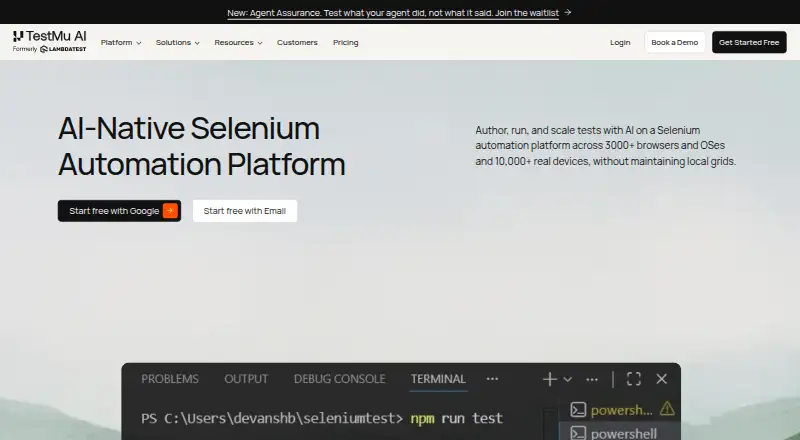
TestMu AI Web Automation is a cloud platform for running web and app automation tests without maintaining local grids. It covers more than 3,000 browser and operating-system combinations and more than 10,000 real devices, and supports Selenium, Playwright, Cypress, Puppeteer, Appium, Espresso, XCUITest, and Jest. KaneAI can create and maintain Selenium tests from natural-language scenarios and repair broken locators during runs. HyperExecute splits test suites across runners, can stop early on failures, and reruns failed tests; TestMu AI says it can execute suites up to 70% faster than a conventional cloud grid. Sessions capture logs, video, and screenshots, while an encrypted tunnel allows testing of locally hosted or firewalled apps without a public URL. The free plan provides 100 lifetime minutes, two parallel web and mobile sessions, and 100 accessibility tests per organization. The company says LambdaTest became TestMu AI on January 12, 2026.
Good
- Supports Selenium and seven other named frameworks
- Covers more than 3,000 browser environments
- Encrypted tunnel supports private app testing
- Sessions capture logs, video, and screenshots
- Free plan includes two parallel sessions
Watch out
- Free plan is limited to 100 lifetime minutes
- Lowest paid plan is Linux-only
- Paid pricing is billed annually
Who it suits
It suits teams automating browser or mobile-app tests across multiple environments, including those needing local or firewalled app testing. The free plan may fit small-scale evaluation, with only 100 lifetime minutes available.
Verdict
TestMu AI combines broad browser coverage with test authoring, execution, and debugging tools. Review the free-minute limit and annual billing terms when assessing its fit.
Plans and prices
From TestMu AI Web Automation (formerly LambdaTest Web Automation)'s own pricing page, checked 7 Oct 2026.
| Plan | Price | What it gives you |
|---|---|---|
| Free | Free | 2 parallel web and mobile automation sessions · 100 accessibility tests per organization · Free forever; 100 lifetime minutes |
| Web Automation on Desktop (Linux Only) | $29 a month | Linux · latest and top 20 versions of Chrome, Firefox, and Microsoft Edge · Billed annually |
| Web Automation on Desktop | $79 a month | Multi OS · 3,000+ browser environments · Selenium and JavaScript frameworks · Billed annually |
| Virtual Automation Cloud | $139 a month | Mobile browsers on emulators and simulators · virtual devices for app automation · Appium, Espresso, XCUI, and Detox · Billed annually |
| Real Device Plus Automation Cloud | $199 a month | Real-device web and app automation · Appium, Espresso, and XCUITest · geolocation testing in 120+ countries · Billed annually |
The facts
Each one read from TestMu AI Web Automation (formerly LambdaTest Web Automation)'s own pages, with the date it was checked.
What it does
- AI authoring
- KaneAI can author, run, and maintain Selenium tests from natural-language scenarios and auto-heal broken locators at runtime.checked 7 Oct 2026
- Debugging
- Selenium sessions capture network logs, console logs, video recordings, screenshots, and command logs automatically.checked 7 Oct 2026
- Enterprise
- The pricing page says Enterprise offers custom pricing and lists SOC1/SOC2 security, SSO, IP whitelisting, custom data retention, dedicated support roles, private Slack, and on-premise options.checked 7 Oct 2026
- Execution
- HyperExecute can auto-split Selenium suites across runners, fail fast, and rerun failed tests; TestMu AI says it can execute suites up to 70% faster than a conventional cloud grid.checked 7 Oct 2026
- Frameworks
- The platform supports Selenium, Playwright, Cypress, Puppeteer, Appium, Espresso, XCUITest, and Jest.checked 7 Oct 2026
- Integrations
- The integrations page lists Jira, Slack, CircleCI, GitHub, GitLab, and Bitbucket among its integrations.checked 7 Oct 2026
- Local testing
- An encrypted TestMu AI tunnel supports testing locally hosted, staging, and firewalled web apps without a public URL.checked 7 Oct 2026
- Purpose
- The Selenium automation platform runs and scales tests across 3,000+ browsers and operating systems and 10,000+ real devices without maintaining local grids.checked 7 Oct 2026
- Security
- TestMu AI states that it is SOC 2 Type 2 compliant and GDPR and CCPA compliant, and that test data on virtual machines is wiped when a session ends.checked 7 Oct 2026
The company
- Company history
- TestMu AI says LambdaTest became TestMu AI on January 12, 2026, and that the company was founded in 2017.checked 7 Oct 2026
- Founded
- 2017checked 28 Sep 2026
- Headquarters
- San Francisco, California, United Stateschecked 28 Sep 2026
The full review of TestMu AI Web Automation (formerly LambdaTest Web Automation)
Overview
TestMu AI Web Automation is a cloud service for authoring and running automated browser and app tests across many environments. It is best suited to teams that need cross-browser or mobile coverage without maintaining a local testing grid. Its breadth is compelling, but buyers should weigh the narrow free allowance against annual billing for paid plans.
Key features
The platform supports Selenium, Playwright, Cypress, Puppeteer, Appium, Espresso, XCUITest, and Jest. Its stated coverage spans more than 3,000 browser and operating-system environments and more than 10,000 real devices, a practical advantage for teams validating against varied configurations without running their own grid.
KaneAI can create, run, and maintain Selenium tests from natural-language scenarios, and repair broken locators at runtime. That may ease test upkeep as interfaces change, while code-based authoring remains an option. HyperExecute distributes suites across runners, can fail fast, and reruns failed tests; TestMu AI says it can execute suites up to 70% faster than a conventional cloud grid. That speed claim is useful context, not a substitute for assessing the service against a team's own workload.
Each Selenium session captures network and console logs, video, screenshots, and command logs automatically, giving teams several useful angles for diagnosing failures. An encrypted tunnel allows tests against locally hosted, staging, and firewalled web apps without a public URL. Integrations include Jira, Slack, CircleCI, GitHub, GitLab, and Bitbucket.
TestMu AI states that it is SOC 2 Type 2, GDPR, and CCPA compliant, and that virtual-machine test data is wiped after a session. Enterprise adds SOC1/SOC2 security, SSO, IP whitelisting, custom data retention, dedicated support roles, private Slack, and on-premise options. The company says it was founded in 2017 and that LambdaTest became TestMu AI on January 12, 2026.
Pricing
The free plan costs nothing, billed Free forever. Its 100 lifetime minutes and two parallel web and mobile automation sessions are enough for a small evaluation, but the lifetime quota makes it unsuitable for sustained regular runs. It also includes 100 accessibility tests per organization.
Web Automation on Desktop (Linux Only) costs $29 a month, billed annually. It covers Linux and the latest and top 20 versions of Chrome, Firefox, and Microsoft Edge. This is the lowest-cost paid option, but its Linux-only scope is a meaningful trade-off for teams that need multi-OS coverage.
Web Automation on Desktop costs $79 a month, billed annually, and adds multi-OS access to 3,000+ browser environments and Selenium and JavaScript frameworks. It is the more fitting desktop tier for teams testing across operating systems.
Virtual Automation Cloud costs $139 a month, billed annually. It covers mobile browsers on emulators and simulators, virtual devices for app automation, and Appium, Espresso, XCUI, and Detox. Choose it when virtual mobile-device testing is the priority.
Real Device Plus Automation Cloud costs $199 a month, billed annually. It provides real-device web and app automation, Appium, Espresso, and XCUITest, plus geolocation testing in 120+ countries. This is the more relevant tier when virtual devices are not enough and location-specific testing matters. Enterprise has custom pricing and adds the security, support, retention, and deployment options noted above. Paid plan prices are annual-billing rates; the listed terms do not give a separate monthly-billing rate.
Platforms
TestMu AI supports Android, iOS, Linux, macOS, Windows, web, API, and self-hosted environments. Mobile web testing and visual testing are supported, alongside a self-hosted runner. That mix suits teams with browser, app, and infrastructure needs, though the Linux-only desktop tier is narrower than the platform's overall reach.
Who it's for
This is a strong fit for software teams that need broad browser and device coverage, already use supported automation frameworks, and want centralized execution and debugging rather than a locally maintained grid. The natural-language authoring and locator repair may appeal to teams seeking less test maintenance, while the free tier is better for a brief trial than ongoing work. Teams needing real-device automation should budget for the $199 a month annual-billed tier; those with only Linux desktop needs can spend less on the $29 a month annual-billed plan.
Pros and cons
- Pros: Broad browser and real-device coverage avoids the need to maintain a local grid for those environments.
- Pros: Framework support spans several web and mobile testing approaches, and automatic session artifacts help investigate failures.
- Pros: The encrypted tunnel supports testing protected or local web apps without a public URL.
- Pros: KaneAI authoring and runtime locator repair, plus HyperExecute's distributed runs and failed-test reruns, target test creation and execution overhead.
- Cons: The free plan's 100 lifetime minutes sharply limits its usefulness beyond evaluation.
- Cons: Paid prices are stated with annual billing, so the entry price does not describe a monthly-billed commitment.
- Cons: The cheapest paid desktop plan is Linux-only; multi-OS, virtual-device, and real-device needs require higher-priced tiers.
Alternatives
For a related test automation directory, compare Test Automation Software, End-to-End Testing Software, Cross-Browser Testing Software, Browser Automation Tools, and Functional Testing Software.
TestingWhiz is another freemium option with a free Community Edition and a free trial. HyperExecute may suit teams focused on cloud test execution: its free tier includes 300 testing minutes, up to two concurrent sessions, and Windows or Linux VMs. CloudQA offers a free Kickstart tier with automated test creation and local execution, unlimited API tests, seven days of test history, and Chrome support.
Cucumber.js is a free npm module for teams seeking that package-based option. Codeception is a free, MIT-licensed alternative. Firebase Cloud Messaging is a no-cost option in the messaging category. Testsigma has a free plan and a $14 a month Test Management Pro plan, stated as $14/user/month; it is worth comparing for buyers considering a per-user-priced alternative. ACCELQ is another freemium option with web, mobile, and API automation offerings.
Verdict
Choose TestMu AI Web Automation if your team needs wide browser and device coverage, framework flexibility, and centralized run diagnostics without maintaining a local grid. Its strongest case is the combination of coverage, automation tooling, and local-app tunneling. Look elsewhere if a small free allowance or annual-billed paid tiers do not suit your budget, or if your requirements are limited to a simpler, narrower testing setup.
Getting started
- Open the TestMu AI Selenium automation website
- Choose the Free plan or a paid plan billed annually
- Select the browser, mobile, API, desktop, or self-hosted platform you need
- Use a supported framework such as Selenium, Playwright, Cypress, Puppeteer, Appium, Espresso, XCUITest, or Jest
- Connect development tools through integrations such as Jira, Slack, GitHub, GitLab, CircleCI, or Bitbucket
- Use the encrypted tunnel when testing locally hosted, staging, or firewalled applications
Limits worth knowing
The Free plan includes 100 lifetime minutes, two parallel web and mobile automation sessions, and 100 accessibility tests per organization. The $29-per-month desktop plan is billed annually and covers Linux with the latest and top 20 versions of Chrome, Firefox, and Microsoft Edge.
Questions
Is there a free plan?
Yes. The Free plan costs 0.00 USD and is billed free forever, with 100 lifetime minutes, two parallel web and mobile automation sessions, and 100 accessibility tests per organization.
Which frameworks does it support?
Supported frameworks include Selenium, Playwright, Cypress, Puppeteer, Appium, Espresso, XCUITest, and Jest.
Can it test locally hosted applications?
Yes. An encrypted TestMu AI tunnel supports locally hosted, staging, and firewalled web apps without a public URL.
What integrations are listed?
Listed integrations include Jira, Slack, CircleCI, GitHub, GitLab, and Bitbucket.
What security commitments are stated?
TestMu AI states that it is SOC 2 Type 2, GDPR, and CCPA compliant, and that virtual-machine test data is wiped after a session ends.
Alternatives to TestMu AI Web Automation (formerly LambdaTest Web Automation)
- 1

TestCafe
Free planOpen sourceAndroidiOSWebAPI8.7From $20 a month - 2

Cypress
Free planOpen sourceWebAPILinuxmacOS8.4From $67 a month - 3

Katalon Studio
Free planAndroidiOSWebAPI8.4From $1,000 a year - 4
testRigor
Free planAndroidiOSWebAPI8.3From $300 a month - 5

Kameleo
Free planAndroidiOSWebAPI8.2Free plan - 6

TestingBot
AndroidiOSWebAPI7.9From $20 a month