testRigor
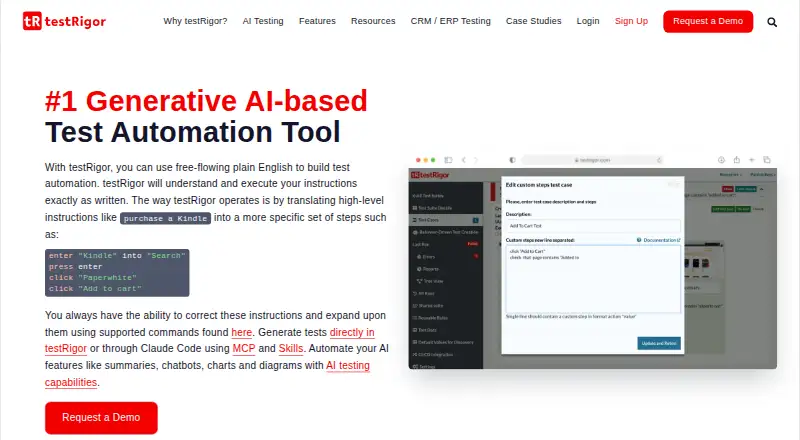
testRigor creates and runs software tests written in plain English, using generative AI.
What testRigor is
testRigor creates and runs software tests written in plain English, using generative AI. Users can generate tests from documented cases, then revise or build them with natural-language instructions. Web testing covers more than 3,000 browser and device combinations across multiple operating systems; the product also supports native and hybrid mobile testing, physical devices through partners, and native desktop testing. Its scope includes API testing and mocking, email and two-factor authentication checks, SMS and phone-call validation, data-driven tests, and downloaded-file validation. Integrations include Jira, TestRail, Zephyr, XRay, GitLab, GitHub Actions, Jenkins, CircleCI, Azure DevOps, BrowserStack, LambdaTest, and Twilio. The free public plan allows unlimited test cases but makes tests and results public and shareable by unique URL. testRigor does not test games. Its Trust Center lists compliance resources, but access to reports requires an MNDA.
Good
- Creates and runs tests from plain-English instructions.
- Web testing spans over 3,000 browser and device combinations.
- Supports native and hybrid mobile testing.
- Includes API testing, mocking, and data-driven tests.
- 14-day trial is listed.
Watch out
- Free public-plan tests and results are public.
- The homepage FAQ says it does not test games.
- Compliance report access requires signing an MNDA.
Who it suits
testRigor is aimed at developers and QA teams, including fast-moving startups checking essential application functions. It may suit teams seeking plain-English test creation across web, mobile, desktop, and API testing.
Verdict
testRigor combines natural-language test authoring with coverage across web, mobile, desktop, and APIs. Review the public visibility of free-plan results and the listed paid-plan terms before choosing it.
Plans and prices
From testRigor's own pricing page, checked 21 Sep 2026.
| Plan | Price | What it gives you |
|---|---|---|
| Public Open Source | Priced on request | Tests and test results are public · Results can be shared using a unique public URL |
| Free - Public | Free | tests and results public · publicly searchable · free forever |
| Private Linux Chrome | $300 a month | Linux Chrome execution · AI generation and execution · 14-day trial · from $300 / month |
| Enterprise | Priced on request | personalized enterprise offer · custom pricing |
| Private Complete | Priced on request | Ubuntu · Windows · Mac · Android · iOS · Windows Native · all AI capabilities · 14-day trial |
The facts
Each one read from testRigor's own pages, with the date it was checked.
What it does
- API mocking
- The language supports mocked API responses with custom headers, bodies and HTTP codes.checked 15 Oct 2026
- API testing
- Tests can call HTTP APIs, inspect status codes, extract JsonPath values and save results for later steps.checked 15 Oct 2026
- Chrome extension
- The testRigor Test Case Recorder Chrome extension has 5,000 users, version 1.18 and a May 21, 2024 update date.checked 15 Oct 2026
- CLI and CI
- A command-line tool can trigger suites, pass CI tokens and variables, push test files and tunnel to localhost.checked 15 Oct 2026
- Desktop testing
- Native Windows desktop testing is available in paid versions.checked 15 Oct 2026
- Documentation depth
- The documentation site includes language commands, advanced JavaScript, CLI, MCP, Claude Code, release notes and how-to articles.checked 15 Oct 2026
- Email testing
- Email steps can send messages, attach files and verify deliverability.checked 15 Oct 2026
- Funding news
- TechCrunch reported a $4.1 million seed round on August 24, 2021, after earlier angel and pre-seed financing.checked 15 Oct 2026
- Integrations
- Documented integrations include TestRail, Zephyr, Xray, Jira, Pivotal Tracker, Jenkins, CircleCI, Azure DevOps, LambdaTest, BrowserStack, Sauce Labs, Slack, Microsoft Teams and PagerDuty.checked 15 Oct 2026
- Intended users
- The About page describes testRigor as built for developers and QA teams, including fast-moving startups that need to verify essential application functions.checked 2 Oct 2026
- Known limitation
- The homepage FAQ says testRigor does not test games.checked 2 Oct 2026
- Licence
- The hosted product is proprietary under a personal, nonexclusive, nonassignable software-use licence; auxiliary GitHub projects use open-source licences such as MIT.checked 15 Oct 2026
- Limit: reliability and debugging
- G2 reviewers report occasional flaky or false-positive failures, timing issues and error messages that make root-cause diagnosis difficult.checked 15 Oct 2026
- Limit: small-budget suitability
- Gartner comparison feedback says the product may not suit companies with small budgets and mentions occasional instability.checked 15 Oct 2026
- Mainframe testing
- The product advertises plain-English automation for mainframe applications.checked 15 Oct 2026
- MCP and SDK extensibility
- The MCP server exposes management of suites, runs, variables, datasets and reusable rules for AI assistants.checked 15 Oct 2026
- Mobile and desktop
- It supports native and hybrid mobile testing, physical devices through partners, and native desktop testing.checked 2 Oct 2026
The company
- Company legal name
- Crunchbase identifies the maker as TestRigor, Inc.checked 15 Oct 2026
- Company location and size
- LinkedIn lists San Francisco headquarters and 51–200 employees.checked 15 Oct 2026
- Founded
- LinkedIn lists the company as founded in 2015.checked 15 Oct 2026
- Headquarters
- San Francisco, California, United Stateschecked 23 Sep 2026
- Limit: code ownership
- A G2 reviewer says the proprietary codeless model limits access to underlying test code and developer-oriented collaboration.checked 15 Oct 2026
Money
- Free plan limitation
- The free public plan makes tests and results public and shareable by unique public URL.checked 2 Oct 2026
- Limit: performance and price
- Reviewers report slow UI or execution and say server pricing becomes difficult to justify for large suites.checked 15 Oct 2026
The full review of testRigor
testRigor turns plain-English instructions into software tests, making it a strong fit for QA teams and developers who want to create coverage without writing every test in code. Its reach across web, mobile, desktop, and APIs is compelling, but the free plan’s public results make it unsuitable for private application testing.
Overview
Generative AI creates and runs tests from free-flowing English, and users can build on or correct tests in the same style. That lowers the barrier to authoring tests while keeping the product useful for teams refining documented test cases. The tradeoff is that the most private-looking entry point, the free public plan, exposes tests and results through shareable URLs.
Key features
- Plain-English test authoring: Generate tests from documented cases, then edit or create tests with natural-language instructions. This suits teams that want a less code-centric authoring workflow.
- Broad web coverage: Web tests span more than 3,000 browser and device combinations across multiple operating systems. Cross-browser testing is a notable strength for teams supporting varied environments.
- Mobile and desktop: Native and hybrid mobile testing includes physical devices through partners, alongside native desktop testing.
- Beyond interface checks: API testing and mocking, email and 2FA tests, SMS and phone-call validation, data-driven tests, and downloaded-file validation cover workflows that extend beyond page interactions.
- Integrations: Jira, TestRail, Zephyr, XRay, GitLab, GitHub Actions, Jenkins, CircleCI, Azure DevOps, BrowserStack, LambdaTest, and Twilio are supported.
- Privacy and compliance: The homepage says private user and company data is not recorded or stored. Trust Center resources cover GDPR, HIPAA, ISO/IEC 27001, and SOC 2 Type 2; reports require signing an MNDA.
Pricing
testRigor uses a freemium model, with a free plan and a 14-day trial. The key decision is whether tests and results can be public or need to remain private.
- FREE - PUBLIC: free, free forever, with unlimited test cases. Tests and results are public and shareable by unique URL, and support is StackOverflow only. It is suitable for open-source work or non-sensitive evaluation, not confidential projects.
- Private Linux Chrome: From $300 / month. It provides private tests, Linux Chrome only, AI-based test generation and execution, and a 14-day trial. The private results are a meaningful step up from the public tier, but browser coverage is narrow; teams needing other environments should look beyond this plan.
- Private Complete: Try for 2 weeks, with a 14 day trial. It includes Ubuntu, Windows, Mac, Android, iOS, Windows Native, and all AI capabilities. Standard support is included. This is the more capable private option, but its ongoing price is custom pricing.
- Enterprise: Custom pricing with personalized enterprise offers. Enterprise support is via Slack or MS Teams, making it the tier aimed at organizations seeking a dedicated support channel.
- Public Open Source: Price not listed; tests and results are public and shareable using a unique public URL.
Review the privacy terms before adopting a public tier: its unlimited test cases do not change the fact that results are public. The 14-day trial offers a short evaluation window, while Private Complete’s custom pricing makes cost comparison less straightforward.
Platforms
testRigor supports Android, iOS, web, API, browser extension, Linux, macOS, Windows, and self-hosted environments. That range makes it relevant to teams testing across device types and operating systems, rather than only browser-based products. The Private Linux Chrome plan is the exception: its execution scope is limited to Linux Chrome.
Who it's for
Developers and QA teams, including fast-moving startups checking essential application functions, are the clearest audience. It is especially well suited to teams that value plain-English authoring and broad cross-platform coverage. It is not a fit for game testing, and teams unwilling to expose tests or results should avoid the free public plan.
Pros and cons
- Pro: Plain-English generation and editing can make test authoring accessible to teams that do not want every change expressed as code.
- Pro: Browser and device breadth, plus mobile, desktop, API, messaging, and file checks, supports testing more than standard web flows.
- Pro: Private Complete spans major desktop and mobile platforms and includes all AI capabilities.
- Con: The free plan makes both tests and results public, a serious constraint for proprietary applications.
- Con: The $300-per-month Private Linux Chrome plan is limited to one operating-system/browser pairing.
- Con: Private Complete and Enterprise use custom pricing, which makes budgeting less immediate.
- Con: Game testing is not supported.
Alternatives
Consider these GUI Testing Software, Functional Testing Software, Browser Automation Tools, or AI Software Testing Tools directories to compare category options.
- ACCELQ is worth comparing if you want a freemium tool spanning web, mobile, and API automation; its Professional plan covers those automation areas, with features varying by product.
- Autify is another freemium option across web, mobile, and API platforms. Its Aximo Individual User plan starts at free and provides 2,000 one-time credits with no expiration.
- Maestro suits readers who prefer a free local option: its Local plan runs on your own devices and includes CLI, Studio, Viewer, and local agents.
- WebdriverIO is a free open-source automation framework for readers comfortable with a Node.js requirement.
- Nightwatch is a free open-source alternative with no paywalls.
- Cypress may suit teams seeking a freemium web-focused option: its free Starter plan includes 10 users, 500 test results per month, 100 prompt executions per month, and 30-day access to paid features.
- Percy is a narrower alternative for screenshot-focused work, with a free tier offering 5,000 screenshots per month and unlimited users and projects.
- Playwright is a free browser-automation choice for teams that want Chromium, Firefox, and WebKit support and can work in TypeScript, Python, .NET, or Java.
Verdict
Choose testRigor if your team wants natural-language test authoring and needs coverage across web, mobile, desktop, and APIs. Its breadth is the main reason to consider it; the public free tier and limited Linux Chrome paid entry plan are the main reasons to look elsewhere. For confidential work, evaluate a private tier and its pricing before committing.
Getting started
- Visit https://testrigor.com/.
- Start with the free public plan or review the private plans and their trial options.
- Create tests from documented test cases, or write and refine them in plain English.
- Choose a testing scope such as web, mobile, desktop, or API testing.
- Connect relevant tools such as Jira, GitHub Actions, Jenkins, BrowserStack, or Twilio.
Limits worth knowing
The free plan allows unlimited test cases, but tests and results are public and shareable by unique URL. Private Linux Chrome starts at $300 a month and is limited to Linux Chrome; Private Complete offers a 14-day trial.
Questions
Does testRigor have a free plan?
Yes. FREE - PUBLIC is listed as free forever and allows unlimited test cases, with tests and results public.
Is a free trial available?
Yes. A 14-day trial is listed for Private Linux Chrome and Private Complete.
Which platforms and testing types does testRigor support?
Listed platforms include Android, iOS, Linux, macOS, self-hosted, web, and Windows. It supports web, native and hybrid mobile, native desktop, and API testing.
Does testRigor test games?
No. Its homepage FAQ says it does not test games.
What integrations are listed?
Integrations include Jira, TestRail, Zephyr, XRay, GitLab, GitHub Actions, Jenkins, CircleCI, Azure DevOps, BrowserStack, LambdaTest, and Twilio.
Alternatives to testRigor
- 1

Katalon Studio
Free planAndroidiOSWebAPI8.4From $1,000 a year - 2
Testsigma
Open sourceAndroidiOSWebAPI8.3From $14 a month - 3
Keysight Eggplant Test
AndroidiOSWebAPI7.9$9,999 one-time - 4
TestFirst
Free planAndroidWebAPImacOS7.9From $12 a month - 5

Autify
Free planAndroidiOSWebAPI7.6From $99 a month - 6

Keploy
Free planWebAPIExtensionLinux7.2From $19 a month