
Telchemy SQmediator
Telchemy SQmediator monitors and troubleshoots real-time performance for VoIP, video, and data services.
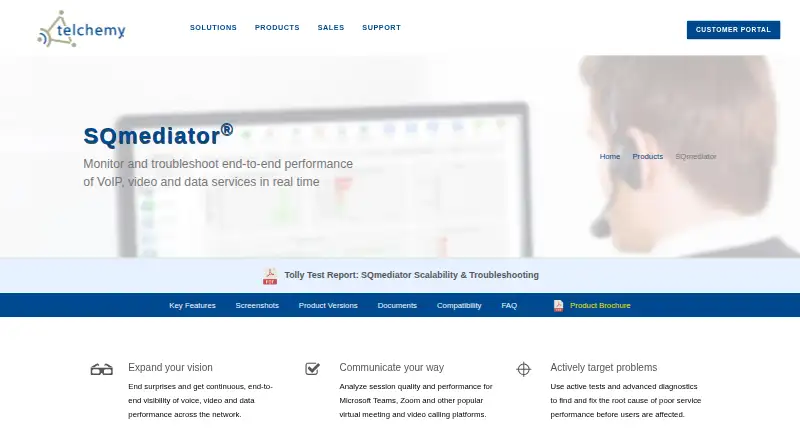
What Telchemy SQmediator is
Telchemy SQmediator monitors and troubleshoots real-time performance for VoIP, video, and data services. It combines passive monitoring with active tests, reporting experience scores such as MOS alongside QoS measures and diagnostics for voice, audio, and video sessions. Its listed meeting platforms include Microsoft Teams, Zoom, Google Meet, GoToMeeting, and Webex; it can analyze encrypted audio and video streams without decrypting them. Linux, Windows, and Android test agents can simulate voice or video calls and check web, email, DNS, DHCP, and SIP services. Dashboards, email alerts, and SNMP traps can notify teams when configured service thresholds are exceeded. The system runs on Linux server hardware or virtual machines, on premises, in the cloud, or in data centers. Its multitenant design can manage thousands of customers and sites and millions of end users. Deployment requires an Oracle or PostgreSQL database that customers set up themselves. Pricing is available on request; licensing depends on selected modules, and combining passive monitoring with active testing costs extra.
Good
- Combines passive monitoring with active testing.
- Reports MOS, QoS metrics, and session diagnostics.
- Analyzes encrypted media without decrypting it.
- Supports multitenant deployments at large scale.
- Offers Linux, Windows, and Android test agents.
Watch out
- Pricing is available only on request.
- No free plan is listed.
- Customers must set up an Oracle or PostgreSQL database.
- Passive monitoring plus active testing costs extra.
Who it suits
SQmediator suits enterprise, government, and service-provider teams that need to monitor service quality across many customers or sites. It is also relevant to teams seeking both passive monitoring and simulated service tests.
Verdict
SQmediator brings service monitoring, diagnostics, and simulated tests into one platform, with broad deployment and tenancy options. Buyers should account for database setup and module-based licensing when assessing fit.
Plans and prices
From Telchemy SQmediator's own pricing page, checked 5 Oct 2026.
| Plan | Price | What it gives you |
|---|---|---|
| Business Edition | Priced on request | Single-server version; Web Services API optional; passive + active at additional cost |
| Enterprise Edition | Priced on request | Passive monitoring or active testing; passive + active at additional cost |
| Service Provider Edition | Priced on request | Passive monitoring or active testing; passive + active at additional cost |
| Small Business Edition | Priced on request | Single-server version; Web Services API optional; passive + active at additional cost |
| Small Service Provider Edition | Priced on request | Single-server version; Web Services API optional; passive + active at additional cost |
The facts
Each one read from Telchemy SQmediator's own pages, with the date it was checked.
What it does
- Active test agents
- Compact software test agents are available for Linux, Windows, and Android and can run simulated voice and video calls and network service tests.checked 5 Oct 2026
- Active testing
- Test agents can place simulated VoIP or videoconferencing calls and test web, email, DNS, DHCP, and SIP services.checked 4 Oct 2026
- Alerts
- Users can configure metric thresholds that trigger dashboard alerts, email alerts, and SNMP traps.checked 5 Oct 2026
- Availability and buyers
- Telchemy sells through direct sales, indirect sales, and OEM licensing, and identifies enterprise, government, and service-provider uses for SQmediator.checked 5 Oct 2026
- Database requirement
- SQmediator requires an Oracle or PostgreSQL database, which customers must download and set up themselves.checked 5 Oct 2026
- Deployment
- SQmediator runs on Linux server hardware or virtual machines and can be deployed on-premises, in the cloud, or in data centers.checked 5 Oct 2026
- Encrypted media
- SQmediator analyzes encrypted video and audio streams without decrypting them.checked 4 Oct 2026
- Integrations
- It sends SNMP traps and provides a SOAP/XML web services interface for client applications to configure the system, retrieve data, and control active tests.checked 5 Oct 2026
- Licensing
- Telchemy says customers pay for the modules they use; passive monitoring plus active testing costs extra, and user-defined services require a license key.checked 5 Oct 2026
- Monitoring modes
- It combines passive quality monitoring with active testing for network services and applications.checked 5 Oct 2026
- Pricing model
- The maker says customers pay only for the modules they use and that combining passive monitoring with active testing is available at an additional cost; it does not state prices on the product page.checked 4 Oct 2026
- Purpose
- SQmediator monitors and troubleshoots VoIP, video, and data service performance in real time.checked 5 Oct 2026
- Quality metrics
- It reports QoE/QoS metrics, including MOS scores, and analyzes SIP registration, call setup, and failure codes.checked 5 Oct 2026
- Scale
- Its multitenant architecture can manage thousands of customers and sites and millions of end users from one application and database.checked 4 Oct 2026
- Scale and tenancy
- The product supports multitenant deployments managing thousands of customers and sites and millions of end users, with capacity expanded through additional system components.checked 5 Oct 2026
- Security
- Telchemy says the application is hardened against attacks including SQL/XSS injection and brute-force password attacks, and has role-based access controls and password rules.checked 5 Oct 2026
- Support
- Telchemy offers customer-portal support tickets, support by contact form or phone, and optional web-based or on-site training.checked 5 Oct 2026
Where it runs
- Agent platforms
- The product page lists Linux, Windows, and Android software test agents.checked 4 Oct 2026
- Meeting platforms
- It supports Microsoft Teams, Zoom, Google Meet, GoToMeeting, Webex, and other meeting platforms, and analyzes encrypted media streams without decryption.checked 5 Oct 2026
- Video platforms
- The product page lists Microsoft Teams, Zoom, Google Meet, GoToMeeting, and Webex as supported meeting platforms.checked 4 Oct 2026
The company
- Company
- Telchemy says it was founded in 1999 and is based in Alpharetta, Georgia.checked 4 Oct 2026
- Founded
- 1999checked 23 Sep 2026
- Headquarters
- Alpharetta, Georgia, USAchecked 23 Sep 2026
The full review of Telchemy SQmediator
Telchemy SQmediator is a platform for monitoring and troubleshooting voice, video, and data service performance. It is best suited to enterprises, government organizations, and service providers managing many sites or customers. Its blend of passive monitoring and simulated tests is compelling, but database setup and modular licensing make it a more involved choice than a lightweight monitoring tool.
Overview
SQmediator brings live service-quality monitoring and active testing together, reporting MOS and other QoE scores alongside QoS metrics and diagnostics for voice, audio, and video sessions. That combination helps teams investigate both observed service problems and failures that simulated calls or service checks can reveal.
Its multitenant architecture is designed to manage thousands of customers and sites and millions of end users from one application and database. Capacity can be expanded with additional components, making the platform more relevant to service providers and large organizations than to teams with modest monitoring needs.
Key features
Passive monitoring and active tests
Compact software agents for Linux, Windows, and Android can place simulated VoIP or videoconferencing calls and test web, email, DNS, DHCP, and SIP services. MOS scoring, jitter tracking, packet-loss tracking, and synthetic call tests support a broad view of service quality. Passive monitoring and active testing can be combined, but that combination costs extra, so buyers should assess whether they need both before choosing modules.
Meeting quality and alerting
SQmediator supports Microsoft Teams, Zoom, Google Meet, GoToMeeting, Webex, and other meeting platforms. It analyzes encrypted audio and video streams without decrypting them, a useful capability for organizations that need visibility into meeting quality while retaining encrypted media. Dashboard and email alerts, plus SNMP traps, can flag service metrics that exceed configured thresholds.
Integration, security, and setup
The SOAP/XML API can configure the system, retrieve data, and control active tests. It is standard in multi-server editions and optional in the listed single-server editions. The product is designed to meet US DoD security requirements and includes role-based access, password rules, and defenses against SQL and XSS injection and brute-force attacks.
SQmediator runs on Linux server hardware or virtual machines, on premises, in the cloud, or in data centers. It requires Oracle or PostgreSQL, which customers must download and set up themselves using Telchemy’s scripts and instructions. That gives buyers deployment flexibility, but adds infrastructure work before the platform is ready to use.
Pricing
SQmediator is paid software with custom pricing. Telchemy says customers pay for the modules they use; combining passive monitoring with active testing costs extra, and user-defined services require a license key. This modular approach lets buyers scope the system to their requirements, but makes it important to account for needed capabilities rather than compare edition names alone.
- Small Business Edition: custom pricing; single-server, with the API optional and passive monitoring plus active testing at additional cost. A fit for smaller deployments that can work within a single server.
- Small Service Provider Edition: custom pricing; single-server, with the API optional and passive monitoring plus active testing at additional cost. It suits service providers needing a smaller deployment.
- Business Edition: custom pricing; single-server, with the API optional and passive monitoring plus active testing at additional cost. It is another single-server option for business deployments.
- Service Provider Edition: custom pricing; choose passive monitoring or active testing, with the combination costing extra. It targets providers that need to monitor customer services or run tests.
- Enterprise Edition: custom pricing; choose passive monitoring or active testing, with the combination costing extra. It is the edition aimed at enterprise-scale deployments.
Telchemy sells directly, through indirect sales, and through OEM licensing. It offers support tickets through a customer portal, with web-based or on-site training available as an option. There is no free plan.
Platforms
SQmediator supports Android, Linux, Windows, web access, and a SOAP/XML API. The server runs on Linux hardware or virtual machines. Deployment can be on premises, in the cloud, or in data centers, while the test agents run on Linux, Windows, and Android.
Who it's for
SQmediator is strongest for service providers, enterprises, and government organizations that need multitenant monitoring, diagnostics, and active tests across many sites or users. Teams that need encrypted meeting-media analysis or control over deployment location may also find its breadth valuable. Smaller organizations that do not need this scale, or that want to avoid setting up a database and selecting modules, should look elsewhere.
Pros and cons
- Pros
- Passive monitoring and simulated service tests sit in one platform, helping teams compare observed quality with test results.
- Multitenancy and support for thousands of customers and millions of end users suit large provider and enterprise environments.
- Encrypted meeting audio and video can be analyzed without decryption, and major meeting platforms are supported.
- Linux server deployment across on-premises, cloud, and data-center environments gives infrastructure teams deployment choice.
- Cons
- Customers must install and configure Oracle or PostgreSQL, adding setup work and database responsibility.
- Passive monitoring plus active testing costs extra, so the full monitoring-and-testing combination raises licensing cost.
- The API is optional rather than standard in single-server editions, which matters for buyers planning integrations.
- Custom pricing and module-based licensing make total cost dependent on deployment scope and selected capabilities.
Alternatives
VoIP Monitoring Software is the broader category for comparing tools. Consider VoIPmonitor if you want a paid VoIP monitoring option with a free trial; its Cloud 3 channels plan is $22 a month and includes three channels, full features, 21-day CDR retention, and PCAP storage on your server.
CallMeter is another paid alternative with a free trial and monthly or annual plans. Choose Obkio if a freemium option is a priority: it has a free plan and a 14-day trial with premium features, a maximum of 10 agents, and no credit card required. Bicom Systems SIP Monitoring (sipMON) is a paid, Linux and self-hosted alternative.
Oracle Enterprise Operations Monitor is a paid alternative for Linux and web. ServicePilot VoIP Monitoring offers a free plan as well as paid options, including object monitoring priced at $0.50 a month per object, with the rate decreasing based on quantity. MultiDSLA is a paid option with a controller and one or more node devices that controls 100+ nodes. HOMER is a free, open-source alternative with commercial support available by quote.
Verdict
Choose SQmediator if you need one platform for service-quality monitoring, diagnostics, and active tests across a large, multitenant deployment. Its scale, meeting-platform coverage, and encrypted-media analysis stand out for service providers, enterprises, and government buyers. Look elsewhere if you want a simpler setup or need predictable pricing: database administration and module-based licensing are central parts of the buying decision.
Alternatives to Telchemy SQmediator
- 1

Dotcom-Monitor
Free planAndroidiOSWebAPI8.3From $13.33 a month - 2

Obkio
Free planAndroidiOSWebAPI8.2From $249 a month - 3
Exoprise
WebAPIExtensionLinux6.8From $100 a month - 4
VoIP Spear
WebAPImacOSWindows6.5From $14.95 a month - 5
VoIPmonitor
WebAPILinuxSelf-hosted6.5From $259 a year - 6

CallMeter
WebAPISelf-hosted6.4