HOMER
HOMER is a free VoIP and real-time communications capture framework for analysis and monitoring.
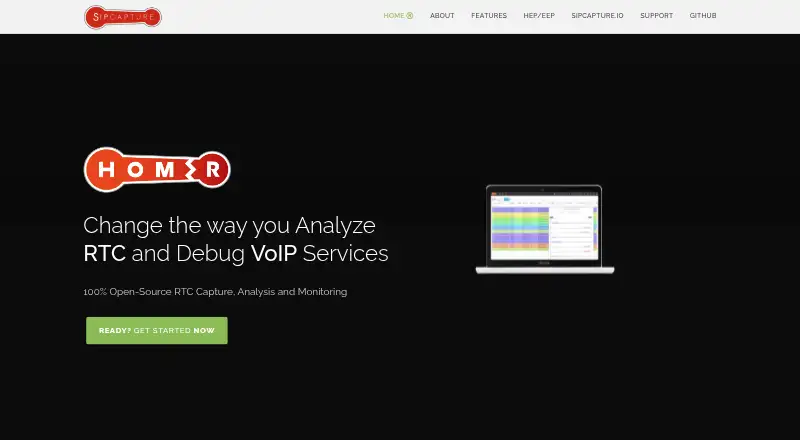
What HOMER is
HOMER is a free VoIP and real-time communications capture framework for analysis and monitoring. Its listed tools include advanced search, end-to-end analysis and packet drill-down, along with call-flow and PCAP capture, statistics, analytics, a REST API and widgets. Capture agents support HEP3 encapsulation, payload encryption and compression, and TLS. The listed core covers SIP, RTCP, RTCP-XR, WebRTC signaling and log collection; integrations include HEP/EEP support for tools such as Kamailio, OpenSIPS, Asterisk, FreeSWITCH and RTPEngine. The HOMER 11 repository describes an all-in-one HEP capture and API server for the 11.x data lake. Its documented components include ingest, DuckLake storage, a Node with FlightSQL and a Coordinator with a REST API. Docker is supported, and the project is licensed under AGPL-3.0. HOMER is aimed at ITSPs, VoIP providers and trunk suppliers. Commercial development support, 24/7 SLA production support and advanced training are available by quote.
Good
- Free open-source plan.
- Includes advanced search and packet drill-down.
- Capture agents support encryption and TLS.
- Docker deployment is supported.
- Lists multi-user LDAP and Radius support.
Watch out
- Commercial support options require a quote.
- VQRTCP collection and SIPREC are optional and disabled by default.
Who it suits
HOMER is aimed at ITSPs, VoIP providers and trunk suppliers that need capture and analysis tools. Its open-source release is free, while commercial support options are quote-based.
Verdict
HOMER offers capture, analysis and monitoring capabilities for VoIP and real-time communications. Teams considering the HOMER 11 release should note that VQRTCP and SIPREC are optional and disabled by default.
Plans and prices
From HOMER's own pricing page, checked 4 Oct 2026.
| Plan | Price | What it gives you |
|---|---|---|
| HOMER Open Source | Free | 100% open-source; commercial support available by quote |
The facts
Each one read from HOMER's own pages, with the date it was checked.
What it does
- Access control
- The capture server lists multi-user LDAP and Radius support.checked 4 Oct 2026
- Capture agents
- Agents support HEP3 encapsulation, payload encryption and compression, and TLS.checked 4 Oct 2026
- Capture server
- Listed server features include call-flow and PCAP, statistics and analytics, a REST API, and widgets.checked 4 Oct 2026
- Current release status
- The maker's HOMER 11 repository describes it as an all-in-one HEP capture and API server for the Homer 11.x data lake.checked 4 Oct 2026
- Deployment
- The project supports Docker, and the current HOMER repository documents release packages and Docker builds.checked 4 Oct 2026
- HOMER 11 components
- HOMER 11 documentation describes ingest, DuckLake storage, a Node with FlightSQL, and a Coordinator with a REST API.checked 4 Oct 2026
- Integrations
- The site lists HEP/EEP support for Kamailio, OpenSIPS, Captagent, Asterisk, FreeSWITCH, RTPEngine, sipgrep, sngrep, and hepipe.checked 4 Oct 2026
- License
- The HOMER 11 repository states that the project is released under the AGPL-3.0 License.checked 4 Oct 2026
- Optional capabilities
- The HOMER 11 README says VQRTCP collection and SIPREC support are optional and disabled by default.checked 4 Oct 2026
- Protocol coverage
- The listed core includes SIP, RTCP, RTCP-XR, WebRTC signaling, and log collection.checked 4 Oct 2026
- Purpose
- HOMER is a VoIP and RTC capture framework for analysis and monitoring.checked 4 Oct 2026
- Search and analysis
- The site lists advanced search, end-to-end analysis, and packet drill-down capabilities.checked 4 Oct 2026
- Security
- The site lists payload encryption and TLS support for capture agents.checked 4 Oct 2026
- Support
- Commercial support options listed include development support, 24/7 SLA production support, and advanced training; requests are quote-based.checked 4 Oct 2026
- Target users
- The maker describes HOMER for ITSPs, VoIP providers, and trunk suppliers.checked 4 Oct 2026
The company
- Founded
- 2011checked 28 Sep 2026
The full review of HOMER
HOMER is a free, open-source framework for capturing and analyzing VoIP and real-time communications traffic. It suits ITSPs, VoIP providers and trunk suppliers that can run their own capture infrastructure. Its strongest case is deep investigation of call flows and packets; teams wanting a managed monitoring service should look elsewhere.
Overview
HOMER combines traffic capture with search and analysis, letting operators move from a broad issue to packet-level inspection. Advanced search, end-to-end analysis and packet drill-down make it useful for diagnosing problems across SIP and related communications systems, rather than merely watching a high-level dashboard.
The HOMER 11 project describes an all-in-one HEP capture and API server for the Homer 11.x data lake. Its components include ingest, DuckLake storage, a Node with FlightSQL, and a Coordinator with a REST API. Docker and release packages offer deployment paths, but the self-hosted approach means operators need to account for running and integrating the stack themselves. The AGPL-3.0 license is also an important consideration for organizations modifying or incorporating the project.
Key features
The capture server brings together call-flow and PCAP capabilities, statistics, analytics, widgets and a REST API. This mix supports both direct troubleshooting and integration into a wider operations workflow. HOMER also supports MOS scoring, jitter tracking and packet-loss tracking, giving teams several measures for examining call quality.
Capture agents support HEP3 encapsulation, payload encryption and compression, and TLS. The core protocol coverage includes SIP, RTCP, RTCP-XR, WebRTC signaling and log collection. HEP/EEP integrations span Kamailio, OpenSIPS, Captagent, Asterisk, FreeSWITCH, RTPEngine, sipgrep, sngrep and hepipe, making HOMER relevant to operators working across those tools. Multi-user LDAP and Radius support provide access-control options for shared deployments.
VQRTCP collection and SIPREC support are optional in HOMER 11 and disabled by default. Teams that depend on either capability should plan for that configuration rather than assume it is active out of the box.
Pricing
HOMER Open Source costs nothing and is 100% open-source. It is the natural starting point for teams able to deploy and maintain the system themselves, with no paid entry tier to weigh against a feature-limited free version. Commercial support is available by quote, including development support, 24/7 SLA production support and advanced training; this is a better fit for organizations that need vendor assistance than for those expecting a published support price.
Platforms
HOMER supports API, Linux, macOS, self-hosted and web environments. Docker support and release packages give teams deployment options, while the API and integrations help connect capture data and workflows to other systems. Its self-hosted orientation favors operators who want control over their capture stack, not buyers looking for a hosted service with minimal operational responsibility.
Who it's for
HOMER is aimed at ITSPs, VoIP providers and trunk suppliers, particularly teams that need to investigate signaling, call flows and packet-level detail across a communications environment. It is a stronger fit for technically equipped operators with relevant infrastructure than for small teams seeking a ready-made monitoring subscription.
Pros and cons
- Pros: Advanced search, end-to-end analysis and packet drill-down support investigations beyond summary-level monitoring.
- Pros: Broad protocol coverage and integrations connect HOMER to a range of VoIP infrastructure and capture tools.
- Pros: Encryption, TLS and multi-user LDAP and Radius support address transport security and shared access needs.
- Cons: Self-hosted deployment places responsibility for operating the capture stack on the user.
- Cons: VQRTCP collection and SIPREC are optional and disabled by default, so users relying on them must account for configuration.
- Cons: Commercial support is quote-based rather than a fixed-price option.
Alternatives
VoIP Monitoring Software is the category directory for comparing tools in this field.
Obkio is worth considering for teams seeking a freemium option with a 14-day trial, up to 10 agents and no credit card requirement; it supports a wider range of listed desktop and mobile platforms.
Dotcom-Monitor may suit teams that prefer a freemium monitoring plan with up to 25 targets, five-minute monitoring frequency, two monitoring locations and email alerts.
sip-exporter is another free, self-hosted Linux option under AGPL-3.0, with commercial use subject to that license's conditions.
Telchemy SQmediator is a paid alternative with a single-server Small Service Provider Edition; its Web Services API is optional, and passive plus active capabilities cost extra.
MultiDSLA is a paid option built around a controller and one or more node devices, with support for controlling 100+ nodes.
CallMeter offers paid Starter and Professional plans, billed monthly or annually, with features, usage limits and service levels varying by plan.
Exoprise is a paid alternative with a free trial and credits priced at $100 a month; discounts are available for prepaid annual plans and volume purchases.
Nectar Diagnostics is another paid option.
Verdict
Choose HOMER if your organization operates VoIP infrastructure and needs a free, open-source framework for capture, analysis and packet-level troubleshooting. Its breadth of protocols, integrations and diagnostic capabilities is the main reason to choose it. Look elsewhere if you need a managed service or cannot take on self-hosting, and verify optional VQRTCP or SIPREC requirements before planning a HOMER 11 deployment.
Getting started
- Open the SIPCAPTURE website
- Choose Linux, macOS, web, API, or self-hosted access
- Deploy the project with Docker if preferred
- Connect listed HEP/EEP-compatible systems
- Use HOMER's capture, search, analytics, and REST API components
- Request a quote for commercial development, SLA support, or training
Limits worth knowing
The open-source plan is free, while VQRTCP collection and SIPREC support are optional and disabled by default. Commercial development support, 24/7 SLA production support, and advanced training are quote-based.
Questions
Is HOMER free?
Yes. The HOMER Open Source plan is listed at 0.00 USD and is 100% open-source. Commercial support is available by quote.
What license does HOMER use?
The HOMER 11 repository states that the project is released under the AGPL-3.0 License.
Which platforms and deployment methods are supported?
HOMER is listed for API, Linux, macOS, self-hosted, and web use. Docker deployment is supported.
Which protocols and integrations are listed?
Core coverage includes SIP, RTCP, RTCP-XR, WebRTC signaling, and log collection. HEP/EEP integrations include Kamailio, OpenSIPS, Captagent, Asterisk, FreeSWITCH, RTPEngine, sipgrep, sngrep, and hepipe.
Are VQRTCP and SIPREC included by default?
No. HOMER 11 documentation describes both as optional capabilities disabled by default.
Who is HOMER designed for?
The maker describes it for ITSPs, VoIP providers, and trunk suppliers.
Alternatives to HOMER
- 1

Dotcom-Monitor
Free planAndroidiOSWebAPI8.3From $13.33 a month - 2

Obkio
Free planAndroidiOSWebAPI8.2From $249 a month - 3
Exoprise
WebAPIExtensionLinux6.8From $100 a month - 4

Telchemy SQmediator
AndroidWebAPILinux6.7 - 5
VoIP Spear
WebAPImacOSWindows6.5From $14.95 a month - 6
VoIPmonitor
WebAPILinuxSelf-hosted6.5From $259 a year