
Strobes ASPM
Strobes ASPM brings application-security findings together in a risk-prioritized view for developers and security teams.
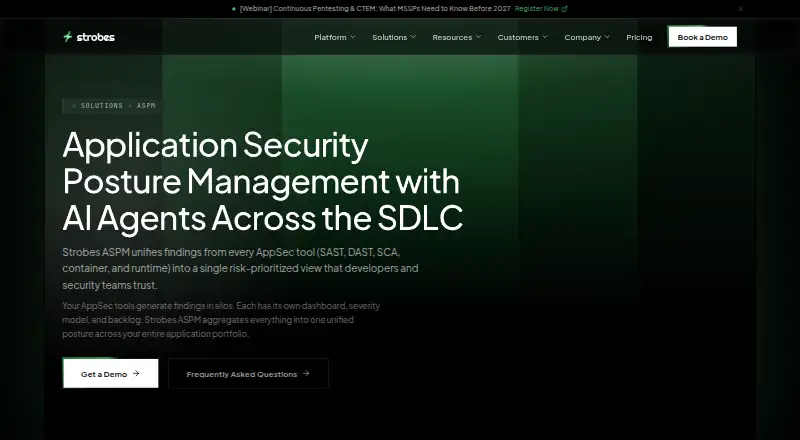
What Strobes ASPM is
Strobes ASPM brings application-security findings together in a risk-prioritized view for developers and security teams. It ingests results from SAST, DAST, software composition analysis, container scanners, penetration tests, and bug bounty programs. Its risk scoring considers exploit likelihood, asset criticality, and compensating controls, with EPSS and KEV in the displayed context. Strobes can enforce security policy in CI/CD, block critical findings, warn on high findings, and provide feedback in pull requests. AI agents can triage and deduplicate findings, create and route tickets, track SLAs, and verify fixes by rescanning. Integrations include more than 100 tools, among them security scanners and cloud services; a GraphQL API supports querying and changing assets, findings, engagements, and assessments. Deployment options include cloud SaaS or private deployment. The free plan allows up to 100 assets, 500 tasks per month, and one connector, with community support. A 14-day trial offers full access to ASM, RBVM, PTaaS, ASPM, and AI Agents, with guided onboarding from a dedicated security engineer.
Good
- Combines findings across six AppSec sources
- Risk context includes EPSS and KEV
- CI/CD policy enforcement and pull request feedback
- Cloud SaaS or private deployment
Watch out
- Free plan limited to 100 assets and 500 monthly tasks
- Free plan includes one connector
- Starter costs $29,000 per year
Who it suits
Strobes ASPM may suit security teams that need to consolidate findings from multiple AppSec tools and prioritize remediation. Its listed customer range includes mid-market teams and large organizations with complex, high-volume environments.
Verdict
Strobes ASPM combines finding triage, risk prioritization, and remediation workflows across multiple tools. Its free tier has asset, task, and connector limits; paid plans start at $29,000 per year.
Plans and prices
From Strobes ASPM's own pricing page, checked 15 Oct 2026.
| Plan | Price | What it gives you |
|---|---|---|
| Free | Free | up to 100 assets · 500 tasks/month · ASM, RBVM, ASPM · 1 connector · community support · forever |
| Starter | $29,000 a year | up to 1,000 assets · 1,000 tasks/month · ASM, RBVM, ASPM · unlimited connectors · email support · annually |
| Growth | $45,000 a year | 1,001–25,000 assets · up to 25,000 tasks/month · ASM, RBVM, ASPM · unlimited connectors and users · dedicated CSM · annually |
| Enterprise | Priced on request | 25,001+ assets · custom task limits · ASM, RBVM, ASPM · unlimited connectors and users · TAM, SLA and custom MSA |
The facts
Each one read from Strobes ASPM's own pages, with the date it was checked.
What it does
- AI automation
- AI agents triage and deduplicate findings, create tickets, route work to teams, track SLAs, and verify fixes by rescanning.checked 30 Sep 2026
- API
- The developer platform exposes GraphQL at /api/graphql/ for querying and mutating assets, findings, engagements and assessments.checked 15 Oct 2026
- CI/CD
- Strobes says it can enforce security policy in CI/CD, block critical findings, warn on high findings, and provide in-PR feedback.checked 30 Sep 2026
- CI/CD gates
- Policies can block critical issues or warn on high-severity issues directly in CI/CD pipelines.checked 15 Oct 2026
- Coverage
- The ASPM page says the platform ingests findings from SAST, DAST, SCA, container scanners, pentests, and bug bounty programs.checked 30 Sep 2026
- Data and AI controls
- Strobes says customer data is not used to train its AI models and that agents use bounded autonomy, approval checkpoints and explainable reasoning.checked 15 Oct 2026
- Data protection
- The trust page says Strobes uses SOC 2 certified data centers, network segmentation, intrusion detection, 24/7 monitoring, and regular third-party penetration testing of its platform.checked 30 Sep 2026
- Deduplication
- Strobes says it normalizes overlapping findings from multiple tools and removes 60–70% of finding noise.checked 15 Oct 2026
- Deployment
- The platform page says Strobes is available as cloud SaaS or private deployment.checked 30 Sep 2026
- Developer API
- Strobes documents GraphQL platform access for querying and mutating assets, findings, engagements, and assessments.checked 30 Sep 2026
- Documentation
- The help center lists 45 exposure-management articles, 39 integration articles, 34 agentic-pentesting articles and sections for dashboards, workflows and administration.checked 15 Oct 2026
- Funding
- BounceWatch records four rounds totaling $780,000, including a $400,000 seed round from Chitra Holdings Inc. on March 5, 2022.checked 15 Oct 2026
- Integrations
- The integrations catalog advertises more than 100 connectors spanning scanners, cloud security, containers, ticketing and development tools.checked 15 Oct 2026
- Intel API
- An Intel REST API at intel.strobes.co provides CVE lookup, EPSS, CISA KEV and threat-actor data; bulk and advanced endpoints require a license.checked 15 Oct 2026
- Intended users
- Strobes describes its customers as security teams ranging from mid-market teams to large organizations with complex, high-volume environments.checked 30 Sep 2026
- Limit: data visibility
- A G2 reviewer says some reported vulnerabilities occasionally fail to appear in the portal, complicating closure tracking.checked 15 Oct 2026
- Limit: learning curve
- Some G2 reviewers report that initial setup and workflow or integration customization take time to learn.checked 15 Oct 2026
- Limit: reporting
- A G2 reviewer criticizes reports as static and high-level, with insufficient filtering, trend analysis and export flexibility.checked 15 Oct 2026
- Native scanners
- Strobes lists built-in DAST, SAST, SCA, API-security, cloud-configuration, container and secret-scanning engines.checked 15 Oct 2026
- Notable news
- Strobes’ press page records a 2022 SOC 2 Type 1 compliance achievement and a 2022 growth-capital announcement involving SucSEED Indovation Fund.checked 15 Oct 2026
The company
- Company facts
- BounceWatch lists Strobes as founded in 2019, headquartered in Plano, with 61 employees and seed-stage status.checked 15 Oct 2026
- Company legal name
- The company-data profile identifies the legal name as Strobes Security, Inc.checked 15 Oct 2026
- Headquarters
- Plano, Texas, United Stateschecked 28 Sep 2026
- LinkedIn company size
- LinkedIn lists Strobes Security as privately held, headquartered in Plano, Texas, with 51–200 employees.checked 15 Oct 2026
The full review of Strobes ASPM
Strobes ASPM brings application-security findings into a shared workflow for developers and security teams. It suits organizations that need to prioritize and coordinate work across multiple AppSec tools. Its breadth of integrations and remediation automation are compelling, but its paid entry point is steep for smaller teams.
Overview
The platform ingests findings from SAST, DAST, software-composition analysis, container scanners, penetration tests, and bug bounty programs. It correlates findings into a risk-prioritized view, maps ownership, and supports remediation workflows and SBOM management. That breadth makes Strobes a candidate for teams trying to coordinate existing security tools rather than replace them.
Risk scoring considers exploit likelihood, asset criticality, and compensating controls, with EPSS and KEV in the displayed context. The aim is to help teams distinguish urgent exposure from a large queue of findings; the value depends on having useful asset and finding data flowing into the platform.
Key features
Triage and remediation
AI agents can triage and deduplicate findings, create tickets, route work to teams, track SLAs, and verify fixes by rescanning. This connects prioritization to follow-through, a practical strength for teams managing high volumes. Strobes also says CI/CD policies can block critical findings, warn on high findings, and provide feedback in pull requests, letting teams surface issues during development rather than only in a central queue.
Integrations and API
Strobes lists more than 100 integrations, including Nessus, Qualys, Burp Suite, Acunetix, Rapid7, Nuclei, Snyk, Checkmarx, SonarQube, major cloud providers, Prisma Cloud, and Wiz. Its GraphQL API supports querying and changing assets, findings, engagements, and assessments. That combination favors organizations with varied toolchains and a need to connect ASPM workflows to other systems.
Security and deployment
Strobes states that it holds SOC 2 Type 2 and ISO 27001:2022 certifications, is CREST certified and CERT-In empanelled, and uses SOC 2-certified data centers, network segmentation, intrusion detection, continuous monitoring, and regular third-party penetration testing. It offers cloud SaaS or private deployment. These controls and deployment choices may suit organizations with formal security requirements, though buyers should assess fit against their own requirements.
Pricing
| Plan | Price | Limits and support |
|---|---|---|
| Free | free, billed forever | Up to 100 assets, 500 tasks per month, one connector, community support |
| Starter | $29,000 a year, billed annually | Up to 1,000 assets, 1,000 tasks per month, unlimited connectors, email support |
| Growth | $45,000 a year, billed annually | 1,001–25,000 assets, up to 25,000 tasks per month, unlimited connectors and users, dedicated CSM |
| Enterprise | Custom pricing | 25,001+ assets, custom task limits, unlimited connectors and users, TAM, SLA, and custom MSA |
All four plans include ASM, RBVM, and ASPM. Free is useful for a small-scale evaluation, but its 100-asset cap, monthly task ceiling, and single connector constrain broader coverage. Starter removes the connector cap but still limits assets and tasks; its annual price makes it a substantial commitment for a team that has outgrown Free. Growth raises the ceilings and adds unlimited users plus a dedicated CSM, fitting larger deployments. Enterprise is for organizations above 25,000 assets or needing custom limits and contractual support terms.
A separate 14-day trial offers full access to ASM, RBVM, PTaaS, ASPM, and AI Agents, with guided onboarding by a dedicated security engineer. It is the clearest way to evaluate the wider offering before choosing a plan.
Platforms
Strobes is available via API, web, and self-hosted deployment, with cloud SaaS and private deployment options. The API and deployment flexibility are useful for teams integrating it into existing workflows or requiring a private environment.
Who it's for
Strobes is best suited to mid-market and large security teams consolidating findings across numerous tools and coordinating remediation at meaningful scale. Smaller teams may appreciate the free tier, but its tight caps and the high annual Starter price make it less compelling once regular, multi-tool use is needed.
Pros and cons
- Pros: Broad scanner and cloud integrations bring diverse findings into one workflow.
- Pros: Risk context, ownership mapping, ticket routing, SLA tracking, and rescanning connect prioritization with remediation.
- Pros: CI/CD enforcement and in-PR feedback can catch issues earlier in development.
- Cons: Free is capped at 100 assets, 500 monthly tasks, and one connector, limiting sustained multi-tool use.
- Cons: Starter costs $29,000 a year, a high entry point for smaller teams.
- Cons: Enterprise has custom pricing, so buyers must engage sales for a quote.
Alternatives
Application Security Posture Management Software and Application Security Orchestration Platforms offer broader category comparisons. Consider Conviso Platform if its free plan's five contributing developers, five assets, ten users, and two integrations better match a small evaluation. Phoenix Security is another freemium option, with a free plan covering up to 1,000 assets and two premium users plus guests.
OX Security may suit teams seeking a paid platform whose OX Code plan names SAST, SCA, secrets and PII, SBOM, IaC, CI/CD, container scanning, IDE, and CLI coverage. SecurStack offers a free plan with 500 monthly scan credits, three users, ten projects, and SAST, SCA, and secrets, making it a more limited-scope option to consider.
Cycode ASPM, Legit Security ASPM, Seemplicity Application Security, and Foxnode ASPM are additional alternatives.
Verdict
Choose Strobes ASPM if your security team needs to unify findings from a broad toolchain and carry prioritized work through ownership, ticketing, policy enforcement, and fix verification. Its strongest case is the combination of integration breadth and remediation automation. Look elsewhere if you need an affordable paid entry point or if the Free tier's asset, task, and connector caps are too restrictive.
Alternatives to Strobes ASPM
- 1

OWASP DefectDojo
Free planOpen sourceWebAPILinuxSelf-hosted8.0$100 usage-based - 2
OX Security
Free planWebAPIExtensionLinux7.4Free plan - 3

Conviso Platform
Free planWebAPI7.3From $19 a month - 4

ArcherySec
Free planWebAPILinuxmacOS6.7Free plan - 5

ScanDog
Free planWebAPI6.5From €19 a month - 6

Invicti
WebAPISelf-hosted6.3$500 one-time