
Phoenix Security
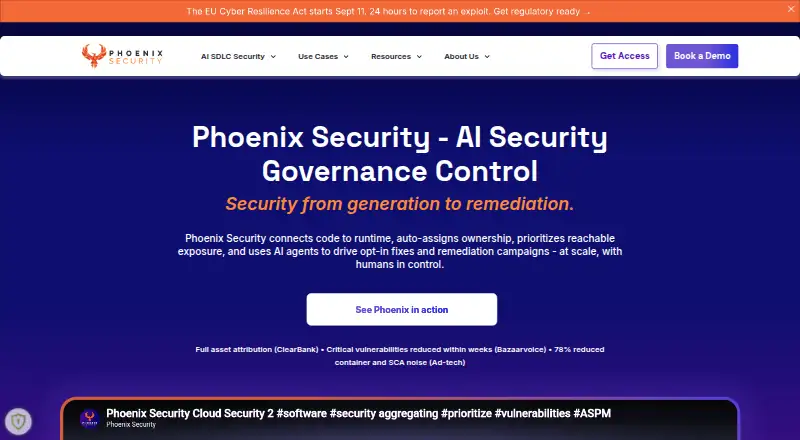
Phoenix Security is a cloud platform for security governance that links code findings with runtime exposure, maps ownership, and helps teams prioritize risk.
What Phoenix Security is
Phoenix Security is a cloud platform for security governance that links code findings with runtime exposure, maps ownership, and helps teams prioritize risk. It brings together findings from SAST, SCA, containers, cloud, runtime, and ticketing in a normalized, deduplicated model. Phoenix says it ranks deployed, running, reachable exposure using threat intelligence and business context. Its AI agents can prepare minimum-impact remediation plans, open pull requests with user opt-in, run remediation campaigns, and measure risk reduction. The platform says it connects with security tools and technology across application, infrastructure, cloud, and container security; listed integrations include Microsoft Defender for Cloud, Lacework, Sysdig, Google Cloud SCC, and Aikido. Phoenix Free includes up to 1,000 assets, two premium users plus guests, community support, and dashboard reporting. Professional costs £1,495/mo and lists 5,000 asset credits, 10 security admins plus guests, and 300 or more users. Enterprise pricing is by contact and includes dedicated hosting and bring-your-own encryption key.
Good
- Combines findings across six listed security areas.
- Maps ownership and prioritizes reachable exposure.
- AI agents can open pull requests with opt-in.
- Free tier includes up to 1,000 assets.
Watch out
- Professional costs £1,495/mo.
- Threat-intelligence feed add-on fees may apply to Professional.
- Some Enterprise AI remediation credits may cost extra.
Who it suits
Phoenix Free may suit teams that need governance across up to 1,000 assets with dashboard reporting. Professional is described for growing and medium enterprises with a concise security team, while Enterprise is intended for larger teams.
Verdict
Phoenix brings findings, ownership, prioritization, and remediation workflows into one cloud platform. Phoenix Free has a stated asset and user limit; Professional starts at £1,495/mo, while Enterprise pricing is available by contact.
Plans and prices
From Phoenix Security's own pricing page, checked 15 Oct 2026.
| Plan | Price | What it gives you |
|---|---|---|
| Phoenix Free | Free | Up to 1000 assets · 2 premium users + guests · community support · dashboard reporting · Free /mo |
| Phoenix Professional | £1,495 a month | 5,000 asset credits · 10 security admins + guests · 300+ users · cyber risk graph · SCA and Web/API DAST · threat intelligence · ML tech-stack insights · automated workflows · remediation campaigns · £1,495 /mo |
| Phoenix Enterprise | Priced on request | 15,000+ asset credits/unlimited · 20 admins · SSO and AD · 900+ users · container security · deduplication and reachability analysis · external endpoint assessment · advanced threat intelligence · dedicated hosting · BYOK · AI remediation campaigns · Contact |
The facts
Each one read from Phoenix Security's own pages, with the date it was checked.
What it does
- AI remediation
- The product describes AI agents that generate fix plans, run remediation campaigns and can open opt-in pull requests while leaving humans in control.checked 15 Oct 2026
- API authentication
- API clients create an ID and secret, exchange them for a temporary bearer token and then authenticate subsequent requests with that token.checked 15 Oct 2026
- API extensibility
- The raw-file import endpoint accepts multipart uploads and processes reports asynchronously, with status values such as TRANSLATING, IMPORTED and ERROR.checked 15 Oct 2026
- CLI and MCP
- Phoenix announced open-source Python clients consisting of a v1.27 REST API CLI and an MCP server; the CLI installs with pipx from GitHub.checked 15 Oct 2026
- Coverage
- The platform combines findings from SAST, SCA, containers, cloud, runtime, and ticketing in a normalized, deduplicated model.checked 30 Sep 2026
- Documentation
- The public knowledge base contains REST API, integration, settings, onboarding, workflow, vulnerability, application-management and user-management sections.checked 15 Oct 2026
- Enterprise hosting and encryption
- Enterprise lists dedicated hosting and bring-your-own encryption key.checked 30 Sep 2026
- Finding deduplication
- Gartner reviewers specifically praise Phoenix for deduplicating SAST findings across multiple source scanners and for its finding attack-surface graph.checked 15 Oct 2026
- Funding
- Crunchbase shows six pre-seed funding rounds but masks the amounts and investor totals.checked 15 Oct 2026
- Hosting
- The pricing comparison lists SaaS hosting for Free and Professional and dedicated SaaS hosting for Enterprise.checked 15 Oct 2026
- Integrations
- GetApp lists integrations including Mend, Qualys Cloud Platform, GitHub, Jira, JFrog Xray, Nessus, Detectify, SonarQube, Snyk, Microsoft Teams, Slack, SonarCloud and ServiceNow.checked 15 Oct 2026
- Integration scope
- Phoenix says it integrates with security scanners and native technology stacks spanning application, infrastructure, cloud, and container security.checked 30 Sep 2026
- Intended customers
- Phoenix describes Professional as intended for growing and medium enterprises with a concise security team, and Enterprise for larger teams.checked 30 Sep 2026
- Licence
- The SaaS terms prohibit copying, reverse engineering, source-code derivation and derivative works, indicating the core platform is proprietary rather than open source.checked 15 Oct 2026
- Limit: analytics visuals
- A Gartner reviewer wanted more detailed analytics visuals in the user interface.checked 15 Oct 2026
The company
- Company founders
- Crunchbase lists Alfonso Eusebio, Dimitri Calianno, Francesco Cipollone and Stefano Longhi as founders.checked 15 Oct 2026
- Company headquarters
- The vendor lists its UK headquarters at 124 City Road, London EC1V 2NX, with a US office in Los Angeles.checked 15 Oct 2026
- Company leadership
- The About page identifies Francesco Cipollone as Phoenix Security's founder and CEO.checked 30 Sep 2026
- Company legal name
- Crunchbase identifies the legal entity as Security Phoenix Ltd and lists it as an active private for-profit company.checked 15 Oct 2026
- Company size
- Gartner lists Phoenix Security as having 11–50 employees.checked 15 Oct 2026
- Founded
- Gartner records Phoenix Security’s founding year as 2022.checked 15 Oct 2026
- Headquarters
- The About page lists Phoenix Security UK HQ at 124 City Road, EC1V 2NX.checked 30 Sep 2026
Money
- Free tier limits
- Phoenix Free includes up to 1,000 assets, two premium users plus guests, community support, and dashboard reporting.checked 30 Sep 2026
- Limit: price
- Gartner and GetApp reviewers repeatedly describe Phoenix as expensive or higher priced than competing products.checked 15 Oct 2026
The full review of Phoenix Security
Phoenix Security is a cloud platform for security teams that need to connect application and infrastructure findings to ownership, exposure, and remediation. It suits organizations coordinating work across a broad technology stack; its main drawback is that Professional starts at £1,495/mo.
Overview
Phoenix brings SAST, SCA, container, cloud, runtime, and ticketing findings into a normalized, deduplicated model. That shared view can make cross-tool security work more coherent than managing separate alert queues, while ownership mapping gives findings a route to an accountable team. Its focus on deployed, running, and reachable exposure makes prioritization more operationally grounded than simply sorting a large backlog.
The platform also supports SBOM management and remediation workflows. Its deployment option is cloud, so it is not the right fit for organizations that require self-hosting.
Key features
Reachability and ownership
Phoenix says it uses threat intelligence and business context to prioritize reachable exposure. That is useful for teams that need to distinguish issues affecting live services from findings with less immediate operational relevance. Ownership mapping complements that prioritization by helping route work to responsible teams.
AI-assisted remediation
AI agents can create minimum-impact fix plans, open pull requests with user opt-in, run remediation campaigns, and measure risk reduction. The opt-in step leaves teams in control of proposed code changes, while campaigns and measurement provide a way to track remediation beyond individual tickets. Some Enterprise AI remediation credits may cost extra.
Integrations
Phoenix connects with security scanners and native application, infrastructure, cloud, and container stacks. Named integrations include Microsoft Defender for Cloud, Lacework, Sysdig, Google Cloud SCC, and Aikido. This breadth supports consolidation across a varied environment, though the value depends on the tools a team already uses.
Pricing
Phoenix uses a freemium model. Phoenix Free costs nothing and includes up to 1,000 assets, two premium users plus guests, community support, and dashboard reporting. Slack support is also included. Those caps make it a way to assess the platform at limited scale, not a generous option for a larger security organization.
Phoenix Professional costs £1,495/mo, billed monthly. It includes 5,000 asset credits, 10 security admins plus guests, and 300+ users. Phoenix positions it for growing and medium enterprises with a concise security team. The jump from Free is substantial, and add-on fees may apply for threat-intelligence feeds, so teams should weigh the asset and admin capacity against their actual needs.
Phoenix Enterprise has custom pricing. It includes 15,000+ asset credits or unlimited assets, 20 admins, SSO and AD, 900+ users, dedicated hosting, and priority Slack, priority email, and customer success. Some threat-intelligence feeds and AI remediation credits may cost extra. The larger limits and dedicated hosting make it the plan for larger teams, but the extra charges mean the headline package may not cover every capability a buyer wants.
Platforms
Phoenix is available through API and web, and its deployment option is cloud. That combination suits teams integrating it into software workflows or working through a browser, but excludes organizations that require a self-hosted installation.
Who it's for
Phoenix is a strong fit for security teams managing findings across application, infrastructure, cloud, containers, and runtime, especially when they need to prioritize reachable exposure and coordinate remediation by ownership. Professional is aimed at growing and medium enterprises with a concise security team; Enterprise is intended for larger teams. Smaller teams can start with Free, provided 1,000 assets and two premium users are enough. It is less suitable for buyers who need self-hosting or cannot justify Professional's monthly starting price.
Pros and cons
- Pro: Findings across SAST, SCA, containers, cloud, runtime, and ticketing are normalized and deduplicated, giving teams one model for cross-tool review.
- Pro: Reachability-based prioritization and ownership mapping connect exposure assessment to who can address it.
- Pro: Opt-in pull requests, remediation campaigns, and risk-reduction measurement support a controlled path from findings to fixes.
- Con: Free is capped at 1,000 assets and two premium users, limiting its usefulness as a long-term tier for larger teams.
- Con: Professional starts at £1,495/mo, a high commitment for teams that have outgrown Free but do not need Enterprise scale.
- Con: Threat-intelligence feeds and AI remediation credits can add cost, and Phoenix is cloud-only.
Alternatives
For a broader category comparison, see Application Security Posture Management Software.
- Conviso Platform is a freemium alternative with a free tier capped at five contributing developers, five assets, 10 users, and two integrations; consider it when those smaller limits better match a team's needs.
- Ivanti Neurons for Zero Trust Access is a paid, contact-sales option with named-user SaaS licensing; consider it when that licensing model is a better fit.
- OWASP DefectDojo offers a free-forever open-source Community Edition with OWASP Slack and GitHub support, plus a Pay As You Go plan; consider it when an open-source option is the priority.
- SecurStack has a free plan with 500 scan credits per month, three users, 10 projects, and SAST, SCA, and secrets scanning; consider it when a scan-credit model and smaller project scope suit your team.
- Strobes ASPM offers a free tier with up to 100 assets, 500 tasks per month, ASM, RBVM, ASPM, one connector, and community support; consider it when those limits and included capabilities align better.
- Arnica Secrets Security offers a free plan with weekly automated reports and scans spanning SAST, SCA, IaC, licensing, reputation, and secrets; consider it when those scanning needs are the priority.
- OX Security is a paid option with quote-based OX Code and OX VibeSec plans; consider it when its plan structure is a better match.
- Foxnode ASPM is a free ASPM alternative.
Verdict
Phoenix is best for growing or large organizations that need a shared view of security findings, exposure-based prioritization, and managed remediation across a broad stack. Its strongest reason to choose it is the connection between reachability, ownership, and controlled remediation; its clearest reason to look elsewhere is the £1,495/mo Professional starting price, alongside cloud-only deployment.
Alternatives to Phoenix Security
- 1

OWASP DefectDojo
Free planOpen sourceWebAPILinuxSelf-hosted8.0$100 usage-based - 2

Strobes ASPM
Free planWebAPILinuxmacOS7.8From $29,000 a year - 3
OX Security
Free planWebAPIExtensionLinux7.4Free plan - 4

Conviso Platform
Free planWebAPI7.3From $19 a month - 5

Arnica Secrets Security
Free planWebAPISelf-hosted6.6From $300 a year - 6

SecurStack
Free planWebExtension6.6From $5 a month