Foxnode ASPM
Foxnode ASPM is an open-source platform for managing application-security vulnerabilities across a software portfolio.
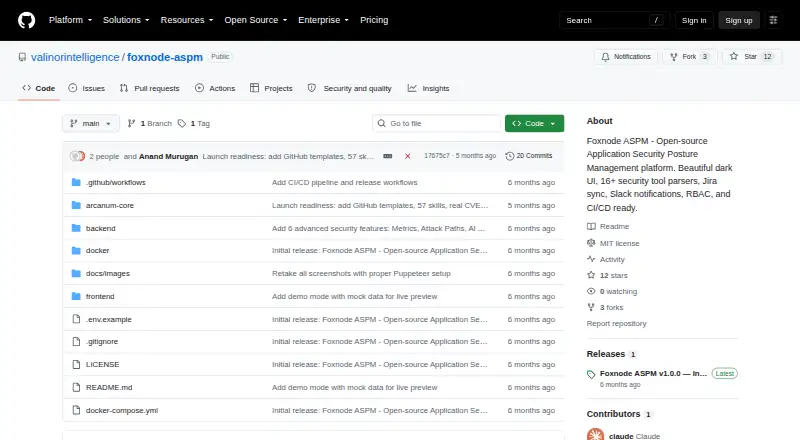
What Foxnode ASPM is
Foxnode ASPM is an open-source platform for managing application-security vulnerabilities across a software portfolio. It gathers findings from more than 16 scanners, removes duplicates, and provides dashboard views of severity, scanner mix, risk trends, and vulnerable products. Built-in parsers cover tools such as Semgrep, Trivy, Snyk, ZAP, Nuclei, Gitleaks, Bandit, Checkov, SonarQube, and Prowler; scan results can also be imported in JSON, CSV, XML, JSONL, and SARIF formats. Jira integration supports issue creation and status synchronization, while Slack can receive alerts. Analysis features include AI-assisted triage, attack-path analysis, an AI security agent, remediation recommendations, and an LLM/AI scanner for issues such as prompt injection and data poisoning. Findings can be mapped to OWASP Top 10, PCI-DSS, SOC 2, CIS Benchmarks, and ISO 27001, with gap analysis. Its SBOM feature covers component inventory, license tracking, and supply-chain risk scoring. Deployment supports Docker Compose, and a REST API enables CI/CD integration. The project uses the MIT License.
Good
- Aggregates and deduplicates findings from 16+ scanners.
- Integrates with Jira and Slack.
- Includes compliance mapping and gap analysis.
- SBOM features cover components, licenses, and supply-chain risk.
- Released under the MIT License.
Watch out
- Self-hosted deployment is listed.
- Local development requires Python 3.12+, Node.js 20+, PostgreSQL 16+, and Redis 7+.
Who it suits
Foxnode ASPM suits teams that need to consolidate security scan results across a software portfolio and connect findings to development workflows. It is aimed at users comfortable with self-hosted deployment and its listed development prerequisites.
Verdict
Foxnode ASPM centralizes scanner findings and adds workflow integrations, compliance mapping, and SBOM features. Its self-hosted deployment and listed technical requirements are relevant considerations for teams evaluating it.
The facts
Each one read from Foxnode ASPM's own pages, with the date it was checked.
What it does
- Access control
- Role-based access control provides Admin, Manager, Analyst, and Viewer roles with granular permissions.checked 2 Oct 2026
- AI and ML scanning
- The LLM/AI scanner detects issues including prompt injection and data poisoning, mapped to the OWASP LLM Top 10.checked 2 Oct 2026
- AI capabilities
- Features include AI finding triage, an AI security agent, AI remediation recommendations, and an LLM/AI security scanner.checked 1 Oct 2026
- API
- A REST API supports CI/CD pipeline integration and scan-result imports.checked 1 Oct 2026
- Compliance
- Compliance mapping covers OWASP Top 10, PCI-DSS, SOC 2, CIS Benchmarks, and ISO 27001.checked 1 Oct 2026
- Contributor support
- The project welcomes contributions and provides contribution steps including running backend pytest tests.checked 1 Oct 2026
- Dashboards
- The dashboard reports severity distribution, scanner breakdown, risk trends, and vulnerable products.checked 2 Oct 2026
- Deduplication
- Hash-based deduplication prevents duplicate findings across scans.checked 2 Oct 2026
- Deployment
- The recommended deployment uses Docker Compose, with nginx and GitHub Actions included in the stack.checked 1 Oct 2026
- Deployment and API
- The project supports Docker Compose deployment and provides a REST API for CI/CD pipeline integration.checked 2 Oct 2026
- Integrations
- Jira integration can create issues from findings with mapped severity, labels, and bidirectional status sync; Slack sends configurable alerts for findings and scan completions.checked 2 Oct 2026
- License
- The repository states that FoxNode ASPM is released under the MIT License.checked 2 Oct 2026
- Product
- FoxNode ASPM is an open-source platform for managing application security vulnerabilities across a software portfolio.checked 2 Oct 2026
- Product purpose
- FoxNode ASPM manages application security vulnerabilities across a software portfolio.checked 1 Oct 2026
- Requirements
- The listed local-development prerequisites are Python 3.12+, Node.js 20+, PostgreSQL 16+, and Redis 7+.checked 2 Oct 2026
- Scanner aggregation
- It aggregates findings from 16+ security scanners and deduplicates them.checked 1 Oct 2026
- Scanner imports
- It includes 16 built-in parsers and accepts scan results in JSON, CSV, XML, JSONL, and SARIF formats.checked 2 Oct 2026
- Scanner support
- Built-in parsers cover Semgrep, Trivy, Snyk, ZAP, Nuclei, Gitleaks, Bandit, Checkov, SonarQube, Prowler, tfsec, TruffleHog, OWASP Dependency-Check, SARIF, and generic JSON/CSV tools.checked 1 Oct 2026
- Security analysis
- Features include AI finding triage, attack-path analysis, an AI security agent, and AI remediation recommendations.checked 2 Oct 2026
- Supply chain
- The SBOM feature provides component inventory, license tracking, and supply-chain risk scoring.checked 2 Oct 2026
- Technical requirements
- Local development requires Python 3.12+, Node.js 20+, PostgreSQL 16+, and Redis 7+.checked 1 Oct 2026
Where it runs
- Compliance mapping
- Findings can be mapped to OWASP Top 10, PCI-DSS, SOC 2, CIS Benchmarks, and ISO 27001 with gap analysis.checked 2 Oct 2026
The full review of Foxnode ASPM
Foxnode ASPM is an open-source application security platform for teams bringing security findings together across a software portfolio. It suits organizations that can operate a self-hosted stack and want scanner aggregation alongside remediation workflows and compliance mapping. Its strongest case is breadth in one platform; teams seeking a managed service should look elsewhere.
Overview
Foxnode ASPM collects results from more than 16 security scanners, correlates findings, and uses hash-based deduplication to reduce repeated issues across scans. Its dashboard gives teams a portfolio-level view of severity, scanner coverage, risk trends, and vulnerable products, making it easier to prioritize work than reviewing each scanner in isolation.
Beyond aggregation, the platform connects findings to remediation workflows, attack-path analysis, and risk prioritization. That combination is useful for security teams managing multiple products, though its self-hosted deployment means the team must take responsibility for running the application and its supporting services.
Key features
- Scanner imports: Built-in parsers cover tools including Semgrep, Trivy, Snyk, ZAP, Nuclei, Gitleaks, Bandit, Checkov, SonarQube, Prowler, tfsec, TruffleHog, and OWASP Dependency-Check. It also accepts SARIF and generic scanner data, with JSON, CSV, XML, and JSONL import formats. That range helps teams consolidate varied tooling without replacing their scanners.
- Finding analysis: Correlation, prioritization, and attack-path analysis help teams focus on risk rather than raw alert counts. Hash-based deduplication cuts down on duplicate findings across scans.
- AI assistance: AI finding triage, remediation recommendations, and an AI security agent support investigation and response. Its LLM/AI scanner targets issues such as prompt injection and data poisoning, with findings mapped to the OWASP LLM Top 10. These features broaden the platform's scope, but teams should choose it for their overall workflow fit rather than assuming automated suggestions remove the need for security review.
- Compliance and supply chain: Findings map to OWASP Top 10, PCI-DSS, SOC 2, CIS Benchmarks, and ISO 27001, with gap analysis. SBOM features provide component inventory, license tracking, and supply-chain risk scoring.
- Workflow and access: Jira integration supports issue creation and status synchronization; Slack sends alerts. Role-based access distinguishes Admin, Manager, Analyst, and Viewer responsibilities.
- Integration and deployment: A REST API supports CI/CD integration and scan-result imports. Docker Compose is the recommended deployment, with nginx and GitHub Actions included in the stack.
Pricing
Foxnode ASPM is free under the MIT License, with no paid tiers or seat and usage caps specified. That makes it attractive for teams able to host and maintain their own instance. The trade-off is operational: local development calls for Python 3.12+, Node.js 20+, PostgreSQL 16+, and Redis 7+, and the recommended deployment uses Docker Compose. Teams looking for a hosted service or vendor support should compare alternatives.
Platforms
Foxnode ASPM is available as a web application, API, and Linux and self-hosted deployment. Its API and CI/CD support suit engineering workflows, while self-hosting gives teams control over deployment at the cost of operating the stack themselves.
Who it's for
Security and engineering teams with findings spread across multiple scanners are the best fit, particularly those that need portfolio visibility, compliance mapping, SBOM analysis, and Jira-based remediation. It is less suitable for organizations that need a managed deployment or cannot support its underlying services.
Pros and cons
- Pro: Broad scanner parsing and multiple import formats let teams centralize existing tools rather than standardize on one scanner.
- Pro: Deduplication, risk analysis, and workflow integrations connect discovery to prioritization and remediation.
- Pro: Compliance gap analysis and SBOM inventory add governance and supply-chain views alongside vulnerability tracking.
- Con: Self-hosting and the stated development prerequisites make operation a meaningful commitment, especially for smaller teams without platform capacity.
- Con: Its free, open-source model does not provide a paid hosted tier for organizations that prefer a vendor-operated service.
Alternatives
Application Security Posture Management Software is the broader category directory for comparing options.
- Conviso Platform is worth considering for teams that want a freemium alternative with a free plan capped at 5 contributing developers, 5 assets, 10 users, and 2 integrations.
- Ivanti Neurons for Zero Trust Access is a paid alternative with broad platform coverage, including mobile and desktop operating systems; its named-user SaaS licensing may suit teams prioritizing that deployment model.
- OWASP DefectDojo offers a free-forever Community Edition and a paid Pay As You Go option, making it an alternative for teams comparing open-source and paid paths.
- Phoenix Security has a free plan capped at 1,000 assets and 2 premium users plus guests, a fit for teams whose needs fall within those limits.
- SecurStack offers a free plan with 500 scan credits per month, 3 users, and 10 projects, including SAST, SCA, and secrets scanning.
- Strobes ASPM provides a free plan capped at 100 assets, 500 tasks per month, and 1 connector, for teams whose initial workload fits those limits.
- OX Security is a paid option spanning code, dependencies, secrets, SBOM, infrastructure as code, CI/CD, containers, and IDE and CLI scanning.
- Veracode Risk Manager is another paid alternative for teams evaluating a commercial risk-management product.
Verdict
Choose Foxnode ASPM if your team needs a free, self-hosted hub for scanner findings, risk analysis, compliance mapping, and SBOM work—and can operate the required stack. Its breadth and workflow links are compelling for that profile. Look elsewhere if you need a managed service or want to avoid owning deployment and maintenance.
Alternatives to Foxnode ASPM
- 1

OWASP DefectDojo
Free planOpen sourceWebAPILinuxSelf-hosted8.0$100 usage-based - 2

Strobes ASPM
Free planWebAPILinuxmacOS7.8From $29,000 a year - 3
OX Security
Free planWebAPIExtensionLinux7.4Free plan - 4

Conviso Platform
Free planWebAPI7.3From $19 a month - 5

Phoenix Security
Free planWebAPI7.2From £1,495 a month - 6

Arnica Secrets Security
Free planWebAPISelf-hosted6.6From $300 a year