ScanDog
ScanDog is cloud software for application security posture management, available through a web interface and API.
What ScanDog is
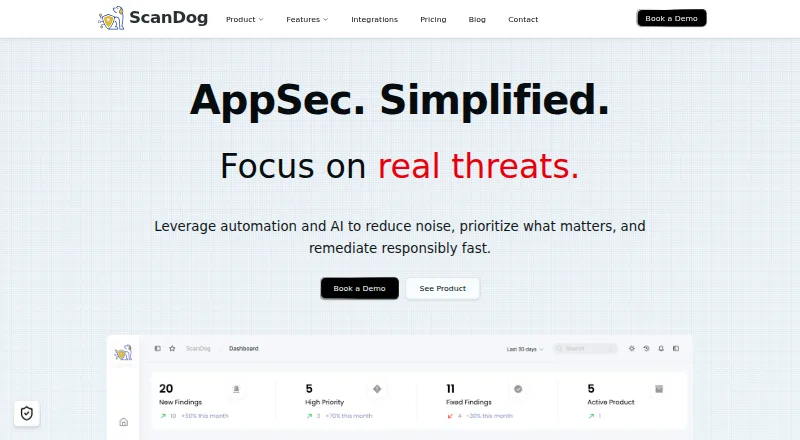
ScanDog is cloud software for application security posture management, available through a web interface and API. It brings security findings together and turns them into recommendations that account for application context. Coverage includes SAST, SCA, DAST, infrastructure-as-code, secret and container scanning, plus SBOM management. Findings can be deduplicated and ranked with EPSS, KEV, exploitability, reachability and business impact. The platform supports remediation workflows, policy gates and ticketing synchronization. Its AI remediation can suggest minimal code changes and safe refactors intended to preserve existing behavior and tests. ScanDog says AI processing uses only narrow snippets around an issue rather than the full codebase. Integrations listed include GitHub, GitLab, Azure DevOps, Jira, Linear, Slack and Microsoft Teams, along with Snyk, Semgrep, Trivy and OWASP ZAP. Exportable audit reports and compliance mapping are listed. Google Chat notifications for pull requests and findings are marked coming soon. ScanDog is located in Berlin, Germany.
Good
- Covers SAST, SCA, DAST, IaC, secrets, containers and SBOMs
- Prioritizes findings with exploitability and business-impact signals
- AI remediation proposes minimal diffs and safe refactors
- Supports deduplication, workflows, policy gates and ticketing sync
- Integrates with major repositories, ticketing tools and scanners
- Available through web and API
Watch out
- Free plan is limited to 3 products and 10 workflows
- Free plan allows 2 users and 30 AI fixes monthly
- Google Chat notifications are still marked coming soon
Who it suits
The Free plan is aimed at individual developers, security enthusiasts and IT professionals who need security finding management. Team is described for growing security teams in mid-sized organizations. It also suits teams already using the listed source-control, ticketing, communication or scanning integrations.
Verdict
Pick ScanDog if you need one application-security view across multiple scanning methods, with risk-based prioritization and remediation workflows. The Free plan provides a small starting allowance, while Team expands products, workflows, users and AI fixes. Look elsewhere if Google Chat notifications are required now or if you need an Enterprise price before contacting the vendor.
Plans and prices
From ScanDog's own pricing page, checked 29 Sep 2026.
| Plan | Price | What it gives you |
|---|---|---|
| Free | Free | 3 products · 10 workflows · 2 users · 30 AI fixes/month |
| Team | €19 a month | Up to 10 products · 200 workflows · Up to 30 users · 200 AI fixes/month · Bill annually |
| Enterprise | Priced on request | Unlimited products · unlimited workflows · unlimited users · unlimited AI fixes/month |
The facts
Each one read from ScanDog's own pages, with the date it was checked.
What it does
- AI data handling
- When AI is used, ScanDog says it receives only narrow snippets around an issue and never the full codebase.checked 29 Sep 2026
- AI remediation
- AI remediation provides minimal diffs and safe refactors intended to preserve behavior and tests.checked 29 Sep 2026
- Compliance
- The product page lists exportable audit reports and compliance mapping, and the site footer displays a GDPR compliant badge.checked 29 Sep 2026
- Google Chat status
- Google Chat notifications for pull requests and findings are marked coming soon.checked 29 Sep 2026
- Integrations
- Listed integrations include GitHub, GitLab, Azure DevOps, Jira, Linear, Slack, Microsoft Teams, and scanners such as Snyk, Semgrep, Trivy, and OWASP ZAP.checked 29 Sep 2026
- Location
- The contact page lists ScanDog's location as Berlin, Germany.checked 29 Sep 2026
- Prioritization
- It prioritizes findings using EPSS, KEV, exploitability, reachability, and business impact.checked 29 Sep 2026
- Product
- ScanDog orchestrates security findings into context-aware recommendations for application security posture management.checked 29 Sep 2026
- Published limits
- Free is limited to 3 products, 10 workflows, 2 users, and 30 AI fixes per month; Team lists up to 10 products, 200 workflows, up to 30 users, and 200 AI fixes per month.checked 29 Sep 2026
- Security coverage
- The platform covers SAST, SCA, DAST, IaC scanning, secret scanning, container scanning, and SBOM management.checked 29 Sep 2026
- Support
- The pricing page lists email support for Free and Team and dedicated support only for Enterprise.checked 29 Sep 2026
- Who it is for
- The Free plan is described for individual developers, security enthusiasts, and IT professionals, while Team is described for growing security teams in mid-sized organizations.checked 29 Sep 2026
The company
- Headquarters
- Berlin, Germanychecked 23 Sep 2026
The full review of ScanDog
ScanDog is a cloud application-security posture management service that unifies findings from many scanning methods and turns them into prioritized work. It suits developers and security teams responsible for several products, especially those that need risk context rather than separate alert queues. Its broad coverage and workflow tooling are compelling, but the smaller plans impose firm limits on products, workflows, users, and AI fixes.
Overview
ScanDog covers static analysis (SAST), software-composition analysis (SCA), dynamic testing (DAST), infrastructure-as-code, secrets, containers, and software-bill-of-materials (SBOM) management. Finding deduplication helps reduce repeated alerts, while policy gates, ticketing synchronization, and remediation workflows connect detection with the work of fixing it.
Prioritization uses EPSS, KEV status, exploitability, reachability, and business impact. That combination is more useful than severity alone: a theoretically serious issue with no reachable path can fall behind an exploitable, business-critical finding. Teams still need to set appropriate business context, but the signals provide a stronger basis for triage.
ScanDog is cloud-based and lists Berlin, Germany as its location. Exportable audit reports, compliance mapping, and a GDPR-compliant badge support organizations that need security activity documented for audits.
Key features
- One view across scanners: Integrations include GitHub, GitLab, Azure DevOps, Jira, Linear, Slack, Microsoft Teams, Snyk, Semgrep, Trivy, and OWASP ZAP. This breadth can consolidate an existing toolchain instead of forcing a single scanner choice.
- Risk-aware triage: EPSS, KEV, exploitability, reachability, and business impact make prioritization AI-assisted and context-sensitive. It is most valuable where alert volume makes severity-only queues impractical.
- Remediation workflows: Deduplication, policy gates, ticketing sync, and workflow support help move findings into ownership and follow-up rather than leaving them in a dashboard.
- AI fixes with a stated boundary: AI remediation proposes minimal diffs and safe refactors intended to preserve behavior and tests. ScanDog says it receives only narrow issue snippets, never the full codebase, when AI is used. The approach may reassure teams cautious about code exposure, although the monthly fix quotas constrain heavy use.
- Notification gap: Google Chat notifications for pull requests and findings are coming soon, so organizations that depend on Google Chat cannot treat it as a current integration.
Pricing
ScanDog uses a freemium model. The Free plan costs 0.00 EUR and includes three products, 10 workflows, two users, and 30 AI fixes per month, with email support. It is aimed at individual developers, security enthusiasts, and IT professionals. Those caps make it a sensible evaluation or small-project tier, but not a broad multi-team rollout.
Team costs €19 per user per month, billed annually. It raises capacity to up to 10 products, 200 workflows, up to 30 users, and 200 AI fixes per month, with email support. Growing security teams in mid-sized organizations get substantially more room for shared processes, though annual billing and per-user pricing matter as membership expands.
Enterprise has custom pricing and removes the published ceilings: unlimited products, workflows, users, and AI fixes per month, with dedicated support. It is the appropriate route for larger programs, but buyers must contact ScanDog to establish cost and terms.
Platforms
ScanDog is delivered through a web interface and API. Its cloud deployment favors centralized teams and integrations rather than an on-device or self-hosted operating model.
Who it's for
Choose ScanDog when one security program spans code, dependencies, live applications, infrastructure, secrets, containers, and SBOMs, and needs risk-based queues plus ticketing and policy controls. Free fits a small individual or pilot deployment; Team fits a growing security group coordinating multiple products. Organizations requiring self-hosting, Google Chat today, or predictable Enterprise pricing should consider other options.
Pros and cons
Pros
- Broad coverage: Seven major scanning and inventory areas reduce the need to manage disconnected security views.
- Useful prioritization signals: Reachability, exploitation indicators, and business impact can focus limited remediation capacity.
- Workflow integration: Policy gates, deduplication, ticketing, and collaboration integrations support operational follow-through.
- Bounded AI input: Narrow snippets rather than the full codebase is a clear data-handling boundary for AI-assisted fixes.
Cons
- Strict Free limits: Three products, 10 workflows, two users, and 30 AI fixes monthly leave little headroom beyond a small deployment.
- Annual Team billing: The €19 per-user monthly rate is tied to annual billing, which reduces flexibility for short commitments.
- Google Chat is not ready: Notifications remain forthcoming, excluding a required channel for now.
- Enterprise requires contact: No published Enterprise price makes budgeting harder for larger buyers.
Alternatives
ArcherySec is the better choice for teams wanting a free, GPL-3.0-licensed, self-hosted deployment across API, web, and desktop/server platforms.
OWASP DefectDojo suits organizations seeking an open-source community edition with free-forever terms and support through OWASP Slack and GitHub.
Conviso Platform is worth considering when a free tier capped at five contributing developers, five assets, 10 users, and two integrations matches the rollout.
Strobes ASPM fits teams that prefer a free plan for up to 100 assets and 500 tasks per month, with ASM, RBVM, ASPM, and one connector.
Harness Security Testing Orchestration is a web-based paid option with Harness Open Source, Litmus Chaos, and community support in its free plan.
OX Security is a paid alternative offering SAST, SCA, secrets/PII, SBOM, IaC, CI/CD, container scanning, and IDE and CLI coverage.
Vulnetix Resolve is a paid option for teams needing Linux, macOS, Windows, and web support.
PointGuard AI is another paid, web-based alternative.
Verdict
ScanDog is a strong fit for developers and security teams that want one cloud workflow for diverse application-security findings, with prioritization grounded in exploitability, reachability, and business impact. Its main reason to choose it is the combination of broad scanner coverage, workflow controls, and bounded AI remediation. Look elsewhere if your deployment needs self-hosting, Google Chat notifications immediately, or a firm Enterprise price before a sales conversation.
Getting started
- Open the ScanDog website
- Choose the Free, Team or Enterprise plan
- Use the web interface or API
- Connect repositories, ticketing, communication and scanner integrations
- Configure workflows, policy gates and remediation processes
Limits worth knowing
Free includes 3 products, 10 workflows, 2 users and 30 AI fixes per month. Team includes up to 10 products, 200 workflows, up to 30 users and 200 AI fixes per month; Enterprise lists unlimited quantities.
Questions
Is ScanDog free?
Yes. The Free plan costs nothing and includes limited products, workflows, users and monthly AI fixes.
How much does Team cost?
Team costs €19 a month, billed annually. The pricing note states €19/user/mo (annual).
Which platforms does ScanDog support?
ScanDog is available through web and API.
What security tools integrate with ScanDog?
Listed scanner integrations include Snyk, Semgrep, Trivy and OWASP ZAP. Repository, ticketing and communication integrations include GitHub, GitLab, Azure DevOps, Jira, Linear, Slack and Microsoft Teams.
Does ScanDog use the full codebase for AI?
ScanDog says AI receives only narrow snippets around an issue and never the full codebase.
Alternatives to ScanDog
- 1
OWASP DefectDojo
Free planOpen sourceWebAPILinuxSelf-hosted8.0$100 usage-based - 2

Strobes ASPM
Free planWebAPILinuxmacOS7.8From $29,000 a year - 3
OX Security
Free planWebAPIExtensionLinux7.4Free plan - 4

Conviso Platform
Free planWebAPI7.3From $19 a month - 5

ArcherySec
Free planWebAPILinuxmacOS6.7Free plan - 6

Invicti
WebAPISelf-hosted6.3$500 one-time