
Harness Security Testing Orchestration
Harness Security Testing Orchestration is a cloud-based web service for coordinating application security testing.
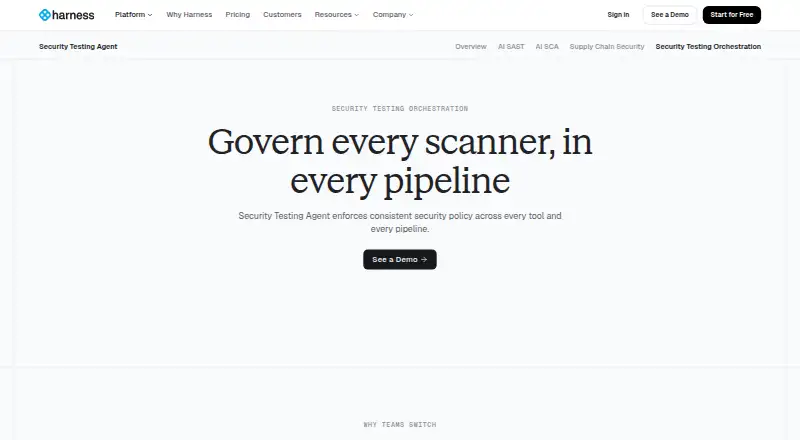
What Harness Security Testing Orchestration is
Harness Security Testing Orchestration is a cloud-based web service for coordinating application security testing. It brings security findings together and supports deduplication, risk-based prioritization, remediation workflows, policy gates, and ticketing sync. These capabilities give teams ways to organize findings and connect them to remediation and workflow controls. Harness lists Essentials and Enterprise plans, both billed through Contact Sales, with pricing on request. Essentials covers up to 500 users, one organization, and five custom dashboards. Enterprise allows unlimited users, organizations, and custom dashboards. The listed pricing model is paid, and there is no free plan. A separate Free Plan is listed as free and includes Harness Open Source, Litmus Chaos, and community support. Harness was founded in 2017 and is headquartered in San Francisco, California. The product is deployed in the cloud and accessed on the web. Teams can consider the listed finding-management and remediation capabilities alongside the plan limits and contact-sales pricing.
Good
- Deduplicates security findings.
- Prioritizes findings by risk.
- Includes remediation workflows and policy gates.
- Synchronizes with ticketing.
- Enterprise allows unlimited users and organizations.
Watch out
- No free plan is listed.
- Essentials is limited to one organization.
- Essentials allows up to five custom dashboards.
- Pricing for Essentials and Enterprise is on request.
Who it suits
It suits teams coordinating application security testing who need finding deduplication, risk prioritization, remediation workflows, policy gates, or ticketing sync. Organizations can assess Essentials' user, organization, and dashboard limits against their needs.
Verdict
Harness Security Testing Orchestration brings several security testing coordination functions into a cloud service. Essentials has defined user and dashboard limits, while Enterprise lists unlimited capacity and pricing requires contacting sales.
Plans and prices
From Harness Security Testing Orchestration's own pricing page, checked 22 Sep 2001.
| Plan | Price | What it gives you |
|---|---|---|
| Free Plan | Free | Harness Open Source included · Litmus Chaos included · Community support |
| Essentials Plan | Priced on request | Up to 500 users · Up to 1 organization · Up to 5 custom dashboards · Contact Sales |
| Enterprise Plan | Priced on request | Unlimited users · Unlimited organizations · Unlimited custom dashboards · Contact Sales |
The facts
Each one read from Harness Security Testing Orchestration's own pages, with the date it was checked.
The company
- Founded
- 2017checked 23 Sep 2001
- Headquarters
- San Francisco, California, United Stateschecked 23 Sep 2001
The full review of Harness Security Testing Orchestration
Harness Security Testing Orchestration is a cloud service for coordinating application-security findings and the work required to resolve them. It fits security and development organizations that need risk-based decisions, ticket handoffs, and enforceable policy controls in one workflow. Teams wanting transparent, self-serve pricing or a self-hosted deployment should look elsewhere.
Overview
Harness combines finding deduplication, risk-based prioritization, remediation workflows, ticketing synchronization, and policy gates. In practice, deduplication keeps repeated scanner results from obscuring the queue, while risk-based ordering helps teams focus effort where exposure matters most. Remediation workflows and ticket sync connect findings to assigned work, and policy gates provide a decision point for controlling whether security requirements are met.
The cloud deployment removes the need to operate the service yourself, but it also makes Harness a hosted choice rather than a self-hosted one. Its value is greatest when application security must stay connected to development and release processes; a team that only needs a basic findings repository may not need this broader coordination layer.
Key features
Finding management
Finding deduplication reduces duplicate entries competing for attention. Risk-based prioritization gives teams a practical way to rank remediation instead of treating every issue as equally urgent.
Remediation and controls
Remediation workflows support the transition from identification to action, while ticketing sync helps carry that work into an existing ticket process. Policy gates add enforcement, making the platform more suitable for organizations that require security checks to influence delivery decisions rather than remain advisory.
These capabilities form a coordinated workflow rather than a standalone scanner. The trade-off is commercial and operational: capacity is defined by plan limits, and moving beyond those limits requires a sales conversation.
Pricing
Free Plan
The Free Plan costs nothing and includes Harness Open Source, Litmus Chaos, and community support. It is the only zero-cost tier, but its stated inclusions do not describe the paid orchestration capacity offered by the higher plans, so organizations evaluating full workflow needs should not assume it is an equivalent substitute.
Essentials Plan
Essentials has custom pricing and is billed through Contact Sales. It supports up to 500 users, one organization, and five custom dashboards. That profile suits a single-organization team with a defined operating scale. The user, organization, and dashboard ceilings matter for companies with multiple business units or extensive reporting requirements.
Enterprise Plan
Enterprise also uses custom pricing through Contact Sales, with unlimited users, organizations, and custom dashboards. It is the logical fit for larger or decentralized organizations that would outgrow Essentials’ caps. The lack of a published price means budgeting requires vendor engagement before purchase.
There is no free plan for the paid product itself, and no published renewal term or trial period is provided. Buyers should therefore compare the operational value of the workflow features with the effort of a sales-led purchase.
Platforms
Harness Security Testing Orchestration is delivered on the web as a cloud service. It is suited to browser-based, shared access rather than a locally installed or self-hosted deployment.
Who it's for
Choose Harness when security, engineering, and release teams need one process for deduplicating findings, ranking risk, assigning remediation, synchronizing tickets, and enforcing policy gates. Essentials is aimed at organizations that can work within one organization and five dashboards; Enterprise is better for unlimited organizational and reporting scope.
It is a weaker match for individuals and small teams that need a clearly posted price, a free product tier with the full feature set, or control over hosting. Those buyers may prefer a free or freemium alternative with explicit limits.
Pros and cons
- Pro: Deduplication and risk-based prioritization focus attention on distinct, higher-risk work.
- Pro: Remediation workflows and ticketing sync connect findings to accountable follow-through.
- Pro: Policy gates support enforceable security controls in delivery processes.
- Pro: Enterprise removes user, organization, and custom-dashboard ceilings.
- Con: Essentials is capped at 500 users, one organization, and five custom dashboards.
- Con: Paid tiers have custom pricing, making cost comparison and self-serve adoption difficult.
- Con: The cloud-only model does not serve teams requiring self-hosted deployment.
Alternatives
Browse the Application Security Orchestration Platforms list for more options.
ArcherySec is the better choice when free, GPL-3.0 open-source software and self-hosting matter more than a paid cloud service.
OWASP DefectDojo suits teams wanting a free-forever Community Edition, OWASP community support, and web, API, Linux, or self-hosted access.
ScanDog is worth choosing when a freemium model with explicit product, workflow, user, and AI-fix allowances is preferable.
Conviso Platform fits teams seeking a freemium service with stated developer, asset, user, and integration limits.
Strobes ASPM offers a free tier with asset and monthly-task caps plus a free trial, making it an alternative for teams testing a freemium ASPM workflow.
OX Security is an alternative paid platform with web, API, desktop, extension, and self-hosted access and a broad OX Code feature set.
Vulnetix Resolve is another paid option for teams comparing security software across Linux, macOS, web, and Windows.
PointGuard AI is a paid web-based alternative.
Verdict
Harness Security Testing Orchestration is a strong fit for organizations that need security findings tied to risk decisions, remediation ownership, tickets, and policy enforcement in a managed cloud workflow. Choose it when that coordination is worth a sales-led purchase and, for Essentials, the stated capacity limits. Look elsewhere if transparent pricing, a full free tier, or self-hosting is a primary requirement.
Alternatives to Harness Security Testing Orchestration
- 1

Strobes ASPM
Free planWebAPILinuxmacOS7.8From $2,416.67 a month - 2
OX Security
Free planWebAPIExtensionLinux7.4Free plan - 3
OWASP DefectDojo
Free planWebAPILinuxSelf-hosted6.8From $100 a month - 4

ArcherySec
Free planWebAPILinuxmacOS6.7Free plan - 5

Conviso Platform
Free planWebAPI6.7From $19 a month - 6

apPosture API Security
WebAPILinuxSelf-hosted6.5From $2.92 a month