speedRecon
speedRecon is web-based bank reconciliation software for comparing accounting records with bank records, reviewing unmatched transactions and completing reco…
What speedRecon is
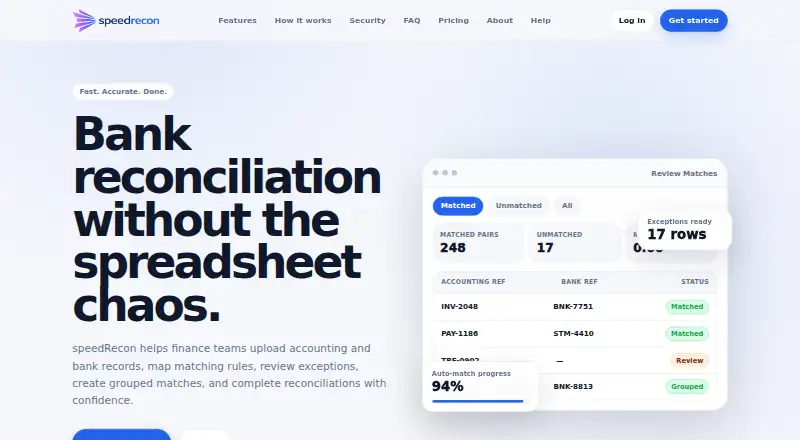
speedRecon is web-based bank reconciliation software for comparing accounting records with bank records, reviewing unmatched transactions and completing reconciliation statements. Users upload accounting and bank data from CSV or Excel files; the service does not connect directly to banks at launch. Matching rules can use references, dates, amounts, text, tolerances and case sensitivity, while manual grouped matching handles one-to-many and many-to-many transactions. An activity timeline records reviews, grouped matches and completion details. Company workspaces separate reconciliations, uploaded files, collaborators and related records, with role-aware access. HTTPS encrypts information in transit, new accounts require email verification, and two-factor authentication is available on supported plans. A free plan provides up to three reconciliations per month and files up to 300 rows. Premium costs 299 GHS a month and allows up to 30 reconciliations; Enterprise costs 499 GHS a month and allows up to 80. The service is intended for SMEs, accountants, finance departments and other organizations.
Good
- Imports CSV and Excel accounting and bank records.
- Rules can match on dates, amounts and references.
- Supports grouped one-to-many and many-to-many matches.
- Timeline records review and completion activity.
- Free plan includes three monthly reconciliations.
Watch out
- No direct bank connection at launch.
- Free plan limits files to 300 rows.
- Free plan retains files for 30 days.
Who it suits
speedRecon suits SMEs, accountants, finance teams, schools, churches, NGOs and growing businesses that reconcile uploaded bank and accounting exports. It may fit teams that need workspace separation and a recorded review trail.
Verdict
speedRecon offers rule-based matching and grouped review for reconciliation work based on uploaded exports. Its lack of direct bank connections and plan-specific reconciliation and row caps are important considerations.
Plans and prices
From speedRecon's own pricing page, checked 15 Oct 2026.
| Plan | Price | What it gives you |
|---|---|---|
| Free forever | Free | single user · 3 reconciliations/month · 300 rows/file · basic security · single-workspace review · 30-day retention · GHS 0 / month |
| Premium | 299 GHS a month | up to 3 users · 30 reconciliations/month · 800 rows/file · 2FA availability · single-workspace review · 90-day retention · GHS 299 / month; GHS 3,399 billed annually |
| Enterprise | 499 GHS a month | up to 8 users · 80 reconciliations/month · 2,000 rows/file · 2FA availability · team collaboration · 180-day retention · GHS 499 / month; GHS 5,499 billed annually |
The facts
Each one read from speedRecon's own pages, with the date it was checked.
What it does
- Access roles
- Owners and invited collaborators can receive different access treatment.checked 15 Oct 2026
- Account verification
- New account registration requires email verification.checked 30 Sep 2026
- Audit timeline
- The product records reconciliation activity, completion events, restored rows, manual matches, and reviewer actions.checked 15 Oct 2026
- Audit trail
- The service records timeline activity, review actions, grouped matches, and completion records.checked 30 Sep 2026
- Automatic matching
- The matching engine produces matched pairs, grouped matches, and unmatched accounting or bank rows for review.checked 15 Oct 2026
- Bank integrations
- Direct bank connections are not available at launch; the workflow uses exported bank and accounting files.checked 15 Oct 2026
- Data handling
- The company says it does not intentionally store full card numbers or CVV codes in its systems.checked 30 Sep 2026
- Data-protection framework
- The DPA references Ghana's Data Protection Act, 2012 (Act 843).checked 15 Oct 2026
- File imports
- Users can import accounting and bank data in CSV or Excel formats.checked 15 Oct 2026
- Final statement
- Completed reconciliations show matched totals, grouped totals, unmatched balances, supporting detail, and reviewer actions.checked 15 Oct 2026
- Grouped matching
- Manual grouped matching supports one-to-many and many-to-many reconciliation cases.checked 15 Oct 2026
- Independent audience signal
- A LinkedIn SpeedRecon post displayed 254 followers when opened.checked 15 Oct 2026
- Independent launch signal
- A LinkedIn post shared by Prudent Corporate Solutions said SpeedRecon had launched about one week earlier and invited users to try it free.checked 15 Oct 2026
- Independent launch timing
- The SpeedRecon LinkedIn post was dated three months before the page was opened in October 2026.checked 15 Oct 2026
- Independent limit: variance visibility
- A LinkedIn commenter said the demonstration did not show a variance check and questioned opening or closing balance verification, anomaly detection, and failure explanations.checked 15 Oct 2026
- Independent positioning
- The LinkedIn company post positioned SpeedRecon as a replacement for spreadsheet reconciliation and emphasized automation and audit readiness.checked 15 Oct 2026
- Independent workflow observation
- The same LinkedIn discussion described ambiguous matches and the need for manual investigation when descriptions or amounts are similar.checked 15 Oct 2026
- Matching rules
- Rules can use references, dates, amounts, text, tolerances, case sensitivity, and combinations of criteria.checked 15 Oct 2026
- Payment-data handling
- The transparency statement says the company does not intentionally store full card numbers or CVV values in its application systems.checked 15 Oct 2026
The company
- Company headquarters
- The maker lists 432/13 Alwaleed Bin Talal Highway, Mamobi, Accra, Ghana.checked 15 Oct 2026
- Founded year
- No founded year is stated on the maker's About page or terms page.checked 15 Oct 2026
- Headquarters
- 432/13 Alwaleed Bin Talal Highway, Mamobi, Accra, Ghanachecked 28 Sep 2026
- Legal maker
- The service is operated by Vencha Investments Ltd.checked 15 Oct 2026
- Licence and ownership
- The terms state that the software, code, interfaces, workflows, designs, documentation, and related intellectual property belong to speedRecon and its licensors.checked 15 Oct 2026
The full review of speedRecon
speedRecon is a web-based reconciliation tool for teams that work from accounting and bank exports. It is best suited to small and growing organizations that want rule-based matching and a traceable review process. The workflow is deliberately file-based, so teams seeking direct bank feeds should look elsewhere.
Overview
Import accounting and bank records as CSV or Excel files, compare them, review unmatched transactions, create grouped matches and complete reconciliation statements. Rules can combine references, dates, amounts and text, with tolerances and case sensitivity to handle records that do not align exactly. One-to-many and many-to-many manual matching is useful when transactions cannot be paired individually, though those grouped matches require reviewer involvement.
The audit trail captures timeline activity, review actions, grouped matches and completion records. Exception workflows and approval controls support a more structured close. The central trade-off is that speedRecon does not connect directly to banks at launch: teams must obtain and upload their exports themselves.
Key features
- Configurable matching: Rules can combine transaction fields and tolerances, offering more control than a simple exact-match workflow.
- Grouped manual matches: One-to-many and many-to-many matching can resolve complex transaction groupings, but it is not a substitute for hands-off reconciliation.
- Review record: Timeline activity, review actions, grouped matches and completion records give teams an audit trail of the reconciliation process.
- Workspace and access controls: Company workspaces isolate reconciliations, uploaded files, collaborators and related records, with role-aware owner and collaborator access.
- Security: The production service uses HTTPS for information in transit; new accounts require email verification, and two-factor authentication is available on supported plans.
Payments may use card, mobile money or manually recorded company payments, depending on account setup, and may be processed by third parties such as Paystack. The company says it does not intentionally store full card numbers or CVV codes.
Pricing
The free plan, Free forever, costs nothing (billed GHS 0 / month). It allows one user, three reconciliations per month and 300 rows per file, with basic account security, a focused single-workspace review and 30-day file retention. It is a useful way for a solo user with light monthly volume to try the workflow, but the reconciliation and row caps make it a narrow fit for ongoing busy close cycles.
Premium costs 299 GHS a month (billed GHS 299 / month; GHS 3,399 billed annually). It supports up to three users, 30 reconciliations per month and 800 rows per file, with two-factor authentication availability, focused single-workspace review and 90-day file retention. This is the more practical tier for a small finance team handling regular reconciliations, though the single-workspace focus and finite monthly and per-file limits remain constraints.
Enterprise costs 499 GHS a month (billed GHS 499 / month; GHS 5,499 billed annually). It raises capacity to eight users, 80 reconciliations per month and 2,000 rows per file, and adds team collaboration support, with two-factor authentication availability and 180-day file retention. It better suits organizations that need shared work and longer access to files, but teams exceeding those caps will need another arrangement.
Platforms
speedRecon is available on the web. Its file-upload model suits teams already exporting bank and accounting records, but not those who require direct bank connections.
Who it's for
The product is intended for SMEs, accountants, finance departments, schools, churches, NGOs and growing businesses. It is most compelling where configurable matching, exception review and approval controls matter more than automated bank feeds. Customer support is available at [email protected].
Pros and cons
- Pros: Rules can account for multiple fields, tolerances and case sensitivity, helping with imperfect records.
- Pros: Grouped manual matching and a recorded review trail support reconciliation cases that need human judgment and a documented close.
- Cons: No direct bank connection at launch means exports must be sourced and uploaded by the team.
- Cons: Reconciliation, row, seat and retention limits differ by plan, which may restrict teams as volume or collaboration needs grow.
Alternatives
For a broader comparison, see Account Reconciliation Software.
- SahiSay Reconciliation is worth considering if you want Android, iOS, web and Windows access, or a free plan allowing five reconciliations per day and unlimited transactions per file.
- Settler may suit API or self-hosted use: its free open-source plan supports 10,000 monthly reconciliations and local evidence and replay traces.
- FIS Data Integrity Manager is another paid web option.
- OpenRecon is a free option for API or self-hosted use, with no paid tier and no account requirement.
- BankRecon is a paid web alternative with a free trial.
- Eko Recon is a free alternative for API, self-hosted, web or Windows environments.
- Reconify is a paid alternative with a free trial and support for API, desktop, web and self-hosted environments.
- OneCap is a paid web alternative with a free plan and a Starter tier for limited transaction volumes.
Verdict
Choose speedRecon if your organization reconciles exported records and needs configurable matching, grouped review and a documented approval process. Its strongest reason to buy is that combination of rule flexibility and traceable review; its clearest reason to look elsewhere is the absence of direct bank feeds, alongside plan caps that may constrain higher-volume teams.
Getting started
- Open https://speedrecon.com/ in a web browser
- Create an account and complete email verification
- Choose the Free forever, Premium, or Enterprise plan
- Upload accounting and bank records as CSV or Excel files
- Set matching rules using the available fields and tolerances
- Review unmatched items, create grouped matches, and complete the reconciliation
Limits worth knowing
The Free forever plan permits one user, three reconciliations per month, files up to 300 rows, basic account security, and 30-day file retention. Premium raises limits to three users, 30 reconciliations monthly, 800 rows per file, and 90-day retention; Enterprise supports eight users, 80 reconciliations, 2,000 rows, and 180-day retention.
Questions
What does speedRecon cost?
There is a free plan. Premium costs 299 GHS a month, and Enterprise costs 499 GHS a month; annual billing is listed for both paid plans.
Which platforms does speedRecon support?
speedRecon is available on the web.
Does it connect directly to banks?
No. Its workflow uses uploaded bank and accounting exports, such as CSV or Excel files.
How many users can paid plans support?
Premium supports up to three users. Enterprise supports up to eight users and includes team collaboration support.
What security controls are available?
HTTPS encrypts information in transit, email verification is required for new accounts, and two-factor authentication is available on supported plans.
Alternatives to speedRecon
- 1
Reconify
Open sourceWebAPILinuxmacOS7.6From $399 a month - 2
SahiSay Reconciliation
Free planAndroidiOSWebWindows7.3From ₹1,499 a month - 3

HighRadius
AndroidiOSWebAPI7.1 - 4

ReconArt
WebAPILinuxmacOS7.1From $300 a month - 5
Reconcile.ly
Web7.0From $90 a year - 6
Reiterate OS
WebAPI6.9From €19 a month