Settler
Settler is financial reconciliation software for finance teams that need consistent transaction matching and traceable review.
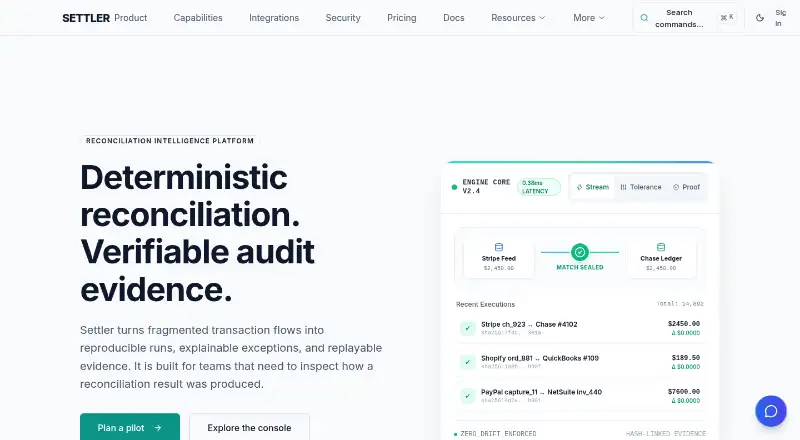
What Settler is
Settler is financial reconciliation software for finance teams that need consistent transaction matching and traceable review. Its rules-based engine applies configurable policies and field-level tolerances, producing repeatable results when given the same inputs. Reconciliation runs can generate linked hashes, provenance records, structured evidence and audit-ready export bundles. When exceptions arise, the system provides deterministic context and records operator decisions; any AI assistance is advisory, with final authority remaining with people.
The API supports tenant-scoped runs, evidence retrieval, replay and health checks. Listed adapters include Stripe, PayPal, Square, Shopify, QuickBooks, Xero, NetSuite, SAP, Plaid, TrueLayer and Chargebee, plus 14 more stated on the page. Settler is available as a self-hosted deployment using Docker Compose or Kubernetes, as well as through cloud and managed plans. The free, self-hosted Open Source plan is limited to 10,000 monthly reconciliations. Cloud API costs $99 a month, and Managed Operations costs $399 a month. Settler says it is not a compliance certification.
Good
- Rules and tolerances make matching repeatable.
- Runs can produce evidence bundles and provenance chains.
- Operator decisions are recorded for exception review.
- Docker Compose and Kubernetes deployment options are listed.
- Adapters include payment, accounting and commerce services.
Watch out
- Open Source is limited to 10,000 monthly reconciliations.
- Cloud API costs $99 a month.
- Managed Operations costs $399 a month.
- Settler is not a compliance certification.
Who it suits
Settler suits finance and risk teams that need repeatable reconciliation, reviewable exceptions and exportable evidence. Developers and administrators can also use its API and self-hosted deployment options.
Verdict
Settler brings reconciliation runs, exception decisions and audit evidence into one workflow, with both self-hosted and hosted options. Check plan limits and support levels against your volume and operational needs.
Plans and prices
From Settler's own pricing page, checked 3 Oct 2026.
| Plan | Price | What it gives you |
|---|---|---|
| Open Source | Free | 10,000 monthly reconciliations · self-hosted · local evidence and replay traces · community support |
| Cloud API | $99 a month | 100,000 monthly reconciliations · 1,000 exceptions in Cloud API baseline · multi-tenant cloud · hosted evidence · $99/mo |
| Managed Operations | $399 a month | 1,000,000+ monthly reconciliations · operator-assisted exceptions · monthly close evidence · business-hours SLA · $399+/mo |
| Enterprise Dedicated | Priced on request | Contractual reconciliation volume · dedicated, VPC, or on-prem deployment · custom retention · contractual SLA · Custom |
The facts
Each one read from Settler's own pages, with the date it was checked.
What it does
- API
- The API supports tenant-scoped reconciliation runs, evidence retrieval, replay, and health checks.checked 3 Oct 2026
- Audience
- Settler describes itself as API-first reconciliation infrastructure for finance teams and offers developer, operator, finance/risk, and InfoSec/admin workflows.checked 3 Oct 2026
- Audit controls
- The security page describes append-only audit records and SHA-256 evidence hash chains intended to make post-run modification detectable.checked 3 Oct 2026
- Audit evidence
- Runs can produce hash-linked manifests, provenance chains, structured evidence, and export-ready audit bundles.checked 3 Oct 2026
- Compliance
- Settler says it is not a compliance certification and describes audit export as compatible with SOC 2 evidence collection, alongside data residency and configurable retention controls.checked 3 Oct 2026
- Exception review
- Exceptions include deterministic context and auditable operator decisions; AI assistance is advisory and humans retain final authority.checked 3 Oct 2026
- Integrations
- Listed adapters include Stripe, PayPal, Square, Shopify, QuickBooks, Xero, NetSuite, SAP, Plaid, TrueLayer, and Chargebee, with 14 more stated on the page.checked 3 Oct 2026
- Matching
- Its rules-as-code engine uses configurable policies and field-level tolerances to produce repeatable results for the same inputs.checked 3 Oct 2026
- Purpose
- Settler provides deterministic financial reconciliation that turns transaction flows into reproducible runs, explainable exceptions, and replayable evidence.checked 3 Oct 2026
- Security
- The security page states that tenant data is partitioned at database, API, and runtime layers, with row-level PostgreSQL security and tenant-scoped API keys.checked 3 Oct 2026
- Self-hosting
- Settler offers Docker Compose and Kubernetes deployment targets, and says self-hosted mode has no telemetry by default and is Apache 2.0 licensed.checked 3 Oct 2026
- Support
- The pricing page lists Community support for Open Source, Email for Cloud API, and named operator plus escalation for Managed Operations.checked 3 Oct 2026
- Volume limits
- The comparison lists monthly reconciliation limits of 10,000 for Open Source, 100,000 for Cloud API, and 1,000,000+ for Managed Operations; Enterprise volume is contractual.checked 3 Oct 2026
The full review of Settler
Overview
Settler is reconciliation software for teams that need transaction matching to produce repeatable results and an evidence trail. It is best suited to finance and engineering groups building reconciliation into their own systems or operating it at substantial volume. Its strongest case is control over rules, replay and deployment; teams seeking a simple, ready-made web app may find it more infrastructure than they need.
Key features
Rules, exceptions and approvals
Settler applies configurable policies and field-level tolerances through a rules-as-code engine, making matching results repeatable for the same inputs. That is useful when finance and risk teams need a result they can explain and reproduce, rather than a one-off match. Exceptions carry deterministic context, and operator decisions are auditable; approval controls and exception workflows support review rather than leaving disputed items buried in a run. AI assistance is advisory, with humans retaining final authority, a sensible boundary for consequential financial decisions.
Evidence and replay
Runs can generate hash-linked manifests, provenance chains, structured evidence and export-ready audit bundles. The API supports tenant-scoped runs, evidence retrieval, replay and health checks, giving developers a way to integrate reconciliation and later inspect how a result was produced. Append-only audit records and SHA-256 evidence hash chains are intended to make post-run changes detectable. Settler says its audit exports can support SOC 2 evidence collection; it is not itself a compliance certification.
Integrations and security
Adapters include Stripe, PayPal, Square, Shopify, QuickBooks, Xero, NetSuite, SAP, Plaid, TrueLayer and Chargebee, with 14 more stated on the page. This is a broad starting set for payment, commerce and accounting flows, though teams should confirm their specific systems are covered. Tenant data is partitioned at database, API and runtime layers, with row-level PostgreSQL security and tenant-scoped API keys. Data residency and configurable retention controls are described alongside those safeguards.
Pricing
Settler has a free, open-source self-hosted tier and paid hosted and managed plans. The meaningful differences are monthly run capacity, deployment, evidence handling and support, not simply access to matching.
| Plan | Price | What it includes |
|---|---|---|
| Open Source | free | 10,000 monthly reconciliations, self-hosting, local evidence and replay traces, community support |
| Cloud API | $99 a month (billed $99/mo) | 100,000 monthly reconciliations, 1,000 exceptions in the Cloud API baseline, multi-tenant cloud and hosted evidence |
| Managed Operations | $399 a month (billed $399+/mo) | 1,000,000+ monthly reconciliations, operator-assisted exceptions, monthly close evidence and business-hours SLA |
| Enterprise Dedicated | Custom pricing | Contractual volume, dedicated, VPC or on-prem deployment, custom retention and contractual SLA |
Open Source is the clearest fit for teams able to deploy and support their own software: it preserves self-hosting and replay while capping volume at 10,000 monthly reconciliations and limiting support to the community. Cloud API raises that ceiling to 100,000 and moves evidence to hosted infrastructure for $99 a month, but its baseline includes 1,000 exceptions. Managed Operations costs $399 a month at the stated starting rate and is aimed at higher-volume teams that want operator help and a business-hours SLA; its 1,000,000+ monthly capacity is a different scale. Enterprise Dedicated is for contractual volume or deployment and retention requirements that do not fit those standard options. A free trial is offered, but its length and terms are not established here.
Platforms
Settler supports API, Linux, web and self-hosted use. Docker Compose and Kubernetes are deployment targets. Self-hosted mode has no telemetry by default and is licensed under Apache 2.0, which will matter to teams weighing operational control against hosted convenience.
Who it's for
Settler is aimed at finance teams that need reproducible reconciliation, with distinct developer, operator, finance/risk and InfoSec/admin workflows. It makes most sense when teams can make use of an API-first system, need traceable exception decisions, or have deployment and data-control requirements. Smaller organizations that only need occasional spreadsheet-style checks may not benefit from taking on reconciliation infrastructure.
Pros and cons
- Pros: Repeatable rules and field-level tolerances make matching outcomes explainable and replayable.
- Pros: Hash-linked evidence and auditable exception decisions support investigation and evidence collection without claiming certification.
- Pros: Self-hosting, hosted API and managed operations cover materially different deployment and support needs.
- Cons: The free tier requires self-hosting and stops at 10,000 monthly reconciliations, so it is not a no-operations hosted starter.
- Cons: Cloud API's 1,000-exception baseline may constrain teams whose review queues grow faster than run volume.
- Cons: Enterprise Dedicated has custom pricing, while higher-touch support begins with Managed Operations.
Alternatives
For a broader category comparison, browse Account Reconciliation Software. OneCap is another web option with a free plan and paid pricing; speedRecon may suit an individual looking for a free web workspace, though its free forever tier is capped at three reconciliations per month and 300 rows per file. FIS Data Integrity Manager is a paid web alternative without a free plan. SahiSay Reconciliation offers a free plan and web, Windows, iOS and Android platforms. BankRecon is a paid web option with a free trial; its Standard plan covers 1–3 entities, 3–10 bank accounts and up to about 10,000 transactions per month. Eko Recon is a free API, self-hosted, web and Windows alternative with pricing by quote. Reiterate OS is worth considering when invoice processing is the priority: its Mini plan is €19 a month per client and includes invoice gathering and accounting-agent chat. ReconArt is a paid option with API, self-hosted and web platforms, annual subscription billing and a stated 25 million transactions per year on Essentials.
Verdict
Settler is the right choice for finance and engineering teams that want reconciliation rules, exception decisions and replayable evidence under their control, especially when self-hosting or high-volume API workflows matter. The main reason to look elsewhere is operational simplicity: a small team that needs a conventional web tool rather than infrastructure may be better served by a narrower alternative. Choose Settler when traceability and deployment flexibility justify owning a more technical workflow.
Getting started
- Visit the Settler website.
- Choose the Open Source, Cloud API, Managed Operations, or Enterprise Dedicated plan.
- For self-hosting, use the Docker Compose or Kubernetes deployment target.
- Connect through the API or a listed adapter.
- Configure reconciliation policies and field-level tolerances.
Limits worth knowing
Open Source supports 10,000 monthly reconciliations. Cloud API includes 100,000 monthly reconciliations and 1,000 exceptions in its baseline; Managed Operations includes 1,000,000+ monthly reconciliations.
Questions
Is Settler free?
Yes. The Open Source plan costs nothing and is limited to 10,000 monthly reconciliations.
What do the paid plans cost?
Cloud API costs $99 a month. Managed Operations costs $399 a month. Enterprise Dedicated is billed by custom agreement.
Can Settler be self-hosted?
Yes. Open Source is self-hosted, with Docker Compose and Kubernetes deployment targets. Self-hosted mode has no telemetry by default and is Apache 2.0 licensed.
Which integrations are listed?
Adapters include Stripe, PayPal, Square, Shopify, QuickBooks, Xero, NetSuite, SAP, Plaid, TrueLayer, and Chargebee, with 14 more stated on the page.
Does Settler provide compliance certification?
Settler says it is not a compliance certification. It describes audit export as compatible with SOC 2 evidence collection.
Is there a free trial?
Yes, a free trial is listed.
Alternatives to Settler
- 1
Reconify
Open sourceWebAPILinuxmacOS7.6From $399 a month - 2
SahiSay Reconciliation
Free planAndroidiOSWebWindows7.3From ₹1,499 a month - 3
speedRecon
Free planWebAPI7.2From 299 GHS a month - 4

HighRadius
AndroidiOSWebAPI7.1 - 5

ReconArt
WebAPILinuxmacOS7.1From $300 a month - 6
Reconcile.ly
Web7.0From $90 a year