OpenRecon
OpenRecon compares transactions from payment processors and gateways with an internal ledger, then reports missing transactions and mismatches.
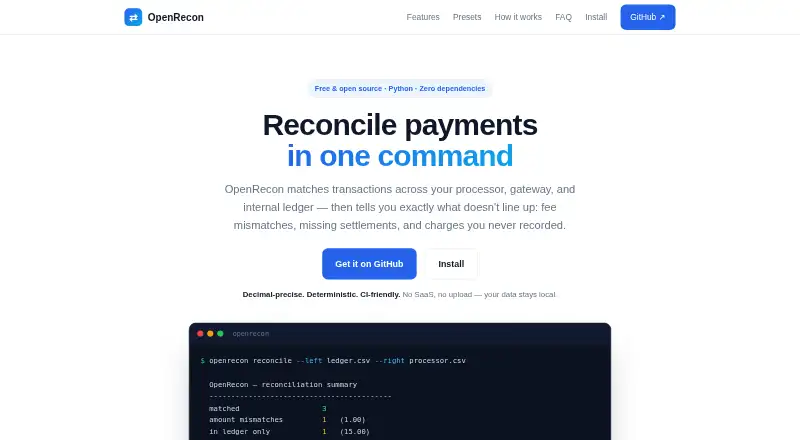
What OpenRecon is
OpenRecon compares transactions from payment processors and gateways with an internal ledger, then reports missing transactions and mismatches. It first pairs rows using shared IDs or references; remaining rows are compared by amount, currency, and date window. Amounts use Python Decimal rather than floating-point values. Presets cover Stripe, Adyen, PayPal, Razorpay, Braintree, and Square, with column auto-detection or explicit field mapping.
The tool accepts two CSV files and provides a command-line interface and Python library. Results can be shown as console summaries or optional JSON and CSV reports. The command-line tool exits with a non-zero status when discrepancies are found, supporting scheduled and CI workflows. Its maker says it runs locally without network calls, keeping ledger and processor files on the user's computer. OpenRecon is free, has no account requirement or paid tier, and uses the MIT license. It requires Python 3.9+ and has no dependencies beyond the standard library. The listed input is two CSV files; many-to-one matching, multi-currency settlement, refund and chargeback handling, and HTML reports are planned improvements.
Good
- Runs locally without network calls
- Presets cover six payment processors
- Offers CLI and Python library
- Supports JSON and CSV reports
- No dependencies beyond Python's standard library
Watch out
- Input is limited to two CSV files
- Multi-currency settlement is listed as a planned improvement
- Refund and chargeback handling are planned improvements
- HTML reports are planned
Who it suits
OpenRecon suits payments, finance and accounting, engineering, operations, marketplace, and audit teams that need to reconcile two CSV files. It can also suit teams embedding reconciliation in internal tools.
Verdict
OpenRecon is a focused option for reconciling processor data against a ledger using two CSV files, with local processing and script-friendly output. Its stated gaps include multi-currency settlement, refunds, chargebacks, and HTML reports.
Plans and prices
From OpenRecon's own pricing page, checked 4 Oct 2026.
| Plan | Price | What it gives you |
|---|---|---|
| Free | Free | No paid tier · no account · MIT license |
The facts
Each one read from OpenRecon's own pages, with the date it was checked.
What it does
- About
- The site says OpenRecon is built and maintained by payments and fintech engineer Naresh Paturi.checked 4 Oct 2026
- Automation
- The CLI exits with a non-zero status when discrepancies exist, supporting scheduled and CI workflows.checked 4 Oct 2026
- Intended users
- The maker describes use by payments, finance and accounting, engineering and operations, marketplaces, audit teams, and teams embedding reconciliation in internal tools.checked 4 Oct 2026
- Interfaces and outputs
- OpenRecon provides a CLI and Python library, with console summaries and optional JSON or CSV reports.checked 4 Oct 2026
- Limits
- The listed input is two CSV files; many-to-one matching, multi-currency settlement, refund and chargeback handling, and HTML reports are listed as planned improvements.checked 4 Oct 2026
- Local data
- The maker says OpenRecon runs locally with no network calls, so ledger and processor files stay on the user's computer.checked 4 Oct 2026
- Matching
- It first matches shared IDs or references, then matches remaining rows by amount, currency, and date window.checked 4 Oct 2026
- Money precision
- Amounts use Python Decimal rather than floating point.checked 4 Oct 2026
- Processor presets
- Built-in presets cover Stripe, Adyen, PayPal, Razorpay, Braintree, and Square, with column auto-detection and explicit mapping available.checked 4 Oct 2026
- Purpose
- OpenRecon matches transactions across payment processors, gateways, and an internal ledger, and reports mismatches and missing transactions.checked 4 Oct 2026
- Requirements
- The maker lists Python 3.9+ and no dependencies beyond the standard library.checked 4 Oct 2026
- Support and contribution
- The maker invites contributions and ideas on GitHub and suggests opening a pull request to add a processor preset.checked 4 Oct 2026
The full review of OpenRecon
OpenRecon is a focused reconciliation utility for matching processor and gateway transactions with an internal ledger. It suits technical finance, operations, and engineering teams that are comfortable with Python and command-line workflows. Its strongest case is a private, scriptable two-file check; teams handling more involved settlement scenarios should look elsewhere.
Overview
OpenRecon compares payment-processor or gateway CSV data with an internal-ledger CSV and reports mismatches and missing transactions. It first uses shared IDs or references, then evaluates remaining rows by amount, currency, and a date window. Amounts use Python's Decimal type rather than floating-point arithmetic, which is the right foundation for monetary comparisons.
Processing stays local: the maker says the tool makes no network calls, so ledger and processor files remain on the user's computer. That is valuable for organizations that do not want transaction files sent to a hosted service. The trade-off is a narrow input model of two CSV files, rather than a broader settlement workspace.
Key features
Matching and processor presets
Presets for Stripe, Adyen, PayPal, Razorpay, Braintree, and Square provide a practical starting point. Column auto-detection can reduce setup work, while explicit mappings handle files whose headers do not fit a preset. Identifier-first matching is effective for directly linked records; amount, currency, and date-window matching gives unmatched rows a second path without sacrificing decimal precision.
CLI, library, and reports
A command-line interface and Python library let teams choose between repeatable scripts and embedding reconciliation inside an internal tool. Console summaries suit routine review, while optional JSON and CSV reports are easier to pass into downstream automation than a purely visual dashboard. The CLI returns a non-zero exit status when discrepancies exist, making failures visible to scheduled jobs and continuous-integration pipelines.
Scope and roadmap
The current two-CSV workflow handles straightforward one-to-one checks. Many-to-one matching, multi-currency settlement, refunds, chargebacks, and HTML reports are planned improvements, so organizations whose reconciliation depends on those cases will encounter a hard boundary rather than an optional extra.
Pricing
OpenRecon has one Free plan at no cost. There is no paid tier, no account requirement, and no free trial because the software is free rather than trial-based. The MIT license and absence of subscription renewal make it suitable for teams that can operate their own workflow and do not need vendor-managed service terms.
The free plan gives every user the same core CLI, library, local processing, processor presets, and report formats. It does not buy access to advanced settlement features: those are not part of the current scope. Teams needing hosted collaboration, richer workflow controls, or support obligations should compare commercial alternatives instead of expecting a higher OpenRecon tier.
Platforms
OpenRecon is offered as an API and self-hosted software. The maker lists Python 3.9 or newer and no dependencies beyond the standard library. That keeps installation and deployment comparatively controlled for engineering-led teams, but it is not a native desktop, mobile, or browser application.
Who it's for
Payments, finance, and accounting groups can use it for repeatable processor-to-ledger checks. Engineering and operations teams benefit from the Python library, CLI exit codes, and machine-readable reports when reconciliation is part of scheduled or CI workflows. Marketplaces and audit teams get a local, traceable file-based process, while teams embedding reconciliation into internal tools can build on the library.
It is a poor fit for users who need a point-and-click hosted product, many-to-one settlement logic, multi-currency handling, refund or chargeback workflows, or HTML output. Contributions and new processor presets are invited through GitHub, including pull requests, which makes it more attractive to teams willing to adapt the software themselves.
Pros and cons
Pros
- Local, network-free processing: transaction files stay on the user's computer, a meaningful advantage for privacy-conscious finance workflows.
- Money-safe comparisons: Python Decimal avoids floating-point errors in amount matching.
- Automation-ready: CLI failure statuses plus JSON and CSV output fit scheduled jobs and CI pipelines.
- Useful processor coverage: six built-in presets, auto-detection, and explicit mappings reduce CSV preparation for common providers.
- No-cost, permissive entry: the MIT-licensed Free plan has no account, paid tier, or renewal commitment.
Cons
- Only two CSV inputs: broader data pipelines and multi-file settlement processes do not fit the current workflow.
- Important settlement gaps: many-to-one matching, multi-currency settlement, refunds, and chargebacks are planned rather than supported.
- No HTML reports: teams wanting presentation-ready reconciliation documents must use the console, JSON, or CSV outputs.
- Technical operating model: Python and self-hosting favor engineering-led teams over nontechnical finance users seeking a hosted interface.
Alternatives
For a wider directory of options, see Account Reconciliation Software.
- SahiSay Reconciliation is the better choice for Android, iOS, web, or Windows access, a free tier with five reconciliations per day and PDF export, or a paid Pro plan.
- Settler suits teams wanting self-hosted or cloud API deployment, up to 10,000 monthly reconciliations on its open-source plan, and local evidence and replay traces.
- speedRecon is aimed at a browser-based single workspace, with its free plan capped at three reconciliations per month and 300 rows per file.
- FIS Data Integrity Manager is a paid web option for organizations that prefer a commercial service.
- BankRecon is a paid web product with a free trial and a Standard plan for limited entities, bank accounts, and monthly transactions.
- Eko Recon is a free API, self-hosted, web, and Windows alternative with vendor pricing to request.
- Reconify fits teams seeking a paid, trial-based multi-platform service, with Startup pricing from $399 a month.
- OneCap is a web-based paid option with a free plan focused on ledger reconciliation, business rules, AI assistance, Excel reports, and email support.
Verdict
Choose OpenRecon if you need a free, local, Python-friendly way to reconcile two CSV files and feed discrepancy results into scripts or internal systems. Its decimal-safe matching, provider presets, and automation signals are strong reasons to adopt it for focused processor-to-ledger checks. Look elsewhere when reconciliation spans currencies, refunds, chargebacks, many-to-one settlement, or requires a hosted interface and polished HTML reporting.
Alternatives to OpenRecon
- 1
Reconify
Open sourceWebAPILinuxmacOS7.6From $399 a month - 2
SahiSay Reconciliation
Free planAndroidiOSWebWindows7.3From ₹1,499 a month - 3
speedRecon
Free planWebAPI7.2From 299 GHS a month - 4

HighRadius
AndroidiOSWebAPI7.1 - 5

ReconArt
WebAPILinuxmacOS7.1From $300 a month - 6
Reconcile.ly
Web7.0From $90 a year