Shuffle
Shuffle is an open-source automation platform for security teams that build and run workflows.
What Shuffle is
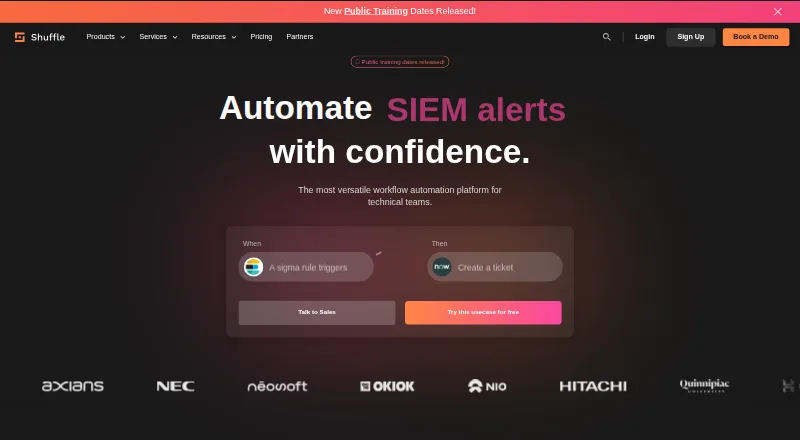
Shuffle is an open-source automation platform for security teams that build and run workflows. Its visual workflow designer pairs with a no-code app creator that can generate integrations from Swagger or OpenAPI specifications and API documentation URLs. The public app catalog contains more than 2,500 apps, including Slack, Gmail, MISP, Wazuh, Splunk, and Jira. Workflows can be triggered by webhooks, schedules, subflows, or user input; documented extensions include AWS Lambda, AWS S3, Kafka, and Pub/Sub.
Teams can run Shuffle as self-hosted open source or licensed software, use Shuffle Cloud SaaS, or adopt a documented hybrid deployment. Runtime architectures include Docker Compose, distributed Docker Swarm, a cloud-hybrid setup with a local Orborus runner, and Kubernetes through Helm charts. Security documentation describes bcrypt password hashing, AES-256 encryption for app authentication, protected datastore keys and files, tenant-controlled SAML/SSO and MFA, and API access using Bearer tokens. Shuffle also describes regional routing and isolated tenant contexts for cloud AI requests; on-prem installations can use local models without external requests. Its Scale plan is free and includes 2,000 monthly app runs.
Good
- Open-source platform designed for security automation.
- Visual workflow designer and no-code app creator.
- Catalog lists more than 2,500 apps.
- Supports webhooks, schedules, subflows, and user input.
- Self-hosted, SaaS, and hybrid deployment options.
- Documents SAML/SSO, MFA, and AES-256 encryption.
Watch out
- Free Scale plan stops at 2,000 app runs monthly.
- Scale has a hard App Runs limit.
- Scale includes three tenants and one location.
- Custom Python apps are not easily created for Shuffle Cloud.
Who it suits
Shuffle suits security operations centers and CERT/SIRT teams seeking to build and share automation workflows. It also fits teams that want self-hosted, cloud, or hybrid deployment options and integrations sourced from a large app catalog.
Verdict
Choose Shuffle if a security team needs workflow automation with flexible deployment and a broad integration catalog. The free Scale plan gives teams up to 2,000 monthly app runs, while its hard limit and tenant and location caps may lead larger deployments to consider Business or Enterprise.
Plans and prices
From Shuffle's own pricing page, checked 29 Sep 2026.
| Plan | Price | What it gives you |
|---|---|---|
| Scale | Free | Free / month for 2k App Runs · hard App Runs limit · 3 tenants · 1 location · 98.2% feature coverage · no listed support or onboarding |
| Business | Priced on request | App Runs start at 300k · soft limit · unlimited tenants, locations, and branding · 100% feature coverage · SLA and email support · onboarding and setup · 3 use cases covered |
| Enterprise | Priced on request | App Runs start at 300k · soft limit · unlimited tenants, locations, and branding · 100% feature coverage · SLA, email, on-call, and alert mechanism support · professional services · onboarding and setup · unlimited use cases |
The facts
Each one read from Shuffle's own pages, with the date it was checked.
What it does
- AI data handling
- Shuffle says cloud AI requests are routed to regional model endpoints and tenant contexts are isolated; on-prem installations can use local models without external requests.checked 29 Sep 2026
- API
- Shuffle describes itself as API-first and documents Bearer-token authentication for its API on both cloud and on-prem installations.checked 29 Sep 2026
- Audience
- Shuffle says it was created to address automation problems in the CERT/SIRT community and aims to help security operations centers share processes, automations, and detections.checked 29 Sep 2026
- Authentication
- Shuffle documents tenant-controlled SAML/SSO and MFA, and names Okta, Auth0, PingID, and AzureAD as supported platforms.checked 29 Sep 2026
- Deployment options
- Shuffle is offered as self-hosted open source, self-hosted licensed, and Shuffle Cloud SaaS, with hybrid deployment also documented.checked 29 Sep 2026
- Integration implementation limit
- The apps documentation says custom Python apps cannot yet be created easily for Shuffle Cloud, while on-prem instances support local app hotloading.checked 29 Sep 2026
- Integrations
- Shuffle's public app catalog lists more than 2,500 apps, including integrations such as Slack, Gmail, MISP, Wazuh, Splunk, and Jira.checked 29 Sep 2026
- Purpose
- Shuffle is an open-source automation platform designed for the security industry, for building and executing automation workflows.checked 29 Sep 2026
- Runtime deployment
- Documented runtime architectures include Docker Compose, distributed Docker Swarm, cloud hybrid with a local Orborus runner, and Kubernetes using Helm charts.checked 29 Sep 2026
- Security
- The architecture documentation says passwords are bcrypt-hashed and app authentication, protected datastore keys, and files are AES-256 encrypted.checked 29 Sep 2026
- Support
- The pricing page lists Shuffle Support with SLA and email support for Business, with on-call support and an alert mechanism additionally listed for Enterprise.checked 29 Sep 2026
- Triggers
- Core workflow triggers include webhooks, schedules, subflows, and user input; listed extension triggers include AWS Lambda, AWS S3, Kafka, and Pub/Sub.checked 29 Sep 2026
The company
- Founded
- 2019checked 28 Sep 2026
Where it runs
- Workflow and app builder
- Its visual workflow designer works with a no-code app creator that can generate integrations from Swagger/OpenAPI specifications or API documentation URLs.checked 29 Sep 2026
The full review of Shuffle
Shuffle is an open-source automation platform built for security teams that need to turn operational procedures into repeatable workflows. It is particularly well suited to CERT/SIRT groups and security operations centers combining many existing tools, while deployment choices make it viable for organizations that cannot put every workload in a SaaS environment. Its strongest proposition is the combination of a large app catalog, API-driven extensibility, and self-hosting; the free cloud tier is useful for evaluation but its run ceiling and cloud app-development limitation matter quickly.
Overview
Shuffle was created for the CERT/SIRT community, with an emphasis on sharing processes, automations, and detections across a security operation. The visual workflow designer is paired with a no-code app builder that can create integrations from Swagger or OpenAPI specifications and from API documentation URLs. That gives teams a practical way to connect services that are not already represented as ready-made actions.
The product is API-first, with Bearer-token authentication documented for both cloud and on-premises installations. Security documentation describes bcrypt password hashing, AES-256 encryption for app authentication, protected datastore keys, and encrypted files. Tenant-controlled SAML/SSO and MFA are supported through providers including Okta, Auth0, PingID, and AzureAD. Cloud AI requests are routed to regional model endpoints with tenant isolation, while on-premises deployments can use local models without sending requests externally.
Key features
Shuffle's public catalog contains more than 2,500 apps, including Slack, Gmail, MISP, Wazuh, Splunk, and Jira. For a security operation, that breadth reduces the need to build every connector internally and makes it easier to carry an alert from a detection system into collaboration, ticketing, and threat-intelligence tools.
Workflows can begin with webhooks, schedules, subflows, or user input. Extension triggers add AWS Lambda, AWS S3, Kafka, and Pub/Sub, covering both cloud events and message-driven architectures. Approval steps, scheduled runs, event triggers, incident integrations, and audit logs are supported, so Shuffle can represent controlled response procedures rather than only unattended jobs.
Deployment is unusually flexible: options include self-hosted open source, self-hosted licensed installations, Shuffle Cloud SaaS, and documented hybrid arrangements. Runtime architectures cover Docker Compose, distributed Docker Swarm, a cloud-hybrid model with a local Orborus runner, and Kubernetes through Helm charts. This suits teams that need local execution while retaining cloud management, but the range of architectures also puts more responsibility for design and operations on the customer.
Custom Python app creation is not yet easy in Shuffle Cloud, whereas on-premises instances support local app hotloading. Cloud buyers should therefore confirm that the catalog and generated integrations cover their use cases; organizations expecting to maintain a substantial library of bespoke Python apps have a stronger reason to self-host.
Pricing
Shuffle uses a freemium model. The Scale plan costs free and includes 2,000 App Runs per month. It has a hard App Runs limit, allows three tenants and one location, and provides 98.2% feature coverage. No support or onboarding is listed for this tier. It is a sensible starting point for a small team, a proof of concept, or low-volume automation, but the hard quota can interrupt a growing operation rather than merely increase its bill.
Business uses custom pricing and starts at 300,000 App Runs with a soft limit. It includes unlimited tenants, locations, and branding, 100% feature coverage, SLA and email support, onboarding and setup, and coverage for three use cases. This is the more appropriate commercial tier for a production team that needs room to scale and formal assistance but does not require the highest support commitment.
Enterprise also uses custom pricing and starts at 300,000 App Runs with a soft limit. It adds unlimited tenants, locations, and branding, full feature coverage, SLA, email, on-call and alert-mechanism support, professional services, onboarding and setup, and unlimited use cases. It is aimed at larger or more distributed security organizations where escalation coverage and implementation help justify a bespoke contract.
Platforms
Shuffle supports web access and API use, with Linux and self-hosted deployment options. The self-hosted and hybrid models are important for teams with data-residency or local-execution requirements; the cloud option favors organizations that want less infrastructure management.
Who it's for
Choose Shuffle for a security operations center, CERT, or SIRT that needs to orchestrate many security and business tools, formalize approvals and incident handling, and retain control over where workflows run. It is also a strong fit when OpenAPI-based integration generation can cover gaps in the catalog.
Look elsewhere if a 2,000-run hard cap is too restrictive, if you need effortless custom Python development in the cloud, or if your automation is not security-oriented enough to benefit from Shuffle's ecosystem and deployment model.
Pros and cons
- Pros: More than 2,500 catalog apps reduce connector work; OpenAPI and documentation-based app generation extends coverage; self-hosted, cloud, and hybrid architectures support different governance needs; SAML/SSO, MFA, encryption, and audit logs address operational controls.
- Cons: The free Scale tier stops at 2,000 monthly runs and is limited to three tenants and one location; custom Python apps are difficult to create in Shuffle Cloud; Business and Enterprise require custom pricing; the deployment choices can demand substantial infrastructure expertise.
Alternatives
Runbook Automation Software is the broader category guide for comparing workflow and response tools. Rundeck is a better fit when cross-platform runbook execution, including macOS and Windows, is central and its free Community plan for small teams is sufficient.
Tines suits teams that prefer a hosted, security-focused workflow product with a Free edition limited to three live workflows. StackStorm is the straightforward choice for a fully free, open-source, self-hosted automation project with no paid products.
Tanium Deploy is relevant when endpoint deployment is already anchored in a Tanium license. Tracecat is worth considering for self-hosted users wanting unlimited workflows, cases, and agents on its free Open Source plan. Azure Automation fits Azure-centered process automation, with 500 job-run minutes per month included. Palo Alto Networks Cortex Cloud API Security and Torq Case Management are paid alternatives for organizations seeking those specialized platforms.
Verdict
Shuffle is a strong recommendation for security teams that need broad integrations, approval-aware workflows, and the freedom to choose cloud, self-hosted, or hybrid execution. The main reason to choose it is the unusual combination of a 2,500-plus app catalog and extensible API workflow design. Look elsewhere when the free tier's hard 2,000-run ceiling, cloud custom-app limitation, or the operational burden of self-hosting conflicts with your scale or resources.
Getting started
- Visit https://shuffler.io/.
- Choose self-hosted open source, self-hosted licensed, Shuffle Cloud SaaS, or a hybrid deployment.
- For self-hosted runtime, consider a documented option such as Docker Compose, Docker Swarm, or Kubernetes with Helm charts.
- Use the visual workflow designer and no-code app creator to build workflows and integrations.
- Start with the Scale free plan if its 2,000 monthly app runs and three-tenant limit fit your needs.
Limits worth knowing
Scale is free and includes 2,000 App Runs per month with a hard limit, three tenants, and one location. The plan lists 98.2% feature coverage and no support or onboarding.
Questions
Is Shuffle free?
Yes. The Scale plan is free and includes 2,000 App Runs per month.
Which platforms does Shuffle support?
Listed platforms are API, Linux, self-hosted, and web.
Can Shuffle be self-hosted?
Yes. It is offered as self-hosted open source and self-hosted licensed software, as well as Shuffle Cloud SaaS; hybrid deployment is also documented.
What integrations are available?
The public app catalog lists more than 2,500 apps, including Slack, Gmail, MISP, Wazuh, Splunk, and Jira.
What does Shuffle Scale include?
Scale includes 2,000 monthly App Runs, three tenants, one location, and 98.2% feature coverage. It has a hard App Runs limit and lists no support or onboarding.
Can Shuffle Cloud use custom Python apps?
Custom Python apps cannot yet be created easily for Shuffle Cloud. On-prem instances support local app hotloading.
Alternatives to Shuffle
- 1

Sumo Logic
Free planWebAPILinuxmacOS7.6Free plan - 2
OpenSOAR
Free planOpen sourceWebAPILinuxSelf-hosted7.3Free plan - 3

Tines
Free planWebAPILinuxSelf-hosted7.2Free plan - 4
Tracecat
Free planWebAPISelf-hosted6.3Free plan - 5
 5.9
- 6
Rapid7 InsightConnect
WebAPILinuxSelf-hosted5.8