
Palo Alto Networks Cortex Cloud API Security
Palo Alto Networks Cortex Cloud API Security discovers, prioritizes, and protects APIs across cloud environments.
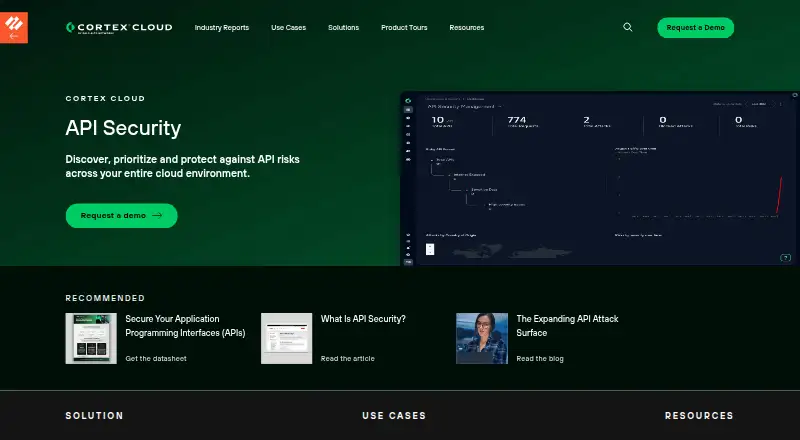
What Palo Alto Networks Cortex Cloud API Security is
Palo Alto Networks Cortex Cloud API Security discovers, prioritizes, and protects APIs across cloud environments. It can find and validate APIs across gateways, workloads, and cloud environments, including shadow, zombie, and unmanaged APIs. Configuration and traffic context inform risk ranking by severity and potential business impact. The product assesses internet exposure, sensitive data transmission, weak authentication, missing encryption, and specification drift. It describes real-time protection against OWASP API Top 10 threats, including injection, authentication bypass, and data exposure. Teams can use monitor mode or blocking enforcement. Agentless gateway integrations include AWS API Gateway, Azure APIM, GCP Apigee, and Kong; agent-based Linux workload protection is marked Beta. OpenAPI specifications can be imported to check live traffic and scan for misconfigurations or vulnerabilities. Azure APIM integration requires the Data Collection add-on and a running Azure APIM service. Cortex CLI API scans require an OpenAPI specification and Java 11 or later, while Web and API Security requires the Runtime Security add-on. Pricing is on request; the product page offers a demo request.
Good
- Finds shadow, zombie, and unmanaged APIs.
- Ranks risks by severity and business impact.
- Offers monitor and blocking modes.
- Imports OpenAPI specifications for scanning.
- Supports listed AWS, Azure, GCP, and Kong gateways.
Watch out
- Linux workload protection is marked Beta.
- Runtime Security add-on is required for Web and API Security.
- Azure APIM needs an add-on and running service.
- CLI scans require an OpenAPI file and Java 11 or later.
Who it suits
It is aimed at SOC analysts, security practitioners, and workload owners responsible for API security. It may suit teams that need API discovery, risk prioritization, and runtime protection across cloud environments.
Verdict
Cortex Cloud API Security combines API discovery, risk assessment, and protection, with different deployment paths for gateways and Linux workloads. Check the add-on and scan prerequisites for the integrations and workflows you plan to use.
The facts
Each one read from Palo Alto Networks Cortex Cloud API Security's own pages, with the date it was checked.
What it does
- API discovery
- It discovers and validates APIs across gateways, workloads, and cloud environments, including shadow, zombie, and unmanaged APIs.checked 30 Sep 2026
- API scan output
- Cortex CLI API scans produce findings, application error responses and scan metadata.checked 30 Sep 2026
- API scan prerequisites
- Cortex CLI API scanning requires an OpenAPI specification file and Java 11 or later.checked 30 Sep 2026
- API specifications
- Cortex Cloud can import OpenAPI specifications and validate live traffic against them to identify deviations, undocumented endpoints, or security gaps.checked 30 Sep 2026
- API specification scanning
- Cortex Cloud can import OpenAPI specifications and scan them for misconfigurations and vulnerabilities.checked 30 Sep 2026
- Azure APIM requirement
- The Azure APIM integration requires the Data Collection add-on and a running Microsoft Azure APIM service.checked 30 Sep 2026
- Deployment
- The product offers agentless gateway integrations and agent-based protection through the Cortex XDR agent for Linux workloads.checked 30 Sep 2026
- Detected threats
- Listed API threats include SQL injection, cross-site scripting, CVE exploit attempts, authentication bypass, sensitive data leakage, bot and scanner activity, and traffic anomalies.checked 30 Sep 2026
- Enforcement modes
- Teams can run protection in monitor mode or enforce blocking.checked 30 Sep 2026
- Gateway integrations
- The maker lists AWS API Gateway, Azure APIM, Apigee, Kong and F5 BIG-IP LTM as API gateway integrations.checked 30 Sep 2026
- Intended users
- The documentation identifies SOC analysts, security practitioners, and workload owners as roles involved in API security.checked 30 Sep 2026
- Purpose
- Cortex Cloud API Security discovers, prioritizes, and protects APIs across cloud environments.checked 30 Sep 2026
- Risk insights
- The product assesses discovered APIs for internet exposure, sensitive data transmissions, weak authentication, lack of encryption, and specification drift.checked 30 Sep 2026
- Risk prioritization
- It ranks API risks by severity and potential business impact, using configuration and traffic context.checked 30 Sep 2026
- Risk ranking
- It correlates API configurations and traffic to prioritize risks using severity and potential business impact.checked 30 Sep 2026
- Runtime add-on
- The maker's documentation says Web and API Security requires the Cortex Cloud Runtime Security add-on.checked 30 Sep 2026
- Sales and support
- The product page offers a request-a-demo option.checked 30 Sep 2026
- Scanning prerequisite
- The Cortex CLI API security scan requires an exposed application API, a corresponding OpenAPI specification file, and Java 11 or later.checked 30 Sep 2026
- Threat protection
- The product describes real-time protection against OWASP API Top 10 threats, including injection, authentication bypass, and data exposure.checked 30 Sep 2026
- Traffic insights
- Cortex Cloud analyzes API traffic and payloads to help assess exposure, sensitive data transmission and weak authentication.checked 30 Sep 2026
The company
- Founded
- 2005checked 28 Sep 2026
- Headquarters
- Santa Clara, California, USAchecked 28 Sep 2026
Where it runs
- Linux workloads
- Agent-based protection provides real-time detection and protection for web applications and APIs running on Linux workloads, and is marked Beta.checked 30 Sep 2026
Money
- Pricing and trial
- The product page offers a demo request and does not state a price, free plan or free trial.checked 30 Sep 2026
The full review of Palo Alto Networks Cortex Cloud API Security
Palo Alto Networks Cortex Cloud API Security is an API security capability within Cortex Cloud, aimed at teams responsible for protecting APIs across cloud environments. It is strongest for security teams that want discovery and runtime controls together; the Linux protection is still beta, and runtime use requires an add-on.
Overview
The product looks beyond APIs teams have formally cataloged: it can discover shadow, zombie, and unmanaged APIs across gateways, workloads, and cloud environments. It then uses configuration and traffic context to rank risks by severity and likely business impact. That makes prioritization more useful than a flat inventory, particularly for teams managing APIs across several environments.
Cortex Cloud's broader capabilities include workload and container detection, identity threat detection, automated response, audit logs, and post-incident reviews. That breadth may suit organizations already seeking a wider cloud security platform, while teams wanting only a standalone API product should weigh the additional runtime dependency.
Key features
Discovery and risk assessment
Agentless gateway integrations cover AWS API Gateway, Azure APIM, GCP Apigee, and Kong. Risk insights include internet exposure, sensitive-data transmission, weak authentication, missing encryption, and specification drift. Traffic and payload analysis helps assess exposure in context, while risk ranking gives teams a way to focus on issues with greater potential impact.
Azure APIM integration requires both the Data Collection add-on and a running Azure APIM service. That is a meaningful setup dependency for teams planning to use that gateway connection.
Protection and specifications
The product describes real-time protection against OWASP API Top 10 threats, including injection, authentication bypass, and data exposure. Listed detections also include SQL injection, cross-site scripting, CVE exploit attempts, sensitive-data leakage, bot and scanner activity, and traffic anomalies. Teams can choose monitor mode or blocking enforcement, so they can observe activity before enabling prevention.
Cortex Cloud can import OpenAPI specifications, scan them for misconfigurations and vulnerabilities, and compare live traffic with the specification to flag deviations, undocumented endpoints, or security gaps. The Cortex CLI scan requires an exposed application API, its corresponding OpenAPI file, and Java 11 or later; its output includes findings, application error responses, and scan metadata. These prerequisites make the scan useful for teams with specifications and a suitable test target, but less convenient where either is absent.
Linux workload protection
Agent-based protection through the Cortex XDR agent provides real-time detection and protection for web applications and APIs on Linux workloads. It is marked beta, so organizations needing a mature, established Linux deployment should treat it as a limitation rather than assume parity with the gateway integrations.
Pricing
Cortex Cloud API Security is paid, with custom pricing. The product offers a demo request, but no free plan or free trial. Web and API Security requires the Cortex Cloud Runtime Security add-on, so teams should account for that dependency when evaluating cost. There are no published tiers or seat and quota terms to compare; request a demo to discuss the deployment and pricing that fit your environment.
Platforms
The listed platforms are API, Linux, and web, and the deployment model is hybrid. Gateway integrations provide an agentless path, while Linux workload protection uses the Cortex XDR agent and is beta. The Azure APIM connection has additional Data Collection and running-service requirements.
Who it's for
This is a fit for SOC analysts, security practitioners, and workload owners who need to find unmanaged APIs, prioritize exposure, and connect API posture work with runtime protection. It is less compelling for teams seeking a standalone API scanner, those without OpenAPI specifications for CLI scanning, or organizations that require non-beta Linux protection.
Pros and cons
- Pros: Discovery spans gateways, workloads, and cloud environments, including shadow and unmanaged APIs, giving teams broader visibility than a gateway-only inventory.
- Pros: Risk ranking combines configuration and traffic context with severity and business impact, helping teams prioritize remediation.
- Pros: Monitor and blocking modes, plus OpenAPI validation, support both observing live behavior and enforcing controls.
- Cons: Runtime API security requires the Cortex Cloud Runtime Security add-on, adding a dependency to the purchase decision.
- Cons: Linux workload protection is beta, limiting its fit for teams that need a fully established agent-based option.
- Cons: CLI scanning requires an exposed API, a matching OpenAPI file, and Java 11 or later, which narrows where that workflow applies.
- Cons: Azure APIM needs the Data Collection add-on and an active Azure APIM service, creating extra integration requirements.
Alternatives
Oligo Security is worth comparing if a free plan and Linux or self-hosted platform support matter; its free subscription has no end date, though additional AWS infrastructure costs may apply.
Amazon GuardDuty may suit teams seeking a pay-as-you-go option with a 30-day free trial; charges vary with analyzed data volume, source, and AWS Region.
Sysdig Secure is an alternative for teams whose environments span Linux, macOS, self-hosted, web, and Windows; licensing is based on host count, with compute instances used for CSPM.
CrowdStrike Falcon Surface is another paid option with a free trial and demo-based pricing.
FortiCNAPP offers Standard tiers with one-year or three-year billing and entitlement per vCPU.
SentinelOne Singularity Cloud Security offers commercial and complete plans billed per endpoint, with different data-retention periods.
SUSE Multi-Linux Manager is an alternative with Linux and self-hosted platform support and subscription options for sockets, virtual machines, or monitoring.
Sweet Security is another paid option for Linux and self-hosted environments.
For adjacent categories, compare Cloud Detection and Response Software, Cloud Infrastructure Entitlement Management Software, SOAR Software, Runbook Automation Software, Identity Threat Detection and Response Software, and Cloud-Native Application Protection Platforms.
Verdict
Cortex Cloud API Security is best for security teams that need broad API discovery, risk prioritization, and runtime protection within a wider cloud security operation. Its strongest case is the combination of gateway coverage, traffic-informed risk ranking, and specification-aware controls. Look elsewhere if you need transparent plan pricing, standalone API security without the runtime add-on, or non-beta Linux protection.
Getting started
- Open the Cortex Cloud API Security website
- Request a product demo
- Connect a supported gateway such as AWS API Gateway, Azure APIM, GCP Apigee, or Kong
- For Linux workloads, deploy protection through the Cortex XDR agent
- For CLI scanning, provide an exposed API, OpenAPI specification, and Java 11 or later
- Import OpenAPI specifications for validation and scanning
Limits worth knowing
Web and API Security requires the Cortex Cloud Runtime Security add-on. Azure APIM integration requires the Data Collection add-on and an active Microsoft Azure APIM service; Linux workload protection is marked Beta.
Questions
What platforms does Cortex Cloud API Security support?
The listed platforms are API, Linux, and web. Its deployment and cloud coverage are hybrid.
How is Cortex Cloud API Security priced?
It is a paid product with pricing available on request.
Which gateway integrations are available?
Agentless integrations are listed for AWS API Gateway, Azure APIM, GCP Apigee, and Kong.
What does a Cortex CLI API scan require?
The scan requires an exposed application API, a corresponding OpenAPI specification file, and Java 11 or later.
Can teams block threats automatically?
Teams can choose monitor mode or enforce blocking.
Who is the product intended for?
Documentation identifies SOC analysts, security practitioners, and workload owners as involved roles.
Alternatives to Palo Alto Networks Cortex Cloud API Security
- 1
Microsoft Defender for Business
AndroidiOSAPImacOS7.5 - 2
Bedrock Data Security Platform
Free planWebAPI7.2From $399 a month - 3

Forcepoint Data Security Cloud
AndroidiOSWebAPI6.8 - 4
Google Cloud Secret Manager
Free planWeb6.5From $0.02 a month - 5

Prisma Cloud SCA
WebAPI6.3 - 6
DataSunrise
WebLinuxSelf-hostedWindows6.1