
Forcepoint Data Security Cloud
Forcepoint Data Security Cloud is a paid platform for protecting data across AI, web, cloud, endpoint, network, and email channels.
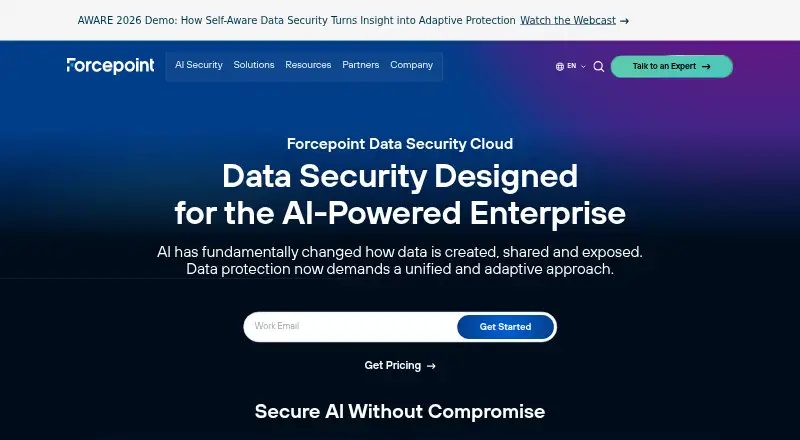
What Forcepoint Data Security Cloud is
Forcepoint Data Security Cloud is a paid platform for protecting data across AI, web, cloud, endpoint, network, and email channels. It continuously discovers data sets across an organization’s digital estate and uses its AI Mesh architecture to classify structured and unstructured data. Risk-adaptive policies apply context during enforcement as risk changes. Forcepoint ARIA correlates risk signals and behavioral insights across solutions to identify security gaps and deploy protection. The cloud-native architecture supports cloud and hybrid environments, while unified identity management synchronizes users and groups across on-premises and cloud directories. Forensics and risk analysis provide timelines of data movement across channels. The platform serves as a control plane for Forcepoint DLP, DSPM, and DDR. Listed capabilities also include secure web gateway, private-app access, cloud access security, data loss prevention, remote browser isolation, and device posture checks. Pricing is available by request.
Good
- Covers AI, web, cloud, endpoint, network, and email channels
- Discovers and classifies data across an organization
- Supports cloud and hybrid environments
- Provides timelines of data movement across channels
- Includes data loss prevention and cloud access security
Watch out
- Paid platform with pricing available by request
Who it suits
Forcepoint Data Security Cloud suits organizations seeking data protection across multiple channels and cloud or hybrid environments. Its listed customer sectors include defense, intelligence, finance, healthcare, and global enterprises.
Verdict
Forcepoint Data Security Cloud brings discovery, classification, policy controls, and investigation together across several data channels. Organizations considering it will need to request pricing.
Plans and prices
From Forcepoint Data Security Cloud's own pricing page, checked 15 Oct 2026.
| Plan | Price | What it gives you |
|---|---|---|
| Custom quote | Priced on request | Custom subscription capacity and fees agreed in an order · SaaS and on-premises DLP options |
| Forcepoint Data Security Cloud | Priced on request | Pricing by request; talk to an expert |
The facts
Each one read from Forcepoint Data Security Cloud's own pages, with the date it was checked.
What it does
- Adaptive controls
- Risk-adaptive policy controls apply context during enforcement as risk changes.checked 3 Oct 2026
- AI workflow coverage
- The platform supports discovery and classification of structured and unstructured data in analytics and AI lakehouse environments.checked 15 Oct 2026
- API scope
- Documented API operations include SSL bypass settings, cloud-application authentication bypass, internal-network traffic rules and transaction-status retrieval.checked 15 Oct 2026
- ARIA
- Forcepoint ARIA correlates cross-solution risk signals and behavioral insights to identify security gaps and deploy protection.checked 3 Oct 2026
- ARIA assistant
- ARIA analyzes platform signals, identifies protection gaps and can activate enforcement through natural-language instructions while retaining administrator control.checked 15 Oct 2026
- CISO dashboard
- A CISO dashboard presents prioritized data-risk insights, trends and performance measures.checked 15 Oct 2026
- Classification
- Its AI Mesh architecture classifies structured and unstructured data.checked 3 Oct 2026
- DDR
- Its Data Detection and Response component continuously monitors activity and uses AI-driven responses to stop potential data loss.checked 15 Oct 2026
- Deployment
- The cloud-native architecture supports cloud and hybrid environments.checked 3 Oct 2026
- Discovery
- It continuously discovers new data sets across an organization’s digital estate.checked 3 Oct 2026
- DLP
- The platform includes out-of-the-box data-loss-prevention policies covering more than 80 countries.checked 15 Oct 2026
- Documentation
- Forcepoint maintains online technical documentation covering deployment, administration, endpoint agents, integrations and API operations.checked 15 Oct 2026
- DSPM
- Its Data Security Posture Management component discovers and classifies files with AI and supports remediation of data risk.checked 15 Oct 2026
- Email DLP
- The product extends data-loss-prevention policy coverage to outbound email.checked 15 Oct 2026
- Forensics
- Forensics and risk analysis provides detailed timelines of data movement for investigations and compliance evidence.checked 15 Oct 2026
- Hybrid deployment
- Forcepoint describes the architecture as cloud-native while supporting cloud and hybrid environments.checked 15 Oct 2026
- Identity management
- Unified identity management synchronizes users and groups across on-premises and cloud directories for identity-based policies.checked 15 Oct 2026
- Integrations
- The SSE deployment documentation lists SSO and API integrations for Microsoft 365, Google Workspace, Dropbox, Box, AWS, Slack, Salesforce, ServiceNow, Atlassian and GitHub.checked 15 Oct 2026
- Investigation
- Forensics and risk analysis provide detailed timelines of data movement across channels.checked 3 Oct 2026
Where it runs
- Cloud app security
- Cloud App Security discovers, classifies, monitors and protects data in SaaS and generative-AI applications from any device.checked 15 Oct 2026
The company
- Company
- Forcepoint says it has protected sensitive data for more than 20 years and serves customers across defense, intelligence, finance, healthcare and global enterprises.checked 3 Oct 2026
- Company facts
- Forcepoint LLC is identified in its subscription agreement as a Delaware limited liability company headquartered at 10900-A Stonelake Blvd., Austin, Texas.checked 15 Oct 2026
- Company size and founding
- LinkedIn lists Forcepoint as privately held, founded in 1994, headquartered in Austin and employing 1,001–5,000 people.checked 15 Oct 2026
- Headquarters
- Austin, Texas, United Stateschecked 28 Sep 2026
The full review of Forcepoint Data Security Cloud
Forcepoint Data Security Cloud unifies data protection across AI, web, cloud, endpoint, network, and email channels. It is aimed at organizations managing cloud and hybrid estates, especially those considering Forcepoint’s broader security suite. The main trade-off is broad coverage with pricing that requires a direct vendor conversation.
Overview
This cloud-native platform provides a shared control plane for Forcepoint DLP, DSPM, and DDR. It is designed for organizations that want discovery, classification, policy enforcement, identity coordination, and investigation managed across several data channels instead of assembled from disconnected point products.
Forcepoint says it serves defense, intelligence, finance, healthcare, and global enterprises, and has protected sensitive data for more than 20 years. Its Trust Center lists ISO/IEC 27001:2022, SOC 2 Type 2, CCPA, CSA STAR Level 1, FIPS 140-3, and GDPR among its compliance entries.
Key features
Discovery and classification
Continuous discovery identifies new data sets across an organization’s digital estate. AI Mesh classifies both structured and unstructured data, giving policy teams a broader foundation for protecting varied information. This breadth matters most where data is spread across many systems; smaller teams seeking one narrowly defined control may not need such a wide platform.
Adaptive protection
Risk-adaptive policy controls use context as risk changes, allowing enforcement to respond to changing circumstances rather than relying solely on fixed rules. Forcepoint ARIA correlates cross-solution risk signals and behavioral insights to identify security gaps and deploy protection. Together, these capabilities favor organizations that need controls to reflect user and activity risk.
Suite control and investigation
As the control plane for Forcepoint DLP, DSPM, and DDR, Data Security Cloud can coordinate those products from a common layer. Unified identity management synchronizes users and groups across on-premises and cloud directories, reducing the need to maintain separate identity views. Forensics and risk analysis provide timelines of data movement across channels, supporting investigations that span a distributed environment.
Access and channel coverage
The offering includes a secure web gateway, private-app access, cloud access security, data loss prevention, remote browser isolation, and device posture checks. That combination is useful for organizations seeking one program covering access and data controls, but it also makes the product a substantial enterprise platform rather than a lightweight standalone utility.
Pricing
The Forcepoint Data Security Cloud plan uses custom pricing; buyers must request a quote and talk to an expert. No public seat quotas, trial term, renewal term, or free plan is provided. This approach suits enterprises whose deployment scope and channel mix require a tailored proposal, but it makes independent budget comparisons difficult before contacting Forcepoint.
Platforms
Forcepoint Data Security Cloud supports Android, iOS, Linux, macOS, Windows, web, API, browser extension, and self-hosted deployments. Its cloud-native architecture supports both cloud and hybrid environments, giving organizations flexibility when infrastructure is split between hosted and on-premises systems.
Who it's for
This is best for large or regulated organizations that need coordinated protection across many channels, complex identity environments, and detailed data-movement investigations. It is particularly relevant to teams evaluating Forcepoint DLP, DSPM, and DDR together. Organizations wanting a transparent low-cost plan, a small deployment, or a single-purpose data tool should look elsewhere.
Pros and cons
- Pro: Discovery and AI Mesh classification cover newly found, structured, and unstructured data across a broad estate.
- Pro: Adaptive controls and ARIA connect policy decisions to changing risk and behavioral signals.
- Pro: DLP, DSPM, and DDR integration provides a unified Forcepoint control plane.
- Pro: Identity synchronization and cross-channel timelines support hybrid operations and investigations.
- Con: Custom pricing offers no public cost benchmark or published plan limits.
- Con: Its extensive channel and suite scope may be excessive for organizations seeking a focused point product.
Alternatives
Data Security Posture Management Software is the relevant category when posture management, rather than broad multi-channel enforcement, is the priority. For a wider secure-access comparison, see Security Service Edge Software.
Zscaler Private Access is a paid private-access alternative with Android, iOS, Linux, macOS, web, and Windows support; its ZPA Standard plan is limited private access for 5% of users, while the ZPA Platform plan has custom pricing. Skyhigh Private Access is another paid private-access option for Android, iOS, macOS, web, and Windows.
Bedrock Data Security Platform offers a freemium Snowflake-focused plan at no cost with weekly scans and fewer advanced capabilities. Onam Security API Security has a free tier at no cost, limited to one cloud account, 500 resources, and 30-day finding history, plus a $22 a month Pro plan.
Cyberhaven Data Security Platform is a paid alternative with pricing by request and a product demo. Netwrix Password Secure is a paid option whose self-service plan starts at $60 a year with a one-year minimum commitment. Proofpoint Email DLP and Encryption focuses on email protection. Poirot DSPM is free forever, open source, and self-hosted.
Verdict
Choose Forcepoint Data Security Cloud if your organization needs one enterprise control plane for discovery, adaptive protection, access, identity, and investigation across cloud and hybrid channels. Its strongest reason to buy is coordinated coverage across the Forcepoint security suite. Look elsewhere if you need predictable public pricing, a smaller focused deployment, or a free starting tier.
Alternatives to Forcepoint Data Security Cloud
- 1
Microsoft Defender for Business
AndroidiOSAPImacOS7.5 - 2
Bedrock Data Security Platform
Free planWebAPI7.2From $399 a month - 3
Google Cloud Secret Manager
Free planWeb6.5From $0.02 a month - 4

Prisma Cloud SCA
WebAPI6.3 - 5

Palo Alto Networks Cortex Cloud API Security
WebAPILinux6.2 - 6
DataSunrise
WebLinuxSelf-hostedWindows6.1