OpenSOAR
OpenSOAR is an open-source, self-hosted platform for automating security alert triage, enrichment, and response with Python playbooks.
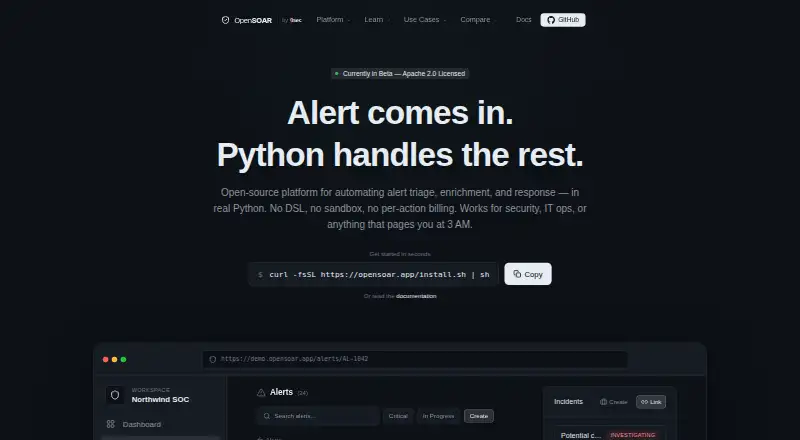
What OpenSOAR is
OpenSOAR is an open-source, self-hosted platform for automating security alert triage, enrichment, and response with Python playbooks. Alerts can enter through webhooks, Elasticsearch polling, or syslog; the platform can normalize payloads, extract indicators of compromise, and deduplicate them. Playbooks are asynchronous Python functions that can be tested, versioned, and run with standard Python packages. The execution engine supports parallel actions, timeouts, retries, and exponential backoff. Case tools can create and link incidents, assign cases, add timeline comments and observables, and show correlation suggestions. Listed integrations include Elastic Security, VirusTotal, AbuseIPDB, Slack, and Email, with an extensible Python SDK. AI options include Claude, OpenAI, and Ollama for features such as summarization, triage recommendations, playbook generation, and correlation. The maker says local Ollama can be used without data leaving the network. OpenSOAR is free under Apache 2.0, with no feature gates or per-action billing, and its homepage labels it as currently in beta.
Good
- Free under Apache 2.0 with no feature gates.
- Accepts alerts through webhooks, Elasticsearch polling, and syslog.
- Python playbooks support retries, timeouts, and parallel actions.
- Can use local Ollama for AI triage.
Watch out
- Homepage labels the product as currently in beta.
- Deployment is self-hosted.
Who it suits
It suits SOC teams, MSSPs, incident responders, SREs, infrastructure and on-call teams, and DevOps teams seeking alert automation. Teams wanting to keep AI triage data within their network can use local Ollama, according to the maker.
Verdict
OpenSOAR brings alert intake, Python automation, case management, and AI options into a self-hosted platform. It is free without feature gates, but is currently labeled as beta.
Plans and prices
From OpenSOAR's own pricing page, checked 15 Oct 2026.
| Plan | Price | What it gives you |
|---|---|---|
| Free | Free | Apache 2.0 licensed · self-hosted · no feature gates · no per-action billing |
| OpenSOAR | Free | Apache 2.0 licensed · self-hosted · no feature gates · no per-action billing |
The facts
Each one read from OpenSOAR's own pages, with the date it was checked.
What it does
- AI
- AI features include LLM summarization, triage recommendations, playbook generation, auto-resolve, and correlation, with Claude, OpenAI, and Ollama listed as options.checked 30 Sep 2026
- AI features
- The project lists LLM summarization, triage recommendations, playbook generation, auto-resolution and correlation using Claude, OpenAI or Ollama.checked 15 Oct 2026
- Alert ingestion
- The platform accepts webhook alerts, including normalized Elastic and generic JSON payloads, and can extract indicators and deduplicate alerts.checked 15 Oct 2026
- API
- The service exposes a FastAPI API covering alerts, playbooks, runs, integrations, incidents, authentication and webhooks.checked 15 Oct 2026
- API limitation
- The API can list, enable, inspect and run discovered playbooks but cannot upload a new Python playbook.checked 15 Oct 2026
- Audit
- The maker says automation actions are logged with timestamps and full context, and AI decisions include logged inputs, outputs, and reasoning.checked 30 Sep 2026
- Authentication
- Authentication uses JWT sessions and API keys, with role-based authorization described in the architecture documentation.checked 15 Oct 2026
- AWS Marketplace packaging
- AWS Marketplace lists a bCloud LLC AMI for Ubuntu 24.04 with optional maintenance support and usage-based infrastructure charges.checked 15 Oct 2026
- Built-in integrations
- Core includes Elastic Security, VirusTotal, AbuseIPDB, Slack and SMTP email connectors.checked 15 Oct 2026
- Case management
- OpenSOAR links alerts to incidents, assigns cases, records timeline comments, stores observables and offers correlation suggestions.checked 15 Oct 2026
- Community integrations
- A separate repository lists CrowdStrike Falcon, SentinelOne, Jira, PagerDuty and MISP packs, all marked in development.checked 15 Oct 2026
- Data control
- The maker says AI triage can use local Ollama and that no data leaves the network if the user does not want it to.checked 30 Sep 2026
- Deployment
- OpenSOAR is self-hosted and its repository documents a Docker Compose deployment.checked 30 Sep 2026
- Documentation depth
- Documentation covers getting started, alert lifecycle, incidents, playbooks, deployment, authentication, API, integrations, troubleshooting and engineering architecture.checked 15 Oct 2026
- Execution
- The async playbook engine supports parallel actions and per-action timeouts, retries, and exponential backoff.checked 30 Sep 2026
- Independent availability
- The AWS Marketplace listing says no customer reviews have been submitted yet.checked 15 Oct 2026
- Ingestion
- It supports alert intake through webhooks, Elasticsearch polling, and syslog, with payload normalization, IOC extraction, and deduplication.checked 30 Sep 2026
- Integrations
- The maker lists Elastic Security, VirusTotal, AbuseIPDB, Slack, and Email as integrations, with an extensible Python SDK.checked 30 Sep 2026
- Intended users
- The maker identifies SOC teams, MSSPs, incident responders, SREs, infrastructure and on-call teams, and DevOps teams as use cases.checked 30 Sep 2026
- Kubernetes deployment
- A Helm chart is available, but its documentation calls it a version-zero skeleton rather than a high-availability reference architecture.checked 15 Oct 2026
- Licence
- OpenSOAR is released under the Apache 2.0 license.checked 15 Oct 2026
- Limit: integration breadth
- The repository itself says competing projects such as Shuffle and StackStorm have substantially more integrations than OpenSOAR's five built-in connectors.checked 15 Oct 2026
- Limit: Kubernetes maturity
- The Helm packaging notes say the chart is not a high-availability reference architecture and does not bundle Elasticsearch or Kibana.checked 15 Oct 2026
- Limit: playbook publishing
- There is no dedicated playbook upload API, publishing UI or separate synchronization button.checked 15 Oct 2026
The full review of OpenSOAR
OpenSOAR is a self-hosted platform for teams that want to build alert-response workflows in Python. It suits security and operations groups with the skills to run the service and maintain playbooks; its beta label makes it a cautious choice for critical workflows.
Overview
OpenSOAR brings alert intake, enrichment, response automation, and case handling into one system. It accepts alerts through webhooks, Elasticsearch polling, and syslog, then normalizes payloads, extracts indicators of compromise, and deduplicates them. This can help teams bring several alert sources into a consistent workflow, while self-hosting gives them deployment and data-control responsibilities as well as flexibility.
The platform is open source under Apache 2.0, and its free plan has no feature gates or per-action billing. That makes experimentation and expansion possible without software charges tied to features or action volume. The trade-off is operational: teams must run the service themselves, and the beta status warrants caution before relying on it for essential response processes.
Key features
Python playbooks and execution
Playbooks are asynchronous Python functions that can be tested, versioned, and run with standard Python packages. This is a strong fit for teams that already maintain Python code and want flexibility beyond a fixed set of response steps. It is less suited to teams without Python expertise, since they would be taking on custom workflow code as well as the platform.
The execution engine can run actions in parallel and supports timeouts, retries, and exponential backoff for individual actions. Those controls help workflows handle slow or intermittently failing steps without treating every action as a simple one-shot operation.
Alert handling and cases
After ingestion, OpenSOAR can create and link incidents, assign cases, add timeline comments and observables, and surface correlation suggestions. That combination gives responders a place to connect incoming alerts with investigation work rather than treating automation as an isolated task.
Its named integrations include Elastic Security, VirusTotal, AbuseIPDB, Slack, and Email, while an extensible Python SDK gives teams a route to add integrations. The existing set covers alerting, threat intelligence, and team communication, but teams depending on other services should expect to build or extend their own connections.
AI and data control
AI options include LLM summaries, triage recommendations, playbook generation, auto-resolution, and correlation, with Claude, OpenAI, and Ollama named as choices. Local Ollama can keep AI triage within the network for teams that do not want data to leave it. AI breadth may be useful where analysts want help summarizing or routing work, but using it does not remove the need to review consequential response decisions.
Access and audit
OpenSOAR provides JWT authentication, integration API keys, three core roles, and admin-managed local accounts. Automation actions are logged with timestamps and context; AI decisions log their inputs, outputs, and reasoning. These controls give teams useful access and audit mechanisms, though they still need to operate and secure the self-hosted deployment.
Pricing
OpenSOAR: free. The Apache 2.0-licensed, self-hosted plan includes playbook automation, alert enrichment, and threat-intelligence actions, with no feature gates or per-action billing. There is no paid tier to compare against; the cost advantage does not include the work of providing and maintaining infrastructure.
There is no free trial because the product is free. The plan terms do not identify a seat or usage cap, so teams can evaluate it without a stated per-action charge. The more consequential qualification is beta status: teams should be careful about making it the sole foundation for operational response.
Platforms
OpenSOAR is offered as a web application and API, and is self-hosted rather than a hosted service. Its repository documents Docker Compose deployment, and its documentation covers setup, playbooks, deployment, API use, troubleshooting, and engineering references. This gives technically capable teams a documented path to operate it, but it is not a fit for organizations that want the vendor to run the platform.
Who it's for
OpenSOAR is aimed at SOC teams, MSSPs, and incident responders, as well as SRE, infrastructure, on-call, and DevOps teams. Its Python playbooks and alert-to-case workflow are especially relevant to groups that can maintain custom automation and want security and operational response in a self-managed system. Teams seeking a mature managed service or a workflow tool that avoids code maintenance should look elsewhere.
Pros and cons
- Pros: A free Apache 2.0 plan with no feature gates or per-action billing avoids software-cost penalties for expanding automation.
- Pros: Webhooks, Elasticsearch polling, and syslog feed into normalization, IOC extraction, and deduplication, reducing the need to treat each intake route separately.
- Pros: Python playbooks, case handling, and an extensible SDK give technically capable teams room to shape workflows around their own response needs.
- Pros: Local Ollama support and logged AI decisions offer options for teams that want network-local triage and a record of AI inputs and outputs.
- Cons: Self-hosting puts deployment and service operation on the team, so the free license does not make it operationally hands-off.
- Cons: Python-based workflows require code skills and ongoing maintenance, which may be a barrier for teams looking for a guided no-code approach.
- Cons: The product is in beta, making it a riskier foundation for teams that cannot tolerate uncertainty in critical response workflows.
Alternatives
For a broader comparison of category options, see SOAR Software. Choose Tracecat if its free, self-hosted plan with unlimited workflows, cases, and agents, self-managed monthly executions, and tool approvals better matches the workflow model you need. Choose Sumo Logic if you want a web-based logs, metrics, and traces service with a free tier capped at 20 daily credits, seven-day log retention, and three users, or a limited trial.
CrowdStrike Falcon Surface is another alternative. Consider Tines if a web-based workflow service with a free edition limited to three live workflows better suits your needs. Wildbox is another free option, available across API, desktop, web, and self-hosted platforms. Palo Alto Networks Cortex Cloud API Security is another alternative for API-focused needs. Consider Swimlane Turbine if its paid, self-hosted offering with published action and user thresholds suits your scale. Cyware Security Orchestration and Automation is another paid alternative with custom-quote pricing.
Verdict
OpenSOAR is a compelling choice for Python-capable SOC, response, and operations teams that want a self-hosted automation and case-management platform without feature or action charges. Its flexible workflows, multi-source intake, and local AI option are meaningful advantages. Look elsewhere if you need a managed service, prefer to avoid maintaining code, or require a product beyond beta for critical response operations.
Getting started
- Open the OpenSOAR website
- Review the canonical setup and deployment documentation
- Deploy the platform using the documented Docker Compose method
- Configure self-hosted access and administrator-managed local accounts
- Create Python playbooks and connect listed integrations
Limits worth knowing
The free OpenSOAR plan has no feature gates or per-action billing. The product is currently labeled beta, and deployment is self-hosted.
Questions
Is OpenSOAR free?
Yes. The OpenSOAR plan costs nothing and is Apache 2.0 licensed, with no feature gates or per-action billing.
Which platforms does it support?
OpenSOAR is available through an API, as a self-hosted deployment, and on the web.
What integrations are listed?
Listed integrations are Elastic Security, VirusTotal, AbuseIPDB, Slack, and Email. An extensible Python SDK is also provided.
Can AI processing stay local?
Yes. Ollama is listed as an AI option, and the maker says local Ollama processing can keep data from leaving the network.
Who is it intended for?
The maker identifies SOC teams, MSSPs, incident responders, SREs, infrastructure and on-call teams, and DevOps teams.
Alternatives to OpenSOAR
- 1

Sumo Logic
Free planWebAPILinuxmacOS7.6Free plan - 2

Tines
Free planWebAPILinuxSelf-hosted7.2Free plan - 3
Shuffle
Free planWebAPILinuxSelf-hosted6.3Free plan - 4
Tracecat
Free planWebAPISelf-hosted6.3Free plan - 5
 5.9
- 6
Rapid7 InsightConnect
WebAPILinuxSelf-hosted5.8