SESTEK Text-to-Speech
SESTEK Text-to-Speech turns written text into speech for business applications.
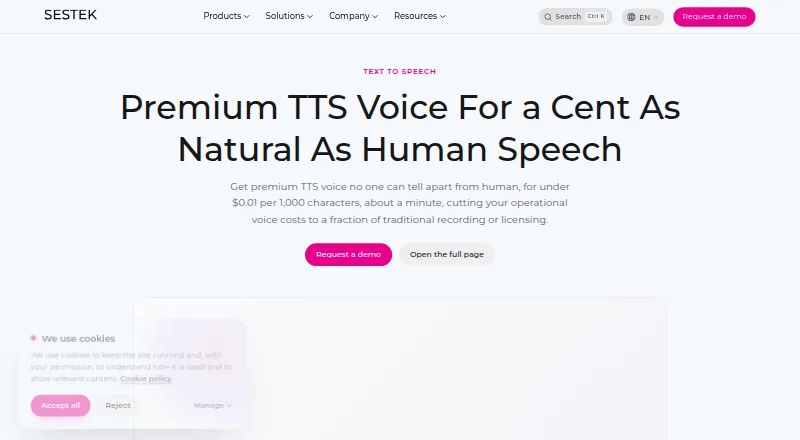
What SESTEK Text-to-Speech is
SESTEK Text-to-Speech turns written text into speech for business applications. It offers more than 20 languages, including accent-specific Arabic voices such as Gulf, Najdi, Kuwaiti, and Emirati, along with American and British English. Users can adjust tone, pace, emphasis, and volume, and set pronunciations for names, abbreviations, product codes, and specialized terms. SSML support covers pauses, pronunciation, external audio, and voice switching. SESTEK can create an organization-specific voice model that it says remains exclusive to that organization. Deployment is available on-premises or in the cloud, with the same feature set in either model. Standard voices run on Windows, Linux, Docker Compose, and Kubernetes without a GPU; Premium voices need a GPU and run on Linux, Docker Compose, and Kubernetes. APIs and SDKs let developers add voice capabilities to existing software, with Azure and ElevenLabs integrations also supported. Export formats include WAV, Opus, MP3, and FLV. Licensing options include pay-as-you-go, subscription, and custom agreements, but prices are not published.
Good
- Supports more than 20 languages.
- Custom voice models can be organization-exclusive.
- Standard voices run without a GPU.
- Offers WAV, Opus, MP3, and FLV exports.
Watch out
- Prices are not published.
- Premium voices require a GPU.
- Premium voices are limited to Linux, Docker Compose, and Kubernetes.
Who it suits
It suits businesses adding speech generation to software or business applications, especially those needing language, accent, pronunciation, or voice customization. The deployment and runtime options may also suit teams choosing between on-premises and cloud use.
Verdict
SESTEK Text-to-Speech offers adjustable speech, custom pronunciations, and several deployment options for business use. Check the runtime requirements and request pricing information to see whether its licensing fits your needs.
Plans and prices
From SESTEK Text-to-Speech's own pricing page, checked 30 Sep 2026.
| Plan | Price | What it gives you |
|---|---|---|
| Custom agreement | Priced on request | Custom licensing agreement |
| Pay-as-you-go | Priced on request | Pricing not published; licensing offered for business usage |
| Subscription | Priced on request | Pricing not published; licensing offered for business usage |
The facts
Each one read from SESTEK Text-to-Speech's own pages, with the date it was checked.
What it does
- API access
- Yeschecked 20 Sep 2026
- Audience
- SESTEK describes its TTS licensing options as business choices suited to usage scale and pattern.checked 30 Sep 2026
- Custom voice
- SESTEK can develop a voice reflecting an organization’s brand, and says the resulting voice model is exclusive to that organization.checked 29 Sep 2026
- Custom voices
- SESTEK can develop a brand-specific voice model exclusive to an organization.checked 30 Sep 2026
- Deployment
- TTS is available for cloud or on-premises deployment with the same feature set in either environment.checked 30 Sep 2026
- Developer access
- SESTEK says APIs and SDKs let developers add voice capabilities to existing software without significant infrastructure changes.checked 29 Sep 2026
- Export formats
- WAV,Opus,MP3,FLVchecked 20 Sep 2026
- Integration
- SESTEK says APIs and SDKs can add voice capabilities to existing software, and its platform supports Azure and ElevenLabs integrations.checked 30 Sep 2026
- Integrations
- The platform supports Azure and ElevenLabs integrations and can connect with SESTEK Speech Recognition, Virtual Translator, and AI Agents.checked 29 Sep 2026
- Languages
- The product supports more than 20 languages, with accent-specific voices including Gulf, Najdi, Kuwaiti, and Emirati Arabic, and American and British English.checked 29 Sep 2026
- Licensing
- The product page lists pay-as-you-go, subscription-based, and custom agreement licensing, but does not state prices.checked 29 Sep 2026
- Pronunciation
- Businesses can define custom pronunciations for abbreviations, brand names, product codes, and industry terms.checked 30 Sep 2026
- Purpose
- SESTEK TTS converts written text into natural-sounding speech for business applications.checked 30 Sep 2026
- Runtime requirements
- Standard voices run on Windows, Linux, Docker Compose, and Kubernetes without a GPU; Premium voices require a GPU and are available on Linux, Docker Compose, and Kubernetes.checked 30 Sep 2026
- Security
- SESTEK states that it holds ISO 27001, ISO 9001, and SOC 2 Type 2 certifications and undergoes annual independent audits.checked 30 Sep 2026
- Speech controls
- Users can adjust tone, pace, emphasis, and volume without changing the underlying voice model.checked 30 Sep 2026
- SSML
- TTS supports commonly used SSML tags for pauses, pronunciation, external audio, and voice switching.checked 30 Sep 2026
- Suite connections
- TTS can connect with Speech Recognition, Virtual Translator, and AI Agents in the SESTEK Agentic CX Suite.checked 30 Sep 2026
- Support
- The SESTEK site links to a customer support portal.checked 30 Sep 2026
- Supported environments
- Standard-tier voices run on Windows, Linux, Docker Compose, and Kubernetes without requiring a GPU; Premium-tier voices require a GPU and are available on Linux, Docker Compose, and Kubernetes.checked 29 Sep 2026
The company
- Company history
- SESTEK says it was founded in 2000 as an R&D-driven speech technology innovator.checked 29 Sep 2026
- Founded
- 2000checked 28 Sep 2026
- Headquarters
- Istanbul, Türkiyechecked 28 Sep 2026
Where it runs
- Platforms
- Windows,Linux,APIchecked 20 Sep 2026
The full review of SESTEK Text-to-Speech
SESTEK Text-to-Speech is a business speech-generation product for teams adding spoken output to applications or services. It suits organizations that need control over delivery, terminology, and deployment more than individuals seeking a simple reading tool. Its strongest case is the combination of language coverage and business-specific voice options; Premium voices require GPU infrastructure, and licensing requires a custom quote.
Overview
Founded in 2000, SESTEK builds speech technology for business use. Its text-to-speech engine uses an LLM-based neural architecture, with more than 20 languages and accent-specific options such as Gulf, Najdi, Kuwaiti, and Emirati Arabic, alongside American and British English. This range makes it a practical fit for organizations serving varied markets, though language coverage alone does not determine whether a particular voice meets a team’s needs.
Key features
Teams can adjust tone, pace, emphasis, and volume without changing the underlying voice model. Custom pronunciation rules cover abbreviations, brand names, product codes, and specialist terms, which helps keep spoken output intelligible when generic readings would sound wrong. Common SSML tags add control over pauses, pronunciation, external audio, and voice switching.
SESTEK can develop a voice that reflects an organization’s brand, with the resulting model exclusive to that organization. That is a meaningful option for businesses seeking a consistent voice identity, but it is a bespoke development choice rather than a ready-made voice setting. WAV, Opus, MP3, and FLV exports, API access, and SDKs give teams several ways to incorporate or distribute generated speech.
On-premises and cloud deployment share the same feature set, allowing organizations to choose an operating model without giving up product capabilities. Standard-tier voices run on Windows, Linux, Docker Compose, and Kubernetes without a GPU. Premium-tier voices require a GPU and are available on Linux, Docker Compose, and Kubernetes; teams without that hardware should weigh the Standard tier or cloud deployment. Azure and ElevenLabs integrations, plus connections to SESTEK Speech Recognition, Virtual Translator, and AI Agents, extend its fit for organizations building a broader speech workflow.
SESTEK says it holds ISO 27001, ISO 9001, and SOC 2 Type 2 certifications and undergoes annual independent audits. Those credentials may matter to businesses evaluating vendor security and quality processes, though they do not replace an organization’s own review.
Pricing
SESTEK offers pay-as-you-go, subscription, and custom-agreement licensing, all with custom pricing. Pay-as-you-go is the clearest fit for variable or usage-led business demand; a subscription better suits recurring usage, while a custom agreement is aimed at organizations needing individually arranged terms. No prices, quotas, seat limits, or contract terms are provided, so buyers should request a demo and quote to compare the options against expected usage. There is no consumer-style free tier described.
Platforms
The product supports API access, Linux, Windows, and self-hosted deployment. Standard voices also support Docker Compose and Kubernetes without GPU hardware; Premium voices need a GPU and run on Linux, Docker Compose, or Kubernetes. The cloud option gives businesses an alternative to running the service on-premises, with the same feature set.
Who it's for
SESTEK is best suited to businesses integrating speech into products or workflows, especially those that need precise pronunciation, adjustable delivery, multilingual or accent-specific voices, or an exclusive branded voice. Its deployment choice and suite connections also suit teams integrating speech into a larger contact-center or customer-experience stack. It is a weaker fit for individual users seeking straightforward narration, or for teams that cannot support Premium-tier GPU requirements and need those voices.
Pros and cons
- Pros: More than 20 languages and accent-specific voices give multilingual businesses useful coverage.
- Pros: Controls, custom pronunciations, and SSML let teams shape delivery and handle organization-specific terminology.
- Pros: Cloud or on-premises deployment, API and SDK access, and an exclusive custom-voice option support varied business implementations.
- Cons: Premium voices require a GPU, narrowing their fit for teams with limited infrastructure.
- Cons: Every licensing route is custom-priced, so buyers must request a quote before comparing costs.
Alternatives
For a broader directory of speech-generation tools, browse Text-to-Speech Software. If your priority is contact-center evaluation rather than generating speech, consider these alternatives:
- Convin is worth considering for teams wanting a free Quality Management Software plan, with a free plan and trial, alongside Android, iOS, and web access.
- Feelingstream is an alternative with API, macOS, self-hosted, web, and Windows platforms.
- Level AI Contact Center Analytics is another paid option, with API and web platforms and demo-led pricing.
- QEval is a paid API and web option built by ETS Labs, the applied AI division of Etech Global Services, whose contact-center operations date to 2003.
- AmplifAI Quality Assurance is a paid alternative supporting API, self-hosted, and web platforms.
- MaxContact Auto QA offers paid API and web access, with conversation-volume pricing and monthly or annual contract options.
- Balto QA is a paid API, macOS, web, and Windows option with custom fees; it has no free plan or trial.
- CallMiner Eureka is a paid API and web alternative whose pricing depends on user count or interaction volume, modules, integrations, and potentially deployment model.
Verdict
Choose SESTEK Text-to-Speech if your business needs configurable multilingual speech, organization-specific pronunciations, and the choice of cloud or on-premises deployment. Its custom-voice option and integration paths give it room to fit into established business systems. Look elsewhere if you need public pricing, a simple individual reading app, or Premium voices without GPU capacity.
Getting started
- Visit the SESTEK Text-to-Speech website.
- Request a demo to discuss language coverage, deployment, or custom voice development.
- Choose on-premises or cloud deployment.
- Select a licensing option: pay-as-you-go, subscription, or custom agreement.
- Choose a runtime that matches the voice tier and GPU requirements.
- Use the APIs or SDKs to add voice capabilities to your software.
Questions
How much does SESTEK Text-to-Speech cost?
Pricing is available on request. Licensing options include pay-as-you-go, subscription, and custom agreement.
Which languages and accents does it support?
It supports more than 20 languages. Accent-specific voices include Gulf, Najdi, Kuwaiti, and Emirati Arabic, plus American and British English.
Can an organization get a custom voice?
Yes. SESTEK can develop a voice reflecting an organization's brand and says the resulting model is exclusive to that organization.
Where can it be deployed?
It is available on-premises or in the cloud, with the same feature set in both models.
What are the runtime requirements?
Standard voices run on Windows, Linux, Docker Compose, and Kubernetes without a GPU. Premium voices require a GPU and run on Linux, Docker Compose, and Kubernetes.
What audio formats can it export?
The listed formats are WAV, Opus, MP3, and FLV.
Alternatives to SESTEK Text-to-Speech
- 1

Voicebox
Free planOpen sourceAndroidiOSWebAPI9.3From $12 a year - 2

Speechify
Free planAndroidiOSWebAPI9.0From $10 a month - 3
Resemble AI
Free planAndroidiOSWebAPI9.0From $280 a month - 4
iSpeech
Free planOpen sourceAndroidiOSWebAPI9.0Free plan - 5

Fliki
Free planAndroidiOSWebAPI8.8From $28 a month - 6
Voice.ai
Free planAndroidiOSWebAPI8.8From $5 a month