iSpeech
iSpeech provides text-to-speech and automated speech recognition through APIs, SDKs, and online tools.
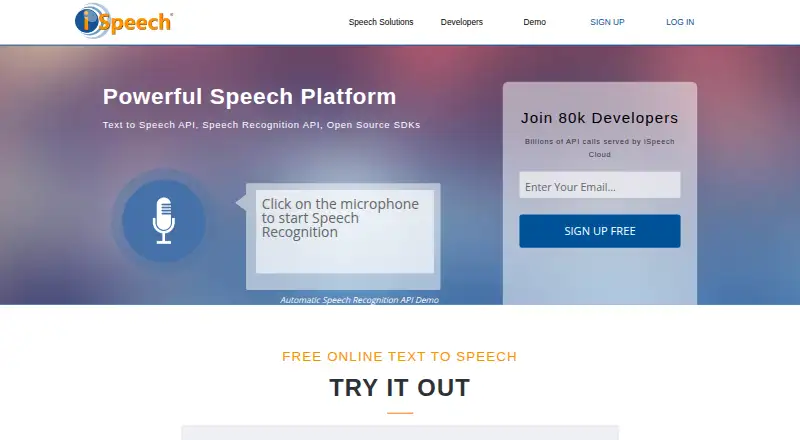
What iSpeech is
iSpeech provides text-to-speech and automated speech recognition through APIs, SDKs, and online tools. Its speech API converts text into spoken audio in multiple voices, formats, bitrates, frequencies, and playback speeds, with support for MathML and SSML. It can also transcribe submitted audio across multiple languages and recognition models; iSpeech says custom recognition models are available. The homepage lists support for more than 30 languages. Audio downloads include WAV, MP3, OGG, WMA, AIFF, A-law, μ-law, VOX, and MP4. The service is available on Android, iOS, Linux, macOS, Windows, and the web, as well as through APIs and extensions. iSpeech offers a free personal-use plan and supports commercial use. Plus is $2.95 a month, billed monthly, and Premium is $3.95 a month, billed monthly. Other listed options include Pay Per Use at $50 a month for dynamic TTS usage only, and Pay Per Install at $0.25 a month with a 10,000-install minimum. The company also describes educational uses such as spoken course materials and pronunciation practice.
Good
- Free personal-use plan is listed.
- Supports text-to-speech and audio transcription.
- Homepage lists support for more than 30 languages.
- Audio downloads span multiple listed formats.
- Commercial use and API access are available.
Watch out
- Pay Per Use covers dynamic TTS only.
- Pay Per Install has a 10,000-install minimum.
- Privacy policy cannot warrant security of transmitted information.
Who it suits
iSpeech may suit people who need text-to-speech or transcription, as well as developers seeking API or SDK access. Its described education uses include mobile learning apps, spoken course materials, and pronunciation practice.
Verdict
iSpeech combines speech synthesis and recognition with APIs, SDKs, and online tools. Check the plan terms and usage limits against your intended use before choosing a paid option.
Plans and prices
From iSpeech's own pricing page, checked 20 Sep 2026.
| Plan | Price | What it gives you |
|---|---|---|
| Pay Per Use | $50 a month | 2,000 credits · Dynamic TTS usage only |
| Pay Per Install | $0.25 a month | 10,000-install minimum · First 10,000–100,000 installs; 10,000-install minimum |
| Hacker | Free | Free |
| Basic | Free | As many files as you want · each file up to 1 min · non-commercial voices · always free |
| Plus | $2.95 a month | As many files as you want · each file up to 30 min · non-commercial voices · as low as $2.95* |
| Premium | $3.95 a month | As many files as you want · each file up to 12 hours · non-commercial voices · as low as $3.95* |
| Junior | $29 a month | Annual option $299/yr with 2 months free · $29/mo |
| Pay-per-use 2,000 credits | $50, paid once | 1 credit equals 1 word or speech-recognition transaction · $50.00 |
| Junior annual | $299 a year | $299/yr (2-month Free) |
| Growth | $399 a month | Annual option $3999/yr with 2 months free · $399/mo |
| Growth annual | $3,999 a year | $3999/yr (2-month Free) |
| Elite(L33T) | Priced on request | Contact Us (low custom price) |
| Elite (L33T) | Priced on request | Contact Us (low custom price) |
The facts
Each one read from iSpeech's own pages, with the date it was checked.
Where it runs
- Android app update
- Google Play lists the iSpeech-Text to Speech app as updated on July 9, 2025.checked 14 Oct 2026
- Limit: Android support response
- A Google Play reviewer says support did not answer questions and that changing voices made it difficult to restore the original voice.checked 14 Oct 2026
What it does
- API access
- API access requires an API key, with mobile development, mobile production, and web/general production key types.checked 11 Oct 2026
- API authentication
- Every API call requires an API key obtained through a registered developer account.checked 14 Oct 2026
- API protocols
- Requests can use HTTP GET or POST with URL-encoded, JSON or XML payloads and responses.checked 14 Oct 2026
- Audiobook workflow
- The publisher tool converts PDF textbook files into customized audio and supports pronunciation changes and 30-plus languages.checked 14 Oct 2026
- Audio downloads
- The audio creation page offers downloads in WAV, MP3, OGG, WMA, AIFF, A-law, μ-law, VOX, and MP4 formats.checked 11 Oct 2026
- Capterra ease-of-use score
- Capterra lists an ease-of-use score of 4.7 out of 5 for iSpeech Translator.checked 14 Oct 2026
- Commercial use
- Yeschecked 20 Sep 2026
- Developer support
- The developer guide directs users to email support and lists weekday sales phone support during Eastern Time business hours.checked 14 Oct 2026
- Developer tools
- The API guide lists SDK availability for iPhone, Android, BlackBerry, .NET, Java, PHP, Flash, JavaScript, Ruby, Python, and Perl.checked 11 Oct 2026
- eLearning features
- The eLearning offering includes confidence scores for speaking practice, real-time word highlighting and voice interactions in mobile apps.checked 14 Oct 2026
- Export formats
- aiff,mp3,ogg,wma,flac,wav,alaw,ulaw,vox,mp4checked 20 Sep 2026
- Google Play data safety
- The Android listing says no data is shared with third parties, data is encrypted in transit and the app may collect personal information, messages and three other data types.checked 14 Oct 2026
- Hosted service
- The publisher documentation describes the TTS service as cloud based and requiring no hardware or software installation.checked 14 Oct 2026
- Languages
- The homepage says the Speech API supports text-to-speech and speech recognition in more than 30 languages.checked 11 Oct 2026
- Limit: mobile translator
- A G2 reviewer reports missing voice input/output for some languages, freezes during conversion and an awkward keyboard workflow in the mobile app.checked 14 Oct 2026
Money
- Capterra trial listing
- Capterra says a free trial is not available and directs buyers to contact the vendor for pricing.checked 14 Oct 2026
- Free plan
- Yeschecked 20 Sep 2026
The company
- Company
- iSpeech describes itself as a privately held company headquartered in Newark, New Jersey, with an office in San Francisco, California.checked 11 Oct 2026
- Company legal status
- iSpeech identifies itself as a privately held company called iSpeech, Inc.checked 14 Oct 2026
- Company scale claim
- LinkedIn says iSpeech has more than 30 million app downloads, 25,000-plus developers and billions of API calls.checked 14 Oct 2026
- Founded and size
- LinkedIn lists iSpeech, Inc. as founded in 2007 with 11–50 employees.checked 14 Oct 2026
- Headquarters
- The company lists Newark, New Jersey as headquarters and San Francisco as an additional office.checked 14 Oct 2026
The full review of iSpeech
iSpeech combines text-to-speech and speech recognition, with tools for developers as well as people creating audio directly. It is best suited to app makers and education teams that need speech capabilities across products. Its range of voices, languages, and export formats is appealing, but the split between personal plans and usage-based developer pricing calls for care before committing.
Overview
iSpeech provides speech synthesis and automated transcription through APIs, SDKs, and online tools. The Speech API supports more than 30 languages, making it relevant to projects that need speech in multiple languages rather than a single-purpose audio generator. Commercial use and API access are supported, though the pricing structure varies sharply between downloadable audio and developer usage.
Key features
- Configurable synthesis: The API supports multiple voices, formats, bitrates, frequencies, and playback speeds, plus MathML and SSML. That flexibility suits developers building speech into products or rendering specialized text; it is more capability than a casual one-off user may need.
- Speech recognition: iSpeech can transcribe submitted audio across multiple languages and recognition models, and says it can create custom models. This makes it a stronger fit for applications that need both spoken output and transcription than a text-to-speech-only tool.
- Downloads: The audio creation page offers WAV, MP3, OGG, WMA, AIFF, A-law, μ-law, VOX, and MP4. That breadth helps when a downstream workflow expects a particular format, although developer pay-per-use terms distinguish dynamic TTS from static use, caching, and downloads.
- Developer reach: SDK examples cover iPhone, Android, BlackBerry, Java, .NET, JavaScript, and Flash/Flex/Air; the API guide also lists PHP, Ruby, Python, and Perl. This range gives teams several integration paths, while the support route is [email protected] and purchases include priority technical support.
- Security: iSpeech describes physical, managerial, and technical safeguards, but does not warrant the security of transmitted information. Teams handling sensitive audio should weigh that qualification before sending it through the service.
Pricing
iSpeech is freemium, with a free plan and a free trial. The personal audio plans are modestly priced, but their recording and word allowances make them better for bounded workloads than ongoing high-volume production.
- Basic: Free for personal use. It is the no-cost starting point, but the personal-use condition rules it out for commercial work.
- Plus: $2.95 a month, billed monthly, for 30-minute recordings and approximately 4,167 words. This is a reasonable fit for occasional short audio; the allowance is restrictive for longer materials.
- Premium: $3.95 a month, billed monthly, for 12-hour recordings and approximately 100,000 words. The small step up from Plus makes it the more practical personal option for larger projects.
- Pay Per Use: $50 a month for 2,000 credits, covering dynamic TTS usage only. It is aimed at developers who need usage-based synthesis, but static use, caching, or downloading audio requires contacting iSpeech.
- Pay Per Install: $0.25 a month for the first 10,000–100,000 installs, with a 10,000-install minimum. The minimum makes this a poor fit for small deployments.
- Hacker: Free. This is another no-cost option, though the plan does not establish a quota or use case to compare with the personal Basic plan.
- Junior: $29 a month, with annual billing at $299/yr (2-month Free). It is positioned as a paid tier, but no included usage allowance is given to assess its capacity.
- Growth: $399 a month, with annual billing at $3999/yr (2-month Free). This is a substantial commitment, and the plan's capacity is not described.
- Elite(L33T): Custom pricing, with a low custom price. It is the route for buyers seeking a tailored paid arrangement.
Commercial customers should not assume the personal audio allowances apply to developer use: dynamic TTS, static use, caching, and downloads are treated differently. Check that distinction against the intended workflow before choosing a paid plan.
Platforms
iSpeech supports Android, iOS, Linux, macOS, Windows, web, APIs, and extensions. The developer materials also name BlackBerry and several programming languages, giving product teams integration options beyond the consumer-facing platforms.
Who it's for
iSpeech suits developers adding synthesis or transcription to applications, and educators or schools creating spoken course materials and pronunciation practice. Audio creators who need several export formats may also find the online tools useful. It is less compelling for buyers who need clearly defined, high-volume developer allowances at a glance, or for users whose only need is simple text-to-speech.
Pros and cons
- Pros: Synthesis and recognition in one API offering can serve applications needing both directions of speech.
- Pros: More than 30 languages, configurable speech output, and numerous download formats suit varied content and integration needs.
- Pros: Personal Premium offers 12-hour recordings and approximately 100,000 words for $3.95 a month, a substantial allowance for that plan category.
- Cons: The free Basic plan is personal-use only, limiting its value for commercial evaluation or deployment.
- Cons: Pay Per Use covers dynamic TTS only, so static use, caching, and downloaded audio can require a separate conversation about terms.
- Cons: Several paid tiers do not state an included usage allowance, making their fit harder to judge in advance.
Alternatives
For a broader category comparison, see Text-to-Speech Software.
- Voice RSS is worth considering when a defined daily request cap is preferable: its free plan allows 350 daily requests and 100KB per request, while Advanced at $5 a month raises that to 1,000 daily requests.
- TTSReader is another freemium option with a free plan and free trial.
- Adobe Firefly offers a free plan with limited daily generations; consider it when that generation-based model fits better.
- Pocket TTS is a free, open-source alternative with CPU-based speech synthesis and a Python API and CLI, suited to readers who want that approach.
- Voice.ai pairs text-to-speech with an online voice changer and audio tools, making it an option when those functions matter alongside speech output.
- Calik AI is a freemium alternative spanning AI Center modules and agent tools rather than a dedicated speech offering.
- Fish Audio has a free tier with 8,000 monthly credits, generation up to seven minutes, and a 500-character per-generation cap, useful when those limits match the job.
- SaluteSpeech offers synthesis and recognition packages, including a freemium allowance of 200,000 synthesis characters and 100 recognition minutes.
Verdict
Choose iSpeech if you are building an app or education tool that can benefit from both speech synthesis and recognition, or need flexible voices, formats, and language support. Its breadth is the main reason to choose it; the main reason to look elsewhere is the uncertainty around developer usage beyond dynamic TTS and the limits of several paid tiers. Match the plan to the exact use case before paying.
Getting started
- Open the iSpeech website.
- Choose an online tool or review the API and SDK options.
- Select a plan, such as the free personal-use Basic plan or a paid option.
- Use the listed platform or developer tools that fit your project.
- Choose an audio output format from the listed download formats.
Limits worth knowing
Basic is a free personal-use plan. Plus lists 30-minute recordings and approximately 4,167 words, while Premium lists 12-hour recordings and approximately 100,000 words; Pay Per Use is for dynamic TTS only and includes 2,000 credits.
Questions
Is iSpeech free?
Yes. Basic is listed as a free plan for personal use.
What does Plus cost?
Plus costs $2.95 a month, billed monthly, and lists 30-minute recordings or approximately 4,167 words.
What does Premium cost?
Premium costs $3.95 a month, billed monthly, and lists 12-hour recordings or approximately 100,000 words.
Which platforms are listed?
The platform list includes Android, API, extension, iOS, Linux, macOS, web, and Windows.
Does iSpeech provide API access and support commercial use?
Yes. API access and commercial use are both listed.
What audio formats can I download?
Listed formats are WAV, MP3, OGG, WMA, AIFF, A-law, μ-law, VOX, and MP4.
Alternatives to iSpeech
- 1
Voicebox
Free planOpen sourceAndroidiOSWebAPI8.5From $12 a year - 2
Resemble AI
Free planAndroidiOSWebAPI8.3From $280 a month - 3

Speechify
Free planAndroidiOSWebAPI8.3From $10 a month - 4
Voice.ai
Free planAndroidiOSWebAPI8.3From $5 a month - 5

Fliki
Free planAndroidiOSWebAPI8.2From $28 a month - 6
Vocalware
Free planAndroidiOSWebAPI8.1$99.50 one-time