
Fish Audio
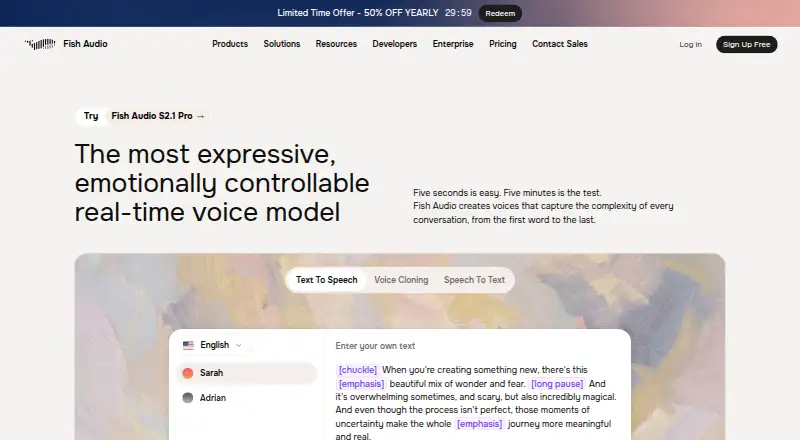
Fish Audio provides text-to-speech, voice cloning, speech-to-text, voice agents, and other audio tools.
What Fish Audio is
Fish Audio provides text-to-speech, voice cloning, speech-to-text, voice agents, and other audio tools. Its TTS controls include emotion and expression, real-time generation, multilingual support, and adjustments for speed, volume, and model parameters. Fish Audio says TTS automatically supports eight languages with native accents, and its platform hosts more than 2,000,000 voices. Developers can use the API for speech generation, voice cloning, and transcription through REST, WebSocket streaming, and official Python and TypeScript SDKs. Listed platforms include web, Linux, macOS, Windows, API, and self-hosted deployments. The free tier includes 8,000 monthly credits, up to 7 minutes of generation, and personal, non-commercial use. Enterprise deployments include VPC, on-premises, air-gapped, and sovereign cloud options. Fish Audio says default data stays in the United States and self-hosted deployments run within the customer's infrastructure. Unused monthly minutes do not roll over.
Good
- TTS includes emotion, expression, and speed controls.
- API supports speech generation, cloning, and transcription.
- Listed for web, desktop, API, and self-hosted use.
- Enterprise deployments include on-premises and air-gapped options.
Watch out
- Free tier is limited to personal, non-commercial use.
- Unused monthly minutes do not roll over.
Who it suits
It suits creators making voiceovers, audiobook narration, or character voices, as well as developers building conversational chatbots. Its API and self-hosted options may suit teams integrating audio tools into their own systems.
Verdict
Fish Audio combines audio generation and transcription tools with API and deployment choices. Check the free tier's generation limits and non-commercial restriction, and note that monthly minutes expire rather than roll over.
Plans and prices
From Fish Audio's own pricing page, checked 30 Sep 2026.
| Plan | Price | What it gives you |
|---|---|---|
| Free Tier | Free | $0/mo · 8,000 credits monthly · up to 7 minutes generation · up to 500 characters per generation · 3 public voice slots · standard generation speed · personal, non-commercial use |
| Plus | $11 a month | 250,000 credits monthly · up to 200 minutes generation · up to 15,000 characters per generation · unlimited public + 10 private voice slots · 1 professional voice slot · $132 billed annually |
| Pro | $75 a month | 2,000,000 credits monthly · up to 1,620 minutes generation · 3 team seats included · up to 30,000 characters per generation · unlimited voice slots · 5 professional voice slots · 7 days money back guarantee · $900 billed annually |
| Max | $749 a month | 25,000,000 credits monthly · up to 6,250 minutes generation · 10 team seats included · 15 professional voice slots · $8988 billed annually |
| Enterprise | Priced on request | custom pricing · pay as you go with organization-level controls · Zero Data Retention · On-Premise Deployment · SOC2 Compliance · Custom SSO (Coming soon) · volume pricing billed annually |
The facts
Each one read from Fish Audio's own pages, with the date it was checked.
What it does
- API
- The API offers speech generation, voice cloning, and transcription through REST, WebSocket streaming, and official Python and TypeScript SDKs.checked 30 Sep 2026
- API access
- Yeschecked 20 Sep 2026
- Commercial use
- The pricing page says free plan users may use generated content only for personal, non-commercial projects, while premium subscribers may commercially use verified voices they own.checked 30 Sep 2026
- Data residency
- The enterprise page says default data stays in the United States and that self-hosted deployments run inside the customer's infrastructure.checked 30 Sep 2026
- Enterprise deployment
- Enterprise deployments are offered for VPC, on-premises, air-gapped, and sovereign cloud environments.checked 30 Sep 2026
- Integrations
- The enterprise page lists integrations or ecosystem connections for Vapi, Twilio, Retell, and workflow automation tools.checked 30 Sep 2026
- Languages
- Fish Audio states that TTS automatically supports eight languages with native accents.checked 30 Sep 2026
- Paid from
- 15checked 20 Sep 2026
- Product
- Fish Audio provides text-to-speech, voice cloning, speech-to-text, voice agents, and other audio tools.checked 30 Sep 2026
- Security
- Fish Audio says its SOC 2 Type II audit is underway and that enterprise contracts can enable Zero Data Retention; it also describes HIPAA-aligned configurations and BAAs for qualifying healthcare workloads.checked 30 Sep 2026
- Support
- Enterprise support includes 24/7 production support, a technical account manager, and a stated 99% uptime SLA.checked 30 Sep 2026
- Usage limit
- The pricing FAQ says unused monthly minutes do not roll over to the next billing cycle.checked 30 Sep 2026
- Use cases
- Fish Audio names video voiceovers, audiobook narration, character voices, and conversational chatbots as use cases.checked 30 Sep 2026
- Voice cloning
- Yeschecked 20 Sep 2026
- Voice controls
- Its TTS page describes emotion and expression controls, real-time generation, multilingual support, and controls for speed, volume, and model parameters.checked 30 Sep 2026
- Voice library
- The website says its platform hosts more than 2,000,000 voices.checked 30 Sep 2026
The company
- Company
- The site identifies Hanabi AI Inc. as the company behind Fish Audio.checked 30 Sep 2026
- Headquarters
- Dover, Delaware, United Stateschecked 23 Sep 2026
Money
- Free plan
- Yeschecked 20 Sep 2026
The full review of Fish Audio
Fish Audio combines text-to-speech, voice cloning, transcription and voice-agent tools for creators and developers who need several audio workflows in one service. Its controls, broad voice library and multiple API options make it a flexible choice; the free tier is limited to personal use, while paid monthly minutes expire rather than roll over.
Overview
Fish Audio serves both individual creators making voiceovers or narration and teams building conversational audio products. Its TTS supports emotion and expression controls, real-time generation and eight languages with native accents. The service also offers speech-to-text, voice cloning and voice agents, with REST and WebSocket APIs plus Python and TypeScript SDKs.
The platform hosts more than 2,000,000 voices and supports WAV, PCM, MP3 and Opus output. That range makes it useful for projects from character voices to chatbots, though the value of a large library depends on finding voices that suit a particular production.
Key features
- Voice generation: Adjust emotion, expression, speed, volume and model parameters. Real-time generation and eight automatically supported languages with native accents give creators room to shape delivery without limiting the product to one format.
- Voice library and cloning: The library includes more than two million voices, and voice cloning is available. Plus provides one professional voice slot; Pro offers five, and Max offers 15.
- API and integrations: Generate speech, clone voices and transcribe audio through REST or WebSocket streaming, or use the official Python and TypeScript SDKs. Enterprise connections include Vapi, Twilio, Retell and workflow automation tools.
- Deployment and data: Enterprise customers can choose VPC, on-premises, air-gapped or sovereign cloud deployments. Data stays in the United States by default; self-hosted deployments run inside the customer's infrastructure.
- Security and support: Fish Audio's SOC 2 Type II audit is underway. Enterprise contracts can enable Zero Data Retention; HIPAA-aligned configurations and BAAs are available for qualifying healthcare workloads. Enterprise support includes 24/7 production support, a technical account manager and a stated 99% uptime SLA.
Pricing
The free tier costs nothing and includes 8,000 credits monthly, up to 7 minutes of generation, a 500-character cap per generation, three public voice slots and standard generation speed. It is limited to personal, non-commercial use, so it is best for trying the service or personal projects—not commercial publishing.
Plus costs $11 a month, billed $132 billed annually. It raises the monthly allowance to 250,000 credits and up to 200 minutes, allows 15,000 characters per generation, and includes unlimited public and 10 private voice slots plus one professional voice slot. It suits individual creators who need commercial work and more capacity than the free tier, but the monthly generation ceiling remains modest for frequent production.
Pro costs $75 a month, billed $900 billed annually. It includes 2,000,000 monthly credits, up to 1,620 minutes, three team seats, a 30,000-character generation cap, unlimited voice slots and five professional voice slots. This is the more practical tier for a small team or a creator with substantial output; it also includes a seven-day money-back guarantee.
Max costs $749 a month, billed $8988 billed annually. Its 25,000,000 monthly credits and up to 6,250 minutes, 10 team seats and 15 professional voice slots target high-volume teams. Enterprise has custom pricing, with volume pricing, pay-as-you-go organization controls, Zero Data Retention, on-premise deployment and SOC2 Compliance.
Across paid plans, unused monthly minutes do not roll over, so buyers should match the tier to usage they can consume within each billing cycle.
Platforms
Fish Audio is available on the web and supports API, Linux, macOS, Windows and self-hosted deployment. The API's REST and streaming options suit software integrations; self-hosting and enterprise deployment choices are relevant to organizations that need to run audio workloads in their own infrastructure.
Who it's for
Fish Audio is a strong fit for video creators, audiobook narrators and character-voice producers who want expressive TTS and voice cloning, as well as developers building conversational chatbots or other audio applications. Its free plan can help with personal experimentation, while commercial use requires a paid option. Organizations with stricter infrastructure or data requirements can consider enterprise deployment and controls.
It is a weaker fit for anyone expecting free commercial output, carrying unused monthly minutes forward, or needing a small, simple plan for occasional commercial use: the free tier is non-commercial, minutes expire monthly, and Plus still caps generation at 200 minutes.
Pros and cons
- Pro: TTS controls cover emotion, expression, speed and volume, giving creators more say over delivery than a basic text-to-speech workflow.
- Pro: Speech generation, cloning and transcription share an API with REST, WebSocket streaming and official SDKs, which helps developers build around multiple audio tasks.
- Pro: Self-hosted and enterprise deployment choices address infrastructure needs that a web-only tool would not.
- Con: The free tier permits only personal, non-commercial use, so commercial creators must budget for a paid plan.
- Con: Monthly minutes expire instead of rolling over, making low or uneven usage harder to justify against a fixed monthly allowance.
- Con: Team seats are included only with Pro and Max among the priced plans, leaving Plus oriented toward individual use.
Alternatives
For a free option with API, desktop, web and self-hosted platform support, consider GPT-SoVITS. Voicebox is another freemium choice, with Android and iOS support alongside API, desktop and self-hosted platforms. VoiceStudio is free and spans API, desktop, web and self-hosted use.
CosyVoice is a free, Apache-2.0-licensed option for users who want downloadable source code and models to self-manage, with API and Linux support. Kits AI is a freemium alternative with web, Windows and API support; its Free plan includes 15 conversion minutes, voice designer/blender and generative vocals, but no voice slots or download minutes.
CereProc is a paid alternative with broad platform support and a CereVoice Cloud 1 Million Credit plan at £12.99 a month. Chatterbox TTS is a free option for Linux and macOS. Resemble AI is a paid alternative with API, self-hosted and web support.
Browse the Voice Cloning Software, AI Voice Cloning Software, AI Voice Generators and Text-to-Speech Software directories to compare more options.
Verdict
Choose Fish Audio if you need expressive speech generation alongside cloning, transcription or API-based audio features, especially when self-hosting or enterprise deployment matters. Its breadth is the main reason to choose it; the commercial restriction on the free tier and non-rollover minutes are the clearest reasons to look elsewhere or size a paid plan carefully.
Getting started
- Visit the Fish Audio website.
- Choose the free tier or a paid plan; the free tier is for personal, non-commercial use.
- Use Fish Audio on web, Linux, macOS or Windows, or access its API.
- For API integration, use REST, WebSocket streaming, or the official Python or TypeScript SDKs.
- For enterprise deployment, consider VPC, on-premises, air-gapped or sovereign cloud options.
Limits worth knowing
The free tier provides 8,000 credits monthly, up to seven minutes of generation, up to 500 characters per generation and three public voice slots. It runs at standard generation speed and is limited to personal, non-commercial use; unused monthly minutes do not roll over.
Questions
Who makes Fish Audio?
The site identifies Hanabi AI Inc. as the company behind Fish Audio. Fish Audio is headquartered in Dover, Delaware, United States.
Is Fish Audio free?
It offers a free tier with 8,000 credits monthly and up to seven minutes of generation. Free-tier use is personal and non-commercial.
What does Fish Audio cost?
The Plus plan is listed at $11.00 per month, billed annually at $132.
What platforms are available?
Fish Audio lists API, Linux, macOS, self-hosted, web and Windows.
Can Fish Audio be used commercially?
Commercial use is listed as available. The free tier is limited to personal, non-commercial use.
What enterprise deployment and data options does it offer?
Enterprise deployments are offered for VPC, on-premises, air-gapped and sovereign cloud environments. Fish Audio says default data stays in the United States, while self-hosted deployments run inside the customer's infrastructure.
Alternatives to Fish Audio
- 1

Voicebox
Free planOpen sourceAndroidiOSWebAPI9.3From $12 a year - 2

Speechify
Free planAndroidiOSWebAPI9.0From $10 a month - 3

Resemble AI
Free planAndroidiOSWebAPI9.0From $280 a month - 4
iSpeech
Free planOpen sourceAndroidiOSWebAPI9.0Free plan - 5

Fliki
Free planAndroidiOSWebAPI8.8From $28 a month - 6
Voice.ai
Free planAndroidiOSWebAPI8.8From $5 a month