
SchemaCrawler
SchemaCrawler is a free database schema discovery and comprehension tool for database documentation and data governance.
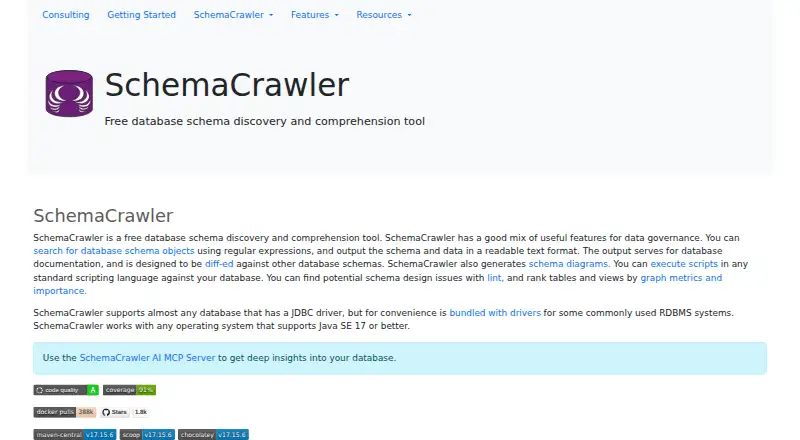
What SchemaCrawler is
SchemaCrawler is a free database schema discovery and comprehension tool for database documentation and data governance. Its command-line tools export database metadata as plain text, HTML5, HTML5 with embedded diagrams, JSON, or YAML. The output formats are designed to make schema differences easier to identify. SchemaCrawler can generate entity-relationship diagrams and run JavaScript or Python scripts against a live database connection. It supports almost any database with a JDBC driver, though some proprietary drivers must be downloaded separately. Documented integrations include Apache Maven, GitHub Actions, GitLab pipelines, Docker, Graphviz, and templating engines such as Velocity, Thymeleaf, FreeMarker, and Mustache; templating engines are not bundled with the download. Its AI MCP Server enables natural-language exploration of database structure and table relationships, as well as SQL query generation. SchemaCrawler runs on operating systems that support Java SE 17 or later. The free open-source software has bundled JDBC-driver distributions under GPL v3, and commercial-use licensing terms can be arranged.
Good
- Exports metadata in five listed formats.
- Can generate entity-relationship diagrams.
- Supports almost any database with a JDBC driver.
- Free and open-source software.
Watch out
- Some proprietary JDBC drivers require separate downloads.
- Templating engines are not bundled.
- Requires an operating system supporting Java SE 17 or later.
Who it suits
SchemaCrawler suits database practitioners who need schema documentation, comparisons, or data-governance support. It may also fit users who can work with command-line tools and Java SE 17 or later.
Verdict
SchemaCrawler provides several ways to inspect, document, and compare database structures without a software charge. Account for its Java requirement and separately obtained drivers or templating engines where relevant.
Plans and prices
From SchemaCrawler's own pricing page, checked 30 Sep 2026.
| Plan | Price | What it gives you |
|---|---|---|
| SchemaCrawler | Free | Free and open-source software · bundled JDBC-driver distributions are GPL v3 · commercial-use licensing terms can be arranged |
The facts
Each one read from SchemaCrawler's own pages, with the date it was checked.
What it does
- AI interface
- The SchemaCrawler AI MCP Server supports natural-language interaction for exploring database structure, understanding table relationships, and generating SQL queries.checked 30 Sep 2026
- Database support
- It supports almost any database with a JDBC driver, though some proprietary drivers must be downloaded separately.checked 30 Sep 2026
- Diagrams and scripts
- SchemaCrawler can generate entity-relationship diagrams and execute scripts in JavaScript or Python against a live database connection.checked 30 Sep 2026
- Integrations
- The site documents integrations with Apache Maven, GitHub Actions, GitLab pipelines, Docker, Graphviz, and templating engines including Velocity, Thymeleaf, FreeMarker, and Mustache.checked 30 Sep 2026
- Online tutorial
- A live online command-line tutorial works in a browser without additional software or plugins.checked 30 Sep 2026
- Output formats
- The command-line tools can output database metadata as plain text, HTML5, HTML5 with embedded diagrams, JSON, or YAML.checked 30 Sep 2026
- Purpose
- SchemaCrawler is a free database schema discovery and comprehension tool for database documentation and data governance.checked 30 Sep 2026
- Schema comparison
- Its schema output formats are designed to make it easy to find differences between database schemas.checked 30 Sep 2026
- Security
- The security guidance says SchemaCrawler cannot vouch for the security of scripts it executes and recommends removing the scripting JAR if scripting is not needed.checked 30 Sep 2026
- SQL Server encryption
- The security guidance says the server, host, and port connection method turns off encrypted connections and recommends a trusted certificate and a URL containing encrypt=true.checked 30 Sep 2026
- Support
- Community support is available on Stack Overflow, while professional support packages provide direct access to the author and can cover project advice or consulting.checked 30 Sep 2026
- Support scope
- The support page says only the latest SchemaCrawler version receives new feature development and security updates, and older-version support requires a Professional Support Package.checked 30 Sep 2026
- Templating limit
- Templating engines are not included in the SchemaCrawler download and must be downloaded separately.checked 30 Sep 2026
Where it runs
- Platform requirement
- SchemaCrawler works on operating systems that support Java SE 17 or better.checked 30 Sep 2026
The full review of SchemaCrawler
Overview
SchemaCrawler is a free, open-source command-line tool for discovering, documenting, and comparing relational database schemas. It suits developers and data teams comfortable working with Java and JDBC who need portable schema output or database governance workflows.
Its range of output formats, diagrams, and automation integrations make it a capable choice without a software fee, but the Java requirement and separately sourced drivers or templating engines add setup work.
For other options, browse our Database Documentation Tools list.
Key features
- Schema documentation and comparison: Generate metadata as plain text, HTML5, HTML5 with embedded diagrams, JSON, or YAML. The formats are designed to make differences between schemas easier to find, useful when documenting databases or reviewing changes.
- Diagrams and scripting: Generate entity-relationship diagrams or run JavaScript and Python scripts against a live database connection. Scripting can extend database workflows, but SchemaCrawler warns that it cannot vouch for script security; remove the scripting JAR if scripting is unnecessary.
- Broad JDBC connectivity: It supports almost any database with a JDBC driver. Some proprietary drivers must be downloaded separately, so database access may require extra setup.
- Automation and templating: Integrations are documented for Apache Maven, GitHub Actions, GitLab pipelines, Docker, and Graphviz. Velocity, Thymeleaf, FreeMarker, and Mustache are supported templating options, but their engines are not bundled and must be obtained separately.
- AI interface: The SchemaCrawler AI MCP Server supports natural-language exploration of database structures and table relationships, as well as SQL query generation.
- Browser tutorial: A live command-line tutorial runs in a browser without additional software or plugins, offering a way to learn the workflow before installing anything.
Pricing
SchemaCrawler: free. The free and open-source software includes the core tool; bundled JDBC-driver distributions are GPL v3, and commercial-use licensing terms can be arranged. There is no free trial because the plan is free. Professional support packages are separate and provide direct access to the author for project advice or consulting.
Community support is available on Stack Overflow. Only the latest version receives new feature development and security updates; support for older versions requires a Professional Support Package.
Platforms
SchemaCrawler works on operating systems that support Java SE 17 or better, including Linux, macOS, and Windows. It is self-hosted, with an API also listed as a platform. The server, host, and port connection method for SQL Server turns off encrypted connections; the security guidance recommends using a trusted certificate and a connection URL containing encrypt=true.
Who it's for
SchemaCrawler is a strong fit for database developers, administrators, and governance teams who value command-line tooling, schema comparison, and outputs that can feed documentation or automation. Its relational coverage includes data lineage, data dictionaries, and schema history. It is less suitable for users who want a turnkey graphical application or prefer not to manage Java, JDBC drivers, and any required templating engines.
Pros and cons
Pros
- No software charge: The core plan costs nothing, making it accessible for individual and organizational schema work.
- Flexible outputs: Five output types cover both human-readable documentation and structured data for downstream use.
- Automation options: Documented integrations and live-connection scripts suit teams incorporating schema inspection into development workflows.
Cons
- Java is required: Systems need Java SE 17 or better, which adds a prerequisite for users who want a simple standalone app.
- Some components are separate: Proprietary JDBC drivers and templating engines may need to be downloaded independently.
- Script security needs attention: Users who do not need scripting are advised to remove its JAR; SQL Server users also need to account for the encryption behavior of one connection method.
- Older versions have limited support: New features and security updates go only to the latest version, while older-version support requires a paid package.
Alternatives
dbdocs is worth considering for teams that want a web-capable documentation option with public sharing and password protection on its free plan; Personal Pro is $20 a month, or $16/month annually, for a single user.
Taavik may suit users seeking a freemium alternative with a web platform and a free plan that specifies database-server, member, query, schedule, history, and run limits.
tbls is another free, self-hosted CLI option for users who prefer an MIT-licensed single-binary tool.
DbSchema is an alternative for users who want a desktop product with a free trial and paid Pro and Architect plans.
DBX is a free alternative for readers interested in a community-built project maintained in a public repository.
Dataedo may fit teams looking for a paid product with a published Essentials plan at $18,000 a year and a three-editor minimum.
DataDocs is a web alternative with a free plan for one data source and 25 assets, or a Growth plan at $25 a month.
Azimutt is another freemium option for readers comparing web-based alternatives.
Verdict
Choose SchemaCrawler if you need free, scriptable relational-schema discovery with multiple export formats, schema comparison, and automation potential. Look elsewhere if Java-based command-line setup, separate components, or the need to stay on the latest version do not fit your team.
Alternatives to SchemaCrawler
- 1

MySQL
Free planAPILinuxmacOSSelf-hosted7.9Free plan - 2

Hackolade Studio
Free planWebAPILinuxmacOS7.8Free plan - 3

DbSchema
Free planLinuxmacOSWindows7.0From $29.40 a month - 4
pgModeler
Free planLinuxmacOSWindows6.9From $59.90 a month - 5

ChartDB
Free planWebSelf-hosted6.8From $25 a month - 6
DrawSQL
Free planWebAPI6.8From $19 a month