
Scanopy
Scanopy is network discovery and documentation software for mapping hosts, services, and network connections.
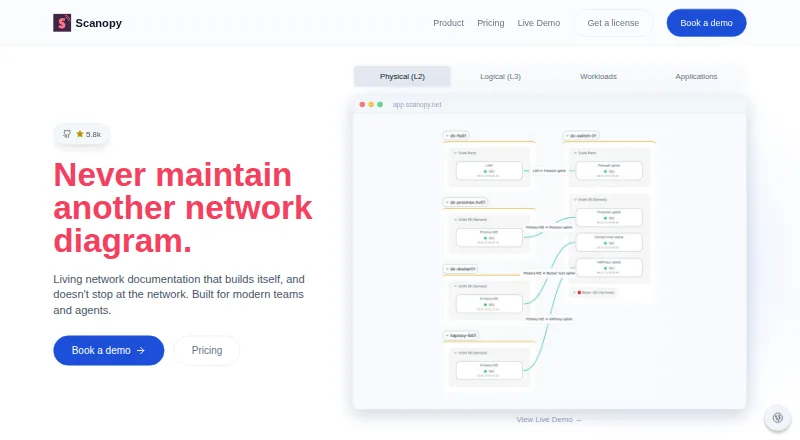
What Scanopy is
Scanopy is network discovery and documentation software for mapping hosts, services, and network connections. It builds Physical (L2), Logical (L3), Workloads, and Applications views from scans, then refreshes documentation on a schedule rather than continuously polling. A single network daemon handles discovery, so endpoint agents are not required. Integrations include Docker, Podman, UniFi Controller, SNMP, and beta support for Instant On and gNMI. Depending on the plan, teams can export or share diagrams in formats such as PNG, SVG, PDF, Mermaid, and CSV. The free Community Edition is self-hosted, open source under AGPL-3.0, and limited to one network and one seat. Scanopy documents assets and connections; it does not replace monitoring for device health, bandwidth, or alerts. Cloud topology and account data are stored on US-hosted infrastructure, while self-hosted discovery data stays in the customer's database.
Good
- Maps hosts, services, and network topology from scans
- Does not require agents on individual endpoints
- Offers a self-hosted open-source Community Edition
- Includes multiple topology views and diagram exports
Watch out
- Does not continuously poll the network
- Does not monitor device health, bandwidth, or alerts
- Community Edition is limited to one network and one seat
- Instant On and gNMI integrations are beta
Who it suits
Scanopy may suit homelab users and teams handling IT operations, managed services, security and compliance, or platform and DevOps work. Its free edition is limited to one network and one seat.
Verdict
Scanopy focuses on network inventory and documentation, with scheduled scans and several topology views. Consider its plan limits and the separate need for monitoring tools when deciding whether it fits your network.
Plans and prices
From Scanopy's own pricing page, checked 15 Oct 2026.
| Plan | Price | What it gives you |
|---|---|---|
| Community Edition | Free | self-hosted · 1 site · 1 user seat |
| Starter | $11.99 a month | 1 seat · 1 network · unlimited hosts · 7-day snapshot retention · billed yearly |
| Pro | $39.99 a month | 1 seat · 3 networks · unlimited hosts · 30-day snapshot retention · extra networks $8/network/month · billed yearly |
| Scanopy Cloud (starting) | $79.99 a month | 14-day free trial · flat-rate · hosted server · annual billing |
| Business | $79.99 a month | 5 seats · 15 networks · unlimited hosts · 90-day snapshot retention · extra seats $8/seat/month · extra networks $6/network/month · billed yearly |
| Self-Hosted Standard | $4,000 a year | 25 seats · 50 sites · 1 production + 2 non-production servers · unlimited hosts · custom snapshot retention · annually |
| Self-Hosted Plus | $7,000 a year | 50 seats · 100 sites · 1 production + 2 non-production servers · unlimited hosts · air-gapped keys · priority support · annually |
| Enterprise | Priced on request | custom seats · custom sites · custom servers · custom hosts · managed deployment · signed SLA |
The facts
Each one read from Scanopy's own pages, with the date it was checked.
What it does
- API
- The REST API uses bearer user API keys, supports /api/v1 endpoints, pagination and organization/site scoping, and is rate limited to 300 requests per minute.checked 15 Oct 2026
- API stability
- The API is pre-1.0 and may introduce breaking changes without an API-version increment.checked 15 Oct 2026
- Certifications
- Scanopy states that it does not currently hold formal certifications such as SOC 2 or ISO 27001.checked 29 Sep 2026
- Cloud data
- Scanopy Cloud stores topology and account data on US-hosted infrastructure, while self-hosted discovery data stays in the customer's database.checked 29 Sep 2026
- Community development
- The GitHub repository showed about 5.9 thousand stars, 315 forks and 7,341 commits when opened.checked 15 Oct 2026
- Community edition
- The free Community Edition is self-hosted, open source under AGPL-3.0, limited to one network and one seat, and has no time restriction.checked 29 Sep 2026
- Community release discussion
- A Reddit release post described four views—L2, L3, workloads and applications—and announced snapshots plus SNMPv1 and SNMPv3 AuthPriv support.checked 15 Oct 2026
- Distributed scanning
- Multiple daemons can be deployed across network segments, sites and VLANs.checked 15 Oct 2026
- Documentation depth
- The documentation includes quick start, discovery, topology, daemon deployment, integrations, troubleshooting, architecture, database schema and REST API reference sections.checked 15 Oct 2026
- Exports and sharing
- Plans list SVG, Mermaid, Confluence, draw.io, Visio, HTML, PDF, PNG and CSV exports plus embeds and read-only share links.checked 15 Oct 2026
- Founder
- The About page identifies Maya as Scanopy's founder and describes the product as a side project started from homelab needs.checked 15 Oct 2026
- Independent installation
- Marius Hosting documented running Scanopy on Synology with Docker and Portainer, using separate daemon, database and server containers.checked 15 Oct 2026
- Integrations
- Documented discovery integrations include Docker, Podman, Proxmox VE, UniFi, HPE Instant On, SNMP, SSH scripts, gNMI and Wake-on-LAN.checked 15 Oct 2026
- Known detection limit
- Pattern-based detection can miss non-standard ports, services requiring authentication, internal gateway-hidden components and cloud services.checked 15 Oct 2026
- Known IPv6 limit
- The product currently supports IPv4 only and does not perform full IPv6 subnet scanning.checked 15 Oct 2026
- Known subnet limit
- Subnets larger than /10 are skipped automatically, and a /10 may take days to scan.checked 15 Oct 2026
- License
- The Community Edition is open source under AGPL-3.0; commercial licenses are offered for users avoiding AGPL obligations.checked 15 Oct 2026
- Limit: export options
- VirtualizationHowto reported that its tested interface offered PNG export only and wanted PDF and additional export controls.checked 15 Oct 2026
- Logical topology
- The product creates Layer 3 maps showing IP subnets and host relationships.checked 15 Oct 2026
Where it runs
- Application mapping
- Application views group services by application and show dependencies between them.checked 15 Oct 2026
- Independent platform coverage
- Korben listed version 0.17.20 with daemon binaries for Windows, Linux, macOS and FreeBSD and a Linux server for x86-64 and ARM64.checked 15 Oct 2026
The company
- Company legal name
- The website footer identifies the maker as Scanopy LLC.checked 15 Oct 2026
- Company location
- The public GitHub README says the project is built in NYC.checked 15 Oct 2026
Money
- Limit: free export
- GIGAZINE reported that exporting from the Free plan produced an error during its hands-on test.checked 15 Oct 2026
The full review of Scanopy
Overview
Scanopy discovers hosts and services, then turns scan results into network documentation and topology diagrams. It suits teams that need to understand and share network structure without installing agents on every endpoint. Its scheduled refreshes and multiple views are useful for inventory work, but it is not a substitute for tools that monitor device health, bandwidth, or alerts.
Key features
Scanopy builds Physical (L2), Logical (L3), Workloads, and Applications views from network scans. That range helps teams examine both underlying connections and how workloads or applications relate; scheduled scans refresh the documentation, but the product does not continuously poll the network. For readers who need live health checks or alerting, that distinction is decisive.
A single daemon runs on a network, avoiding endpoint-by-endpoint agent deployment. Integrations include Docker, Podman, UniFi Controller, SNMP, and Instant On and gNMI, the latter two marked beta. Exports and sharing vary by plan and include formats and destinations such as PNG, SVG, HTML, PDF, Mermaid, Confluence, and CSV, along with shareable and embeddable diagrams. Paid plans include API access, with a documented limit of 300 requests per minute.
Scanopy supports device inventory, IP address management, network diagrams, credential storage, and relationship mapping. Its daemon does not capture, inspect, or store packet contents. Scanopy Cloud stores topology and account data on US-hosted infrastructure; with self-hosted discovery, the data stays in the customer's database. Scanopy does not currently hold formal certifications such as SOC 2 or ISO 27001, a material consideration for organizations with certification requirements.
Pricing
The free Community Edition is open source under AGPL-3.0, self-hosted, and has no time restriction. Its one-network, one-seat cap makes it suitable for a personal lab or a small evaluation, but not a shared team deployment.
- Starter: $11.99 a month, billed yearly. One seat, one network, unlimited hosts, and seven-day snapshot retention make it the lowest-cost paid option for a single operator who needs more history than the free edition offers.
- Pro: $39.99 a month, billed yearly. It keeps one seat and unlimited hosts but allows three networks and 30-day snapshot retention. Extra networks cost $8/network/month, so it suits an individual managing several sites, not a team needing multiple seats.
- Business: $79.99 a month, billed yearly. Five seats, 15 networks, unlimited hosts, and 90-day snapshot retention make it the more practical cloud plan for a small team. Extra seats are $8/seat/month and extra networks are $6/network/month.
- Self-Hosted Standard: $4,000 a year, billed annually, for 25 seats, 50 networks, one organization, unlimited hosts, and custom snapshot retention.
- Self-Hosted Plus: $6,000 a year, billed annually, for 50 seats, 100 networks, five organizations, unlimited hosts, and custom snapshot retention. The extra seats, networks, and organizations distinguish it for larger self-managed deployments.
- Enterprise: custom pricing, with custom seats, networks, organizations, hosts, and snapshot retention.
A 14-day trial is available. The main trade-off across the lower-priced plans is constrained seats, networks, and snapshot history; the higher self-hosted tiers raise those ceilings at annual prices.
Platforms
Scanopy is available for API, Linux, macOS, self-hosted, web, and Windows environments. Self-hosting is especially relevant to organizations that want discovery data to remain in their own database.
Who it's for
Scanopy is aimed at homelabs, IT operations, MSPs, security and compliance teams, and platform and DevOps teams. It is strongest when the priority is maintaining a structured picture of devices, services, and connections. Teams that require certified controls should weigh its lack of formal SOC 2 or ISO 27001 certification, while teams that need operational alerting should pair it with monitoring tools.
Pros and cons
- Pros: Four topology views provide several useful ways to interpret scan results; one daemon avoids endpoint agent rollouts; and the no-expiry, open-source Community Edition offers a genuine self-hosted starting point.
- Cons: Scheduled scans are not continuous monitoring, so they cannot replace health, bandwidth, or alerting tools. The free plan is limited to one network and seat, while paid plans constrain seats and network counts. Cloud topology and account data is hosted in the US, and formal SOC 2 or ISO 27001 certification is absent.
Alternatives
For a broader look at this category, see Network Documentation Software.
- LOGINventory is worth considering when a free plan covering up to 20 devices is a better fit than Scanopy's one-network, one-seat Community Edition.
- GestióIP is an alternative for readers seeking free IPAM software, with an optional Configuration Management Module priced at $400 a year for up to 50 devices.
- Netipam is another free option for Linux, self-hosted, or web environments.
- Open Network Diagram is a free, self-hosted Docker deployment under GNU GPL v3.
- Danbyte offers a free, open-source self-hosted option with all features included and no seat license or license expiry.
- Nautobot has a self-managed open-source Community edition intended for exploration, initial workflows, and limited production deployments.
- Obelinf offers a free Personal plan for one user, one organization, one site, four racks, and 30 devices.
- ITFlow is a free, open-source self-hosted option; hosting and sponsor support are paid services.
Verdict
Choose Scanopy if you need scheduled network discovery, documentation, and several topology perspectives without installing endpoint agents, and its seat and network limits fit your operation. Its self-hosted free edition lowers the barrier to starting, while paid tiers add capacity and retention. Look elsewhere or pair it with monitoring software if you need continuous health tracking and alerts, or require formal security certifications.
Getting started
- Visit https://scanopy.net/.
- Choose the self-hosted Community Edition or a paid plan.
- For discovery, run the single daemon on a network; endpoint agents are not required.
- Configure scans to refresh documentation on a schedule.
- Use plan-supported exports or integrations as needed.
Limits worth knowing
The free Community Edition is self-hosted and limited to one network and one user seat. The lowest paid plan, Starter at $11.99 per month billed yearly, includes one seat, one network, unlimited hosts, and seven-day snapshot retention.
Questions
Is there a free plan?
Yes. Community Edition costs nothing, is self-hosted and open source under AGPL-3.0, and has no time restriction.
What does the free plan include?
It is limited to one network and one user seat.
What is the cheapest paid plan?
Starter costs $11.99 per month billed yearly. It includes one seat, one network, unlimited hosts, and seven-day snapshot retention.
Which platforms are supported?
Listed platforms are API, Linux, macOS, self-hosted, web, and Windows.
Does Scanopy continuously monitor the network?
No. It refreshes documentation on a schedule rather than continuously polling, and it does not replace monitoring for device health, bandwidth, or alerts.
What integrations are listed?
Docker, Podman, Instant On, UniFi Controller, gNMI, and SNMP are listed. Instant On and gNMI are marked beta.
Alternatives to Scanopy
- 1
GestióIP
Free planOpen sourceWebAPILinuxSelf-hosted8.2From $400 a year - 2
i-doit
Open sourceAndroidiOSWebAPI8.1From €48.65 a month - 3
NinjaOne
AndroidiOSWebAPI7.9From $1.50 a month - 4

NetBox
Free planOpen sourceWebAPILinuxSelf-hosted7.6Free plan - 5

Danbyte
Free planOpen sourceWebAPILinuxSelf-hosted7.4Free plan - 6

Obelinf
Free planWebAPI7.4From $99 a month