Netipam
Netipam is open-source software for IP address management, network topology, inventory, and operational visibility.
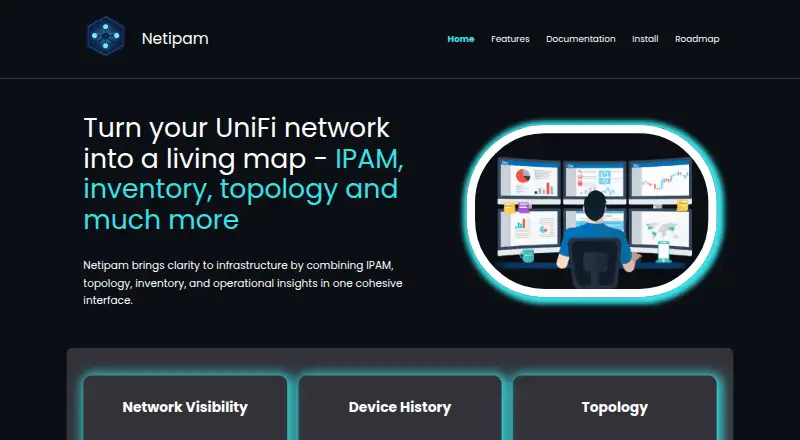
What Netipam is
Netipam is open-source software for IP address management, network topology, inventory, and operational visibility. It is intended for enthusiasts and professionals managing home or office networks, and currently gets client and device information from UniFi gateways or UniFi OS. Its dashboard can show offline and newly discovered device alerts, WAN status, subnet utilization charts, and a critical-devices list. Topology views show network hierarchy and upstream connections, and can export to Excel. Subnet pages show CIDR, usable and used addresses, DHCP range, VLAN ID, DNS, and the next three free IPs. Device and client records include status events and online/offline and IP history covering 30 days. Inventory fields include asset number, manufacturer, model, operating system, acquisition source, and date. Proxmox host profiles can map virtual machines and LXC guests to hosts. The software keeps data on the local device and requires no external services or database. Installation instructions cover Docker, Synology DSM Container Manager, and Linux distributions including Ubuntu, Debian, Rocky Linux, AlmaLinux, RHEL, CentOS, and Fedora. It is in beta; the installation page lists version 0.8.7 as current. Available deployment options include Linux, self-hosted, and web.
Good
- Keeps data local without external services or database
- Shows subnet details and the next three free IPs
- Tracks device status and IP history for 30 days
- Topology views can export to Excel
- Provides Admin, Editor, and Viewer roles
Watch out
- Currently pulls client and device details from UniFi
- Project is currently in beta
- Listed current version is 0.8.7
Who it suits
Netipam suits home, homelab, small-business, and commercial network operators who want local network visibility and IPAM. Its current device-information focus is UniFi, with Proxmox profiles for mapping virtual machines and LXC guests.
Verdict
Netipam brings IPAM, topology, device inventory, and operational information together while keeping data local. Its current UniFi focus and beta status are important considerations for prospective users.
The facts
Each one read from Netipam's own pages, with the date it was checked.
What it does
- Access control
- Built-in roles are Admin, Editor and Viewer, with permissions ranging from full access to view-only access.checked 1 Oct 2026
- Alerts
- The dashboard can show offline alerts and newly discovered client or device alerts.checked 2 Oct 2026
- Audience
- The maker describes Netipam as network visibility and IPAM for enthusiasts and professionals, and its feedback form lists home, homelab, small business, and commercial network types.checked 2 Oct 2026
- Current version
- The installation page lists version 0.8.7 as the current version.checked 1 Oct 2026
- Dashboard alerts
- The dashboard provides offline alerts, new-device alerts, WAN status, subnet utilization charts and a critical-devices list.checked 1 Oct 2026
- Data locality
- The homepage says Netipam requires no external services or external database and keeps all data local on the device.checked 1 Oct 2026
- Data location
- The maker says Docker deployment requires no external services or database and keeps data local on the user's device.checked 2 Oct 2026
- Deployment
- The maker provides installation instructions for Docker, Synology DSM Container Manager, and several Linux distributions.checked 2 Oct 2026
- History
- Client and device records include 30-day online and offline history and IP address history.checked 2 Oct 2026
- Integrations
- UniFi is the current focus; the documentation describes Proxmox profiles for mapping guests to hosts, including VM and LXC types.checked 2 Oct 2026
- Inventory
- Devices can be tracked with fields including asset number, manufacturer, model, operating system, acquisition source, and date.checked 2 Oct 2026
- IPAM
- Subnet details include CIDR, usable and used addresses, DHCP range, VLAN ID, DNS, and the next three free IPs.checked 2 Oct 2026
- IPAM details
- Subnet pages show CIDR, usable and used addresses, DHCP range, VLAN ID, DNS and the next three free IPs.checked 1 Oct 2026
- License
- The public GitHub repository identifies Netipam as MIT-licensed open-source software.checked 1 Oct 2026
- Project status
- The Docker Hub listing describes Netipam as currently in beta and developed and tested internally.checked 1 Oct 2026
- Proxmox integration
- Proxmox host profiles can automatically map virtual machines and LXC guests to hosts and assign client types.checked 1 Oct 2026
- Purpose
- Netipam combines IP address management, network topology, device inventory, and operational insights.checked 2 Oct 2026
- Security
- The maker says Netipam uses a local view-only UniFi user and recommends a dedicated UniFi account with view-only permissions when using username and password authentication.checked 2 Oct 2026
- Target users
- Netipam is designed for enthusiasts and professionals managing home or office networks.checked 1 Oct 2026
- Topology
- Network topology displays upstream connections and hierarchy, with an option to export the topology to Excel.checked 2 Oct 2026
- UniFi focus
- Netipam imports client and device information from a UniFi controller to build IPAM, topology, and connection status views.checked 2 Oct 2026
- UniFi import security
- Netipam imports from UniFi using a local view-only user, and the documentation recommends an API key or dedicated read-only account.checked 1 Oct 2026
- User roles
- Netipam provides Admin, Editor, and Viewer roles with different access permissions.checked 2 Oct 2026
Where it runs
- Device history
- Device and client history includes online/offline charts, status events and IP history covering the past 30 days.checked 1 Oct 2026
Alternatives to Netipam
- 1
GestióIP
Free planOpen sourceWebAPILinuxSelf-hosted8.2From $400 a year - 2
ManageEngine OpUtils
Free planAndroidiOSWebAPI8.2From $138 a year - 3
Subnetly
Free planiOSWebAPILinux7.9From $49 a month - 4

NetBox
Free planOpen sourceWebAPILinuxSelf-hosted7.6Free plan - 5

Danbyte
Free planOpen sourceWebAPILinuxSelf-hosted7.4Free plan - 6

Obelinf
Free planWebAPI7.4From $99 a month