Robyn
Robyn is an open-source Marketing Mix Modeling package from Meta Marketing Science.
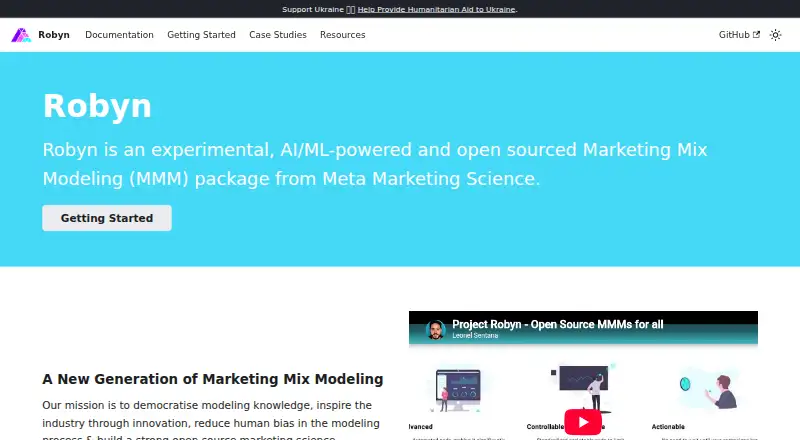
What Robyn is
Robyn is an open-source Marketing Mix Modeling package from Meta Marketing Science. It uses machine-learning methods to estimate media channel efficiency and effectiveness, along with adstock rates and saturation curves. The package is aimed at granular datasets with many independent variables, particularly those used by digital and direct-response advertisers with rich data sources. Robyn automates hyperparameter optimization using evolutionary algorithms and applies ridge regression to address multicollinearity and overfitting. It decomposes time-series trends, seasonality and holiday patterns with Prophet, and can calibrate models against methods such as geo-based tests, Facebook Lift and MTA. Its budget allocator uses a constrained nonlinear solver to propose reallocations intended to maximize outcomes; model one-pagers support comparisons. Robyn does not require personally identifiable or individual-level data and does not depend on cookies or pixel data. A stable R version is on CRAN, while its Python version is a beta rewrite that may have translation issues. Robyn is free and MIT licensed.
Good
- Free, open-source package with an MIT license.
- Automates hyperparameter optimization with evolutionary algorithms.
- Can calibrate models against geo experiments and Facebook Lift.
- Supports budget planning, forecasting and scenario planning.
- Does not require personally identifiable or individual-level data.
Watch out
- The Python version is beta and may have translation issues.
- The beta Python API requires the Robyn R package first.
- Paid media variables and spend vectors must match in length and order.
Who it suits
Robyn suits digital and direct-response advertisers with granular marketing data and many independent variables. It may also fit teams seeking privacy-conscious marketing mix modeling without individual-level data.
Verdict
Robyn combines marketing mix modeling, calibration and budget allocation in a free package. Its stable R release and beta Python option have different maturity, so users should account for the Python limitations.
The facts
Each one read from Robyn's own pages, with the date it was checked.
What it does
- Adstock options
- Robyn offers geometric, Weibull CDF, and Weibull PDF adstock transformations.checked 30 Sep 2026
- Availability
- Robyn has a stable R version on CRAN and a development version on GitHub; the maker also documents a Python version marked beta.checked 30 Sep 2026
- Budget allocation
- Its budget allocator uses a gradient-based constrained nonlinear solver to maximize outcomes by reallocating budgets.checked 30 Sep 2026
- Calibration
- Robyn can calibrate models against ground-truth methodologies including geo-based tests, Facebook Lift, and MTA.checked 30 Sep 2026
- Input requirement
- Paid media variables and paid media spend vectors must have the same length and media order.checked 30 Sep 2026
- Integrations
- Robyn uses Nevergrad for optimization, Prophet for trend and seasonality decomposition, and glmnet for ridge regression fitting.checked 30 Sep 2026
- Intended users
- The package is built for granular datasets with many independent variables and is described as especially suitable for digital and direct-response advertisers with rich data sources.checked 30 Sep 2026
- License
- The repository states that Robyn is MIT licensed.checked 30 Sep 2026
- Model calibration
- Robyn calibrates marketing mix models using causal experiments such as randomized controlled trials and geo experiments.checked 30 Sep 2026
- Model comparisons
- Robyn generates model one-pagers to support intuitive model comparisons.checked 30 Sep 2026
- Modeling
- Robyn uses machine-learning techniques to estimate media channel efficiency and effectiveness, adstock rates, and saturation curves.checked 30 Sep 2026
- Optimization
- Robyn uses a multi-objective evolutionary algorithm for hyperparameter optimization.checked 30 Sep 2026
- Privacy
- The maker describes Robyn as privacy friendly, requiring no PII or individual-level log data and not depending on cookies or pixel data.checked 30 Sep 2026
- Privacy design
- Robyn does not require personally identifiable information or individual-level data and does not depend on cookies or pixel data.checked 30 Sep 2026
- Product
- Robyn is an experimental, AI/ML-powered, open-source Marketing Mix Modeling package from Meta Marketing Science.checked 30 Sep 2026
- Product type
- Robyn is an experimental, AI/ML-powered, open-source Marketing Mix Modeling package from Meta Marketing Science.checked 30 Sep 2026
- Python API limitation
- The beta Python API requires the Robyn R package to be installed first.checked 30 Sep 2026
- Python availability
- The Python version is a beta rewrite of Robyn's R package and may have translation issues.checked 30 Sep 2026
- Python limitation
- The repository says the Python version is an LLM-translated beta and may encounter bugs.checked 30 Sep 2026
- R availability
- Robyn has a stable version on CRAN and a development version on GitHub.checked 30 Sep 2026
- Support
- Users can join the public Robyn MMM Users Facebook Group, raise GitHub issues, and take Meta's official Robyn blueprint course.checked 30 Sep 2026
- Target users
- Robyn is built for granular datasets with many independent variables and is especially suitable for digital and direct-response advertisers with rich data sources.checked 30 Sep 2026
- Time-series features
- Robyn uses Facebook Prophet to automatically decompose trend, seasonality, and holiday patterns.checked 30 Sep 2026
- Time-series modeling
- Robyn uses time-series decomposition for trend and seasonality modeling.checked 30 Sep 2026
The full review of Robyn
Robyn is an open-source marketing mix modeling package from Meta Marketing Science for teams analyzing advertising performance across many variables. It is best suited to digital and direct-response advertisers with granular data and the expertise to work with a technical modeling package. Its stable R release is the sensible starting point; the Python option is still beta.
Overview
Robyn combines media modeling, experiment-based calibration and budget allocation in a free package. It estimates channel efficiency and effectiveness, adstock and saturation, then helps compare models and plan budget shifts. That breadth makes it useful for measurement teams building their own workflow, but it is not a ready-made, low-effort solution for advertisers with limited data or modeling capacity.
Robyn is designed for granular datasets with many independent variables, especially those from digital and direct-response advertising. Its privacy-oriented design does not require personally identifiable information or individual-level log data, and does not rely on cookies or pixel data. Paid media variables and spend vectors must have matching lengths and media order, so careful input preparation matters.
Key features
Robyn estimates media effects with machine-learning techniques and offers geometric, Weibull CDF and Weibull PDF adstock transformations to represent how advertising impact persists. Nevergrad evolutionary algorithms automate hyperparameter optimization, while ridge regression helps regularize multicollinearity and prevent overfitting. These methods address common modeling challenges in complex datasets, but they do not make input quality or model interpretation irrelevant.
For time-series structure, Robyn uses Prophet to decompose trend, seasonality and holiday patterns, with glmnet used for ridge regression fitting. It can calibrate models against ground-truth approaches including geo-based tests, Facebook Lift and MTA, and supports causal calibration such as randomized controlled and geo experiments. This gives teams a way to anchor model estimates in observed outcomes, provided they have suitable experiments.
The budget allocator uses a gradient-based constrained nonlinear solver to maximize outcomes by reallocating budgets. Model one-pagers support intuitive comparisons, while budget planning, forecasting and scenario planning support downstream decisions. These capabilities make Robyn relevant beyond estimation, though allocation recommendations still depend on the underlying model and its inputs.
Pricing
Robyn is free, with a free plan and no paid plan described. That removes a software subscription cost for teams able to operate the package themselves; it does not change the need for appropriate data, technical capacity or valid measurement inputs.
Platforms
Robyn supports API, Linux, macOS, Windows and self-hosted use. The R package has a stable CRAN version as well as a development version on GitHub. The Python version is a beta translation of the R package and may have bugs or translation issues; its API also requires the Robyn R package to be installed first. For production work, the R release is the more mature choice, while Python users should be prepared for those dependencies and limitations.
Who it's for
Robyn is a strong fit for digital and direct-response advertisers with rich, granular media data, analysts who need to compare marketing mix models, and teams that can calibrate estimates with experiments. Its privacy design is useful where individual-level records, cookies or pixel data are not wanted. It is a weaker fit for teams seeking a turnkey service, minimal setup, or a mature Python-only workflow.
Pros and cons
- Pros: Free and open source under the MIT license, allowing teams to use the package without a software subscription.
- Pros: Combines adstock options, automated optimization, calibration and constrained budget allocation in one modeling workflow.
- Pros: Does not require PII, individual-level logs, cookies or pixel data.
- Cons: Its focus on granular, high-variable datasets and aligned media inputs places a real data-preparation burden on users.
- Cons: The Python version is beta, may encounter bugs, and depends on the R package being installed.
Alternatives
For another free, open-source marketing mix modeling option, Google Meridian offers source code and methodology papers intended to support transparency and user auditability. Compare it with Robyn if auditability of the implementation and methodology is a priority.
Revup Marketing has a free plan limited to one plan, one user and one team, with higher tiers for more plans, users and teams; consider it if those plan-based limits better suit your workflow. Etropo Budget Buddy is a paid budget-planning alternative, with an Essential plan at $89 a month; choose it if you want a budget-planning product rather than Robyn's open-source modeling package.
Keen is another paid alternative. LiftLab offers an enterprise marketing measurement platform with custom pricing and terms specified in an Order Form, making it a consideration for teams seeking an enterprise platform. Planful uses custom pricing tailored to company size, user count and selected modules. Revlo Marketing is another paid alternative. Cassandra is a paid option with a six-month minimum commitment; its Essentials plan costs €2,700 a month and includes up to three MMM models and five incrementality experiments per year, so it is a substantially different commitment from free Robyn.
Browse the Marketing Performance Management Software category for more options.
Verdict
Choose Robyn if your team has granular media data, can work with a technical modeling package and wants free, open-source modeling with calibration and budget allocation. Its combination of modeling tools and privacy-conscious inputs is the main reason to choose it. Look elsewhere if you need a turnkey service or a mature Python workflow: the beta Python version has known limitations, and Robyn's strongest use case assumes substantial data and modeling capability.
Alternatives to Robyn
- 1

Adobe Customer Journey Analytics
WebAPImacOSWindows7.0 - 2
Google Meridian
Free planWebAPILinuxmacOS6.8Free plan - 3
Revup Marketing
Free planWeb6.8From $39 a month - 4

Cassandra
Web6.3From €2,700 a month - 5
Etropo Budget Buddy
WebAPI6.3From $299 a year - 6
Sellforte
Web6.3From $1,900 a month