Google Meridian
Google Meridian is an open-source Bayesian marketing mix modeling library for estimating channel contribution and ROI, modeling response curves, and planning…
What Google Meridian is
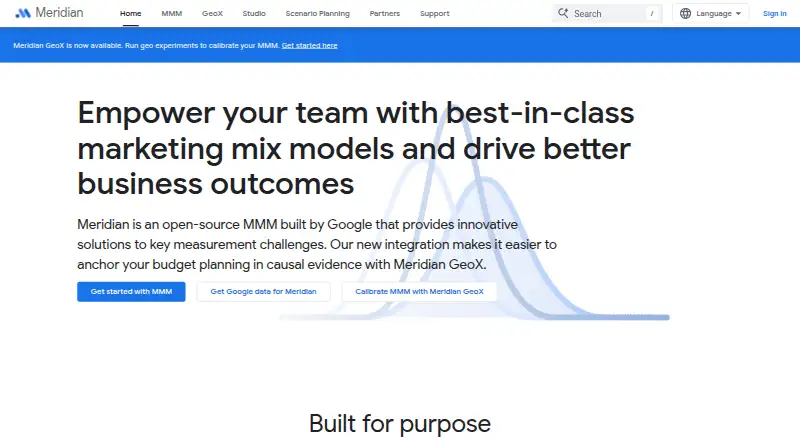
Google Meridian is an open-source Bayesian marketing mix modeling library for estimating channel contribution and ROI, modeling response curves, and planning budgets. It is designed to estimate causal marketing impact and incremental outcomes for treatment variables. Teams can use geo-level data for granular media effect estimates, add business knowledge through priors, and include controls such as Google Query Volume. Meridian supports reach and frequency modeling for video and search query volume data to account for organic demand. Its budget optimization and scenario planning capabilities help teams assess channel allocation. Meridian GeoX provides an open-source way to run geo experiments and use their results to calibrate models; automated calibration and model health diagnostics are also supported. The Scenario Planner notebook requires access to at least one trained model stored in Google Drive or Google Cloud Storage. Meridian Studio is a Google Cloud-powered enterprise platform for managing models, with capacity to run up to hundreds simultaneously. Meridian is free and open source. Google describes its intended audience as cross-functional measurement teams, including analysts, business users, data scientists, and technical practitioners.
Good
- Open-source Bayesian modeling library
- Supports budget optimization and scenario planning
- Geo experiments can help calibrate models
- Source code and methodology papers support auditability
Watch out
- Scenario Planner needs an accessible trained model
- Meridian Studio is an enterprise platform powered by Google Cloud
Who it suits
Meridian suits cross-functional measurement teams that need to estimate marketing contribution, assess channel allocation, or use geo experiments to calibrate models. Its learning paths are aimed at marketing analysts, business users, data scientists, and technical practitioners.
Verdict
Meridian combines causal marketing measurement with budget and scenario planning, and offers geo-experiment calibration. The Scenario Planner depends on an accessible trained model, so teams need that input before generating reports.
Plans and prices
From Google Meridian's own pricing page, checked 29 Sep 2026.
| Plan | Price | What it gives you |
|---|---|---|
| Meridian Open-Source | Free | Free for anyone to use · Open-source MMM library |
The facts
Each one read from Google Meridian's own pages, with the date it was checked.
What it does
- Audience
- Google describes Meridian as designed for cross-functional measurement teams, including marketing analysts, business users, data scientists, and technical practitioners.checked 28 Sep 2026
- Calibration
- Meridian supports automated calibration using geo-experiment results and provides expanded model health diagnostics.checked 28 Sep 2026
- Causal measurement
- The model is designed to estimate the causal impact of marketing and incremental outcomes for treatment variables.checked 29 Sep 2026
- Cloud enterprise option
- Meridian Studio is described as a Google Cloud-powered enterprise platform for building, managing, and customizing Meridian models, with capacity to run up to hundreds of models simultaneously.checked 29 Sep 2026
- Customization
- Users can incorporate business knowledge through priors and include control variables such as Google Query Volume.checked 29 Sep 2026
- Experiments
- Meridian GeoX is an open-source solution for running geo experiments and using their results to calibrate marketing mix models.checked 28 Sep 2026
- Geo analysis
- Meridian supports geo-level data for more granular insights and media effect estimation.checked 29 Sep 2026
- Geo experiments
- Meridian GeoX is an open-source solution for running publisher-agnostic geo experiments and using their results to calibrate MMMs.checked 29 Sep 2026
- Google data
- Google’s MMM Data Platform helps users gather campaigns for their brands across Google Ads and Display & Video 360.checked 29 Sep 2026
- Integrations
- Google's MMM Data Platform helps gather brand campaign data across Google Ads and Display & Video 360.checked 28 Sep 2026
- Intended users
- Google describes Meridian as designed for cross-functional measurement teams, with learning paths for marketing analysts, business users, data scientists, and technical practitioners.checked 29 Sep 2026
- Limit
- Scenario Planner report generation assumes at least one trained model is available in accessible Google Drive or Google Cloud Storage.checked 28 Sep 2026
- Model features
- Meridian supports reach and frequency modeling for video and search query volume data to control for organic demand.checked 28 Sep 2026
- Model inputs
- The workflow uses a target KPI, media data for each marketing channel, and relevant control variables.checked 29 Sep 2026
- Open source
- Google provides the Meridian source code and methodology papers to support transparency and user auditability.checked 28 Sep 2026
- Product
- Meridian is an open-source marketing mix modeling library for building, running, and analyzing Bayesian models with causal inference capabilities.checked 28 Sep 2026
- Reach and frequency
- Meridian can model channels using reach and frequency data, and Google’s MMM Data Platform provides this data for YouTube.checked 29 Sep 2026
- Scale
- Meridian Studio is a Google Cloud powered enterprise platform that lets measurement teams run up to hundreds of models simultaneously.checked 28 Sep 2026
- Security
- The Meridian Studio page describes its UI-based solution as secure and governed, but does not specify security certifications or compliance standards.checked 29 Sep 2026
- Support
- The Meridian support page directs users to Discord for community support and GitHub for technical troubleshooting, feature requests, and bug reports.checked 29 Sep 2026
- What it does
- Meridian is an open-source Bayesian marketing mix modeling framework for estimating channel ROI and contribution, modeling response curves, and planning budgets.checked 29 Sep 2026
Money
- Budget planning
- Meridian’s analysis supports interactive fixed or flexible budget optimization with configurable constraints.checked 29 Sep 2026
- Scenario Planner requirement
- The Scenario Planner Colab expects at least one trained model stored in Google Drive or Google Cloud Storage accessible to the notebook.checked 29 Sep 2026
The full review of Google Meridian
Google Meridian is a free, open-source framework for Bayesian marketing mix modeling and causal measurement. It suits cross-functional teams with the analytical capacity to build and interpret models. Its strongest case is transparent measurement linked to budget planning; scenario reports require a trained model the notebook can access.
Overview
Meridian estimates marketing channel contribution, return on investment and incremental outcomes, with response curves to help explain how effects change with spend. Teams can use geo-level data for more granular media-effect analysis, incorporate business knowledge through priors, and add controls such as Google Query Volume to account for organic demand.
Open-source code and methodology papers give technical teams a basis for auditing the approach. That transparency comes with a practical tradeoff: Meridian is a modeling framework, not a turnkey measurement service. Teams need the skills and workflow to build, run and analyze models.
Meridian belongs in the Marketing Performance Management Software category, but its focus is specifically marketing measurement and allocation.
Key features
Measurement and budget planning
Meridian combines ROI and contribution reporting with forecasting, budget optimization and scenario planning. This connects measurement to allocation decisions, so teams can assess channel mixes rather than stop at retrospective results. The scenario workflow is conditional: the notebook needs at least one trained model in accessible Google Drive or Google Cloud Storage before it can generate a report.
Geo experiments and calibration
Meridian GeoX supports publisher-agnostic geo experiments, and their results can calibrate marketing mix models. Automated calibration and expanded model-health diagnostics help teams connect experimental evidence with model estimates and assess the resulting model.
Reach, frequency and Google data
Meridian can model reach and frequency for video and search query volume data, helping account for organic demand alongside media exposure. Google's MMM Data Platform helps gather brand campaign data across Google Ads and Display & Video 360; it also provides YouTube reach and frequency data. These Google data connections are useful for teams working with those channels, while Meridian's GeoX is described as publisher-agnostic.
Scaling model work
Meridian Studio is a Google Cloud-powered enterprise platform for building, managing and customizing models, with capacity to run up to hundreds simultaneously. Its governed, automated UI workflow is aimed at measurement teams that need to manage model work at scale, rather than replace the open-source library for every use case.
Pricing
Meridian Open-Source: free. The plan is free for anyone to use and includes the open-source MMM library. That makes it a sensible starting point for teams able to supply their own modeling work. No paid plan price or seat or usage quota is established for the open-source offer; Meridian Studio is the enterprise option, with custom pricing.
The Scenario Planner requirement still applies on the free offer: a trained model must be stored in Drive or Cloud Storage and accessible to the notebook. Meridian offers community discussions and expert support through Discord, plus technical troubleshooting through GitHub.
Platforms
Meridian supports API, Linux, macOS, self-hosted and web environments. That range gives technical teams flexibility in how they work with the library, while the notebook-based scenario workflow depends on access to supported cloud storage.
Who it's for
Meridian is designed for cross-functional measurement teams, including marketing analysts, business users, data scientists and technical practitioners. It is best suited to organizations that can support Bayesian modeling and want causal measurement, geo analysis and budget planning in one framework. Teams seeking a packaged service without model-building work, or unable to provide an accessible trained model, should look elsewhere.
Pros and cons
- Pros: Open-source code and methodology papers support auditability, which matters when teams need to examine how measurement estimates are produced.
- Pros: Geo-experiment calibration, reach and frequency modeling, and response curves connect different forms of evidence to channel planning.
- Pros: Free access to the library makes it usable without a software subscription fee.
- Cons: Scenario reporting cannot proceed without a trained model accessible from Drive or Cloud Storage, so teams cannot treat it as an instant planning tool.
- Cons: Building and interpreting Bayesian models calls for analytical and technical capacity; the library is not a substitute for that expertise.
Alternatives
Robyn is another free option with Linux, macOS, Windows, API and self-hosted platform support; consider it if you want a free MMM alternative with Windows among its stated platforms.
Keen is a paid product with a free trial and API and web platforms; choose it if those platform options and a trial are a better fit.
Revlo Marketing is a paid alternative.
Revup Marketing offers a freemium plan and web access, an option for readers who want a web-based freemium alternative.
Etropo Budget Buddy is a paid web and API option with a free trial. Its Essential Plan costs $89 a month, billed monthly, for five team members, up to 15 line items and three currencies, with budget dashboards, actual-spend analysis and Google Sheets integration; pick it when those defined budgeting limits and features suit the job better than model-based measurement.
Sellforte is a paid web product with a free trial. Its Incrementality Testing plan is $1,900 a month, based on average monthly media spend of $300,000, and includes digital-media Geo Lift, Conversion Lift and A/B experiments, plus incremental sales and iROAS; consider it when that packaged testing focus fits better.
Paramark is a paid web alternative with annual plans, including Essentials at $100,000 a year and Advanced at $150,000 a year; it may suit readers comparing paid marketing mix model options.
Planful uses custom pricing tailored to company size, user count and selected modules; consider it if you are seeking a tailored subscription.
Verdict
Choose Meridian if your measurement team can build and audit Bayesian models and wants to connect causal estimates and geo-experiment evidence to budget decisions without a library subscription fee. Its open approach and planning breadth are compelling; the need to bring a trained model and the expertise to use it are the reasons to choose a more packaged alternative.
Getting started
- Open the Meridian website.
- Choose an environment from the listed API, Linux, macOS, self-hosted, or web platforms.
- Use the open-source library to build and run a model.
- For Scenario Planner, make a trained model available in Google Drive or Google Cloud Storage.
- Use Meridian GeoX if you want to run geo experiments and use their results for calibration.
- For model volume and a governed UI workflow, consider Meridian Studio.
Limits worth knowing
Scenario Planner report generation requires at least one trained model accessible in Google Drive or Google Cloud Storage. The Meridian Open-Source plan is free; Meridian Studio is presented as an enterprise platform.
Questions
Is Google Meridian free?
Yes. Meridian is open source and listed as free for anyone to use.
What does Meridian do?
It builds Bayesian marketing mix models for channel ROI and contribution, causal impact, response curves, and budget planning.
Can Meridian support scenario planning?
Yes. It supports budget optimization and scenario planning. The Scenario Planner notebook expects an accessible trained model in Google Drive or Google Cloud Storage.
Does Meridian support geo experiments?
Yes. Meridian GeoX is an open-source solution for running publisher-agnostic geo experiments and using results to calibrate models.
What platforms are listed?
The listed platforms are API, Linux, macOS, self-hosted, and web.
What support is available?
Meridian offers community discussions and expert support through Discord, plus technical troubleshooting through GitHub.
Alternatives to Google Meridian
- 1

Adobe Customer Journey Analytics
WebAPImacOSWindows7.0 - 2
Revup Marketing
Free planWeb6.8From $39 a month - 3

Cassandra
Web6.3From €2,700 a month - 4
Etropo Budget Buddy
WebAPI6.3From $299 a year - 5
Sellforte
Web6.3From $1,900 a month - 6

Budgee
Web6.2From $25 a month