ReviewJet
ReviewJet automates customer review requests, collects reviews, and displays them in website widgets.
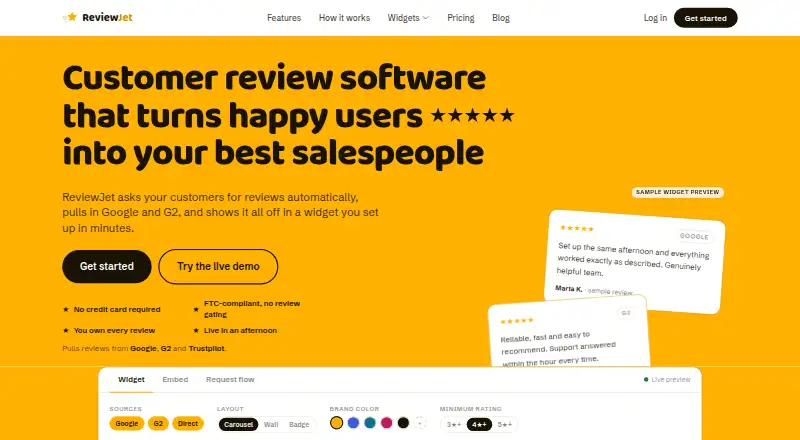
What ReviewJet is
ReviewJet automates customer review requests, collects reviews, and displays them in website widgets. It is aimed at B2B SaaS teams. Requests can follow signup timing, a closed-won deal, or a resolved support ticket; messages are timed to the customer's timezone and can include one follow-up. Hosted forms collect reviews from Google, G2, Trustpilot, or direct sources, and teams can A/B test two subject lines or message templates per sequence. Display options include a carousel, wall of love, and rating badge, with brand theming and a minimum-rating filter. The embed uses one asynchronous script tag and renders HTML without an iframe; ReviewJet says it adds under 15 KB of page weight. Named site stacks include WordPress, Webflow, Shopify, Next.js, Framer, HubSpot CMS, Squarespace, and Wix. Analytics track request activity, widget interactions, and review volume and average rating by source. ReviewJet is web-based, has no free plan, and offers a one-time demo with no card required.
Good
- Requests can follow signup, sales, or support events.
- Supports Google, G2, Trustpilot, and direct reviews.
- Offers three widget formats and brand theming.
- Analytics include review volume by source.
- Support email is answered within one business day.
Watch out
- No free plan is offered.
- Requests pause when the monthly plan limit is reached.
- No published uptime percentage or availability SLA.
Who it suits
ReviewJet is suited to B2B SaaS teams that want to automate review outreach and show collected reviews on their website. Teams should consider their monthly request volume, since requests pause when a plan limit is reached.
Verdict
ReviewJet combines timed review requests, hosted forms, and configurable website widgets for B2B SaaS teams. Its one-time demo is limited, and teams should account for request caps and the absence of a published availability SLA.
Plans and prices
From ReviewJet's own pricing page, checked 7 Oct 2026.
| Plan | Price | What it gives you |
|---|---|---|
| Starter | $49 a month | 1,000 review requests/mo · unlimited widgets and displayed reviews · 1 seat · 1 workspace · Monthly |
| Plus | $149 a month | 5,000 review requests/mo · up to 5 seats · up to 5 workspaces · white-label widgets · Monthly |
| Pro | $499 a month | Unlimited review requests, seats and workspaces · priority support · dedicated onboarding · Monthly |
| Enterprise | Priced on request | Custom sources and integrations · data residency · security review · dedicated CSM · annual invoicing |
| Free try | — | 1 widget · up to 20 previews · up to 25 queued email review requests · no card needed · One-time demo; does not renew |
The facts
Each one read from ReviewJet's own pages, with the date it was checked.
What it does
- AI response assistance
- Nochecked 22 Sep 2026
- Analytics
- Reporting includes request sends, opens, star clicks and completed reviews, widget impressions and interactions, and review volume and average rating by source.checked 7 Oct 2026
- Automated requests
- Requests can be triggered by signup timing, closed-won deals, or resolved support tickets, with messages timed to the customer's timezone and one follow-up.checked 7 Oct 2026
- Availability limit
- ReviewJet says it does not publish an uptime percentage or sign an availability SLA because it has not measured availability for long enough to stand behind a number.checked 7 Oct 2026
- Collection and testing
- ReviewJet provides hosted review forms and lets users A/B test two subject lines or message templates per sequence.checked 7 Oct 2026
- Data residency and GDPR
- Workspace data can be stored in AWS us-east-1 or eu-central-1; a Data Processing Agreement incorporating EU Standard Contractual Clauses is available on request.checked 7 Oct 2026
- Embedding
- The widget uses one asynchronous script tag, renders HTML without an iframe, and adds under 15 KB of page weight, according to the features page.checked 7 Oct 2026
- Integrations
- The site names WordPress, Webflow, Shopify, Next.js, Framer, HubSpot CMS, Squarespace, and Wix as supported site stacks.checked 7 Oct 2026
- Paid from
- 24checked 22 Sep 2026
- Request channels
- email_and_smschecked 22 Sep 2026
- Review display widgets
- Yeschecked 22 Sep 2026
- Review sources
- It aggregates Google, G2, Trustpilot, and direct reviews in one place.checked 7 Oct 2026
- Security
- The security page states that traffic uses TLS 1.2 or higher and databases, file storage, and backups are encrypted at rest with AES-256.checked 7 Oct 2026
- Support
- The contact page says a person answers support and general email within one business day, usually faster.checked 7 Oct 2026
- What it does
- ReviewJet automates customer review requests, aggregates reviews, and displays them in website widgets; its stated target is B2B SaaS teams.checked 7 Oct 2026
- Widgets
- Widget formats include a carousel, wall of love, and rating badge, with brand theming and a minimum-rating filter.checked 7 Oct 2026
Money
- Free plan
- Nochecked 22 Sep 2026
- Plan limits
- If a plan's monthly request limit is reached, requests pause until the next cycle; the pricing page says there are no per-review overage charges.checked 7 Oct 2026
The full review of ReviewJet
ReviewJet is review-request and display software for B2B SaaS teams. It best suits teams that can tie requests to customer milestones and want to show feedback on their websites. Its event-based collection and focused reporting are useful, though monthly request caps and the lack of an availability SLA call for planning.
Overview
ReviewJet brings review requests, hosted forms, source aggregation, and website widgets into one workflow. Teams can request feedback after a signup, closed-won deal, or resolved support ticket, then draw reviews from Google, G2, Trustpilot, and direct submissions. That makes it a natural fit for SaaS companies with clear customer touchpoints and a reason to surface ratings on their sites.
The key operational constraint is capacity: once a plan reaches its monthly request limit, requests pause until the next billing cycle. There are no per-review overage charges, but teams with uneven or growing request volume need to choose a quota that can accommodate it. ReviewJet also does not publish an uptime percentage or sign an availability SLA.
Key features
Timed requests and hosted forms
Requests can be triggered by customer events, timed to the recipient's timezone, and followed by one reminder. Hosted review forms give customers a direct way to submit feedback, while A/B testing two subject lines or message templates per sequence lets teams compare outreach. This is a practical, bounded toolkit for improving requests; it does not include AI response assistance.
Website widgets and analytics
Teams can display reviews in a carousel, wall of love, or rating badge, with brand theming and a minimum-rating filter. A single asynchronous script tag renders HTML without an iframe and adds under 15 KB of page weight, according to ReviewJet. The site-stack integrations include WordPress, Webflow, Shopify, Next.js, Framer, HubSpot CMS, Squarespace, and Wix.
Reporting tracks request sends, opens, star clicks, and completed reviews, along with widget impressions and interactions and review volume and average rating by source. That gives teams visibility from outreach through display, though the available formats and reporting are centered on review collection rather than AI-assisted replies.
Security and support
ReviewJet says traffic uses TLS 1.2 or higher and that databases, file storage, and backups are encrypted at rest with AES-256. Workspace data can be stored in AWS us-east-1 or eu-central-1, and a Data Processing Agreement incorporating EU Standard Contractual Clauses is available on request. A person responds to support and general email within one business day, usually faster. Teams that require a contractual availability commitment should weigh the absence of an uptime percentage and SLA.
Pricing
There is no free plan. A one-time demo is offered with no card required; it does not renew and includes one widget, up to 20 previews, and up to 25 queued email review requests. It is useful for seeing the widget workflow, but its small request allowance is not an ongoing free tier.
| Plan | Price and included capacity | Best fit |
|---|---|---|
| Starter | $49 a month, billed Monthly; 1,000 review requests/mo, unlimited widgets and displayed reviews, 1 seat, 1 workspace | A small team running a contained review program |
| Plus | $149 a month, billed Monthly; 5,000 review requests/mo, up to 5 seats and workspaces, white-label widgets | Teams that need more request capacity, collaborators, or unbranded widgets |
| Pro | $499 a month, billed Monthly; unlimited review requests, seats, and workspaces, priority support, dedicated onboarding | Larger teams with high volume and a need for onboarding and priority support |
| Enterprise | Custom pricing; GDPR DPA and data residency, security review, custom sources and integrations, dedicated customer success manager | Organizations needing those enterprise provisions |
The pricing note gives a starting rate of $24/mo (annual), while the listed Starter plan is $49 a month billed Monthly. Teams should compare the annual starting rate with the monthly plan terms that fit their needs. Starter is constrained to one seat and workspace; Plus raises those limits to five and adds white-label widgets. Pro removes the stated request and seat caps and adds priority support and onboarding. On every capped plan, requests stop at the monthly limit until the next cycle.
Platforms
ReviewJet is available on web. Its widget integrations cover WordPress, Webflow, Shopify, Next.js, Framer, HubSpot CMS, Squarespace, and Wix, giving teams using those site stacks a named route to embed reviews.
Who it's for
ReviewJet is best suited to B2B SaaS teams that can trigger requests from signups, sales wins, or support resolutions, and want customer feedback displayed on their website. Starter fits a single-seat operation with moderate volume; Plus is more appropriate when several teammates need access or white-label widgets matter. Pro is aimed at teams that need unlimited stated capacity and dedicated onboarding.
It is a weaker fit for teams that need a free ongoing plan, AI-assisted review replies, or a published uptime commitment. Teams with strict data requirements can consider Enterprise for its DPA, data residency, and security review provisions.
Pros and cons
- Event-based timing: Signup, closed-won, and resolved-ticket triggers align requests with customer milestones, with timezone-aware delivery and one follow-up.
- Useful display controls: Multiple widget formats, brand theming, and a minimum-rating filter let teams shape how reviews appear on their sites.
- Measured workflow: Reporting spans outreach, completed reviews, and widget engagement, helping teams follow the collection process end to end.
- Capacity pauses at the cap: Requests stop until the next cycle when the monthly quota is reached, which can interrupt collection during busy periods.
- No free ongoing tier: The one-time demo is limited to one widget, 20 previews, and 25 queued email requests.
- No availability commitment: ReviewJet publishes no uptime percentage or availability SLA, a drawback for teams that need a contractual service target.
- No AI response assistance: Teams seeking automated help with review replies will need another tool or workflow.
Alternatives
For a broader comparison, browse Review Generation Software and Review Management Software.
- HiFiveStar is a web-based freemium option with a forever-free plan for one location that includes review monitoring, replies, a review link and QR code, and widgets; choose it when that free single-location package fits.
- Yotpo Reviews offers a free plan with limits of 50 orders per month, 500 outgoing emails, and 200 kick-start credits, plus a $15 a month Starter plan; it suits readers comparing a freemium option with a stated paid entry tier.
- Judge.me has a free plan with unlimited review requests, widgets, a star rating badge, CSV imports, and photo and video review requests, making it an option when those review collection features are the priority.
- Junip has a free plan with unlimited review requests and orders, on-site displays, automated request emails, analytics, and review replies; consider it when those capabilities on a free plan match your needs.
- Loox has a free Beginner plan capped at 500 total orders and is available through Shopify's 30-day subscription billing period with no annual commitment; it may suit readers whose needs fit that order limit.
- Podium Webchat offers a custom quote tailored to the business and supports web, mobile, desktop, and extension platforms.
- REVIEWS.io has a free plan with 25 review invites per month; consider it when that invite allowance fits.
- Birdeye is a paid option whose pricing depends on what is deployed across business locations.
Verdict
Choose ReviewJet if you run a B2B SaaS review program tied to customer milestones and want timed requests, hosted forms, source reporting, and configurable website widgets in one workflow. Its strongest case is the connection between event-based collection and on-site display. Look elsewhere if a free ongoing plan, AI reply assistance, or a published availability SLA is essential; also budget for the request cap that pauses collection when reached.
Getting started
- Open the ReviewJet website
- Start the free trial or one-time demo
- Choose a monthly plan with its request allowance
- Connect a supported website stack
- Configure request triggers, channels, and message variants
- Add the asynchronous widget script to your site
Limits worth knowing
Starter allows 1,000 review requests monthly, one seat, and one workspace; Plus allows 5,000 requests, up to five seats, and up to five workspaces. When a monthly request limit is reached, sending pauses until the next cycle; Pro removes the request, seat, and workspace limits.
Questions
Does ReviewJet have a free plan?
No. It offers a free trial and a one-time demo instead; the demo needs no card and includes one widget, up to 20 previews, and up to 25 queued email requests.
What does the Starter plan cost?
Starter costs $49 a month, billed monthly, and includes 1,000 review requests per month, unlimited widgets and displayed reviews, one seat, and one workspace.
Which review sources are supported?
ReviewJet lists Google, G2, Trustpilot, and direct submissions.
Which platforms can host its widgets?
Named site stacks are WordPress, Webflow, Shopify, Next.js, Framer, HubSpot CMS, Squarespace, and Wix.
Does ReviewJet provide AI response assistance?
No. The listed features do not include AI response assistance.
What security and data-location options are listed?
Traffic uses TLS 1.2 or higher, with AES-256 encryption at rest. Workspace data can be stored in AWS us-east-1 or eu-central-1, and a GDPR DPA is available on request.
Alternatives to ReviewJet
- 1

AppFollow
Free planAndroidiOSWebAPI8.8From $19 a month - 2
Superchat
Free planAndroidiOSWebAPI8.7From €89 a month - 3
GuestRevu
Free planAndroidiOSWebAPI8.6From $34.99 a month - 4
ReviewTrackers
AndroidiOSWebAPI8.5From $89 a month - 5
Review Revolution
Free planAndroidiOSWebAPI8.5Free plan - 6
Appfigures
Free planAndroidiOSWebAPI8.5From $9.99 a month