PortSIP PBX
PortSIP PBX is a multi-tenant communications platform from PortSIP Solutions, Inc.
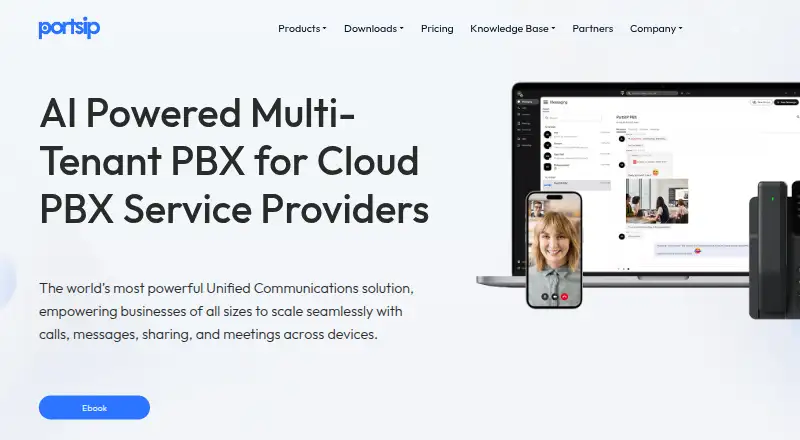
What PortSIP PBX is
PortSIP PBX is a multi-tenant communications platform from PortSIP Solutions, Inc. for service providers and MVNOs. It supports Cloud PBX, UCaaS, CPaaS, and CCaaS deployments, combining custom call routing, SMS, WhatsApp, team messaging, contact-center functions, and voice and video meetings. Auto attendant, voicemail transcription, multiple business numbers, and desktop and mobile apps are included. Contact-center capabilities cover skill-based routing, queue strategies, live wallboards, analytics, callback, and real-time monitoring and training tools. AI can transcribe calls and voicemails, create notes and summaries, and analyze sentiment. Microsoft 365 integration handles user provisioning, single sign-on, and directory and contact synchronization. REST APIs, Pub/Sub, messaging APIs, webhooks, a calling SDK, and call-control APIs support development work. The PBX can run in a customer data center, on premises, or on Azure, AWS, and Google Cloud, including Docker deployment. PortSIP says one deployment can support 50,000–100,000 simultaneous online users. Apps support SRTP and DTLS-SRTP encryption, with AES-256 when enabled. A Free Edition costs nothing for three extensions and two simultaneous calls; paid licenses use extension-based pricing and quote-required billing.
Good
- Free Edition includes all features
- Custom call routing and auto attendant
- AI transcription, summaries, and sentiment analysis
- Supports Azure, AWS, Google Cloud, and on-premises deployment
- REST APIs, webhooks, SDK, and call-control APIs
- 24 x 7 support advertised
Watch out
- Free Edition allows two simultaneous calls
- Free Edition is limited to three extensions
- Paid licenses require a quote
- Deployment requires Debian or Ubuntu for the listed Linux PBX
Who it suits
PortSIP PBX suits service providers and MVNOs that need a broad communications, contact-center, and developer platform. It also fits organizations choosing self-hosted, cloud, or Docker deployment with Microsoft 365 integration.
Verdict
Choose PortSIP PBX when you need one platform spanning business communications, contact-center operations, AI tools, and APIs. The free edition is useful for three extensions and two simultaneous calls, while larger deployments use extension-based licenses. Look elsewhere if those call or extension limits do not fit a free deployment.
Plans and prices
From PortSIP PBX's own pricing page, checked 11 Oct 2026.
| Plan | Price | What it gives you |
|---|---|---|
| Free Edition | Free | Up to 2 simultaneous calls · 3 extensions · all features included |
| Licensed Edition — Perpetual | — | Access to all features · License based on extension users |
| Licensed Edition — Annual | — | Access to all features · License based on extension users |
| Annual license | Priced on request | Licensed by extension users · 1:1 simultaneous call ratio · all features included · Quote required |
| Perpetual license | Priced on request | Licensed by extension users · 1:1 simultaneous call ratio · all features included · Quote required |
The facts
Each one read from PortSIP PBX's own pages, with the date it was checked.
What it does
- AI
- AI features include call and voicemail transcription, generated notes and summaries, and sentiment analysis.checked 11 Oct 2026
- Auto attendant
- Yeschecked 22 Sep 2026
- Business numbers
- multiplechecked 22 Sep 2026
- Call routing
- customchecked 22 Sep 2026
- Communications
- The platform combines call routing, SMS, WhatsApp, team messaging, contact center, and voice and video meetings.checked 11 Oct 2026
- Contact center
- Contact center features include skill-based routing, queue strategies, live wallboards, analytics, callback, and real-time monitoring and training tools.checked 11 Oct 2026
- Deployment
- PortSIP PBX can run in a customer data center, on premises, or on Azure, AWS, and Google Cloud, with Docker deployment.checked 11 Oct 2026
- Developer APIs
- The product offers REST APIs, Pub/Sub, messaging APIs, webhooks, a calling SDK, and call control APIs.checked 11 Oct 2026
- Included users
- 3checked 22 Sep 2026
- Integrations
- Microsoft 365 integration supports user provisioning, SSO in web and native apps, and directory and contact synchronization.checked 11 Oct 2026
- Privacy and compliance
- PortSIP lists GDPR, EU standard contractual clauses, EU-US and Swiss-US privacy frameworks, and APEC privacy programs among its compliance options.checked 11 Oct 2026
- Product
- PortSIP PBX is a multi-tenant communications platform for service providers and MVNOs offering Cloud PBX, UCaaS, CPaaS, and CCaaS services.checked 11 Oct 2026
- Scale
- PortSIP says one deployment can support 50,000–100,000 simultaneous online users.checked 11 Oct 2026
- Security
- PortSIP PBX and its apps support SRTP and DTLS-SRTP media encryption, with AES-256 when enabled.checked 11 Oct 2026
- Support
- The product page advertises 24 x 7 support.checked 11 Oct 2026
- Voicemail transcription
- Yeschecked 22 Sep 2026
Where it runs
- Desktop and mobile apps
- Yeschecked 22 Sep 2026
- Platform requirements
- The PBX download page lists Debian and Ubuntu and says the Linux PBX is installed using Docker.checked 11 Oct 2026
Money
- Free plan
- Yeschecked 22 Sep 2026
The company
- Maker
- The site footer identifies the company as PortSIP Solutions, Inc.checked 11 Oct 2026
The full review of PortSIP PBX
PortSIP PBX is a multi-tenant communications platform aimed at service providers and MVNOs that need to package voice, messaging, contact-center, and programmable communications. It fits organizations with infrastructure and integration expertise better than a small office seeking a simple hosted phone service. The free edition is a practical way to evaluate the full feature set, while serious deployments move to extension-based licensing.
Overview
PortSIP combines Cloud PBX, UCaaS, CPaaS, and CCaaS in one deployment. Calling sits alongside SMS, WhatsApp, team messaging, voice and video meetings, and contact-center operations, so an operator can deliver several communication services without stitching together separate systems. That breadth is valuable for a communications provider; it is more machinery than most teams need for basic business telephony.
Deployment can run in a customer data center, on premises, or on Azure, AWS, and Google Cloud, with Docker support. PortSIP says one deployment can serve 50,000–100,000 simultaneous online users, positioning it for carrier-scale or multi-tenant projects. The Linux PBX installation uses Docker and names Debian and Ubuntu, so buyers should be prepared to administer their own environment rather than expect a purely turnkey service.
Key features
Calling and collaboration
Custom call routing and an auto attendant handle structured inbound calls, while multiple business numbers support separate lines or services. Voicemail transcription adds a useful text workflow, and desktop and mobile apps keep users connected across devices. SMS, WhatsApp, team messaging, and voice and video meetings extend the platform beyond a conventional PBX.
Contact center and AI
Skill-based routing, queue strategies, live wallboards, analytics, callback, and real-time monitoring and training tools give contact centers operational controls rather than just a call queue. AI can transcribe calls and voicemails, generate notes and summaries, and analyze sentiment. These capabilities are most relevant to organizations managing agent quality and interaction volume; they may be unnecessary overhead for a small internal phone system.
Integrations, APIs, and security
Microsoft 365 integration supports user provisioning, single sign-on in web and native apps, and directory and contact synchronization. REST APIs, Pub/Sub, messaging APIs, webhooks, a calling SDK, and call-control APIs provide substantial scope for embedding communications into another product. Media encryption uses SRTP and DTLS-SRTP, with AES-256 when enabled. PortSIP lists GDPR, EU standard contractual clauses, EU-US and Swiss-US privacy frameworks, and APEC privacy programs among its compliance options, and advertises 24 x 7 support.
Pricing
The Free Edition costs free and includes all features, three extensions, and up to two simultaneous calls. That makes it a strong evaluation or micro-deployment tier, but the two-call ceiling quickly constrains a working team.
Licensed Edition — Perpetual and Licensed Edition — Annual include all features and are licensed by extension users, with custom pricing. The perpetual and annual license descriptions also specify a 1:1 simultaneous-call ratio and require a quote. Perpetual licensing suits organizations that prefer an upfront entitlement; annual licensing fits buyers who want a recurring term. Neither option publishes a price, so budgeting requires a direct quotation.
Platforms
PortSIP supports Android, iOS, Linux, Windows, web access, self-hosted deployment, and APIs. The stated Docker-based Linux installation for Debian and Ubuntu reinforces its fit for technically managed environments.
Who it's for
Choose PortSIP for a service provider, MVNO, or enterprise communications team that needs multi-tenant control, contact-center depth, deployment flexibility, and developer APIs in one platform. It is less suitable for a small business that wants a hosted number and minimal administration, or for any free deployment needing more than three extensions or two concurrent calls.
Pros and cons
- Pro: One platform spans PBX, messaging, meetings, contact center, CPaaS, and UCaaS use cases.
- Pro: Deployment across customer infrastructure or major clouds, plus stated support for 50,000–100,000 online users, accommodates large operators.
- Pro: Broad APIs, SDKs, webhooks, and Microsoft 365 synchronization support product integration and administration.
- Con: The free edition is limited to three extensions and two simultaneous calls, restricting it to evaluation or very small use.
- Con: Docker-based Linux deployment and infrastructure choices demand technical ownership.
- Con: Paid editions require quotes, making costs harder to compare before contacting sales.
Alternatives
Microsoft Teams is the better choice when a team prioritizes a familiar collaboration suite and a free plan with up to 100 meeting participants, 60-minute group meetings, and 5 GB of storage.
3CX suits organizations wanting a free tier for 10 users and four simultaneous calls, albeit with a license that must be manually renewed each year.
Vodia PBX is an alternative for buyers seeking a single-tenant PBX with prepaid annual or monthly charging and extension bundles.
PBXware provides an alternative enterprise PBX with IVR, call flows, unified communications apps, meetings, chat, and business SMS.
VitalPBX is worth considering when a free community edition with 12 extensions is a better fit.
Zoom Phone fits teams that prefer a paid cloud phone service with metered calling starting at $10 a month.
Nextiva is a paid business communications alternative with a Core plan at $15 a month billed monthly.
PanTerra Streams.AI is another paid option for organizations comparing packaged business communications plans.
For broader category browsing, see Business Phone Systems.
Verdict
PortSIP PBX is a strong choice for providers and technically capable organizations that need one extensible, multi-tenant communications platform with contact-center and API depth. Choose it for deployment control and breadth; look elsewhere if you want simple hosted calling, transparent paid pricing, or more capacity than the free edition allows.
Getting started
- Open the PortSIP website
- Choose the Free Edition or a licensed edition
- Deploy in a customer data center, on premises, or supported cloud
- For Linux PBX deployment, use Debian or Ubuntu with Docker
- Install the desktop or mobile apps on supported devices
- Connect Microsoft 365 if provisioning, SSO, and directory synchronization are needed
Limits worth knowing
The Free Edition includes all features but stops at three extensions and two simultaneous calls. Paid editions are licensed by extension users, with perpetual and annual options billed by quote.
Questions
Is there a free plan?
Yes. The Free Edition costs nothing and includes all features, three extensions, and up to two simultaneous calls.
Which platforms are supported?
PortSIP lists Android, iOS, Linux, Windows, web, API, and self-hosted platforms.
How are paid plans priced?
Licensed editions use extension-user licensing. Perpetual and annual license details state that a quote is required.
Can it run on cloud infrastructure?
Yes. Deployment can run on Azure, AWS, or Google Cloud, as well as a customer data center or on premises.
Does it integrate with Microsoft 365?
Yes. Microsoft 365 integration supports user provisioning, SSO in web and native apps, and directory and contact synchronization.
Who makes PortSIP PBX?
The site footer identifies PortSIP Solutions, Inc. as the company.
Alternatives to PortSIP PBX
- 1
Microsoft Teams
Free planAndroidiOSWebLinux9.0Free plan - 2
Nextiva
AndroidiOSWebAPI8.8From $15 a month - 3

VitalPBX
Free planAndroidiOSWebAPI8.8From $100 a month - 4
NFON Cloudya
AndroidiOSWebAPI8.6From €4.50 a month - 5
Ringover
AndroidiOSWebAPI8.6 - 6
OnSIP
Free planAndroidiOSWebmacOS8.6From $49.95 a month