Playasoft Volunteer Database
Playasoft Volunteer Database is a self-hosted web tool for organizing volunteer shifts at festivals and community events.
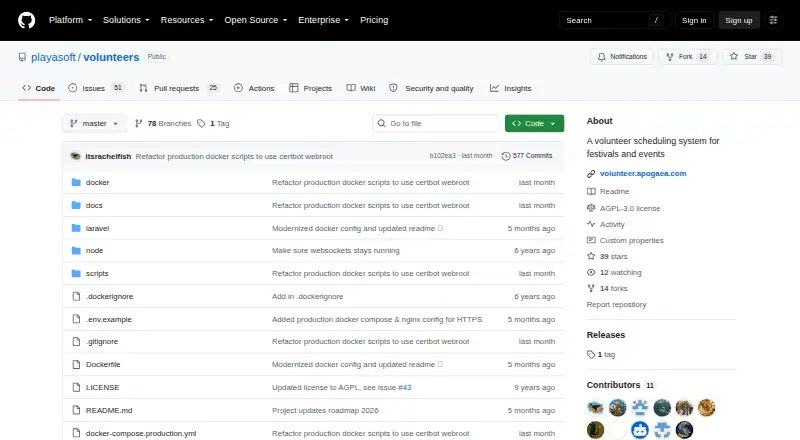
What Playasoft Volunteer Database is
Playasoft Volunteer Database is a self-hosted web tool for organizing volunteer shifts at festivals and community events. Organizers can set up events, departments, and shifts, then create individual signup slots with specified times, durations, and capacity. Volunteers can sign up for slots themselves. Shift access can depend on permission levels, with built-in roles for admins, volunteers, medical staff, fire staff, and rangers. Volunteers can submit certification documents for administrators to review before assigning the related role. Organizers can also password-protect shifts for sensitive positions. The project is free, open-source software under the AGPL-3.0 license, and its live service describes use for Denver Burners community events. The repository provides Docker Compose setup instructions, and the quick start requires Docker and Docker Compose. Optional real-time updates for shift and department changes can be configured using Redis and a WebSocket server. The documented Docker environment runs with MariaDB 10.11. The roadmap lists multi-organization and multi-event support on one installation as planned, as well as a future hosted option for organizations that do not want to self-host.
Good
- Volunteers can sign up for individual shift slots.
- Built-in roles cover several volunteer functions.
- Certification documents can be reviewed by administrators.
- Sensitive shifts can be password-protected.
Watch out
- Quick start requires Docker and Docker Compose.
- Real-time updates require Redis and a WebSocket server.
- Multi-event support is still on the roadmap.
- Hosted service is only a future roadmap phase.
Who it suits
It suits festival and community-event organizers willing to run and maintain a self-hosted web application. It may be useful where volunteers need self-signup and organizers need role-based access or certification review.
Verdict
Playasoft Volunteer Database provides event scheduling and access controls for self-managed installations. Organizers should account for its Docker requirements and planned rather than current multi-event and hosted capabilities.
Plans and prices
From Playasoft Volunteer Database's own pricing page, checked 9 Oct 2026.
| Plan | Price | What it gives you |
|---|---|---|
| Free Open Source Software | Free | — |
The facts
Each one read from Playasoft Volunteer Database's own pages, with the date it was checked.
What it does
- Additional access control
- Shifts can also be password-protected to let department leads control access to sensitive positions.checked 9 Oct 2026
- Database
- The documented Docker environment runs the application with MariaDB 10.11.checked 9 Oct 2026
- Departments and shifts
- Organizers can create departments and shifts with individual signup slots for volunteers.checked 4 Oct 2026
- Deployment
- The project’s quick start requires Docker and Docker Compose and provides instructions to run the site locally or on a server.checked 9 Oct 2026
- Event organization
- Organizers can create events and departments, with departments having shifts across the event schedule.checked 9 Oct 2026
- Hosted service roadmap
- A hosted option for organizations that do not want to self-host appears on the roadmap as a future phase.checked 4 Oct 2026
- Intended users
- The README says the system was originally built for Apogaea and is maintained by DenverBurners.checked 9 Oct 2026
- License
- The GitHub repository identifies the project license as AGPL-3.0.checked 9 Oct 2026
- Multi-event capability
- The project roadmap lists support for multiple organizations and events on one installation as a planned phase.checked 4 Oct 2026
- Optional integration
- Redis can be configured as the broadcast driver for optional real-time updates, with a separate websocket server.checked 9 Oct 2026
- Purpose
- The project describes itself as a volunteer scheduling system for festivals and community events.checked 9 Oct 2026
- Real-time updates
- Optional real-time updates for shift and department changes can be enabled with Redis and a WebSocket server.checked 4 Oct 2026
- Roles and permissions
- Shifts can be restricted by permission level, and the project lists roles including admin, volunteer, medical, fire, ranger, and department lead.checked 9 Oct 2026
- Security guidance
- The production setup guide recommends generating a secure database password and documents enabling HTTPS with Let’s Encrypt.checked 9 Oct 2026
- Shift access
- Shifts can be password-protected to control access to sensitive positions.checked 4 Oct 2026
- Shift signups
- Shifts specify their time, duration, and volunteer capacity, and are divided into signup slots.checked 9 Oct 2026
- Training verification
- Volunteers can upload certification documents to their profiles for administrators to review before granting the corresponding role.checked 9 Oct 2026
Money
- Free and open source
- The live volunteer database describes the project as 100% Free Open Source Software.checked 4 Oct 2026
The full review of Playasoft Volunteer Database
Playasoft Volunteer Database is a free, open-source web application for assigning volunteers to festival and community-event shifts. It fits organizers comfortable operating their own infrastructure, particularly teams that need permissions and certification checks around sensitive roles. The trade-off is operational: Docker-based deployment is part of the package, while hosted and multi-event use remain future roadmap goals.
Overview
The application lets organizers build events, divide them into departments, and place shifts across an event schedule. Volunteers can sign themselves up for individual slots, with each shift defining its time, duration, and capacity. That makes Playasoft a focused coordination tool for event coverage rather than an all-purpose volunteer-management suite.
Its intended setting is community events, with the live service describing use for Denver Burners activities. The repository is licensed under AGPL-3.0, and the project is presented as 100% free open-source software. There is no hosted offering to select today: the roadmap puts a hosted option for organizations that do not want to self-host in a future phase, alongside support for multiple organizations and events on one installation.
Key features
Department and shift creation gives organizers a clear structure for complex event schedules. Capacity limits and separate signup slots show volunteers what remains available and let them claim a specific place, making the system suitable for teams that need defined coverage rather than an unstructured interest list.
Permissions are the strongest differentiator. Shifts can be limited by access level, with built-in admin, volunteer, medical, fire, and ranger roles. Volunteers can upload certification documents for administrators to review before the related role is granted. Password-protected shifts provide an additional gate for positions that department leads want to keep private. These controls are useful where qualifications and responsibility boundaries matter, although they also create administrative work for the event team.
Real-time changes are optional rather than automatic. Enabling broadcasts for shift and department updates requires Redis configured as the broadcast driver plus a separate WebSocket server. Teams able to maintain those services can provide more immediate schedule visibility; smaller groups may reasonably leave the feature disabled to keep deployment simpler.
Pricing
| Plan | Price | Includes |
|---|---|---|
| Free Open Source Software | free | Shift scheduling, volunteer self-signup, and self-service signup in the open-source application |
The free plan is the product: there is no paid tier, seat charge, trial period, or renewal term. Its value is greatest for organizers willing to provide hosting and administration themselves. The zero price does not remove infrastructure responsibilities, including Docker, Docker Compose, a MariaDB 10.11 database in the documented environment, and secure production configuration.
Platforms
Playasoft runs as a self-hosted web application. The quick-start path requires Docker and Docker Compose, while the documented database environment uses MariaDB 10.11. Production guidance covers generating a secure database password and enabling HTTPS with Let’s Encrypt. It is therefore a fit for organizations with a server or technical operator, not for teams seeking an immediately managed mobile service.
Who it's for
Choose Playasoft for festivals and community events that need departmental scheduling, volunteer-controlled signup, and tighter access around medical, fire, ranger, or similarly sensitive duties. It is especially appropriate when an organizer can manage Docker services and wants software that can be adapted under an AGPL-3.0 license.
Look elsewhere if you need a vendor-hosted system, native mobile apps, or one installation serving multiple organizations and events now. Those capabilities are not part of the current operating model.
Pros and cons
Pros
- No software charge: the open-source plan costs 0.00 USD and includes scheduling and self-service signup.
- Role-aware access: permission levels, certification review, and password-protected shifts support controlled assignments.
- Event-focused structure: departments, capacities, durations, and individual slots map cleanly to festival operations.
- Optional live updates: Redis and WebSocket support can provide broadcast changes for teams prepared to run extra services.
Cons
- Self-hosting required: Docker and Docker Compose make deployment and ongoing administration the organizer’s responsibility.
- Extra infrastructure for live updates: Redis and a separate WebSocket server add operational complexity.
- Current scope is single-installation focused: multi-organization and multi-event support are roadmap items.
- No current hosted option: organizations avoiding server management must wait for the planned hosted phase or choose another service.
Alternatives
For a broad comparison, see Volunteer Scheduling Software and Event Volunteer Management Software.
- POINT is the better choice when Android, iOS, and web access, unlimited volunteers and admins on its free plan, messaging, reminders, and time tracking matter more than self-hosting.
- SignUp.com suits organizers wanting a hosted Android, iOS, and web service with a free Basic tier for one primary organizer.
- VolunteerMark is worth considering for hosted event management, with a free tier capped at 50 volunteers and one administrator.
- Vome fits teams seeking hosted recruitment and onboarding, including unlimited volunteers and admin seats on its free Recruit plan.
- Volunteer Shift Manager targets web users needing a free allowance of 50 volunteers, 30 upcoming shifts, and monthly message quotas.
- Church Volunteering is designed for church teams, with a free plan for one team and up to 10 volunteers.
- JoinToServe offers free scheduling for nonprofits on iOS and web without seat limits.
- Timecounts is a hosted web alternative with a free plan for one organizer and unlimited volunteers.
Verdict
Playasoft Volunteer Database is a strong choice for technically capable event organizers who want free, open-source scheduling with meaningful role and certification controls. Choose it for control over deployment and sensitive shift access; look elsewhere if you need hosted convenience, mobile apps, or multi-event management today.
Alternatives to Playasoft Volunteer Database
- 1
ephios
Free planOpen sourceAndroidiOSWebAPI8.3From €9.99 a month - 2
GivePulse
Free planAndroidiOSWebAPI8.1From $1.75 a year - 3
Mobilize
Free planAndroidiOSWebAPI8.1From $100 a month - 4

POINT
Free planAndroidiOSWebAPI8.1Free plan - 5

Vome
Free planAndroidiOSWebAPI8.1From $35 a month - 6
WhenToHelp
Free planAndroidiOSWeb7.9From $110 a year