ephios
ephios is a web-based duty and personnel planning platform for aid organizations, with event signups, qualifications, role permissions, and group visibility.
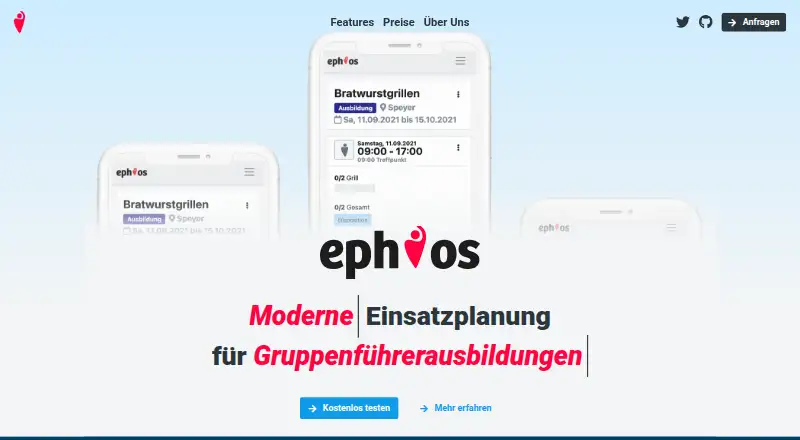
What ephios is
ephios is a web-based duty and personnel planning platform for aid organizations, with event signups, qualifications, role permissions, and group visibility. Organizers can publish activities to relevant groups and require volunteers to confirm participation. Qualifications such as group leader or paramedic can be set as requirements for an event. Listed uses range from training and continuing education to medical services, fire watches, concert security, and beach lifeguarding. The mobile web app can be installed through a smartphone browser and supports push notifications. Other tools include work-hour tracking, guest participation, change logging, document storage, and PDF or calendar export. Volunteers can subscribe to a personalized read-only event feed in several calendar apps. An open-source plugin system can add organization-specific signup flows and workflows such as equipment management. ephios also provides a REST API, supports OAuth2 integrations, and can use external OIDC identity providers. Organizations can self-host it for free or choose Hosting Starter at €9.99 per month, which includes 100 users, installation, maintenance, and personal email support. A one-month trial is offered for a hosted instance.
Good
- Free self-hosting and hosted Starter at €9.99 per month.
- Volunteer signups can require event confirmation and qualifications.
- Mobile web app supports push notifications.
- Exports, calendar feeds, work-hour tracking, and document storage.
Watch out
- Production self-hosting generally requires several server components and TLS.
- Starter includes 100 users; larger plans require contacting the maker.
- Volunteer reporting is basic.
Who it suits
ephios suits aid organizations coordinating volunteer shifts, qualifications, and signups across groups. Self-hosting may suit organizations with the technical capacity to meet its production deployment requirements; hosted Starter is listed for up to 100 users.
Verdict
ephios combines duty planning, volunteer signups, and qualification requirements with self-hosted and hosted options. Organizations should weigh the self-hosting requirements or the Starter plan’s 100-user limit against their needs.
Plans and prices
From ephios's own pricing page, checked 15 Oct 2026.
| Plan | Price | What it gives you |
|---|---|---|
| Self-hosted | Free | open source · selbst gehostet · ohne Gebühr |
| Hosting Starter | €9.99 a month | 100 Nutzer inklusive · Installation und Wartung inklusive · persönlicher E-Mail-Support · 9,99 /Monat |
| Professional | Priced on request | mehr als 100 Nutzer · Preis nach Vereinbarung |
The facts
Each one read from ephios's own pages, with the date it was checked.
What it does
- Additional features
- The site lists work-hour tracking, PDF and calendar export, guest participation, change logging, document storage, and sharing with other associations.checked 5 Oct 2026
- API and identity
- The software provides a REST API with session or token authentication and can support OAuth2 integrations; it also supports external OIDC identity providers.checked 5 Oct 2026
- API authentication
- API clients can authenticate with sessions, personal tokens, or OAuth2.checked 15 Oct 2026
- API limitation
- The documentation says independent API keys not tied to users are planned for the future.checked 15 Oct 2026
- API scopes
- Token scopes cover public, personal, and confidential read and write access.checked 15 Oct 2026
- Architecture
- The repository describes ephios as a Django application using plain HTML, CSS, JavaScript and some uncompiled Vue components.checked 15 Oct 2026
- Audit logging
- Change logging records actions performed on users and events.checked 15 Oct 2026
- Calendar integrations
- Users can subscribe to a personalized read-only event feed in calendar apps including Google Calendar, Apple Calendar, Nextcloud Calendar, and Thunderbird.checked 5 Oct 2026
- Cross-organization sharing
- The site lists sharing with other federations as a capability.checked 15 Oct 2026
- Deployment options
- The documentation provides both manual and Docker installation guides.checked 15 Oct 2026
- Documentation
- Documentation covers user operation, administration, deployment, development, plugins, API usage and changelog entries.checked 15 Oct 2026
- Document storage
- Document storage is listed as an included capability.checked 15 Oct 2026
- Event signup
- Organizers publish events to selected groups and helpers can register, optionally requiring confirmation.checked 15 Oct 2026
- Event signups
- Organizers can publish events to relevant groups and require confirmation for volunteer signups.checked 5 Oct 2026
- Exports
- The product offers PDF export and calendar export.checked 15 Oct 2026
- Extensibility
- An open-source plugin system can add organization-specific signup processes and other volunteer workflows such as equipment management.checked 5 Oct 2026
- Groups
- Groups limit which events each person can see.checked 15 Oct 2026
- Hosting locations
- The hosting terms list German data centers operated by netcup, Hetzner and Uberspace, with AWS email delivery in Sweden.checked 15 Oct 2026
- Licence
- The public ephios repository is licensed under the MIT license.checked 15 Oct 2026
- Limit: data at rest
- The hosting terms state that production-system data is not encrypted at rest.checked 15 Oct 2026
- Limit: database upgrades
- The documentation warns that MariaDB 10.7+ upgrades can require a UUID conversion command.checked 15 Oct 2026
- Limit: MySQL setup
- The documentation reports date-computation errors when MySQL timezone information is missing.checked 15 Oct 2026
- Mobile use
- The mobile experience is installed from a smartphone browser as a progressive web app.checked 15 Oct 2026
- Notifications
- Notifications inform users about upcoming events and staffing needs.checked 15 Oct 2026
The full review of ephios
ephios is a duty-planning platform for aid organizations, especially those coordinating volunteers whose qualifications affect assignments. It combines targeted event signups with roster controls, while the choice between self-hosting and paid hosting shapes the effort involved.
Overview
Organizations can publish events to relevant groups and require confirmation for volunteer signups. That suits work such as medical services, fire watches, beach lifeguarding, training and concert security, where organizers need to direct opportunities and manage who can take part. For a group that only needs a basic public signup sheet, ephios may offer more structure than necessary.
Qualifications such as group leader or paramedic can be assigned to users and required for event participation. Role permissions and group visibility add controls over who can manage or see activities. Together, these features make ephios a stronger fit for operational rosters than for unstructured volunteer calls.
Key features
- Duty and shift planning: Shift scheduling and volunteer self-signup support recurring assignments. Requiring confirmation gives organizers more control over whether a signup becomes a commitment.
- Work records and exports: Work-hour tracking, change logging, PDF export and calendar export help organizations keep records and share schedules.
- Mobile and calendar access: The mobile web app can be installed from a smartphone browser and supports push notifications. Volunteers can subscribe to a personalized read-only event feed in Google Calendar, Apple Calendar, Nextcloud Calendar or Thunderbird.
- Organization-specific workflows: The open-source plugin system can add tailored signup processes and workflows such as equipment management. This flexibility is useful when standard event registration is not enough, though it may require implementation work.
- Integration and identity: A REST API supports session or token authentication; OAuth2 integrations and external OIDC identity providers are also supported.
- Additional coordination: Guest participation, document storage and sharing with other associations broaden its use beyond scheduling.
The maker says the open-source software has been independently security reviewed. Production deployment guidance requires HTTPS and covers SSL and HSTS configuration; self-hosters still need to handle that secure setup.
Pricing
The self-hosted plan is free and open source. It avoids a hosting fee, but production deployment generally requires Python, a WSGI server, reverse proxy, database, Redis, SMTP server, domain and TLS certificate. It is best for organizations able to operate that infrastructure.
Hosting Starter costs €9.99 a month and includes 100 users, installation and maintenance, and personal email support. The maker handles installation and maintenance, making this the more practical route for organizations that want hosted service without taking on deployment. The 100-user ceiling may be restrictive for larger groups.
Professional is for more than 100 users, with custom pricing. A one-month trial is offered; registration provisions an instance under the organization's own ephios.de subdomain. The free self-hosted option has no listed user cap, while the hosted Starter plan's included capacity is 100 users.
Platforms
ephios supports Android, iOS, Linux, web, API and self-hosted use. Its installable mobile web app provides smartphone access without a separately described native app, while calendar feeds and API access suit organizations connecting schedules to other tools.
Who it's for
ephios is best suited to aid organizations coordinating qualified volunteers across recurring duties, training and event services. It is particularly relevant when organizers need group-based publishing, confirmation, qualification requirements and role controls. Smaller groups without technical capacity can choose hosting; organizations that only need lightweight signups may prefer a simpler tool.
Pros and cons
- Pros: Qualification requirements and group controls help match volunteers to responsibilities rather than treating every signup alike.
- Pros: The free open-source self-hosted plan and plugin system allow organizations with technical resources to adapt workflows without a hosting subscription.
- Pros: Hosted Starter includes installation, maintenance and personal email support, reducing operational burden for groups within its 100-user allowance.
- Cons: Self-hosting calls for a substantial production stack, including a database, Redis, mail service, reverse proxy and TLS setup.
- Cons: Starter includes only 100 users; larger organizations must seek a custom-priced Professional solution.
- Cons: Basic volunteer reporting may not suit organizations needing more extensive reporting.
Alternatives
For a broader comparison, see Event Volunteer Management Software.
- SignUpGenius offers a free plan with unlimited sign-ups, making it a candidate for groups prioritizing signup volume over ephios's qualification-based duty controls.
- EventRota has a free plan for up to 10 people and 200 emails, with every feature included; consider it when that small event-sized allowance is enough.
- POINT offers a free plan for volunteer signups and scheduling alongside event, contact and group management, messaging, reminders and time tracking; it may suit groups seeking that combination.
- Serve.Love has a free Starter plan with all features included and community support, a possible fit for groups that favor an entirely free hosted starting point.
- TeamKinetic has a free Community plan with unlimited volunteers, one admin account, three live opportunities and basic reporting; it may suit organizations whose activity fits those limits.
- WhenToHelp offers qualifying charities extended free use with up to 250 volunteers and 100 shifts per week, which may better fit charities needing that stated capacity.
- GivePulse has a free Basic Free plan with one admin, no subgroups and five custom fields; consider it if those limits match the organization.
- Vome has a free Recruit plan with unlimited volunteers and admin seats, plus one application form and one onboarding sequence; it may suit groups prioritizing volunteer recruitment and onboarding.
Verdict
Choose ephios if your aid organization needs controlled volunteer rosters, qualification-based assignments and group-specific event signups. Its open-source self-hosted route offers the most control, while Starter trades that operational work for hosting and support. Look elsewhere if your needs are limited to simple signups or if your group exceeds Starter's 100-user allowance and needs predictable pricing.
Getting started
- Open the ephios registration page to request an instance under the organization's ephios.de subdomain.
- Use the one-month trial to evaluate the hosted service.
- Choose hosted Hosting Starter for €9.99 per month, or use the free self-hosted option.
- For self-hosting, prepare the required Python, WSGI server, reverse proxy, database, Redis, SMTP server, domain, and TLS certificate.
- Install the mobile web app through a smartphone browser if volunteers want mobile access.
Limits worth knowing
The hosted Hosting Starter plan includes 100 users. The Professional plan is for more than 100 users, with pricing arranged by contacting the maker.
Questions
Is ephios free?
The self-hosted plan is free and open source. Hosted Hosting Starter costs €9.99 per month.
Is there a free trial?
Yes. Registration offers a one-month trial and provisions an instance under the organization's ephios.de subdomain.
Which platforms does ephios support?
Listed platforms are Android, iOS, Linux, web, API, and self-hosted. The mobile web app can be installed through a smartphone browser.
Can ephios connect to calendar apps?
Users can subscribe to personalized read-only event feeds in Google Calendar, Apple Calendar, Nextcloud Calendar, and Thunderbird.
Can organizations customize ephios?
Its open-source plugin system can add organization-specific signup processes and workflows such as equipment management.
Alternatives to ephios
- 1
GivePulse
Free planAndroidiOSWebAPI8.1From $1.75 a year - 2
Mobilize
Free planAndroidiOSWebAPI8.1From $100 a month - 3

POINT
Free planAndroidiOSWebAPI8.1Free plan - 4

Vome
Free planAndroidiOSWebAPI8.1From $35 a month - 5
WhenToHelp
Free planAndroidiOSWeb7.9From $110 a year - 6

Better Impact Volunteer Impact
AndroidiOSWebAPI7.7From $288 a year