
Philter
Philter is open source software that identifies and redacts personally identifying and protected health information in text.
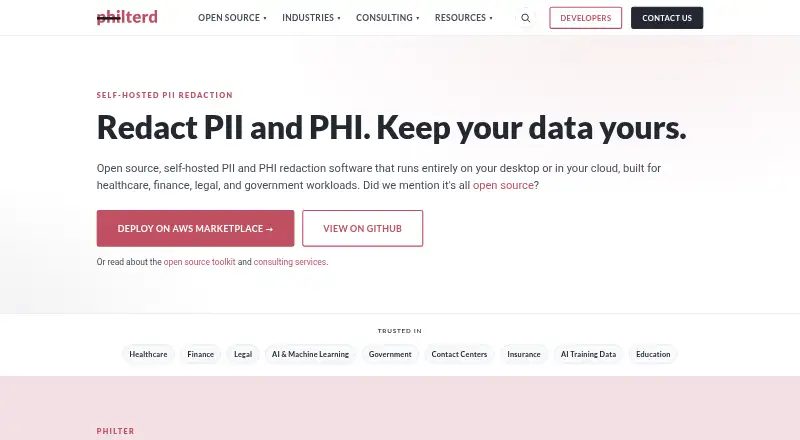
What Philter is
Philter is open source software that identifies and redacts personally identifying and protected health information in text. For detected entities, users can choose to mask, encrypt, substitute synthetic values, remove them, or leave them unchanged. Policies, custom dictionaries, and patterns for identifiers such as medical record numbers and transaction IDs allow configuration for specific needs. Its General Purpose, Healthcare, and COVID-19 NLP lenses target different text types. Philter provides an HTTP REST API, a Java SDK, and an OpenAPI specification, and can be deployed privately or through AWS, Google Cloud, and Microsoft Azure marketplaces. The maker says it processes text in the customer’s environment rather than sending it to third parties, including in firewalled or air-gapped setups. Redaction requests are recorded in a hash-chained audit log that can be queried and exported to CSV. Detection is probabilistic, so the maker advises checking results against an organization’s data before production use. The open source toolkit has community support; commercial licenses include direct support. Philter Desktop commercial use costs $100 a year per user.
Good
- Offers multiple actions for detected text.
- Supports custom dictionaries and identifier patterns.
- Can run in firewalled or air-gapped environments.
- Audit log can be queried and exported to CSV.
Watch out
- Detection is probabilistic and requires validation.
- Open source toolkit support is community-based.
- Commercial desktop plan costs $100 a year per user.
Who it suits
Philter suits teams in healthcare, finance, legal, government, and AI that need redaction in text workflows. It may fit organizations that need customer-controlled deployment and configurable detection policies.
Verdict
Philter offers configurable redaction with deployment options that keep processing in a customer environment. Validate detection against your own data before relying on it in production.
Plans and prices
From Philter's own pricing page, checked 2 Oct 2026.
| Plan | Price | What it gives you |
|---|---|---|
| Open source toolkit | Free | Self-hosted · Apache 2.0 · No license keys · No usage caps · No commercial review |
| Philter Desktop — Personal & evaluation | Free | Individual, non-commercial, and evaluation use · Full on-device redaction · Community support on GitHub |
| Philter Desktop — Commercial | $100 a year | Per user · Commercial use · Direct creator support · Updates, maintenance releases, and upgrades during subscription · $100 USD per user / year |
The facts
Each one read from Philter's own pages, with the date it was checked.
What it does
- Accuracy limitation
- Detection is probabilistic, and the maker advises validating results against a customer’s own data before relying on them in production.checked 2 Oct 2026
- API and SDKs
- Philter provides an HTTP REST API, a Java SDK, and an OpenAPI specification for generating clients in other languages.checked 2 Oct 2026
- Audit trail
- Philter records redaction requests in a tamper-evident, hash-chained audit log in the customer’s datastore, which can be queried and exported to CSV.checked 2 Oct 2026
- Cloud deployment
- Philter can be deployed in a private environment or through AWS, Google Cloud, and Microsoft Azure marketplaces.checked 2 Oct 2026
- Data handling
- The maker says Philter runs in the customer’s environment and does not transmit text to third-party services; it can run in a firewalled or air-gapped environment.checked 2 Oct 2026
- Detection and actions
- It detects many entity types and lets users choose to mask, encrypt, replace with synthetic values, drop, or pass them through.checked 2 Oct 2026
- Intended users
- The maker describes Philter for healthcare, finance, legal, government, and AI workloads, including teams adding redaction to APIs and data pipelines.checked 2 Oct 2026
- Models
- Philter offers General Purpose, Healthcare, and COVID-19 NLP lenses for different text types.checked 2 Oct 2026
- Open source and security
- The maker says its products are released under Apache 2.0, with source code publicly available on GitHub for inspection and self-building.checked 2 Oct 2026
- Policies and custom entities
- Users can define policies, custom dictionaries, and identifier patterns such as medical record numbers and transaction IDs.checked 2 Oct 2026
- Support
- The open source toolkit includes community support through documentation and GitHub issue trackers, while commercial licenses include direct support.checked 2 Oct 2026
- What it does
- Philter is open source software that redacts personally identifiable and protected health information from text.checked 2 Oct 2026
The company
- Company history
- Philterd says it was founded in 2017 by Jeff Zemerick.checked 2 Oct 2026
- Founded
- 2017checked 23 Sep 2026
The full review of Philter
Philter is open-source redaction software for teams processing sensitive text and documents, especially those building safeguards into APIs or data pipelines. It suits organizations that want configurable controls and customer-environment deployment, but probabilistic detection means it should not be trusted in production without validation against their own data.
Overview
Philter detects personally identifiable and protected health information, then lets users choose what to do with each match: mask it, encrypt it, substitute a synthetic value, drop it, or pass it through. That range supports workflows with different disclosure rules, though teams must set policies carefully rather than treating redaction as a single automatic switch.
Policies can incorporate custom dictionaries and identifier patterns, including medical record numbers and transaction IDs. General Purpose, Healthcare, and COVID-19 NLP lenses provide different starting points for varying text. Detection is probabilistic, so the key trade-off is clear: flexibility and control come with a need to validate outcomes on the data that matters to the organization.
Key features
For software teams, Philter provides an HTTP REST API, a Java SDK, and an OpenAPI specification for generating clients in other languages. Automated detection and batch processing can serve both integrated data flows and larger jobs. OCR redaction and support for PDF, DOCX, XLSX, CSV, TXT, RTF, EML, and MSG extend its reach beyond plain text.
Deployment options include a private environment and marketplaces for AWS, Google Cloud, and Microsoft Azure. The maker says processing stays in the customer’s environment, without sending text to third-party services, and that Philter can run behind a firewall or in an air-gapped setup. That is a meaningful fit for sensitive workloads with strict data boundaries. Its tamper-evident, hash-chained audit log is stored in the customer’s datastore and can be queried or exported to CSV, giving teams a record of redaction requests.
The maker releases its products under Apache 2.0 and makes source code publicly available on GitHub for inspection and self-building. The open-source toolkit comes with community support through documentation and GitHub issue trackers; commercial licenses include direct support.
Pricing
Philter’s freemium model spans a free toolkit, an evaluation-oriented desktop edition, and a paid commercial desktop subscription. The Philter Desktop — Personal & evaluation plan costs free for individual, non-commercial, and evaluation use. It includes full on-device redaction and community support on GitHub, making it suitable for personal use or assessing the software, but not commercial deployment.
The Open source toolkit is also free. It is self-hosted, licensed under Apache 2.0, requires no license keys, and has no usage caps. That makes it the most open-ended no-cost option for teams able to rely on community support; it does not include a commercial review.
Philter Desktop — Commercial costs $100 a year, billed at $100 USD per user / year. It adds commercial use, direct creator support, and updates, maintenance releases, and upgrades during the subscription. The per-user price suits individual commercial users; organizations should account for the charge per seat. For commercial use, the free desktop plan is not a substitute, while the free toolkit trades direct support and commercial review for its open-source, uncapped terms.
Platforms
Philter is available for API, Linux, self-hosted, and Windows environments, with hybrid deployment. Its document coverage includes OCR redaction and batch processing, supporting teams that need to incorporate it into existing systems rather than use it only as a standalone text tool.
Who it's for
Philter is aimed at healthcare, finance, legal, government, and AI workloads, including teams adding redaction to APIs and data pipelines. It is most compelling where keeping text within a customer-controlled environment and tailoring treatment to specific identifiers matter. It is a weaker fit for teams seeking dependable production detection without first validating results on their own material, or those wanting a simple end-user redaction utility without policy and integration work.
Pros and cons
- Flexible treatment of matches: Masking, encryption, synthetic replacement, dropping, and pass-through let teams align redaction with different workflows.
- Customer-controlled processing: Private, cloud-marketplace, firewalled, and air-gapped deployment options address stringent data-handling needs.
- Useful integration and document breadth: REST, Java, OpenAPI, batch processing, OCR, and support for common office, email, and text formats suit pipeline and document workloads.
- Validation burden: Probabilistic detection needs checking against the organization’s own data before production reliance.
- Commercial desktop pricing scales by user: The $100 USD per user / year subscription includes direct support and updates, while the free desktop plan is limited to non-commercial and evaluation use.
Alternatives
For a broader directory of tools in this category, see Document Redaction Software.
Choose GroupDocs.Redaction if you want a paid document-processing SDK with a free plan and trial, and support across mobile, desktop, web, API, Linux, and self-hosted platforms.
BleachPDF is a free, subscription-free option that runs on your own computer, for Linux and macOS users seeking a local alternative.
Docuflair Redact is a paid option with a free trial and availability across mobile, desktop, Linux, and web platforms.
PineThink Redact offers a free personal-use plan for single-document redaction on macOS and Windows, with a paid premium tier for readers who need more than that entry-level use.
PDFRedaction is a web-based free option with a daily document allowance for registered users, AI detection, OCR, image redaction, and local processing; it may suit readers focused on PDF handling in a browser.
Redact PDF AI offers a free plan and multiple platforms, with prepaid credits and a starter tier for readers who prefer credit-based or tiered access.
PrivacyScrubber is a web-based freemium alternative with per-session character, PDF-page, and upload limits on its free tier.
Objective RegWorks is a paid option for readers considering software in this space.
Verdict
Philter is a strong choice for technical teams handling sensitive text and documents that need configurable redaction within a customer-controlled environment, especially when API or pipeline integration is central. Its open-source toolkit offers an uncapped starting point, and its audit trail and deployment choices support tightly governed workflows. Look elsewhere if you need production-ready certainty without validating detection on your own data, or a simpler tool that avoids policy and integration work.
Alternatives to Philter
- 1
GroupDocs.Redaction
AndroidiOSWebAPI7.6$1,999 usage-based - 2

Redactable
Free planWebAPI7.4From $19 a month - 3

RedactLaw
Free planWebAPISelf-hosted7.4From $39 a month - 4
Docuflair Redact
AndroidiOSWebLinux7.2From €3,588 a year - 5
BleachPDF
Free planOpen sourceLinuxmacOSSelf-hosted7.0Free plan - 6
Excise
Free planAPILinuxmacOSWindows6.8Free plan