
PDFMonkey
PDFMonkey is a cloud document-generation API that turns templates and dynamic data into files.
What PDFMonkey is
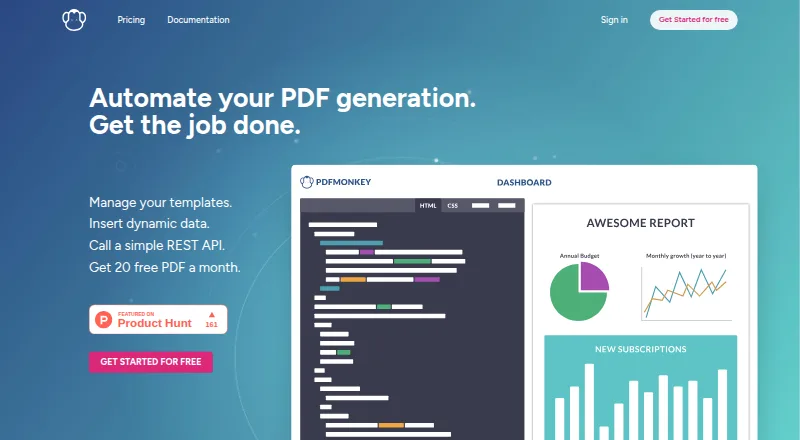
PDFMonkey is a cloud document-generation API that turns templates and dynamic data into files. Users can build templates in a visual drag-and-drop editor or write Code Templates in HTML, CSS, and Liquid, then send JSON data through the REST API. The Chrome-based renderer supports JavaScript, external fonts, images, charts, and other web technologies. Outputs include PDF, PNG, WebP, and JPG files, with bulk generation from datasets. Official connectors include Zapier, Make, n8n, Workato, Bubble, Glide, and InvoiceBerry. Developer tools include Ruby and Node.js SDKs, REST API access, and webhooks for generation events. The free plan allows 20 documents per month, with one-day retention and a 30-second generation limit; it does not support external images, fonts, CSS, or JavaScript. PDFMonkey says API traffic uses HTTPS/TLS, data is stored in encrypted database columns, and generated files are kept in private S3 buckets with one-hour presigned URLs. Its infrastructure is hosted in AWS's EU Paris region. PDFMonkey states that it has no formal SOC 2 or ISO 27001 certification.
Good
- Templates can be visual or HTML, CSS, and Liquid.
- Supports PDF, PNG, WebP, and JPG output.
- Bulk generation from datasets is available.
- Offers Ruby and Node.js SDKs and webhooks.
- Free plan includes 20 documents per month.
Watch out
- Free plan has a 30-second generation limit.
- Free plan excludes external assets and scripts.
- No formal SOC 2 or ISO 27001 certification.
- Free plan retains documents for one day.
Who it suits
PDFMonkey suits developers and teams that need to generate documents from structured data and reusable templates. Its connectors and SDKs may suit workflows that use automation tools or custom applications.
Verdict
PDFMonkey combines template editing, data merging, and developer access for automated document generation. Check the free-tier limits and certification status when assessing it for a workflow.
Plans and prices
From PDFMonkey's own pricing page, checked 15 Oct 2026.
| Plan | Price | What it gives you |
|---|---|---|
| 30-day Trial | Free | 300 documents · 1-day retention · external resources · share links · 2-minute generation timeout · 30 days; no credit card required |
| Free | Free | 20 documents/month · 1-day retention · no external images/fonts/CSS/JS · 30-second generation limit · 1 team member · forever |
| Starter | €5 a month | 300 documents/month · 1-day retention · external resources · 30-second generation limit · 1 team member · €5/month billed monthly (€4.5/month annually) |
| Pro | €15 a month | 3,000 documents/month · 7-day retention · external resources · 2-minute generation limit · 2 team members · €15/month billed monthly (€13.5/month annually) |
| Pro+ | €60 a month | 5,000 documents/month · unlimited retention · unlimited collaborators · share links · 3-minute generation limit · €60/month billed monthly (€54/month annually) |
| Premium | €300 a month | 60,000 documents/month · unlimited retention · unlimited collaborators · share links · 5-minute generation limit · €300/month billed monthly (€270/month annually) |
The facts
Each one read from PDFMonkey's own pages, with the date it was checked.
What it does
- API
- The REST API uses Bearer authentication and exposes CRUD operations for documents and templates, with examples in curl, Ruby, Node.js, Python, and PHP.checked 15 Oct 2026
- Asynchronous generation
- Document creation is normally asynchronous, requiring polling or a webhook before downloading the result.checked 15 Oct 2026
- Builder logic
- Builder templates support visibility conditions, repeated collections, custom CSS, custom JavaScript, and test JSON data.checked 15 Oct 2026
- Charts and web assets
- Templates can use browser-compatible chart libraries and external tools such as Tailwind CSS, Google Fonts, and QR-code libraries.checked 15 Oct 2026
- CLI
- The CLI is installed with npm, requires Node.js 22.12 or later, and supports local template editing, preview, watching, and workspace resource management.checked 15 Oct 2026
- Code templates
- Code templates use HTML, CSS, and Liquid v4 for dynamic fields, conditions, loops, and reusable snippets.checked 15 Oct 2026
- Compliance
- PDFMonkey says it is GDPR-aligned and offers DPA documents, but has no SOC 2 or ISO 27001 certification.checked 15 Oct 2026
- Dashboard templates
- The dashboard lets users create and manage templates and preview the resulting PDF in real time.checked 15 Oct 2026
- Data retention
- Documents are automatically deleted according to plan retention settings, and users can also delete them manually through the dashboard or API.checked 15 Oct 2026
- Data use
- PDFMonkey says customer data is used exclusively to generate requested documents and is not shared, sold or analyzed by PDFMonkey or external services.checked 1 Oct 2026
- Deployment
- cloudchecked 23 Sep 2026
- Developer tools
- PDFMonkey provides official Ruby and Node.js SDKs, REST API access and webhooks for document-generation events.checked 1 Oct 2026
- Form limitation
- Interactive signature fields are unsupported and complex validation is limited.checked 15 Oct 2026
- Hosting
- PDFMonkey infrastructure is hosted on Amazon Web Services in the EU (Paris) region.checked 1 Oct 2026
- Integrations
- Official integrations and connectors include Zapier, Make, n8n, Workato, Bubble, Glide and InvoiceBerry.checked 1 Oct 2026
- Key features
- Browser-based PDF template editor · JSON data merge into templates · REST API for document generation · Bulk document generation from datasets · Reusable templates with versioning · Downloadable generated PDF fileschecked 23 Sep 2026
- License
- The hosted PDFMonkey service is proprietary, while its CLI and several connector repositories are published under the MIT license.checked 15 Oct 2026
- Limit: coding burden
- The same Trustpilot reviewer mentioned that PDF creation involved lengthy code.checked 15 Oct 2026
- Limit: expiring downloads
- Generated-file download URLs are temporary and expire after one hour, so integrations should store the file rather than the URL.checked 15 Oct 2026
- Limit: quotas
- At 100% of a monthly quota, new generations are blocked unless pay-as-you-go billing is enabled or a Boost Pack is purchased.checked 15 Oct 2026
- Limit: template imports
- Existing PDF, Word, or other file formats cannot be imported; templates must be built in the Builder or from HTML/CSS/Liquid.checked 15 Oct 2026
The company
- Company data
- Crunchbase describes PDFMonkey as an active private Paris company with 1–10 employees and no disclosed funding amount.checked 15 Oct 2026
- Company profile
- LinkedIn lists PDFMonkey as a privately held Paris technology company founded in 2019 with 2–10 employees.checked 15 Oct 2026
- Legal company
- French registry data identifies PDFMONKEY as a SAS created in February 2019 with its registered office at 49 Rue de Ponthieu, Paris.checked 15 Oct 2026
Alternatives to PDFMonkey
- 1
 7.5From $29 a month
- 2
 7.2From $8.99 a month
- 37.2From $19 a month
- 4
 7.1From $25 a month
- 5
 7.1From $15 a month
- 67.0From $99 a month