
Paynetics Card Issuing
Paynetics Card Issuing provides businesses and partners with configurable card programs.
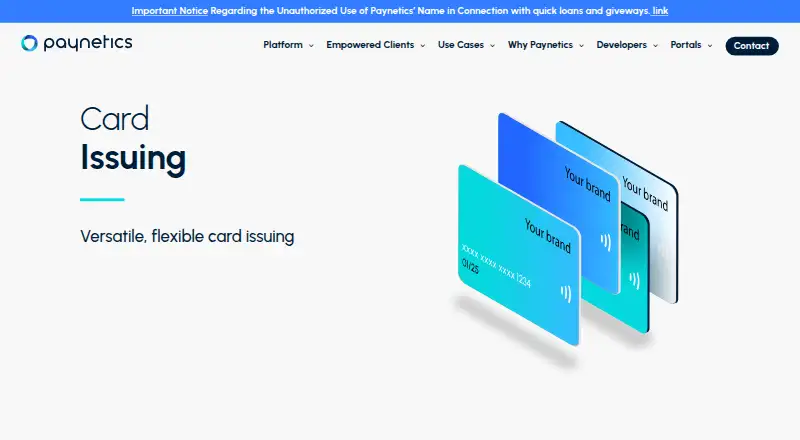
What Paynetics Card Issuing is
Paynetics Card Issuing provides businesses and partners with configurable card programs. Its range includes physical, virtual, and digitised prepaid, debit, credit, and business cards, with products from Visa and Mastercard. Partners can customise designs and set card rules, limits, controls, hierarchies, products, and pricing levels. Cards may connect to dedicated IBAN accounts or an eWallet. The API platform supports digital onboarding and data exchange for compliance, risk analysis, and monitoring; integration options include a REST API for accounts, issuing, transfers, and onboarding, as well as a partner portal. Developer resources include APIs, SDKs, sandbox tools, and operational status. Paynetics supports Apple Pay on iOS and an Android tokenisation option based on Mastercard MDES. A PCI-compliant SDK supports card-data display without partners storing or processing sensitive details. Physical card production requires an order of at least 1,000 units and typically takes around two months. Pricing is on request. Paynetics AD is licensed by the Bulgarian National Bank and passported across the EU; Paynetics UK Ltd is licensed by the FCA for UK services.
Good
- Offers physical, virtual, and digitised card options.
- Partners configure designs, limits, and controls.
- Cards can link to IBAN accounts or eWallets.
- Developer resources include APIs, SDKs, and sandbox tools.
Watch out
- Physical card orders start at 1,000 units.
- Manufacturing typically takes around two months.
- Pricing is available on request.
Who it suits
It suits businesses and partners planning branded or configurable card programs, including use cases such as government disbursements, payroll incentives, remittances, or e-commerce virtual cards.
Verdict
Paynetics offers configurable card programs with API integration and mobile wallet support. Physical cards have a minimum order and typical manufacturing lead time; pricing is on request.
Plans and prices
From Paynetics Card Issuing's own pricing page, checked 30 Sep 2026.
| Plan | Price | What it gives you |
|---|---|---|
| Card issuing | Priced on request | customisable programmes · physical/virtual cards · Visa/Mastercard |
The facts
Each one read from Paynetics Card Issuing's own pages, with the date it was checked.
What it does
- Accounts
- Issued cards can be linked to dedicated IBAN accounts and integrated into an eWallet.checked 30 Sep 2026
- Accounts and wallets
- Cards can be linked to dedicated IBAN accounts or integrated into an eWallet.checked 30 Sep 2026
- API integration
- The API Integration channel provides a single REST API for payment accounts, card issuing, transfers, onboarding and a web Partner Portal.checked 30 Sep 2026
- API onboarding
- The API platform supports digital onboarding and data exchange, including compliance, risk analysis and monitoring.checked 30 Sep 2026
- Card schemes
- Paynetics says it is a principal member of Visa and Mastercard and offers products from both schemes.checked 30 Sep 2026
- Card types
- Its card range includes plastic, virtual and digitised prepaid, debit, credit and business cards.checked 30 Sep 2026
- Controls
- Partners can configure limits, controls, hierarchy, multiple products and pricing levels.checked 30 Sep 2026
- Controls and branding
- Partners can customise card designs and configure rules, limits and controls for issued cards.checked 30 Sep 2026
- Customization
- Card programmes support co-branding, customised designs and flexible rule settings.checked 30 Sep 2026
- Developer tools
- The developer portal offers issuing APIs, SDKs, sandbox tooling and live operational status.checked 30 Sep 2026
- Integration limits
- Paynetics’ documentation says the minimum order for physical cards is 1,000 units and typical manufacturing takes around two months.checked 30 Sep 2026
- Manufacturing integrations
- Paynetics is pre-integrated with AllPay for Europe and the UK and Borica for the Balkan region.checked 30 Sep 2026
- Manufacturing limit
- The minimum physical-card order is 1,000 units, and manufacturing typically takes around two months.checked 30 Sep 2026
- Mobile wallets
- Paynetics says it supports Apple Pay on iOS and a proprietary Android tokenisation solution based on Mastercard’s MDES protocol.checked 30 Sep 2026
- Product
- Paynetics offers card-issuing programs that partners can customise for their business needs.checked 30 Sep 2026
- Program configuration
- The issuing infrastructure supports configurable limits and controls, customised hierarchies, multiple products and different pricing levels.checked 30 Sep 2026
- Purpose
- Paynetics provides versatile, flexible card issuing for businesses.checked 30 Sep 2026
- Regulation
- Paynetics AD is licensed by the Bulgarian National Bank and passported across the EU, while Paynetics UK Ltd is licensed by the FCA.checked 30 Sep 2026
- Schemes
- Paynetics is a principal member of Visa and Mastercard and offers their full range of products.checked 30 Sep 2026
- Security
- Paynetics offers a PCI-compliant SDK for secure card-data display without partners storing or processing sensitive data.checked 30 Sep 2026
- Security and regulation
- Paynetics AD says it is licensed by the Bulgarian National Bank and passported to provide services across the EU; Paynetics UK Ltd says it is licensed by the FCA for UK services.checked 30 Sep 2026
- Support
- The company lists customer support at +44 (0) 330 223 6848 and [email protected].checked 30 Sep 2026
- Tokenisation
- Its tokenisation solution replaces sensitive card details with dynamic components for transactions, which Paynetics says helps secure transmitted information and reduce fraud in digital transfers.checked 30 Sep 2026
The company
- Headquarters
- Sofia, Bulgariachecked 28 Sep 2026
The full review of Paynetics Card Issuing
Paynetics Card Issuing is a business platform for building and operating branded card programmes. It best suits organisations that need several card products, configurable controls and links to accounts or wallets. Its breadth is a strong fit for tailored programmes, but the physical-card order minimum makes that route a significant commitment.
Overview
Partners can issue plastic, virtual and digitised prepaid, debit, credit and business cards on Visa or Mastercard. They can tailor card designs and configure programme rules, limits, controls, product hierarchies and pricing levels. That flexibility helps businesses serve distinct customer groups; it also means this is a programme-building platform rather than a ready-made card product for a small team with a simple expense-card need.
Cards can be connected to dedicated IBAN accounts or integrated into an eWallet. Stated use cases range from gift cards and e-commerce virtual cards to government disbursements, payroll incentives, remittance, cards for children and teens, digital assets, freelancer payments and gaming.
Key features
Configurable issuing and onboarding
The API supports digital onboarding and data exchange for compliance, risk analysis and monitoring. A single REST API covers payment accounts, card issuing, transfers and onboarding, alongside a web Partner Portal. The developer portal includes APIs, SDKs, sandbox tooling and live operational status, giving technical teams tools to develop and monitor an integration. A PCI-compliant SDK supports secure card-data display without requiring partners to store or process sensitive card data.
Wallets, tokenisation and physical cards
Paynetics supports Apple Pay on iOS and an Android tokenisation solution based on Mastercard’s MDES protocol. Tokenisation substitutes dynamic components for sensitive card details in transactions, which Paynetics says helps protect transmitted information and reduce fraud in digital transfers. Physical cards require an order of at least 1,000 units and typically take around two months to manufacture. That is a meaningful hurdle for a pilot or a programme whose demand is uncertain; pre-integration with AllPay for Europe and the UK and Borica for the Balkan region may suit programmes using those manufacturing connections.
Regulation and support
Paynetics AD is licensed by the Bulgarian National Bank and passported to provide services across the EU; Paynetics UK Ltd is licensed by the FCA for UK services. The company lists customer support at +44 (0) 330 223 6848 and [email protected].
Pricing
The Card issuing plan has custom pricing. It includes customisable programmes, physical and virtual cards, Visa and Mastercard, an issuing API, spend controls, funding and balances, multi-program support and KYC/KYB tools. This is a paid offering, with no published seat quota, card quota, trial period or renewal term to weigh against a particular budget. The scope of the programme is central to the buying decision, so organisations should establish the full commercial terms before committing.
Platforms
Paynetics supports Android, iOS, web and API access. The platform coverage suits programmes spanning mobile wallets and web-based partner operations, with API access for integration work.
Who it's for
Paynetics is aimed at businesses and organisations building their own card programmes: from consumer gift cards and online virtual cards to disbursements, payroll incentives, remittance, child and teen prepaid cards, digital-asset payments, freelancer payments and gaming. It is a stronger fit for teams that need configurable products and controls across a programme than for buyers seeking a small, standardised card setup. Organisations planning to issue physical cards should be able to absorb the 1,000-unit minimum and typical two-month manufacturing lead time.
Pros and cons
- Pro: Multiple card types, schemes, products and configurable hierarchies support programmes serving different audiences and use cases.
- Pro: The API, SDKs, sandbox and Partner Portal give integration teams a range of development and operational tools.
- Pro: Apple Pay, Android tokenisation, IBAN account connections and eWallet integration support both digital-wallet and account-linked programmes.
- Con: The 1,000-card minimum and roughly two-month manufacturing time raise the cost and planning burden of a physical-card launch.
- Con: Custom pricing means buyers need a scoped quote to assess programme costs.
Alternatives
Consider Extend if a free starting point for a smaller virtual-card programme matters more: its Starter plan costs nothing and allows up to 100 virtual cards per month, but is capped at 5 users and 10 guests, with one expense category and 15 category labels. For an enterprise platform with custom pricing, Marqeta is another option. Mastercard Decision Intelligence is a paid, web-based alternative with contact-sales pricing. Lithic may suit buyers who want a custom quote based on transaction volume and required features. OpenWay Way4 is a paid alternative available through API, web and self-hosted deployment. Enfuce Cards scopes pricing to the programme, with a one-time implementation fee, monthly service fee, volume-based fee and possible add-ons. Nium Physical and Virtual Cards is another paid option for custom card programmes. Thredd is a paid alternative with API and web platforms.
For broader category comparisons, see Card Issuing Platforms and Banking-as-a-Service Platforms.
Verdict
Choose Paynetics if your organisation needs a configurable, multi-product card programme with API-based onboarding, account or wallet connections and support for both Visa and Mastercard. Its combination of programme controls and developer tooling is the main reason to consider it. Look elsewhere if you need a small physical-card launch, since the 1,000-unit minimum and typical two-month manufacturing time are hard constraints, or if you need a clear price before scoping a programme.
Getting started
- Visit the Paynetics Card Issuing website.
- Contact sales for pricing and a card-issuing programme.
- Configure card designs, rules, limits, controls and products for the programme.
- Use issuing APIs, SDKs or sandbox tooling to integrate onboarding and card services.
- For physical cards, plan for a minimum order of 1,000 units and typical manufacturing of around two months.
Limits worth knowing
The minimum physical-card order is 1,000 units, and manufacturing typically takes around two months. Pricing is on request.
Questions
How is Paynetics Card Issuing priced?
Pricing is on request; the listed Card issuing plan is a customisable programme.
Can it issue virtual and physical cards?
Yes. Its range includes both physical and virtual prepaid, debit, credit and business cards.
Which card schemes does it support?
Paynetics says it is a principal member of Visa and Mastercard and offers products from both schemes.
Which mobile wallets are supported?
Paynetics supports Apple Pay on iOS and an Android tokenisation solution based on Mastercard’s MDES protocol.
What is the minimum physical-card order?
Physical card orders require at least 1,000 units, and manufacturing typically takes around two months.
Where is Paynetics licensed?
Paynetics AD is licensed by the Bulgarian National Bank and passported across the EU. Paynetics UK Ltd is licensed by the FCA for UK services.
Alternatives to Paynetics Card Issuing
- 1

Extend
Free planAndroidiOSWebAPI7.9Free plan - 2

Wallester White Label
AndroidiOSWebAPI6.5From €2,495 a month - 3
Visa DPS Forward
Free planAPI6.4Free plan - 4

Conferma Pay
AndroidiOSWebAPI6.3 - 56.1
- 6
Stripe Issuing
WebAPI5.9$0.10 one-time