
Extend
Extend helps companies manage card spending and employee expenses with virtual cards, tracking, receipt management, and accounting reconciliation.
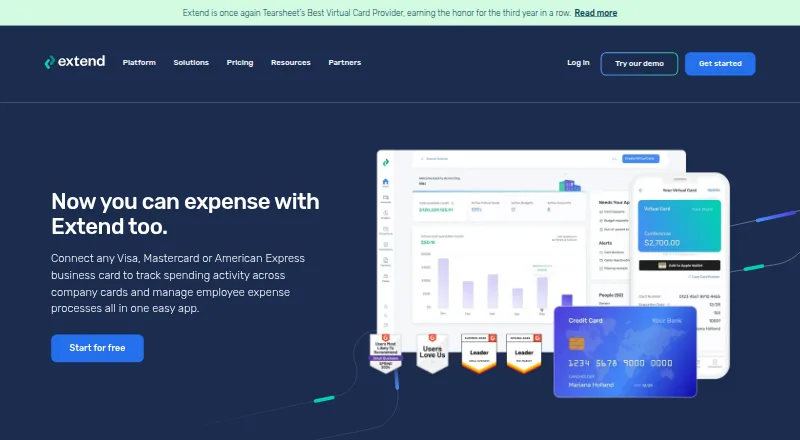
What Extend is
Extend helps companies manage card spending and employee expenses with virtual cards, tracking, receipt management, and accounting reconciliation. Virtual cards can have spending limits and expiration dates, and can be created for vendor payments, subscriptions, or team expenses. Card creation is available only through participating bank partners; eligible Visa or Mastercard cards from other banks can be registered for expense management. Other tools include budgets, receipt capture, expense reports, reimbursements, approvals, and transaction reporting. Extend integrates with QuickBooks Online and Desktop, NetSuite, Xero, Sage Intacct, and Microsoft Dynamics 365 Business Central. Its virtual card API supports issuance, transaction metadata, authorization and clearing data through webhooks, and configurable card controls. Extend says it is PCI and SOC 2 compliant and uses TLS with SHA-256 and RSA encryption. The free Starter plan supports up to five users and 100 virtual cards per month. Pro costs $8.99 per user per month on the annual plan or $11.99 per user per month monthly, with a 10-user minimum for either option.
Good
- Virtual cards support spending limits and expiration dates.
- Expense tools include reimbursements and approval workflows.
- Integrates with six listed accounting platforms.
- API supports configurable card controls and webhooks.
- Starter is free for up to five users.
Watch out
- Virtual card creation requires a participating bank partner.
- Pro has a 10-user minimum.
- No free trial is listed.
Who it suits
Extend is aimed at companies managing employee expenses and company spending. It may suit teams that need virtual cards, expense workflows, or accounting integrations.
Verdict
Extend brings virtual cards, expense workflows, and accounting reconciliation together for business spending. Confirm bank eligibility and the Pro user minimum before choosing a plan.
Plans and prices
From Extend's own pricing page, checked 14 Oct 2026.
| Plan | Price | What it gives you |
|---|---|---|
| Starter | Free | Up to 5 users · up to 10 guests · up to 100 virtual cards/month · 1 expense category · 15 labels · Free |
| Pro (annual) | $8.99 | Up to 50 guests · up to 500 virtual cards/month · up to 5 expense categories · 500 labels · QuickBooks Online sync · reimbursements · Per user/month, billed annually; 10-user minimum |
| Pro (monthly) | $11.99 a month | Up to 50 guests · up to 500 virtual cards/month · up to 5 expense categories · 500 labels · QuickBooks Online sync · reimbursements · Per user/month; 10-user minimum |
| Enterprise | Priced on request | No user minimum · custom implementation · API-based card issuance · unlimited expense categories and labels · NetSuite integration · Contact Extend |
The facts
Each one read from Extend's own pages, with the date it was checked.
What it does
- Accounting integrations
- Listed accounting connections include QuickBooks Online/Desktop, Xero, Sage Intacct, Microsoft Dynamics 365 Business Central and NetSuite.checked 14 Oct 2026
- API
- Extend's virtual card API supports card issuance, transaction metadata, real-time authorization and clearing data through webhooks, and configurable card controls.checked 28 Sep 2026
- API access
- API access requires an Extend account, owner approval and customer-success contact; issued keys expire after 365 days.checked 14 Oct 2026
- API capability
- The virtual-card API supports on-demand issuance, real-time authorization controls, multiple issuers, mobile wallets, tokenization and enriched transaction data.checked 14 Oct 2026
- Bank compatibility
- Virtual-card issuance is available through participating banks, while expense features can also work with eligible Visa or Mastercard cards.checked 14 Oct 2026
- Bill pay
- The bill-pay workflow creates cards for invoices, sends secure links to vendors and tracks invoice payments.checked 14 Oct 2026
- Budgets
- Budgets can be assigned to teams, projects, clients or expense categories with shared balance visibility.checked 14 Oct 2026
- Card controls
- Cards support spending caps, expiration dates, automatic refills, editing, deactivation and reactivation.checked 14 Oct 2026
- Customer help
- Extend provides a help center, onboarding support, webinars, and learning resources.checked 28 Sep 2026
- Developer documentation
- Extend links public Stoplight API documentation and provides Python request examples for issuing, closing and retrieving virtual-card spend.checked 14 Oct 2026
- Expense tools
- Extend offers budgets, receipt capture, expense reports, reimbursements, approval workflows, and transaction reporting.checked 28 Sep 2026
- Funding news
- A Business Wire release dated October 27, 2021 reported a $40 million Series B led by March Capital.checked 14 Oct 2026
- Guest cards
- Cards can be sent to vendors or contractors who do not have Extend accounts.checked 14 Oct 2026
- Integrations
- Extend lists integrations with QuickBooks Online and Desktop, NetSuite, Xero, Sage Intacct, and Microsoft Dynamics 365 Business Central.checked 28 Sep 2026
- Issuer availability
- Virtual card creation is available only with participating bank partners; eligible Visa or Mastercard cards from other banks can be registered for expense management features.checked 28 Sep 2026
- License
- The terms describe Extend software and content as proprietary and grant only a revocable, non-transferable, non-sublicensable service-use license.checked 14 Oct 2026
- Limit: Google Wallet
- A Google Play reviewer complained that cards could not be linked to Google Wallet for NFC payments.checked 14 Oct 2026
- Limit: merchant acceptance
- A G2 reviewer said a merchant that does not accept digital payments would not accept an Extend card.checked 14 Oct 2026
The company
- Company legal name
- The company identifies itself as Extend Enterprises, Inc.checked 14 Oct 2026
- Company profile
- LinkedIn lists Extend as privately held, founded in 2017, headquartered in New York and employing 51–200 people.checked 14 Oct 2026
- Founded
- Extend says it was founded in 2017 by payment industry veterans.checked 28 Sep 2026
- Founders and ownership facts
- Crunchbase lists founders Andrew Jamison, Danny Morrow and Guillaume Bouvard, New York headquarters and five funding rounds.checked 14 Oct 2026
- Headquarters
- New York City, New York, United Stateschecked 28 Sep 2026
Where it runs
- Limit: Apple app
- Apple reviewers report older iOS devices being blocked and occasional crashes or failure to open.checked 14 Oct 2026
The full review of Extend
Overview
Extend is a company-spending and employee-expense platform for businesses that want card controls and expense administration in one place. It is strongest for teams already using an eligible bank card program and accounting software it connects to; the Pro tier’s 10-user minimum makes it a poor fit for a small team needing paid features.
Key features
Virtual cards and controls
Virtual cards can be set up with spending limits and expiration dates for vendor payments, subscriptions, or team expenses. That gives organizations a way to bound recurring or delegated spend, but card creation is restricted to participating bank partners. Eligible Visa or Mastercard cards from other banks can be registered for expense management, not virtual card issuance. Spend controls, funding and balances, and multi-card program support round out the card tools.
Expenses and accounting
Budgets, receipt capture, expense reports, reimbursements, approval workflows, and transaction reporting cover the administrative work around company spending. Integrations with QuickBooks Online and Desktop, NetSuite, Xero, Sage Intacct, and Microsoft Dynamics 365 Business Central make Extend a better fit for businesses already working in those accounting systems. Its single expense category on Starter is restrictive; Pro expands that to five, while Enterprise allows unlimited categories and labels.
API, privacy, and support
The virtual card API supports issuance, transaction metadata, configurable card controls, and real-time authorization and clearing data through webhooks. That makes Extend relevant to businesses that need to connect issuance to their own systems. Extend says it is PCI and SOC 2 compliant and uses TLS with SHA-256 and RSA encryption. It also says only a card’s designated recipient can see its full number; the primary cardholder and organization admins see only the last four digits in the app and reports.
Starter includes email and chat support, Pro adds priority support, and Enterprise includes a designated account manager and custom implementation. A help center, onboarding support, webinars, and learning resources provide additional guidance.
Pricing
Extend uses a freemium model, with no free trial. The free Starter plan costs nothing and supports up to 5 users, 10 guests, and 100 virtual cards per month. It includes one expense category and 15 category labels. This is a useful starting point for a small team with modest card volume, but the category and card caps limit its room to grow.
Pro (annual) is $8.99 a year, billed per user per month on the annual plan, with a 10-user minimum. It raises the limits to 50 guests and 500 virtual cards per month, with up to five expense categories and 500 labels. Pro (monthly) costs $11.99 a month, billed per user per month, with the same 10-user minimum and feature limits. Monthly billing avoids the annual-plan term, but the minimum still makes both paid options a substantial commitment for a small organization.
Enterprise has custom pricing, no user minimum, and custom user packages. It includes virtual card issuance by API key and unlimited expense categories and labels, making it the more suitable tier for organizations needing tailored packages or higher administrative flexibility.
Platforms
Extend is available on Android, iOS, and web, and offers an API for software integrations and card issuance.
Who it's for
Extend suits businesses seeking card controls, employee expense workflows, and accounting reconciliation together, especially those with a participating issuing bank or eligible Visa or Mastercard cards and an accounting platform among its integrations. It is less compelling for solo operators and small teams that need a paid plan, since Pro starts at 10 users. Businesses requiring card creation should confirm their bank’s eligibility before committing.
Pros and cons
- Pros: Card limits and expiration dates help constrain vendor, subscription, and team spending.
- Pros: Receipt, approval, reimbursement, and reporting tools connect card activity with expense administration.
- Pros: Accounting integrations and an API with real-time event data support established finance workflows and custom connections.
- Cons: Virtual card creation depends on a participating bank partner, limiting who can use the core issuance feature.
- Cons: Pro requires at least 10 users, even though the free plan is capped at five users.
- Cons: Starter’s 100-card monthly allowance and one expense category may be too tight for growing teams.
Alternatives
For a broader card-issuing platform comparison, see Card Issuing Platforms.
Choose Paynetics Card Issuing when a customizable card program with physical and virtual Visa or Mastercard cards is the priority; it is paid with customisable programmes. Marqeta is another paid, enterprise platform with API and web access and contact-sales pricing. Mastercard Decision Intelligence is a paid web option with contact-sales pricing. Lithic may suit buyers seeking a custom quote tied to transaction volume and required features. Enfuce Cards scopes pricing to the programme, with implementation, monthly service, volume-based fees, and possible add-ons. Nium Physical and Virtual Cards offers a paid custom card program with terms and pricing handled through contact. Conferma Pay is another paid option for web, iOS, and Android. Highnote is paid and API/web-based, with volume discounts and a dedicated program manager among the Issuing Standard terms; its acquiring tier has flexible pricing.
Verdict
Extend is a sensible choice for businesses that can issue through a participating bank and want card controls, expense workflows, and accounting reconciliation under one platform. Its free tier is practical for small teams testing a limited workflow, but businesses needing paid capacity should look elsewhere unless they can meet Pro’s 10-user minimum or qualify for an Enterprise package.
Getting started
- Visit Extend’s website.
- Choose the free Starter plan or a Pro or Enterprise plan.
- For virtual card creation, use a participating bank partner; eligible Visa or Mastercard cards from other banks can be registered for expense management.
- Use Extend on web, iOS, or Android, or connect through its API.
Limits worth knowing
Starter is free and capped at five users, ten guests, 100 virtual cards per month, one expense category, and 15 category labels. Pro costs $8.99 per user per month on the annual plan or $11.99 per user per month on the monthly plan, with a 10-user minimum; it allows up to 500 virtual cards per month, five expense categories, 500 labels, and 50 guests.
Questions
Is Extend free?
Yes. The Starter plan is free and supports up to five users, ten guests, and 100 virtual cards per month.
How much does Pro cost?
Pro is $8.99 per user per month on the annual plan or $11.99 per user per month on the monthly plan. Both have a 10-user minimum.
Can every company create virtual cards with Extend?
Virtual card creation is available only through participating bank partners. Eligible Visa or Mastercard cards from other banks can be registered for expense management features.
Which platforms does Extend support?
Extend is available on web, iOS, Android, and through an API.
Which accounting integrations does it offer?
Extend lists QuickBooks Online and Desktop, NetSuite, Xero, Sage Intacct, and Microsoft Dynamics 365 Business Central.
What does the Enterprise plan include?
Enterprise uses custom pricing, has no user minimum, supports custom user packages and virtual card issuance by API key, and includes unlimited expense categories and labels.
Alternatives to Extend
- 1

Paynetics Card Issuing
AndroidiOSWebAPI6.5 - 2

Wallester White Label
AndroidiOSWebAPI6.5From €2,495 a month - 3
Visa DPS Forward
Free planAPI6.4Free plan - 4

Conferma Pay
AndroidiOSWebAPI6.3 - 56.1
- 6
Stripe Issuing
WebAPI5.9$0.10 one-time