
Oracle Cloud Infrastructure Secret Management
Oracle Cloud Infrastructure Secret Management stores, retrieves, rotates and manages credentials used by applications and cloud environments.
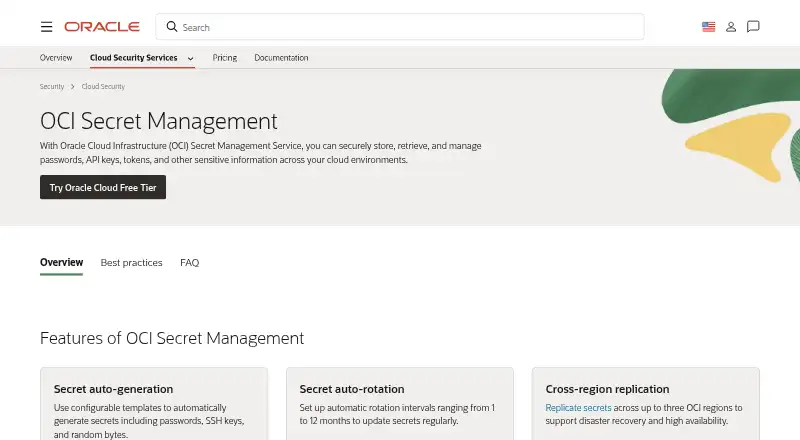
What Oracle Cloud Infrastructure Secret Management is
Oracle Cloud Infrastructure Secret Management stores, retrieves, rotates and manages credentials used by applications and cloud environments. It supports database passwords, access tokens, third-party API keys, SSH private keys, application configuration secrets, and OAuth2 or JWT signing credentials. Applications and administrators can access secrets through APIs, SDKs, the CLI or OCI Console. OCI Vault keys encrypt the secrets, while OCI manages encryption, decryption, access controls and audit logging; OCI IAM policies provide granular permissions. Automatic rotation can run at intervals from one to 12 months and integrates with Autonomous AI Database and OCI Functions. Secrets can be replicated to up to three destination regions, where replicas are read-only and inherit changes from the source. A tenancy can contain up to 5,000 secrets, with up to 30 active versions and 30 versions pending deletion per secret. The service is listed as free, although no price is provided. These capacity limits help indicate the scale it can accommodate.
Good
- Supports common application and cloud credential types.
- Access through APIs, SDKs, CLI and OCI Console.
- Automatic rotation intervals span one to 12 months.
- Secrets can be replicated to three destination regions.
- Listed as free.
Watch out
- Tenancy limit is 5,000 secrets.
- Each secret allows up to 30 active versions.
- Replicas are read-only.
Who it suits
This service suits application and cloud teams that need centrally managed credentials instead of embedding them in source code or configuration files. It may also fit teams using automatic rotation or multi-region secret replication.
Verdict
OCI Secret Management centralizes credentials with access controls, auditing, rotation and replication. Check its tenancy and version limits against the volume of secrets your environment needs.
Plans and prices
From Oracle Cloud Infrastructure Secret Management's own pricing page, checked 14 Oct 2026.
| Plan | Price | What it gives you |
|---|---|---|
| OCI Secret Management | Free | 5,000 secrets per tenancy · 30 active versions and 30 pending-deletion versions per secret · target-vault/key charges may apply for replication |
The facts
Each one read from Oracle Cloud Infrastructure Secret Management's own pages, with the date it was checked.
What it does
- Access control
- OCI IAM policies provide granular access control for secrets.checked 29 Sep 2026
- Access methods
- Administrators and applications can use the browser console, OCI CLI, REST management and retrieval APIs, or OCI SDKs.checked 14 Oct 2026
- API endpoints
- Secret creation uses a management endpoint, while cryptographic operations use a separate cryptographic endpoint; regional endpoints are documented.checked 14 Oct 2026
- Auto-generation
- Configurable templates can generate passwords, SSH keys, passphrases, and random bytes.checked 14 Oct 2026
- Automatic rotation
- Automatic secret rotation supports intervals from 1 to 12 months and integrates with Autonomous AI Database and OCI Functions.checked 29 Sep 2026
- Auto-rotation
- Scheduled rotation can run from one day to 360 days through the API and Terraform configuration, while Oracle’s product page highlights one-to-twelve-month intervals.checked 14 Oct 2026
- Availability design
- The service maintains copies across fault domains and, where available, across two availability domains for durability and high availability.checked 14 Oct 2026
- CLI support
- The OCI CLI can create base64 secrets and configure automatic generation and rotation from JSON configuration files.checked 14 Oct 2026
- Cross-region replication
- Secrets can be asynchronously replicated to as many as three target OCI regions.checked 14 Oct 2026
- Database and Functions integration
- Automatic rotation supports Autonomous Database and OCI Functions, including custom rotation logic executed by Functions.checked 14 Oct 2026
- Default capacity limits
- The documented tenancy defaults are 5,000 secrets, 30 active versions per secret, and 30 versions pending deletion per secret.checked 14 Oct 2026
- Default limits
- A tenancy can have 5,000 secrets, with up to 30 active versions and 30 versions pending deletion per secret.checked 29 Sep 2026
- Deletion behavior
- Deleting a secret starts a retention window between 24 hours and 30 days, after which permanent deletion cannot be reversed.checked 14 Oct 2026
- Encryption and auditing
- Secrets are encrypted using keys in OCI Vault, and OCI manages encryption, decryption, access control, and audit logging.checked 29 Sep 2026
- Encryption protection
- Secrets are encrypted with OCI Vault keys, which can use FIPS-validated HSM or software protection modes.checked 14 Oct 2026
- Expiry and reuse rules
- Secret rules can set absolute or version expiry and block retrieval or reuse of expired or previously used values.checked 14 Oct 2026
- Generated secret limits
- Generated passphrases can be up to 32 characters, while generated RSA SSH key pairs can use 2048, 3072, or 4096-bit keys.checked 29 Sep 2026
- Go SDK
- Oracle publishes a Go secrets SDK with operations such as GetSecretBundle, GetSecretBundleByName, and ListSecretBundleVersions.checked 14 Oct 2026
- IAM controls
- OCI IAM policies can separately authorize reading, inspecting, using, rotating, and managing secrets by compartment, group, dynamic group, or resource type.checked 14 Oct 2026
The company
- Company facts
- LinkedIn lists Oracle as a public IT services company founded in 1977, headquartered in Austin, Texas, with more than 10,001 employees.checked 14 Oct 2026
- Founded
- 1977checked 28 Sep 2026
- Funding or ownership
- Crunchbase lists Oracle as a public company with seven investors and a most recent funding event described as a January 30, 2025 post-IPO debt round.checked 14 Oct 2026
- Headquarters
- Austin, Texas, USAchecked 28 Sep 2026
Money
- Free plan
- Yeschecked 22 Sep 2026
The full review of Oracle Cloud Infrastructure Secret Management
Overview
Oracle Cloud Infrastructure Secret Management gives applications and cloud environments a central service for managing credentials rather than storing them in source code or configuration files. It is best suited to teams already building on OCI that need controlled access, rotation and regional copies of application secrets.
Its strength is a focused set of secret-management controls, including OCI IAM policies and OCI Vault encryption. The tenancy and per-secret version caps make capacity planning important for environments with large or rapidly changing credential stores.
Key features
Secret access and protection
The service handles database passwords, access tokens, third-party API keys, SSH private keys, application configuration secrets, and OAuth2 or JWT signing credentials. Teams can work through APIs, SDKs, the CLI or OCI Console, which gives both automated workloads and administrators a route to retrieve and manage secrets. OCI Vault keys encrypt secrets, while OCI manages encryption, decryption, access control and audit logging. Granular OCI IAM policies are valuable when different applications or operators need different levels of access.
Rotation and lifecycle
Automatic rotation can run every one to 12 months and integrates with Autonomous AI Database and OCI Functions. That can reduce the burden of keeping supported credentials current, but the stated integrations are specific; the service is not a universal rotation answer for every system. Automatic renewal, deployment automation and revocation workflows are also included among its capabilities.
Replication and capacity
Secrets can be replicated to up to three destination regions. Replicas are read-only and inherit changes from the source, making replication useful for regional access without creating independent writable copies.
A tenancy can hold 5,000 secrets, with up to 30 active versions and 30 versions pending deletion per secret. Those limits suit many bounded deployments, but organizations with larger secret inventories or frequent version churn should check their expected capacity. Generated passphrases can be up to 32 characters; generated RSA SSH key pairs support 2048-, 3072- or 4096-bit keys.
Pricing
OCI Secret Management
The service is presented with a free plan and a free pricing model. Its stated allowance is 5,000 secrets per tenancy, 30 active versions per secret and 30 versions pending deletion per secret. There is no paid tier to compare for higher quotas in the plan details, so teams approaching these caps should confirm that the service fits their scale before standardizing on it. Automatic renewal is supported.
Platforms
OCI Secret Management is a cloud service with web and API access. The listed access methods also include SDKs, the CLI and OCI Console, making it suitable for both application integration and console-based administration.
Who it's for
This is a strong fit for OCI-based application and cloud teams that want credentials centrally managed, encrypted with OCI Vault keys, governed through IAM policies and auditable within OCI. Its rotation integrations are particularly relevant to teams using Autonomous AI Database or OCI Functions. It is less compelling for organizations that need a secret store beyond OCI's stated tenancy and version limits or depend on rotation integrations outside those named systems.
Pros and cons
- Pros: Supports a broad range of application credentials, from database passwords to signing credentials, through API, SDK, CLI and console access.
- Pros: OCI Vault encryption, granular IAM policies and audit logging bring protection and access oversight into the OCI environment.
- Pros: Automatic rotation at one-to-12-month intervals and replication to three destination regions cover useful lifecycle and regional needs.
- Cons: The 5,000-secret tenancy ceiling and per-secret version caps may constrain larger or high-churn environments.
- Cons: Replicas are read-only and inherit source changes, so they do not serve as independently managed regional secrets.
- Cons: The named automatic-rotation integrations are limited to Autonomous AI Database and OCI Functions, narrowing the clearest fit for teams with other systems.
Alternatives
For a different security focus, consider Trellix Data Loss Prevention: its enterprise DLP products protect endpoints, email, web, networks and data storage, with on-premises or SaaS management. It is a better match when preventing data loss across those channels matters more than centrally managing secrets.
CryptoBind Database Activity Monitoring (DAM) is a paid alternative for readers seeking database activity monitoring rather than OCI secret storage.
Varonis Data Discovery and Classification uses quote-based pricing and is a paid option for readers considering data discovery and classification instead.
Datiphy is a paid, self-hosted alternative with a free trial.
DB Audit offers a paid Hybrid plan with cloud management and on-premise data processing, plus a free trial; consider it when that deployment split is the priority.
DataSunrise is a paid alternative with a free trial and custom pricing.
SecureCube Access Check is a paid, trial-available alternative with a service edition billed by reference to managed servers.
Tencent Cloud Data Security Audit is a paid web option with an Enterprise Edition priced at $280 a month, billed on prepaid yearly or monthly subscriptions; choose it when that database security audit package is a closer fit.
Readers comparing adjacent categories can browse Database Activity Monitoring Software, Database Security Software, Database Vulnerability Scanners, Identity Governance Software, Key Management Software and Encryption Key Management Software.
Verdict
Choose OCI Secret Management if your applications already rely on OCI and you want centrally governed credentials with Vault-backed encryption, IAM controls, auditing and practical rotation options. Look elsewhere if your secret volume exceeds the tenancy cap, you need writable regional replicas, or your rotation needs depend on integrations beyond the two named services.
Getting started
- Open the Oracle Secret Management website.
- Choose API, SDK, CLI, or OCI Console access.
- Use OCI IAM policies to define access to secrets.
- Store supported credentials and configure rotation or replication as needed.
Limits worth knowing
The free plan is limited to 5,000 secrets per tenancy, with up to 30 active versions and 30 versions pending deletion per secret. Replicas are read-only.
Questions
Is Oracle Cloud Infrastructure Secret Management free?
It is listed with a free plan.
Which platforms can access it?
The listed platforms are API and web. Access methods include APIs, SDKs, the CLI, and OCI Console.
What kinds of secrets can it manage?
Supported content includes database passwords, access tokens, third-party API keys, SSH private keys, application configuration secrets, and OAuth2 or JWT signing credentials.
Can secrets rotate automatically?
Yes. Automatic rotation supports intervals from one to 12 months and integrates with Autonomous AI Database and OCI Functions.
How many regions can receive replicas?
Secrets can be replicated to up to three destination regions. Replicas are read-only and inherit changes from the source.
Who makes the service?
The listed maker is Oracle Cloud Infrastructure Secret Management; the maker headquarters are in Austin, Texas, USA.
Alternatives to Oracle Cloud Infrastructure Secret Management
- 1
Haltdos
Free planWebAPILinuxSelf-hosted6.8From $30 a month - 2
FastNetMon
WebAPILinuxmacOS6.7From $115 a month - 3

Gcore DDoS Protection
Free planWebAPI6.7Free plan - 4

AWS Shield
Free planWebAPI6.5From $3,000 a month - 5

Imperva API Security
WebAPISelf-hosted6.5 - 6
Andrisoft Wanguard
WebAPILinuxSelf-hosted6.3From $595 a year