
CryptoBind Database Activity Monitoring (DAM)
CryptoBind Database Activity Monitoring (DAM) provides real-time database activity visibility, threat detection, and audit support for regulated industries, …
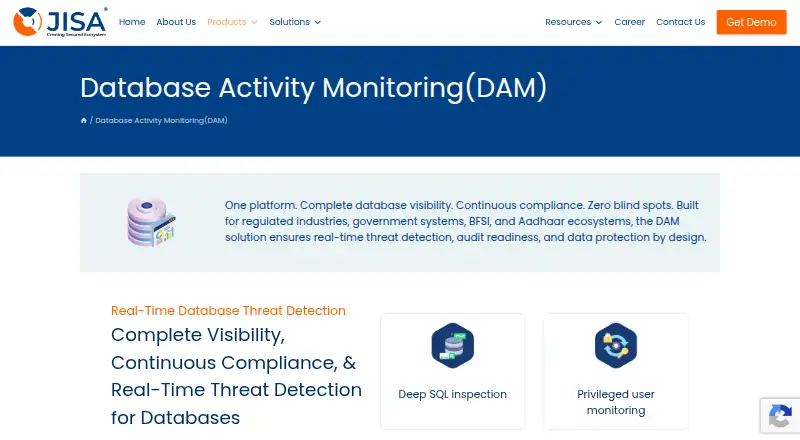
What CryptoBind Database Activity Monitoring (DAM) is
CryptoBind Database Activity Monitoring (DAM) provides real-time database activity visibility, threat detection, and audit support for regulated industries, government systems, BFSI, and Aadhaar ecosystems. It captures SELECT, INSERT, UPDATE, and DELETE operations, reconstructs and normalizes queries, and links application users with database users. It can identify access to sensitive fields such as Aadhaar, PAN, PII, and PCI data, while monitoring DBA and superuser actions, schema changes, privilege grants, account creation or deletion, and escalation. Alerts can follow rules or behavior, with anomaly detection based on activity volume, frequency, and time, and severity levels from Low to Critical. The vendor describes append-only, cryptographically signed audit logs, hashing, WORM storage support, and tampering alerts. Listed databases are PostgreSQL, Oracle, MySQL, and Microsoft SQL Server; MongoDB is an optional add-on, while DB2 is on the roadmap. Deployment choices include on-premises, VM-based private cloud, government cloud, and air-gapped or offline SOC environments. Dashboards, database agents, a central DAM server, and REST and gRPC APIs are described. Pricing is available on request.
Good
- Captures and normalizes database operations in real time.
- Monitors privileged actions and sensitive-field access.
- Provides rule-based and behavioral alerts.
- Lists integrations with major SIEM products.
- Supports on-premises, private-cloud, and air-gapped deployments.
Watch out
- Pricing is available on request.
- MongoDB is an optional add-on.
- DB2 is listed as roadmap, not current support.
- Cloud-native DAM is marked roadmap.
Who it suits
The product is aimed at regulated industries, government systems, BFSI, and Aadhaar ecosystems that need database activity monitoring and audit support. Organizations should confirm pricing and deployment details with the maker.
Verdict
CryptoBind DAM focuses on monitoring, alerts, and audit controls for database environments with regulatory needs. Confirm database coverage, optional components, and deployment fit before requesting pricing.
The facts
Each one read from CryptoBind Database Activity Monitoring (DAM)'s own pages, with the date it was checked.
What it does
- Alerts
- It provides sub-second event streaming and rule-based and behavior-based alerts with severity levels from Low to Critical.checked 30 Sep 2026
- Analytics and alerts
- It supports behavioural and rule-based alerts, anomaly detection based on volume, frequency, and time of day, and severity levels from Low to Critical.checked 29 Sep 2026
- Audit logs
- The vendor says database logs are immutable and cryptographically signed for audit use.checked 30 Sep 2026
- Audit protection
- The brochure describes append-only audit logs, cryptographic log signing, SHA-256/SHA-3 hashing, WORM storage support, and alerts for tampering attempts.checked 29 Sep 2026
- Compliance alignment
- The page lists UIDAI Aadhaar guidelines, RBI’s Cyber Security Framework, CERT-In logging mandates, PCI DSS, ISO/IEC 27001 Annex A, and SOC 2 Type II alignment.checked 30 Sep 2026
- Database support
- Supported databases listed are PostgreSQL, Oracle, MySQL, and Microsoft SQL Server; MongoDB is an optional add-on and DB2 is on the roadmap.checked 30 Sep 2026
- Deployment
- Deployment models listed are on-premises, private cloud, government cloud, and air-gapped SOC.checked 30 Sep 2026
- HSM integrations
- Listed HSM and vault integrations include CryptoBind HSM, Thales Luna, Entrust nShield, SafeNet, and any PKCS#11-compliant HSM.checked 30 Sep 2026
- Intended users
- The vendor describes the solution as built for regulated industries, government systems, BFSI, and Aadhaar ecosystems.checked 30 Sep 2026
- Optional add-ons
- Optional add-ons listed include UEBA, threat-intelligence correlation, data masking, and ML-based anomaly scoring; cloud-native DAM is marked roadmap.checked 29 Sep 2026
- Privileged activity
- It tracks DBA and superuser activity, schema changes, privilege grants, user creation and deletion, and root and sudo escalation.checked 30 Sep 2026
- Privileged user monitoring
- It tracks DBA and superuser activity, privilege escalation, schema changes, privilege grants, and user creation or deletion.checked 29 Sep 2026
- Purpose
- The DAM platform monitors database activity to detect threats, support compliance, and investigate incidents.checked 30 Sep 2026
- Security controls
- The brochure lists TLS 1.2/1.3, role-based access control, multi-factor authentication, IP whitelisting, API key rotation, and AES-256 encrypted log storage.checked 29 Sep 2026
- Sensitive data
- The page says the platform can automatically detect Aadhaar, PAN, and PCI data.checked 30 Sep 2026
- Sensitive data detection
- The product can automatically detect access to sensitive fields such as Aadhaar, PAN, PII, and PCI data.checked 29 Sep 2026
- SIEM integrations
- Listed SIEM integrations include Splunk, IBM QRadar, ArcSight, LogRhythm, ELK/OpenSearch, and Microsoft Sentinel.checked 30 Sep 2026
- SQL monitoring
- It captures SELECT, INSERT, UPDATE, and DELETE activity and supports query reconstruction and normalization.checked 30 Sep 2026
- Support
- JISA says it provides customization and support and describes its local support as strong.checked 30 Sep 2026
- Support and sales
- The maker provides a demo request and lists sales and contact email addresses; no DAM-specific support terms are stated on the opened product pages.checked 29 Sep 2026
- Supported databases
- The page lists PostgreSQL, Oracle, MySQL, and Microsoft SQL Server; MongoDB is an optional add-on and DB2 is on the roadmap.checked 29 Sep 2026
The company
- Headquarters
- Pune, Maharashtra, Indiachecked 28 Sep 2026
Where it runs
- Platform components and APIs
- The brochure describes web-based dashboards and reporting, lightweight database agents, a centralized DAM server, and REST and gRPC APIs.checked 29 Sep 2026
The full review of CryptoBind Database Activity Monitoring (DAM)
Overview
CryptoBind Database Activity Monitoring (DAM) is a database security product for teams that need to track queries, privileged actions, and access to sensitive information. It is best suited to regulated organizations and government systems with dedicated security or audit responsibilities. The broad monitoring and deployment choices are useful; buyers should weigh the custom pricing and confirm database coverage before committing.
Key features
CryptoBind captures SELECT, INSERT, UPDATE, and DELETE operations, reconstructs and normalizes queries, and correlates application users with database users. That identity context can help investigators understand activity that would otherwise appear under a database account alone. Automatic detection of access to Aadhaar, PAN, PII, and PCI data can focus attention on sensitive records rather than general query volume.
Monitoring covers DBA and superuser activity, privilege escalation, schema changes, privilege grants, user creation or deletion, and root and sudo escalation. Rule-based and behavioral alerts include anomaly detection by volume, frequency, and time of day, with severity levels from Low to Critical. Sub-second event streaming favors teams that can act quickly, but rapid alerts are less useful without staff and processes to triage them.
For audit protection, the product describes append-only logs, cryptographic signing, SHA-256/SHA-3 hashing, WORM storage support, and alerts for tampering attempts. These controls are relevant where audit trails must resist alteration. The maker cites alignment with UIDAI Aadhaar guidelines, the RBI Cyber Security Framework, CERT-In log mandates, ISO/IEC 27001 Annex A, PCI DSS database logging requirements, and SOC 2 Type II; organizations should assess those alignments against their own compliance obligations.
Listed databases are PostgreSQL, Oracle, MySQL, and Microsoft SQL Server. MongoDB is an optional add-on, while DB2 remains on the roadmap, so teams depending on DB2 should look elsewhere for current coverage. SIEM integrations include Splunk, IBM QRadar, ArcSight, LogRhythm, ELK/OpenSearch, and Microsoft Sentinel. HSM connections include JISA CryptoBind HSM, Thales Luna, Entrust nShield, SafeNet, and PKCS#11-compliant HSMs.
Deployment options include on-premises, VM-based private cloud, government cloud, and air-gapped or offline SOC environments. The architecture uses web dashboards and reporting, lightweight database agents, a centralized DAM server, and REST and gRPC APIs. Security controls include TLS 1.2/1.3, role-based access control, multi-factor authentication, IP whitelisting, API key rotation, and AES-256 encrypted log storage. Optional add-ons include UEBA, threat-intelligence correlation, data masking, and ML-based anomaly scoring; cloud-native DAM is on the roadmap.
Pricing
CryptoBind is paid software with custom pricing. Request a quote and demo to assess the cost against the databases, deployment model, and optional add-ons you need. No seat, quota, or trial terms are established, so buyers should confirm scope and commercial terms directly before comparing it with a fixed-price alternative.
Platforms
The product lists API, self-hosted, and web platforms, with hybrid deployment. Its on-premises and air-gapped options suit environments that cannot rely on a public-cloud-only deployment; web dashboards and APIs provide access for operations and integration. Optional MongoDB coverage and the DB2 roadmap status matter when matching it to an existing database estate.
Who it's for
CryptoBind is aimed at regulated industries, government systems, BFSI, and Aadhaar ecosystems where sensitive-data access, privileged activity, and audit trails need close oversight. It is a stronger fit for organizations with SIEM or HSM infrastructure and staff able to investigate alerts. Teams with simpler monitoring needs or databases outside the supported set may find its breadth and custom-priced scope unnecessary.
Pros and cons
- Pros: Query and identity correlation, sensitive-field detection, and privileged-user monitoring give security teams useful context for investigating database activity.
- Pros: Signed, append-only audit logs and WORM support address tampering concerns in audit-focused environments.
- Pros: On-premises, private-cloud, government-cloud, and offline deployment options accommodate restrictive environments.
- Cons: Paid custom pricing makes budget comparison difficult without a quote.
- Cons: MongoDB requires an add-on, and DB2 is not yet a supported current option.
- Cons: The alerting capability assumes a team can triage events; fast streaming alone does not provide incident response.
Alternatives
For a broader directory of products in this category, see Database Activity Monitoring Software.
Oracle Cloud Infrastructure Secret Management is a free API and web option for secret management, with a free plan capped at 5,000 secrets per tenancy and 30 active versions per secret; choose it when secret storage, rather than database activity monitoring, is the need.
Trellix Data Loss Prevention is a paid option spanning endpoints, email, web, networks, and data storage, with on-premises or SaaS management; it is the better direction when data loss prevention across those environments is the priority.
CyberArk Secrets Manager is another paid option for readers comparing secrets-management products.
Varonis Data Discovery and Classification is paid and quote-priced; consider it when data discovery and classification is the central requirement.
Satori Data Security Platform is a paid self-hosted and web alternative to compare for data security needs.
DATASKOPE uses custom pricing; contact its specialist for details if you want to compare another quote-based product.
Datiphy is a paid self-hosted option with a free trial, making it worth considering if trial access is important.
DB CyberTech Security is a paid web-based alternative.
Verdict
Choose CryptoBind DAM if your organization needs detailed database activity oversight, privileged-user tracking, audit protections, and deployment options suited to regulated or government environments. Its strongest case is the combination of identity-aware monitoring and tamper-focused audit controls. Look elsewhere if your database estate depends on DB2, if you need MongoDB without an add-on, or if you cannot establish a workable budget through custom pricing.
Alternatives to CryptoBind Database Activity Monitoring (DAM)
- 1
DataSunrise
WebLinuxSelf-hostedWindows6.1 - 26.1$0.07 usage-based
- 3

Satori Data Security Platform
WebSelf-hosted5.9 - 4

Datiphy
Self-hosted5.8 - 5

DB Audit
WebAPILinuxSelf-hosted5.8 - 6
Oracle Audit Vault and Database Firewall
Free planLinuxWindows5.8Free plan