
CyberArk Secrets Manager
CyberArk Secrets Manager centrally stores and governs credentials used by applications, containers, CI/CD pipelines, and other workloads across cloud, on-pre…
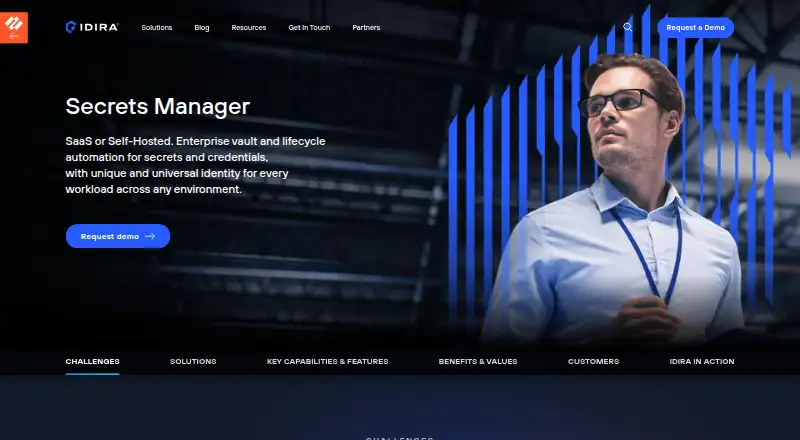
What CyberArk Secrets Manager is
CyberArk Secrets Manager centrally stores and governs credentials used by applications, containers, CI/CD pipelines, and other workloads across cloud, on-premises, and hybrid environments. It handles API keys, tokens, passwords, certificates, and database credentials. Policies can rotate, expire, or retire secrets while tracking ownership and expiration. Applications and containers can authenticate through application attributes and role-based access controls, with key events captured in tamper-resistant audit logs. The SaaS service can assign workloads unique cryptographic SPIFFE identities based on verified attributes; these identities expire in hours and cannot be shared or reused. Organizations can choose managed SaaS or self-hosting in a customer data center, including for data residency or air-gap requirements. The product lists integrations for DevOps, CI/CD, automation, PaaS, and public cloud tools. CyberArk was founded in 2005 and is headquartered in Santa Clara, California. Pricing is available on request; the product page directs visitors to request a demo.
Good
- Manages several credential types in one platform
- Policies can rotate, expire, and retire secrets
- Offers managed SaaS and self-hosted deployment
- Records key events in tamper-resistant audit logs
Watch out
- Pricing is available only on request
- Support contact requires an active subscription and administrator access
Who it suits
It suits security teams managing nonhuman credentials, as well as applications, containers, CI/CD pipelines, and workloads that use them. Organizations needing managed SaaS or self-hosted deployment can consider the corresponding option.
Verdict
CyberArk Secrets Manager combines credential lifecycle controls, workload identity, and auditing for application environments. Its deployment choices and request-based pricing are important considerations.
The facts
Each one read from CyberArk Secrets Manager's own pages, with the date it was checked.
What it does
- Access controls and audit
- Applications and containers can be authenticated using native application attributes and role-based access controls, with key events recorded in tamper-resistant audit logs.checked 8 Oct 2026
- Audit and compliance
- The maker says centralized visibility, policy enforcement and audit trails help teams establish who accessed what, when and under which controls.checked 8 Oct 2026
- Authorization and audit
- Applications and containers can be authenticated using native application attributes and role-based access controls, with key events recorded in tamper-resistant audit logs.checked 8 Oct 2026
- Availability
- The product page describes a distributed, high-availability architecture for enterprise resiliency, scalability and performance requirements.checked 8 Oct 2026
- Data hosting
- For SaaS services, Idira says customers can nominate a hosting region, with the available regions varying by subscribed service.checked 8 Oct 2026
- Deployment
- The product is available as fully managed SaaS or self-hosted in a customer data center, including for data residency or air-gap requirements.checked 8 Oct 2026
- Deployment options
- Secrets Manager is offered as managed SaaS or self-hosted in a customer data center, including for data residency or air-gap requirements.checked 8 Oct 2026
- Integrations
- The maker lists validated integrations for DevOps tools, CI/CD toolchains, automation tools, PaaS platforms and public cloud platforms.checked 8 Oct 2026
- Lifecycle automation
- It can rotate, expire and retire secrets according to policy, with ownership, expiration and audit trails.checked 8 Oct 2026
- Pricing
- The product page directs visitors to request a demo and does not state a price.checked 8 Oct 2026
- Purpose
- Secrets Manager centrally stores, rotates and governs credentials across cloud, on-premises and hybrid environments.checked 8 Oct 2026
- Secrets stored
- It manages API keys, tokens, passwords, certificates and database credentials.checked 8 Oct 2026
- Security practices
- Idira says its services follow industry security practices such as OWASP, NIST and CAIQ, and use tenant data isolation and frequent security reviews where multitenancy applies.checked 8 Oct 2026
- Support
- The vendor offers a product demo request; the product page says a Palo Alto Networks specialist will contact the requester.checked 8 Oct 2026
- Supported secrets
- It manages API keys, tokens, passwords, certificates and database credentials from a single platform.checked 8 Oct 2026
- Target users
- The product is designed for security teams managing nonhuman credentials and for applications, containers, CI/CD pipelines and workloads.checked 8 Oct 2026
- Workload identity
- Secrets Manager SaaS assigns workloads unique cryptographic SPIFFE identities based on verified attributes; the identities expire in hours, according to the product page.checked 8 Oct 2026
- Workload identity details
- Secrets Manager SaaS assigns workloads unique cryptographic SPIFFE identities based on verified attributes; the vendor says these identities expire in hours and cannot be shared or reused.checked 8 Oct 2026
The company
- Founded
- 2005checked 28 Sep 2026
- Headquarters
- Santa Clara, California, United Stateschecked 28 Sep 2026
The full review of CyberArk Secrets Manager
CyberArk Secrets Manager is a platform for governing credentials used by applications and other workloads. It is best suited to security teams managing those nonhuman identities across cloud, on-premises and hybrid environments. Its mix of automated lifecycle controls and managed or self-hosted deployment makes it a substantial enterprise option, though custom pricing complicates early comparisons.
Overview
The platform brings API keys, tokens, passwords, certificates and database credentials under centralized policies. Teams can assign ownership and set credentials to rotate, expire or retire according to policy, with audit trails recording activity. That makes it relevant to organizations coordinating access across many applications and environments; it is not designed as a personal password manager.
Central visibility and policy enforcement can help security teams establish who accessed a secret, when and under which controls. CyberArk describes a distributed, high-availability architecture for enterprise resilience, scale and performance. That focus is useful for demanding environments, but may be more infrastructure than a small team needs.
Key features
Lifecycle controls and auditing
Policy-based rotation, expiration and retirement give teams a way to manage credentials throughout their lifecycle instead of relying on manual upkeep. Applications and containers authenticate using native application attributes and role-based access controls; key events are recorded in tamper-resistant audit logs. These controls support access reviews and compliance work, although they require an organization prepared to manage policies and ownership centrally.
Workload identity
The SaaS service can assign workloads unique cryptographic SPIFFE identities based on verified attributes. CyberArk says these identities expire within hours and cannot be shared or reused. Short-lived, workload-specific identity can reduce reliance on reusable credentials for applications and containers, particularly in automated environments.
Integrations and security
Validated integrations span DevOps and CI/CD tools, automation tools, PaaS platforms and public clouds, and the product supports injecting secrets into CI/CD workflows. Idira says its services follow practices such as OWASP, NIST and CAIQ, with tenant data isolation and frequent security reviews where multitenancy applies. SaaS customers can nominate a hosting region, with region choices depending on the subscribed service.
Pricing
CyberArk Secrets Manager is paid software with custom pricing. The product directs prospective customers to request a demo; there is no published price or plan breakdown to compare. That sales-led approach suits organizations evaluating a broader security deployment, but makes budget screening harder for teams seeking a straightforward self-service purchase.
Support includes case submission, email, phone and a technical community. Contacting support requires an active subscription and administrator access, so support access is tied to the customer relationship rather than being open to prospective users.
Platforms
The product supports web, Windows, macOS and Linux, as well as API access. It can run as managed SaaS or be self-hosted in a customer data center, including deployments with data-residency or air-gap requirements. The choice gives organizations room to align hosting with operational constraints, though self-hosting means the customer chooses and runs the deployment model.
Who it's for
Secrets Manager is aimed at security teams governing nonhuman credentials and the applications, containers, CI/CD pipelines and workloads that use them. It is a strong fit when an organization needs centralized lifecycle policy, auditable access and deployment options across mixed environments. Teams looking for a personal vault or a low-friction purchase should look elsewhere.
Pros and cons
- Pros: Central management covers API keys, tokens, passwords, certificates and database credentials, with policy-driven rotation, expiration and retirement.
- Pros: SaaS workload identity uses unique, short-lived SPIFFE identities that cannot be shared or reused.
- Pros: Managed SaaS and self-hosted deployment accommodate different data-residency and air-gap needs.
- Cons: Custom pricing and a demo-led buying process make costs difficult to compare before engaging CyberArk.
- Cons: Support contact requires an active subscription and administrator access.
- Cons: Its emphasis on enterprise workload governance may exceed the needs of teams with only a few credentials or simple storage requirements.
Alternatives
Oracle Cloud Infrastructure Secret Management is worth considering for a free option: its OCI plan supports up to 5,000 secrets per tenancy and 30 active versions per secret, with 30 versions pending deletion. Compare secrets management tools if you want to assess more products in this category.
Trellix Data Loss Prevention is a paid alternative for organizations focused on protecting data across endpoints, email, web, networks and storage, with on-premises or SaaS management. Varonis Data Discovery and Classification is another paid option, with quote-based pricing.
CryptoBind Database Activity Monitoring (DAM), Satori Data Security Platform, DATASKOPE, Datiphy and DB CyberTech Security are also paid alternatives. For a broader database-focused comparison, see database activity monitoring software. Password managers are a separate category to consider when the need is personal credential storage.
Verdict
CyberArk Secrets Manager is a strong choice for security teams that need centralized, auditable credential lifecycle controls and workload identity across complex environments. Its deployment flexibility is a meaningful advantage for organizations with hosting constraints. Look elsewhere if you need personal password storage, a simple self-service tool or transparent pricing before starting a sales conversation.
Getting started
- Visit the CyberArk Secrets Manager website.
- Request a demo through the product page.
- Choose managed SaaS or self-hosted deployment.
- For SaaS, nominate a hosting region where available for the subscribed service.
- Configure credentials, policies and workload access controls.
Limits worth knowing
Pricing is on request. Contacting CyberArk support requires an active subscription and administrator access; SaaS hosting-region availability varies by subscribed service.
Questions
How much does CyberArk Secrets Manager cost?
Pricing is on request. The product page directs visitors to request a demo.
What deployment options does it offer?
It is available as managed SaaS or self-hosted in a customer data center, including for data residency or air-gap requirements.
What credentials can it manage?
It manages API keys, tokens, passwords, certificates and database credentials.
What platforms are supported?
Listed platforms are API, Linux, macOS, self-hosted, web and Windows.
Does it support CI/CD and audit logs?
Yes. CI/CD injection and audit logs are supported, and validated integrations cover CI/CD toolchains and related tools.
Who makes CyberArk Secrets Manager?
CyberArk was founded in 2005 and is headquartered in Santa Clara, California, United States.
Alternatives to CyberArk Secrets Manager
- 1

Envshed
Free planWebAPILinuxmacOS7.6From $5 a month - 2

Keyway
Free planWebAPILinuxmacOS7.1From €9 a month - 3
Infisical
Free planWebAPILinuxSelf-hosted7.0From $2 a month - 4

Oracle Cloud Infrastructure Secret Management
Free planWebAPI7.0Free plan - 5

secr
Free planWebAPIExtensionLinux7.0From $6 a month - 6

SikkerKey
Free planWebAPILinuxmacOS7.0From $29 a month