
Envshed
Envshed is a cloud secrets manager for small engineering teams, with a CLI designed for shared projects and monorepos.
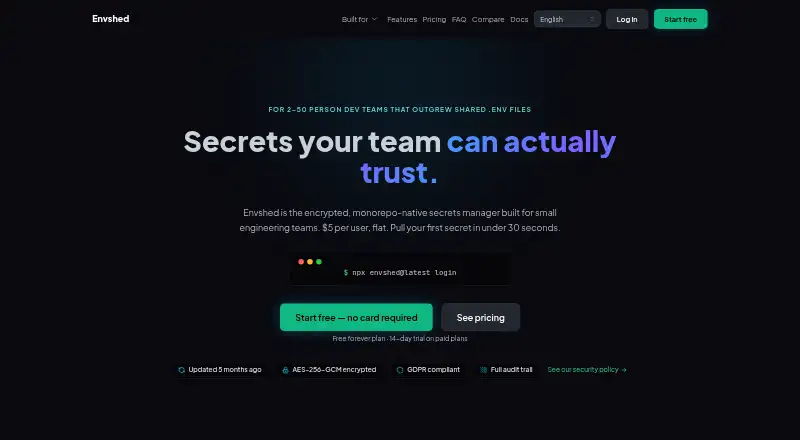
What Envshed is
Envshed is a cloud secrets manager for small engineering teams, with a CLI designed for shared projects and monorepos. It manages secrets and environments, supports per-user overrides, provides expiration warnings, and keeps an audit trail of reads and changes. Its CLI detects pnpm or npm workspaces and can retrieve secrets for every workspace from the repository root. Integrations include GitHub Actions, Docker, a Node.js SDK, a shell-compatible CLI, and Coolify; a REST API can be used from languages including Python, Go, and Rust. Secret values are encrypted at rest with AES-256-GCM, traffic uses TLS 1.3, and encryption keys are stored separately from encrypted data. Envshed offers role-based access control and an immutable audit trail. It is not a zero-knowledge vault, and a small on-call group with production credentials could technically decrypt a secret. Data is stored in a single region on US-based cloud infrastructure. Self-hosting is unavailable, and Envshed says it is not yet SOC 2 or ISO 27001 certified.
Good
- CLI can pull secrets for pnpm or npm workspaces.
- Includes GitHub Actions, Docker, and Coolify integrations.
- AES-256-GCM encryption at rest and TLS 1.3 in transit.
- Developer plan is free forever for up to two members.
- Audit trail records secret reads and changes.
Watch out
- Self-hosting is unavailable.
- Not yet SOC 2 or ISO 27001 certified.
- Not a zero-knowledge vault.
- Data is stored in a single US-based region.
Who it suits
Envshed is aimed at indie developers, early-stage startups of up to about 50 engineers, and open-source maintainers with shared infrastructure. Its workspace-aware CLI may suit teams managing secrets across monorepos.
Verdict
Envshed offers monorepo-aware secret management with a CLI, API, and listed integrations. Teams should weigh its cloud-only deployment and stated access limitations against its security controls.
Plans and prices
From Envshed's own pricing page, checked 15 Oct 2026.
| Plan | Price | What it gives you |
|---|---|---|
| Developer | Free | up to 2 members · up to 3 projects · unlimited secrets · AES-256-GCM encryption · CLI & API access · free forever |
| Team | $5 a month | unlimited members · unlimited projects · unlimited secrets · CLI & API access · webhooks · service tokens · audit logs · $5/user/month |
| Business | $9 a month | everything in Team · SAML SSO · priority support · $9/user/month |
The facts
Each one read from Envshed's own pages, with the date it was checked.
What it does
- Access and audit
- The maker describes role-based access control and an immutable audit trail, including records of secret reads and changes.checked 7 Oct 2026
- Access control
- The platform describes organization, project, and environment roles including owner, admin, editor, and viewer.checked 15 Oct 2026
- API
- The maker says Envshed offers a REST API for use from languages including Python, Go, and Rust.checked 7 Oct 2026
- Audit trail
- Reads and writes are recorded with user, IP address, timestamp, and change information.checked 15 Oct 2026
- Changelog: installer
- On April 16, 2026, Envshed announced a dedicated install.envshed.com host for CLI installation flows.checked 15 Oct 2026
- Changelog: SAML
- On March 15, 2026, SAML 2.0 sign-in through Okta, Azure AD, Google Workspace, and other providers was added to Business.checked 15 Oct 2026
- Changelog: service tokens
- On March 18, 2026, scoped machine-to-machine service tokens for CI/CD were announced.checked 15 Oct 2026
- CLI
- The envshed CLI can pull, push, inject, import, run, version, snapshot, and roll back secrets.checked 15 Oct 2026
- Compliance
- Envshed says it is not yet SOC 2 or ISO 27001 certified and that SOC 2 Type II is on its roadmap.checked 7 Oct 2026
- Data residency
- The service currently stores data in a single region on US-based cloud infrastructure.checked 15 Oct 2026
- Documentation depth
- The documentation site contains getting-started material, a CLI reference with numerous subcommands, feature pages, integrations, configuration, and migration guidance.checked 15 Oct 2026
- Encryption
- Secret values are encrypted at rest with AES-256-GCM and traffic uses TLS 1.3.checked 15 Oct 2026
- GitHub Action inputs
- The documented action accepts token, organization, project, environment, API URL, export mode, and file path inputs.checked 15 Oct 2026
- GitHub Actions
- The GitHub Actions integration fetches secrets and exports masked variables or writes a .env file.checked 15 Oct 2026
- Integrations
- Shipped integrations include GitHub Actions, Docker, Node.js SDK, a shell-independent CLI, and Coolify.checked 15 Oct 2026
- Intended users
- The maker targets indie developers, early-stage startups of up to about 50 engineers, and open-source maintainers running shared infrastructure.checked 7 Oct 2026
- Key features
- It provides a CLI, secret and environment management, per-user overrides, expiration warnings, project duplication, and an audit trail.checked 7 Oct 2026
- Limit: outage behavior
- Already-pulled .env files continue working during an outage, but fresh envshed pull requests require the API to be available.checked 15 Oct 2026
- Limit: self-hosting
- Self-hosting is unavailable today and is described only as a future enterprise roadmap item without a committed date.checked 15 Oct 2026
- Monorepo support
- The CLI detects pnpm or package.json workspaces and maps subdirectories through one root .envshed.json file.checked 15 Oct 2026
- Node SDK
- The @envshed/node package provides JavaScript and TypeScript access to the Envshed REST API.checked 15 Oct 2026
- Node SDK activity
- Socket reports version 0.2.0, one maintainer, and 187 weekly downloads for the package.checked 15 Oct 2026
The company
- Maker audience
- Envshed targets indie developers, open-source maintainers, and startups with roughly 2 to 50 engineers.checked 15 Oct 2026
Where it runs
- Monorepos
- The CLI detects pnpm or npm workspaces and can pull secrets for every workspace from the repository root.checked 7 Oct 2026
The full review of Envshed
Envshed is a cloud secrets manager for small engineering teams, especially those working across packages in a monorepo. Its workspace-aware CLI and team audit controls make it a focused choice; teams requiring self-hosting or zero-knowledge storage should look elsewhere.
Overview
Envshed combines secret and environment management with per-user overrides, expiration warnings, project duplication, and an audit trail. The CLI detects pnpm and npm workspaces and can retrieve secrets for all workspaces from the repository root, which suits teams coordinating shared configuration across a repository. It does not support secret rotation or dynamic secrets, so it is less suitable where credentials must be cycled automatically or created temporarily.
Key features
Developer workflows
The CLI works with any shell, and the maker lists integrations for GitHub Actions, Docker, Node.js SDK, and Coolify. CI/CD injection is supported; Team adds service tokens for CI/CD. A REST API also supports use from Python, Go, and Rust. This gives teams several ways to connect application workflows, but Kubernetes users will not find a dedicated integration.
Security and access
Secrets are encrypted at rest with AES-256-GCM, traffic uses TLS 1.3, and encryption keys are stored separately from encrypted data. Role-based access controls and an immutable audit trail covering secret reads and changes give teams useful oversight. However, Envshed is not a zero-knowledge vault: a small on-call group with production credentials could technically decrypt secret values. It is not yet SOC 2 or ISO 27001 certified, and SOC 2 Type II is on its roadmap.
Data is stored in a single region on US-based cloud infrastructure. Self-hosting is not currently available, though it is planned without a committed date. Those constraints matter for organizations with residency, deployment, or certification requirements. Business includes priority support, and security questions can be sent to [email protected].
Pricing
Envshed has a free Developer plan, paid plans from $5/user/mo, and a 14-day trial. Developer is free forever and allows up to 2 members and 3 projects, with unlimited secrets and CLI and API access. It is a sensible fit for an individual or a very small team, but its member and project caps limit shared use as work expands.
Team costs $5 a month, billed at $5 /user/month. It removes member and project limits and includes unlimited secrets, CLI and API access, webhooks, service tokens for CI/CD, and audit logs. This is the practical tier for growing teams that need shared workflows and access records; the per-user charge means cost rises with the team.
Business costs $9 a month, billed at $9 /user/month. It includes everything in Team plus SAML SSO and priority support, making it the relevant upgrade for organizations that need those controls or support. The free tier has no paid-plan webhooks or service tokens, while SAML SSO and priority support are reserved for Business.
Platforms
Envshed supports API, Linux, macOS, web, and Windows. Its cloud deployment model and lack of self-hosting may rule it out for teams that need to run the service on their own infrastructure.
Who it's for
Envshed targets indie developers, early-stage startups of up to about 50 engineers, and open-source maintainers operating shared infrastructure. The free plan can cover a small starting setup; Team suits larger groups that want unlimited members and projects, while Business is for those needing SAML SSO and priority support. It is a weaker fit for teams with Kubernetes workflows, short-lived or automatically rotated credentials, strict residency needs, or a requirement for self-managed or zero-knowledge storage.
Pros and cons
- Pro: Root-level retrieval across pnpm and npm workspaces can simplify secrets access in monorepos.
- Pro: Unlimited members and projects on Team, together with service tokens and audit logs, support shared CI/CD workflows.
- Pro: AES-256-GCM encryption at rest, TLS 1.3, and separate key storage provide concrete security controls.
- Con: No secret rotation, dynamic secrets, or Kubernetes integration leaves gaps for teams relying on those workflows.
- Con: Cloud-only deployment, single-region US storage, and the absence of zero-knowledge protection may conflict with infrastructure or security requirements.
- Con: Envshed lacks current SOC 2 and ISO 27001 certification, which can disqualify it for some procurement needs.
Alternatives
Explore the Secrets Management Tools directory to compare options. Choose Keyway if self-hosting is important; its listed platforms include self-hosted, and its Pro plan is 9€/month for 10 private repos, unlimited environments, and unlimited collaborators. Consider Infisical if its self-hosted support or broad integration count is a better fit: its free Secrets Management plan includes 5 identities, unlimited projects, and 100+ integrations.
Kubermatic Kubernetes Platform is another option. OpenBao suits readers seeking open-source, self-managed software without vendor pricing or usage fees. Phase is an alternative. secr is another alternative, with a free plan capped at 3 projects, 100 secrets, 1 AI agent, and a 7-day audit log. Secrets Manager is a self-hosted open-source option focused on a single developer and requiring Docker Compose and Node 20+ for its CLI. SikkerKey is another option.
Verdict
Choose Envshed if your small team wants monorepo-aware secret retrieval, shared access controls, and audit records without building those workflows around separate tools. Its free tier is tightly capped, but Team removes member and project limits at $5 /user/month. Look elsewhere if self-hosting, zero-knowledge protection, current compliance certification, Kubernetes integration, or automated secret rotation is essential.
Getting started
- Visit https://envshed.com/en/.
- Start with the free Developer plan, which supports up to two members and three projects.
- Use the CLI or API to manage secrets and environments.
- Connect a listed integration such as GitHub Actions, Docker, or Coolify if needed.
- Consider the 14-day trial or a paid plan starting at $5/user/month.
Limits worth knowing
The free Developer plan is limited to two members and three projects. The Team plan starts at $5/user/month; Business starts at $9/user/month and adds SAML SSO and priority support.
Questions
Is there a free plan?
Yes. Developer is free forever and includes up to two members, up to three projects, and unlimited secrets.
What do the paid plans cost?
Team is $5/user/month. Business is $9/user/month and includes everything in Team, plus SAML SSO and priority support.
Is a free trial available?
Yes, Envshed offers a 14-day trial.
Which platforms does Envshed support?
Its listed platforms are API, Linux, macOS, web, and Windows.
Is Envshed open source or self-hostable?
Self-hosting is not currently available. The maker describes it as planned but gives no committed date.
What security certifications does Envshed have?
Envshed says it is not yet SOC 2 or ISO 27001 certified, with SOC 2 Type II on its roadmap.
Alternatives to Envshed
- 1

Keyway
Free planWebAPILinuxmacOS7.1From €9 a month - 2
Infisical
Free planWebAPILinuxSelf-hosted7.0From $2 a month - 3

Oracle Cloud Infrastructure Secret Management
Free planWebAPI7.0Free plan - 4

secr
Free planWebAPIExtensionLinux7.0From $6 a month - 5

SikkerKey
Free planWebAPILinuxmacOS7.0From $29 a month - 6
KeyEnv
Free planWebAPILinuxmacOS6.9From $40 a year