
OpenBao
OpenBao is an open-source system for managing access to secrets and encryption, including API tokens, keys, passwords, and certificates.
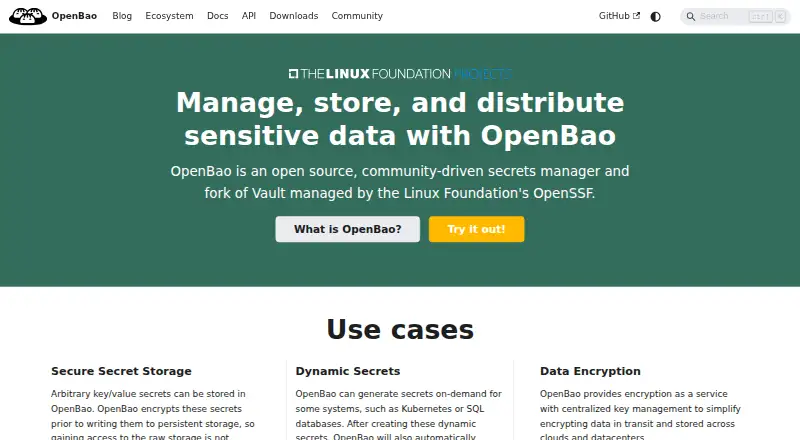
What OpenBao is
OpenBao is an open-source system for managing access to secrets and encryption, including API tokens, keys, passwords, and certificates. You can operate it through a web UI, CLI, or HTTP API, and deploy it yourself using packages, containers, binaries, source builds, or Helm for Kubernetes. It encrypts key/value secrets before storing them, can create temporary credentials for systems such as Kubernetes and SQL databases, and can revoke those credentials when their leases expire. Leases can also be renewed, and individual secrets or groups can be revoked. OpenBao can encrypt and decrypt data without retaining it, using centrally defined parameters. Authentication options include GitHub, LDAP, and AppRole, with policies associated to clients through tokens. Its storage security barrier uses AES-256-GCM and checks the authentication tag during decryption. High-availability configurations are supported. OpenBao is free under the Mozilla Public License 2.0, with no vendor pricing or usage limits stated. Integrated Storage has a default maximum entry size of 1 MiB, configurable through max_entry_size.
Good
- Free, open-source, self-managed deployment.
- Manage secrets through UI, CLI, or HTTP API.
- Generates and revokes lease-bound dynamic secrets.
- Supports high-availability configurations.
- Release downloads have GPG signatures; SBOMs are available.
Watch out
- Integrated Storage defaults to a 1 MiB entry limit.
- Security model excludes arbitrary backend control and running-instance memory analysis.
Who it suits
OpenBao suits organizations that need self-managed control over sensitive credentials and encryption workflows. It is relevant to teams using Kubernetes or SQL databases that need on-demand secrets and lease-based revocation.
Verdict
OpenBao brings secret storage, dynamic credentials, encryption, and policy-linked authentication into a self-managed system. Account for its stated security boundary and Integrated Storage entry-size default when assessing fit.
Plans and prices
From OpenBao's own pricing page, checked 9 Oct 2026.
| Plan | Price | What it gives you |
|---|---|---|
| OpenBao | Free | Self-managed deployment · no vendor pricing or usage limits stated · Open source software under Mozilla Public License 2.0 |
The facts
Each one read from OpenBao's own pages, with the date it was checked.
What it does
- Access methods
- Users can manage OpenBao through its UI, CLI, or HTTP API.checked 9 Oct 2026
- Authentication
- OpenBao supports authentication methods including GitHub, LDAP, and AppRole, and associates authenticated clients with policies through tokens.checked 9 Oct 2026
- Deployment
- OpenBao can be installed through package managers, container registries, precompiled binaries, source builds, or Helm for Kubernetes.checked 9 Oct 2026
- Dynamic secrets
- OpenBao can generate secrets on demand for systems such as Kubernetes and SQL databases, then automatically revoke them when their lease expires.checked 9 Oct 2026
- Encryption
- OpenBao can encrypt and decrypt data without storing it, using centrally defined encryption parameters.checked 9 Oct 2026
- High availability
- OpenBao supports running in a highly available configuration to help preserve availability during failures.checked 9 Oct 2026
- Integrations
- The project lists integrations including Sigstore for artifact signing, StackHPC for OpenStack, and Percona for database encryption key management.checked 9 Oct 2026
- Leases and revocation
- Secrets have leases that can be renewed through built-in APIs, and OpenBao can revoke individual secrets or groups of secrets.checked 9 Oct 2026
- Notable limit
- Integrated Storage has a default maximum entry size of 1 MiB, which can be configured through max_entry_size.checked 9 Oct 2026
- Product
- OpenBao is an identity-based secrets and encryption management system for storing and controlling access to sensitive data such as API tokens, encryption keys, passwords, and certificates.checked 9 Oct 2026
- Release security
- The download page says releases have GPG signatures and SBOMs are available on the GitHub Releases page.checked 9 Oct 2026
- Secret storage
- OpenBao encrypts key/value secrets before writing them to persistent storage.checked 9 Oct 2026
- Security
- OpenBao's security barrier encrypts data sent to storage with AES-256-GCM and verifies the authentication tag when decrypting.checked 9 Oct 2026
- Security boundary
- The security model treats arbitrary control of the storage backend and memory analysis of a running instance as out of scope.checked 9 Oct 2026
- Supported operating systems
- Installation documentation includes packages for Linux distributions, Homebrew for macOS, FreeBSD packages, and a Windows executable.checked 9 Oct 2026
The company
- Founded
- 2023checked 28 Sep 2026
The full review of OpenBao
OpenBao is a self-managed secrets and encryption platform for teams that need policy-controlled credentials under their own operational control. It suits infrastructure, security, and platform engineers comfortable running services themselves. The trade-off is operational responsibility, plus a defined security boundary and a 1 MiB default entry limit in Integrated Storage.
Overview
OpenBao stores and controls sensitive values including API tokens, passwords, encryption keys, and certificates through identity-based access policies. Administration is available through a web UI, CLI, or HTTP API, so it can fit both interactive workflows and automation. The project, founded in 2023, is open source under the Mozilla Public License 2.0 and uses a self-hosted deployment model.
Self-hosting gives an organization control over placement and operations rather than a vendor-managed service. OpenBao supports highly available configurations, helping preserve access during failures, but availability, upgrades, backups, and infrastructure remain the operator’s responsibility. No vendor usage limits or hosted-service pricing apply.
Key features
Key/value secrets are encrypted before being written to persistent storage. The security barrier uses AES-256-GCM and verifies the authentication tag during decryption, providing a clear cryptographic protection layer for stored data. The threat model intentionally excludes arbitrary control of the storage backend and memory analysis of a running instance, so teams should secure those areas separately.
Dynamic secrets are generated on demand for systems such as Kubernetes and SQL databases. Leases can expire automatically, and built-in APIs support renewal before expiry. Individual secrets or groups can also be revoked, making short-lived credentials and incident response more practical than static, long-lived values.
OpenBao can perform encryption and decryption without storing the data itself, using centrally defined encryption parameters. Authentication options include GitHub, LDAP, and AppRole; authenticated clients are associated with policies through tokens. Secret rotation and audit logging are supported, and listed integrations include Sigstore for artifact signing, StackHPC for OpenStack, and Percona for database-encryption key management.
Deployment options range from package managers, container registries, precompiled binaries, and source builds to Helm for Kubernetes. Documentation covers Linux distribution packages, Homebrew on macOS, FreeBSD packages, and a Windows executable. Releases carry GPG signatures, with SBOMs published on GitHub Releases. Integrated Storage has a default maximum entry size of 1 MiB, configurable with max_entry_size; workloads with larger records must plan around that setting.
Pricing
| Plan | Price | What it includes |
|---|---|---|
| OpenBao | free | Open source software under the Mozilla Public License 2.0; self-managed deployment with no vendor pricing or stated usage limits |
There is no free trial because the software is free, and there are no paid tiers or seat charges stated. This is the right pricing model for organizations willing to supply their own hosting and operations; it is less suitable for buyers seeking a vendor-managed support or billing package.
Platforms
OpenBao supports API, Linux, macOS, self-hosted, web, and Windows access. Kubernetes users can deploy through Helm, while teams on other systems can choose packages, containers, binaries, or source builds.
Who it's for
Choose OpenBao when your team needs dynamic, renewable, and revocable credentials; centralized encryption; policy-linked authentication; and direct control of deployment. It is especially fitting for platform teams operating Kubernetes, databases, or multi-system identity workflows. Look elsewhere if you want a hosted service, minimal infrastructure ownership, or a tightly bounded desktop-only tool.
Pros and cons
Pros
- Broad secret lifecycle control: leases, renewal, rotation, and group revocation support short-lived access and faster response to compromise.
- Flexible automation: UI, CLI, and HTTP API access works across operator and pipeline workflows.
- Strong deployment choice: high availability, Kubernetes Helm deployment, and multiple installation formats suit varied infrastructure.
- Auditable, policy-based access: authentication methods and token-linked policies connect identity to authorization, with audit logs for oversight.
Cons
- Self-hosting burden: your team owns availability, upgrades, and protection of the running environment.
- Explicit threat-model limits: storage-backend control and memory inspection are outside the stated security model.
- Integrated Storage ceiling: the default 1 MiB entry maximum can constrain unusually large records unless configured appropriately.
Alternatives
Keyway is a freemium option with hosted-style Pro and Team tiers for readers who prefer collaborator and repository plans. Envshed offers a free Developer tier capped at two members and three projects, fitting smaller teams that want a simpler managed starting point. Infisical provides a free tier with five identities, unlimited projects, and more than 100 integrations for teams prioritizing integration breadth.
Kubermatic Kubernetes Platform is a broader Kubernetes platform, useful when cluster management is the primary need rather than secrets alone. Phase targets up to five users or service accounts, three apps, and three environments on its free tier. secr suits small projects needing three projects, 100 secrets, and seven-day audit retention. Secrets Manager is an open-source self-hosted MVP aimed at a single developer. SikkerKey offers a developer plan with 10 machines and one month of audit retention.
Browse the Secrets Management Tools list for additional options.
Verdict
OpenBao is a strong choice for technically capable teams that want open-source, self-managed control over secrets, encryption, identities, and credential lifecycles. Its main reason to choose it is the combination of dynamic credentials, policy enforcement, and broad deployment flexibility at no software charge. Look elsewhere if your priority is a hosted experience, vendor-managed operations, or a simpler product with less infrastructure responsibility.
Alternatives to OpenBao
- 1

Envshed
Free planWebAPILinuxmacOS7.6From $5 a month - 2

Keyway
Free planWebAPILinuxmacOS7.1From €9 a month - 3
Infisical
Free planWebAPILinuxSelf-hosted7.0From $2 a month - 4

Oracle Cloud Infrastructure Secret Management
Free planWebAPI7.0Free plan - 5

secr
Free planWebAPIExtensionLinux7.0From $6 a month - 6

SikkerKey
Free planWebAPILinuxmacOS7.0From $29 a month