Secrets Manager
Secrets Manager is a free, open-source system for storing application secrets on infrastructure you host yourself.
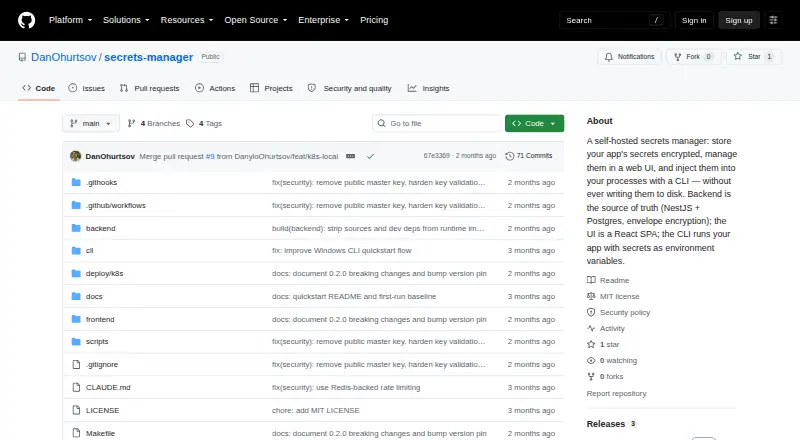
What Secrets Manager is
Secrets Manager is a free, open-source system for storing application secrets on infrastructure you host yourself. Its web interface organizes secrets into organizations, projects, and environments, and supports importing .env files, editing or revealing values, keeping versions, rolling back, and soft-deleting secrets. The `secrets run` command supplies an environment’s secrets to a child process and its descendants without writing a .env file. Documented workflows cover Node.js, Python, npm, and Next.js; CI or deployment can use an API URL, token, and environment ID. Users and service accounts can receive access at project or environment scope, and revealing a value requires a specific grant. The backend uses AES-256-GCM envelope encryption, and the documentation says plaintext secret values are not stored in the database. Audit events include secret reveals, and a secret is not returned if the required audit write fails. Startup requires a user-generated master key; losing it makes stored secrets unrecoverable. The maker also warns that a real key appeared in repository history before 2026-07-26 and says affected secrets should be treated as disclosed. Docker Compose is required, as is Node 20 or later for the CLI step.
Good
- Free and open source under the MIT license.
- Secrets can be grouped by organization, project, and environment.
- CLI injection avoids creating a .env file.
- Secret versions can be rolled back.
- Access grants and audit events are supported.
Watch out
- Requires Docker and Docker Compose.
- CLI setup requires Node 20 or later.
- Losing the master key makes secrets unrecoverable.
- A real key appeared in repository history before 2026-07-26.
Who it suits
It suits developers and teams that want to manage secrets on self-hosted infrastructure and inject them into processes without creating .env files. Teams should be prepared to manage the required master key and deployment prerequisites.
Verdict
Secrets Manager combines self-hosted secret storage, access controls, version history, and CLI injection. The master-key warning and deployment requirements are important considerations before setup.
Plans and prices
From Secrets Manager's own pricing page, checked 11 Oct 2026.
| Plan | Price | What it gives you |
|---|---|---|
| Open-source self-hosted | Free | MVP focused on a single developer; requires Docker Compose and Node 20+ for the CLI |
The facts
Each one read from Secrets Manager's own pages, with the date it was checked.
What it does
- Access controls
- Access can be granted to users and service accounts at project or environment scope, and revealing secret values requires an explicit grant.checked 11 Oct 2026
- Audit
- The system records audit events including secret reveals, and documents that secret values are not returned if the required audit write fails.checked 11 Oct 2026
- CLI
- The `secrets run` command fetches environment secrets and supplies them to a child process without creating a `.env` file.checked 11 Oct 2026
- CLI injection
- The `secrets run` CLI command injects an environment’s secrets into a child process and its children without creating a .env file.checked 11 Oct 2026
- Deployment
- Docker Compose starts PostgreSQL, Redis, the backend, and frontend; local Kubernetes manifests are also provided for a kind cluster.checked 11 Oct 2026
- Deployment requirements
- The quickstart requires Docker and Docker Compose, plus Node 20 or later for the CLI step.checked 11 Oct 2026
- Encryption
- The backend uses AES-256-GCM envelope encryption with a random data key per secret value, and the documentation says plaintext secret values are never stored in the database.checked 11 Oct 2026
- Important security notice
- The maker says a real master key was published in the repository before 2026-07-26 and advises treating secrets encrypted with it as disclosed and following its recovery steps.checked 11 Oct 2026
- Integrations
- The documented CLI workflow uses Node.js and shows app commands for Node.js, Python, npm, and Next.js; CI or deployment can use `SECRETS_API_URL`, `SECRETS_TOKEN`, and `ENVIRONMENT_ID`.checked 11 Oct 2026
- Key requirement
- A user-generated master key is required before startup; losing it makes stored secrets unrecoverable.checked 11 Oct 2026
- License
- The repository identifies its license as MIT.checked 11 Oct 2026
- Master key requirement
- A user-generated master encryption key is required before startup, and the maker warns that losing it makes stored secrets unrecoverable.checked 11 Oct 2026
- MVP audience
- The project describes itself as an open-source MVP focused on a clean first-run experience for a single developer, with multi-user organizations, roles, and grants also available.checked 11 Oct 2026
- Organization
- Users can create organizations, projects, and environments to organize secrets for team projects.checked 11 Oct 2026
- Product status
- The project’s README documents self-hosted Docker Compose deployment and does not list hosted plans or prices.checked 11 Oct 2026
- Purpose
- Secrets Manager is a self-hosted system for storing application secrets encrypted, managing them in a web UI, and injecting them into processes through a CLI.checked 11 Oct 2026
- Secret history
- Secrets have versions that can be rolled back to earlier versions.checked 11 Oct 2026
- Secret management
- The UI supports importing .env files, editing and revealing secrets, keeping versions, rolling back, and soft-deleting secrets.checked 11 Oct 2026
- Security incident
- The maker says a real master key appeared in repository history before 2026-07-26 and warns that any key obtained from the repository before that date must never be used.checked 11 Oct 2026
- Support
- The repository directs vulnerability reports to a private GitHub security advisory and says not to disclose exploitable issues publicly.checked 11 Oct 2026
- Support channel
- The security policy asks users to report exploitable vulnerabilities through a private GitHub security advisory rather than a public issue.checked 11 Oct 2026
Where it runs
- Platforms
- The CLI documentation includes Windows PowerShell and macOS/Linux usage; the product also provides a browser UI and API.checked 11 Oct 2026
- Platform support
- The maker documents CLI support for Windows PowerShell and Command Prompt, and gives macOS/Linux command examples.checked 11 Oct 2026
Alternatives to Secrets Manager
- 1

Envshed
Free planWebAPILinuxmacOS7.6From $5 a month - 2

Keyway
Free planWebAPILinuxmacOS7.1From €9 a month - 3
Infisical
Free planWebAPILinuxSelf-hosted7.0From $2 a month - 4

Oracle Cloud Infrastructure Secret Management
Free planWebAPI7.0Free plan - 5

secr
Free planWebAPIExtensionLinux7.0From $6 a month - 6

SikkerKey
Free planWebAPILinuxmacOS7.0From $29 a month