
FusionAuth
FusionAuth is a Customer Identity and Access Management server for authentication, authorization, and user management.
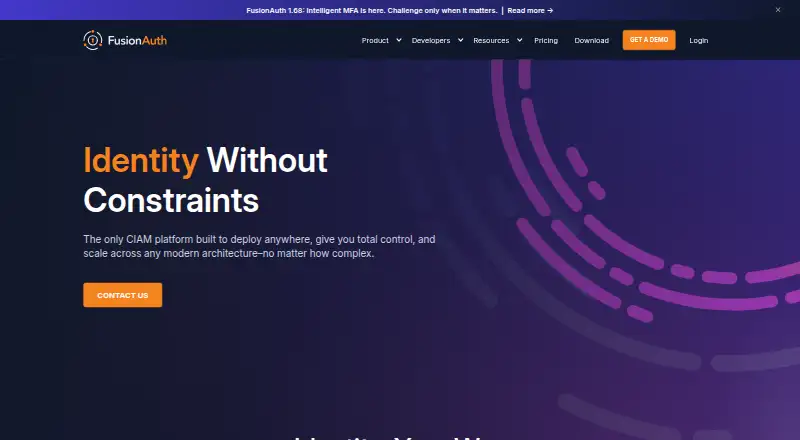
What FusionAuth is
FusionAuth is a Customer Identity and Access Management server for authentication, authorization, and user management. It supports username and password login, identity providers, passkeys, and one-time passwords, and implements OAuth 2.0, OpenID Connect, and SAML v2. Social identity providers include Apple, Facebook, Google, and Twitter. Teams can customize pages and messages, and use lambda functions and webhooks. Authorization includes role-based controls across users, roles, groups, applications, and entities, with fine-grained authorization integration. FusionAuth can run locally, on-premises, in private or air-gapped cloud environments, or as a managed FusionAuth Cloud instance. Its free Community Edition is self-hosted, unlimited, and has no trial clock. Paid Starter costs $162.00 per month when billed annually and lists one connector and 100 machine-to-machine entities. FusionAuth is intended for managing end users at scale; it does not offer native desktop integration or position itself as an Active Directory replacement.
Good
- Free self-hosted Community Edition has no trial clock
- Supports OAuth 2.0, OpenID Connect, and SAML v2
- Deployment includes private and air-gapped cloud options
- Supports passkeys and one-time passwords
Watch out
- Starter lists one connector
- Starter lists 100 machine-to-machine entities
- No native desktop integration
- Starter is $162.00 monthly, billed annually
Who it suits
FusionAuth suits teams managing end-user identity that want deployment choices from self-hosting to managed cloud. It is not positioned as a desktop integration or Active Directory replacement.
Verdict
FusionAuth combines authentication, user management, and authorization with multiple deployment options. Review connector and entity limits, along with the support tier, when selecting a plan.
Plans and prices
From FusionAuth's own pricing page, checked 14 Oct 2026.
| Plan | Price | What it gives you |
|---|---|---|
| Community | Free | self-hosted · unlimited · core authentication · community support |
| Starter | $162 a month | premium authentication · breached-password detection · machine-to-machine · basic hosting · Billed annually |
| Enterprise | $2,970 a month | advanced threat detection · SSO Tenant Manager · 24/7 email and phone support · high-availability hosting · Billed annually |
| Essentials | $2,970 a month | advanced connectivity, MFA and security · custom OAuth scopes · email support · business hosting · Billed annually |
The facts
Each one read from FusionAuth's own pages, with the date it was checked.
What it does
- API
- Its core interface is a REST API documented with OpenAPI; the administrative web interface uses the same APIs.checked 14 Oct 2026
- Authentication
- It supports username/password login, identity providers, passkeys, and one-time passwords.checked 1 Oct 2026
- Authentication methods
- Supported methods include passwords, social and enterprise identity providers, passkeys and one-time passwords.checked 14 Oct 2026
- Authorization
- FusionAuth provides role-based access control and fine-grained authorization capabilities.checked 14 Oct 2026
- Customization
- Pages and messages can be customized, while lambdas alter validation, MFA challenge and token transformation behavior and webhooks react to events.checked 14 Oct 2026
- Deployment
- The product can run locally, on premises, in a customer cloud, on an air-gapped server or as FusionAuth Cloud.checked 14 Oct 2026
- Documentation
- Documentation includes API references, installation guides, deployment, security, SDKs, framework quickstarts and operational troubleshooting.checked 14 Oct 2026
- Funding
- FusionAuth announced a $65 million growth-equity investment from Updata Partners on November 1, 2023, its first outside funding after bootstrapping.checked 14 Oct 2026
- GDPR features
- Its GDPR guidance describes data isolation, user-data export and deletion APIs, pseudonymous identifiers, configurable password hashing and a 24-hour breach-notification target.checked 14 Oct 2026
- Identity providers
- Supported social identity providers include Apple, Facebook, Google, and Twitter, with OpenID Connect and SAML v2 providers also supported.checked 1 Oct 2026
- Install formats
- Self-hosted software is distributed as Docker images, ZIP archives, RPM packages or DEB packages with a database and optional search engine.checked 14 Oct 2026
- Integrations
- Identity-provider integrations include Apple, Facebook, Google, Twitter and arbitrary OIDC or SAML v2 providers, with connectors, plugins and monitoring integrations also available.checked 14 Oct 2026
- Legal entity
- The customer licence identifies the maker as Inversoft, LLC doing business as FusionAuth, a Delaware limited liability company.checked 14 Oct 2026
- Licence
- The core fusionauth-app bundle is closed-source proprietary software that users may not modify, decompile or reverse engineer.checked 14 Oct 2026
- Limit: Capterra users
- Reported drawbacks include paid registration customization, no user-focused profile-edit interface and the core product not being open source.checked 14 Oct 2026
- Limit: G2 users
- Complaints include complex or limited theme customization, non-intuitive advanced workflows, costly self-hosted licensing and missing built-in login rate limiting.checked 14 Oct 2026
- Limit: Software Advice users
- Reported limitations include Kubernetes deployment difficulty, memory or performance concerns, unintuitive permissions, missing smart authentication, no dedicated JavaScript SDK and weaker CI/CD tooling than Auth0 Terraform.checked 14 Oct 2026
- Memory guidance
- The general memory guideline is 512 MB for the application, with 512 MB to 1 GB per node suggested for multi-node setups.checked 14 Oct 2026
- Network requirement
- Paid installations must allow connections to reactor.fusionauth.io, metrics.fusionauth.io and license.fusionauth.io, while Community installations can block outbound access.checked 14 Oct 2026
- Notable limits
- The pricing comparison lists Starter with one connector and 100 machine-to-machine entities, Essentials with five connectors and 1,000 entities, and Enterprise with unlimited connectors and entities.checked 1 Oct 2026
The company
- Company profile
- LinkedIn lists FusionAuth as a privately held software company headquartered in Broomfield, Colorado, founded in 2009, with 51–200 employees.checked 14 Oct 2026
- Headquarters
- United Stateschecked 28 Sep 2026
Money
- Free edition
- The Community Edition is free, self-hosted, unlimited, and has no trial clock.checked 1 Oct 2026
Where it runs
- Limit: GetApp users
- A recurring criticism is that the PHP API documentation needs improvement.checked 14 Oct 2026
The full review of FusionAuth
Overview
FusionAuth is a customer identity and access management server for teams building sign-in and authorization into products. It suits organizations managing end users at scale that want to control deployment, from self-hosted environments to a managed cloud service. Its broad protocol and deployment coverage is compelling, but buyers should weigh paid-plan connector and entity caps against their integration needs.
Key features
FusionAuth supports OAuth 2.0, OpenID Connect, and SAML v2, including SAML as both a service provider and identity provider. Username and password login, passkeys, one-time passwords, and social sign-in through Apple, Facebook, Google, and Twitter give teams several ways to handle authentication. Support for additional OpenID Connect and SAML providers helps accommodate existing identity systems.
Authorization goes beyond login: role-based controls organize users, roles, groups, applications, and entities, with fine-grained authorization integration. Directory synchronization, lifecycle provisioning, and adaptive access policies make it relevant to teams coordinating identity across a wider application setup. Customizable pages and messages, lambda functions, and webhooks provide ways to tailor user journeys and connect application logic.
Deployment flexibility is a major strength. FusionAuth can run locally, on-premises, in a private or air-gapped cloud, or as a managed FusionAuth Cloud instance. Its stated compliance coverage includes SOC 2 Type 2, ISO 27001, and GDPR; HIPAA business associate agreements are offered to select customers, and it can run in FedRAMP-compliant infrastructure. These options make it worth considering where infrastructure control or compliance requirements shape identity decisions.
Pricing
The Community Edition costs nothing, is self-hosted, unlimited, and has no trial clock. It covers core authentication features, with community support through forums, Slack, and GitHub. It is the clearest starting point for teams comfortable operating the service themselves; it does not include the paid plans' hosting tiers or support commitments.
Starter costs $162 a month, billed annually. It includes basic hosting, one connector, and 100 machine-to-machine entities. That entry price may suit a smaller integration footprint, but a single connector and modest entity allowance can constrain systems connecting multiple identity providers or expanding machine-to-machine access.
Essentials costs $2,970 a month, billed annually, and raises the limits to five connectors and 1,000 machine-to-machine entities, with business hosting. It also includes email support with a 24 to 48 hour response time during business hours. This is the more practical tier when Starter's integration caps are too tight and a defined support channel matters.
Enterprise costs $2,970 a month, billed annually, and provides high availability hosting, unlimited connectors, unlimited machine-to-machine entities, and 24/7 email and phone support. Its uncapped connector and entity allowances distinguish it from Essentials, while the listed monthly price is the same; organizations should compare the hosting and support needs that separate the tiers. FusionAuth has a freemium model and no free trial.
Platforms
FusionAuth supports Android, iOS, Linux, macOS, Windows, web, and API use, as well as self-hosted deployment. Supported operating systems include all Linux distributions, macOS 10.15 or newer, Windows Server 2019, and Windows 10. It does not offer native desktop integration, so it is not a substitute for desktop identity tooling.
Who it's for
FusionAuth is best suited to product and platform teams that need customer identity at scale, standards-based sign-in, configurable authorization, and a choice between self-managed and managed deployment. It is a poor fit for organizations seeking native desktop integration or an Active Directory replacement.
Pros and cons
- Pro: OAuth 2.0, OpenID Connect, and SAML v2 support gives teams a broad standards base for application sign-in.
- Pro: Local, on-premises, private-cloud, air-gapped, and managed deployment options accommodate differing infrastructure preferences.
- Pro: The free self-hosted Community Edition is unlimited and has no trial clock, making it possible to use core authentication without a subscription.
- Con: Paid connector and machine-to-machine entity allowances are limited on Starter and Essentials, so integration growth may require a higher tier.
- Con: Community support is forum-, Slack-, and GitHub-based; guaranteed response timing and phone support require paid tiers.
- Con: The product is not intended to provide native desktop identity integration or replace Active Directory.
Alternatives
For a broader comparison, browse Identity and Access Management Software, Single Sign-On Software, Passwordless Authentication Software, Passkey Authentication Software, and Customer Identity and Access Management Software.
miniOrange Identity and Access Management is another freemium option with a free plan and trial; its free Customer IAM tier includes two to three social logins. Ory offers a free developer tier and a production plan at $770 a year, which may suit buyers comparing a lower stated production price. Google Cloud Identity has a free plan and a Premium annual/fixed-term plan at $6 a month with enterprise security features and automated user provisioning.
AWS IAM Access Analyzer is a free alternative focused on validating IAM policies against best practices. Descope offers a free tier with 7,500 monthly active users, 10 monthly active tenants, and three SSO connections, and states that its SDKs are open source. Frontegg has a free pay-as-you-go plan with 7,500 monthly active users, five enterprise connections, unlimited organizations, and a custom domain.
Clerk provides a free Hobby plan with 50,000 monthly retained users per app, up to three dashboard seats, and three social connections. Stytch has a free pay-as-you-go plan starting at $0 per month, with 10,000 monthly active users and AI agents, unlimited organizations, and five SSO or SCIM connections.
Verdict
Choose FusionAuth if your team needs customer identity with standards-based authentication, detailed authorization, and meaningful control over deployment. Its unlimited, self-hosted Community Edition is a strong way to start, while paid tiers add hosting, support, and larger integration allowances. Look elsewhere if you need desktop identity integration, an Active Directory replacement, or a paid plan whose connector and entity caps better match your growth at a lower commitment.
Getting started
- Visit https://fusionauth.io/
- Choose the free self-hosted Community Edition or a paid plan billed annually
- Deploy locally, on-premises, in a private or air-gapped cloud, or use managed FusionAuth Cloud
- Configure authentication methods and identity providers for your application
Limits worth knowing
Community is self-hosted and includes core authentication features. Starter costs $162 a month billed annually and includes one connector and 100 machine-to-machine entities.
Questions
Is FusionAuth free?
Yes. The Community Edition is free, self-hosted, unlimited, and has no trial clock.
How much do paid plans cost?
Starter is $162 a month billed annually. Essentials and Enterprise are each listed at $2,970 a month billed annually.
Which sign-on standards does FusionAuth support?
It implements OAuth 2.0, OpenID Connect, and SAML v2.
Can FusionAuth be self-hosted?
Yes. It can run locally, on-premises, in a private or air-gapped cloud, or as a managed FusionAuth Cloud instance.
What support comes with the plans?
Community support is through forums, Slack, and GitHub. Essentials includes email support with a 24 to 48 hour business-hours response time; Enterprise includes 24/7 email and phone support.
Alternatives to FusionAuth
- 1

Google Cloud Identity
Free planAndroidiOSWebAPI8.3Free plan - 2
WorkOS
Free planAndroidiOSWebAPI8.1From $99 a month - 3

1Password
AndroidiOSWebAPI7.9From $2.99 a month - 4

Descope
Free planAndroidiOSWebAPI7.6From $249 a month - 5

Okta Customer Identity Cloud
Free planAndroidiOSWebAPI7.6From $35 a month - 6

Supabase
Free planAndroidiOSWebAPI7.6From $25 a month