
Descope
Descope is a customer and agentic identity platform for authentication, user management, authorization, and identity journeys.
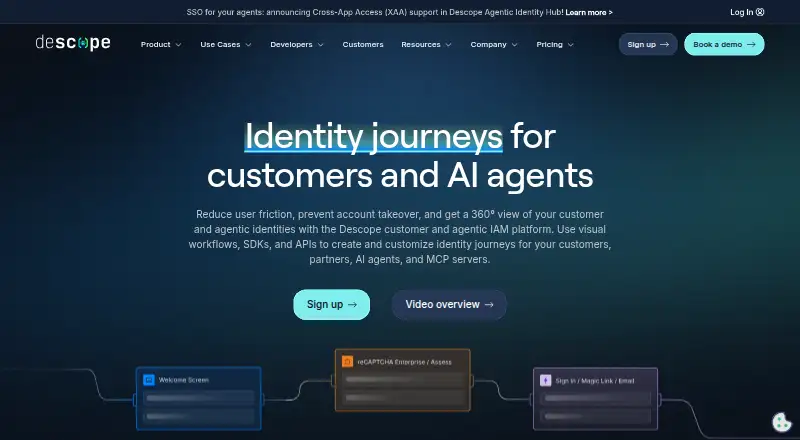
What Descope is
Descope is a customer and agentic identity platform for authentication, user management, authorization, and identity journeys. Developers can design login screens and authentication flows visually with Descope Flows, without writing code. Authentication options include magic links, passkeys, social login, one-time passwords, SSO, biometrics, MFA, authenticator apps, and passwords. The platform provides client, mobile, and backend SDKs along with REST APIs for custom implementations; Descope says its SDKs are open source. It lists integrations for frameworks and languages including React, Next.js, Vue.js, JavaScript, Angular, Python, Node.js, Java, .NET, Go, PHP, Ruby, Kotlin, Swift, React Native, and Flutter. Native mobile SDKs support Swift iOS, Kotlin Android, Flutter, and React Native applications. Descope documents more than 50 third-party connectors for CRM, identity verification, fraud prevention, and audit use cases. The Free Forever plan costs nothing and includes 7,500 MAUs, 10 monthly active tenants, and three SSO connections. Pro costs $249 a month, billed annually; Growth costs $799 a month, billed annually.
Good
- Visual flow builder needs no code
- Supports passkeys, SSO, MFA, and biometrics
- SDKs are open source
- Native mobile SDKs cover iOS and Android
- Free Forever plan includes 7,500 MAUs
Watch out
- Free plan has 10 monthly active tenants
- Free plan has three SSO connections
- Pro costs $249 a month, billed annually
- Paid plans include usage-based overages
Who it suits
Descope suits developers building customer or business applications who need authentication, user management, and authorization. Its SDKs and integrations support both B2C and B2B application use cases.
Verdict
Descope offers visual authentication flows alongside SDKs, APIs, and a broad set of authentication methods. The free plan has defined usage limits, while paid plans add usage-based overages.
Plans and prices
From Descope's own pricing page, checked 30 Sep 2026.
| Plan | Price | What it gives you |
|---|---|---|
| Free Forever | Free | 7,500 MAUs · 10 monthly active tenants · 3 SSO connections · 1 federated app (OIDC) · 5 test users · 10,000 M2M exchanges · 2,000 MACs · 2,000 MATKs · no overages |
| Pro | $249 a month | 10,000 MAUs · 35 monthly active tenants · 5 SSO connections · 2 federated apps (SAML/OIDC) · 100 test users · 50,000 M2M exchanges · 5,000 MACs · 5,000 MATKs · usage-based overages · Billed annually |
| Growth | $799 a month | 25,000 MAUs · 100 monthly active tenants · 10 SSO connections · unlimited federated apps (SAML/OIDC) · 500 test users · 100,000 M2M exchanges · 10,000 MACs · 10,000 MATKs · usage-based overages · Billed annually |
| Enterprise | Priced on request | Tiered discounts · premium support add-on · dedicated CS engineer · custom deployments · unlimited test users · unlimited anonymous users |
The facts
Each one read from Descope's own pages, with the date it was checked.
What it does
- Authentication
- Supported authentication methods include magic links, passkeys, social login, one-time passwords, SSO, biometrics, MFA, authenticator apps and passwords.checked 30 Sep 2026
- Encryption
- Descope states that communications use TLS encryption and data at rest uses full-disk encryption.checked 30 Sep 2026
- Frameworks
- Listed integrations include React, Next.js, Vue.js, JavaScript, Angular, Python, Node.js, Java, .NET, Go, PHP, Ruby, Kotlin, Swift, React Native and Flutter.checked 30 Sep 2026
- Integrations
- Descope documents more than 50 third-party connectors for CRM, identity verification, fraud prevention and audit use cases.checked 30 Sep 2026
- Mobile SDKs
- Native SDKs are supported for Swift iOS, Kotlin Android, Flutter and React Native applications.checked 30 Sep 2026
- Open source
- Descope states that all of its SDKs are open source.checked 30 Sep 2026
- Product
- Descope is a customer and agentic identity platform for authentication, user management, authorization and identity journeys.checked 30 Sep 2026
- SDKs and APIs
- Descope provides client SDKs, mobile SDKs, backend SDKs and REST APIs for custom authentication implementations.checked 30 Sep 2026
- Security certifications
- Descope states that it is SOC 2 Type 2, ISO 27001, FedRAMP High, CSA STAR Level 2 and PCI DSS certified or authorized, and GDPR and HIPAA compliant.checked 30 Sep 2026
- Support
- The Free Forever plan includes community support and a 99% SLA; Pro includes web and email support and a 99.99% SLA; Growth includes a 99.99% SLA.checked 30 Sep 2026
- Workflow builder
- Descope Flows lets developers design login screens and authentication flows visually without writing code.checked 30 Sep 2026
The company
- Founded
- 2022checked 23 Sep 2026
- Headquarters
- Los Altos, California, United Stateschecked 23 Sep 2026
Where it runs
- Target applications
- Descope is available for both B2C and B2B applications, including consumer apps, business apps and centralized identity across customer and internal apps.checked 30 Sep 2026
The full review of Descope
Overview
Descope is a flexible identity platform for teams building authentication into customer-facing or business applications, especially when they need several sign-in methods or distinct login journeys. Its visual flow builder sits alongside developer tools, so teams can configure authentication visually while still integrating it with application code. The trade-off is that usage limits and paid-plan overages deserve close attention as an application grows.
Founded in 2022 and headquartered in Los Altos, California, Descope covers authentication, user management, authorization and identity journeys. It supports B2C and B2B applications, including centralized identity across customer and internal apps. The breadth suits teams that want one platform for more than a basic login screen; it may be more than a small app needs if its authentication requirements are simple.
Key features
Visual flows with developer control
Descope Flows lets developers design login screens and authentication flows visually without writing code for the flow design. SDKs for client, mobile and backend applications, plus REST APIs, provide routes for custom implementations. This combination is useful when teams want to shape sign-in journeys without giving up code-level integration.
Authentication and identity controls
Supported methods include passwords, one-time passwords, magic links, passkeys, social login, SSO, biometrics, MFA and authenticator apps. Descope also supports SAML 2.0, OAuth 2.0 and OIDC, along with directory synchronization, lifecycle provisioning and adaptive access policies. That range can serve applications with varied user populations and access needs; teams seeking only one uncomplicated sign-in method may not need the full breadth.
Integrations, security and SDKs
Listed framework integrations span React, Next.js, Vue.js, Angular, JavaScript, Python, Node.js, Java, .NET, Go, PHP, Ruby, Kotlin, Swift, React Native and Flutter. Native mobile SDKs are supported for Swift iOS, Kotlin Android, Flutter and React Native. More than 50 third-party connectors cover CRM, identity verification, fraud prevention and audit use cases. Descope says its SDKs are open source and that it uses TLS for communications and full-disk encryption for data at rest. It states that it is SOC 2 Type 2, ISO 27001, FedRAMP High, CSA STAR Level 2 and PCI DSS certified or authorized, and GDPR and HIPAA compliant.
Pricing
Descope uses a freemium model. Its Free Forever plan costs nothing and includes 7,500 MAUs, 10 monthly active tenants, 3 SSO connections, 1 federated app (OIDC), 5 test users, 10,000 M2M exchanges, 2,000 MACs and 2,000 MATKs, with no overages. Community support and a 99% SLA accompany the plan. It is a practical starting point for a small deployment, but the caps and absence of overages mean exceeding them requires a plan change rather than simply paying for additional usage.
Pro costs $249 a month billed annually. It raises the allowances to 10,000 MAUs, 35 monthly active tenants, 5 SSO connections, 2 federated apps (SAML/OIDC), 100 test users, 50,000 M2M exchanges, 5,000 MACs and 5,000 MATKs, with usage-based overages. Web and email support and a 99.99% SLA make it a better fit for teams moving beyond the free caps and needing a stronger stated service commitment. The annual billing term and variable overage charges are important costs to account for.
Growth costs $799 a month billed annually. It includes 25,000 MAUs, 100 monthly active tenants, 10 SSO connections, unlimited federated apps (SAML/OIDC), 500 test users, 100,000 M2M exchanges, 10,000 MACs and 10,000 MATKs, with usage-based overages and a 99.99% SLA. Its higher allowances and unlimited federated apps suit larger or more complex deployments, but the price and overages call for a realistic usage estimate.
Enterprise has custom pricing, with tiered discounts, a premium support add-on, a dedicated customer success engineer, custom deployments, unlimited test users and unlimited anonymous users. It is aimed at organizations that need those capabilities rather than a published fixed-price tier.
Platforms
Descope supports Android, iOS, web, API and self-hosted deployments. Native SDK options cover Swift iOS, Kotlin Android, Flutter and React Native, giving mobile teams several supported routes to integrate authentication.
Who it's for
Descope is a strong fit for development teams building B2C or B2B applications that need configurable authentication journeys, multiple sign-in methods, or identity shared across customer and internal applications. Its framework coverage, mobile SDKs and APIs suit teams working across varied stacks. Smaller projects can start on the free tier, while organizations with greater usage or more SSO and federation needs can consider paid tiers. Teams with modest, stable needs should compare the free caps and annual paid commitment against simpler alternatives.
Pros and cons
- Pros: A visual builder paired with SDKs and REST APIs supports both configured flows and custom implementations.
- Pros: Broad authentication choices, multiple SSO protocols, adaptive access and lifecycle controls cover varied identity requirements.
- Pros: Mobile SDKs, numerous framework integrations and more than 50 connectors offer options across application stacks and related services.
- Cons: Free usage is tightly bounded, including just 5 test users and 3 SSO connections; there are no free-plan overages.
- Cons: Pro and Growth require annual billing and add usage-based overages, making costs less predictable as usage rises.
Alternatives
Choose Authgear if open-source positioning and the ability to self-host or move to any OIDC-compliant provider matter more than Descope's described visual flow builder and broad connector set.
Authio Lobby is another freemium option; its Developer plan is free forever for projects under 10,000 MAUs, with passwordless methods, but excludes SSO and SCIM.
Consider Logto as another freemium identity option.
SecureAuth Workforce Authority is a paid alternative for workforce identity, with custom-quote pricing.
Ory offers a freemium model; its Production plan is $770 a year, an option to compare when evaluating a separately priced production tier.
cidaas offers a 30-day trial of its free Customer IAM tier, with 500 registered users, core authentication functions and community support.
Secret Double Octopus is another option for passwordless MFA, with Starter and Enterprise plan prices not published.
Kinde has a free plan with no monthly fee and a 0.7% transaction charge when billing customers with Kinde; it may suit teams prioritizing that pricing structure.
For category browsing, see Passkey Authentication Software, Passwordless Authentication Software, Identity and Access Management Software, Customer Identity and Access Management Software, Single Sign-On Software and Biometric Authentication Software.
Verdict
Descope is best for teams that need configurable authentication journeys across customer or business apps and want visual flow design alongside SDKs, APIs and a wide choice of authentication methods. The free tier provides a useful entry point, while Pro and Growth expand quotas and service commitments. Look elsewhere if your needs are simple, your usage is likely to outgrow the free caps unpredictably, or annual billing and usage-based overages are a poor fit.
Alternatives to Descope
- 1

Bitwarden
Free planOpen sourceAndroidiOSWebAPI8.6From $1.65 a month - 2

Ory
Free planOpen sourceWebAPILinuxmacOS8.4From $770 a year - 3
WorkOS
Free planAndroidiOSWebAPI8.1From $99 a month - 4
StrongKey FIDO Server
Free planOpen sourceAndroidiOSWebAPI7.8Free plan - 5
Hanko
Free planAndroidiOSWebAPI7.5From $29 a month - 6
HYPR Authenticate
AndroidiOSWebAPI7.5From $3 a month