
Google Cloud Identity
Google Cloud Identity centrally manages users and groups as a cloud identity service.
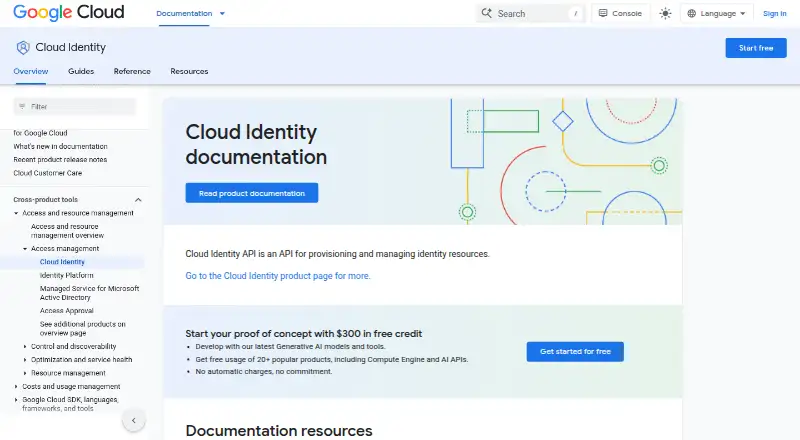
What Google Cloud Identity is
Google Cloud Identity centrally manages users and groups as a cloud identity service. It can connect identities between Google and providers such as Active Directory and Microsoft Entra ID, and provides single sign-on to thousands of SaaS applications, including Salesforce, SAP SuccessFactors, and Google Workspace. Its multi-factor authentication options include security keys, Google Prompt, authenticator codes, backup codes, SMS, voice calls, and passkeys. The unified console manages Android, iOS, and Windows devices, with controls for policies, company-data wipes, app deployment, and reports. Automated provisioning can create, update, or remove user profile information in third-party cloud applications. Directory Sync extends Active Directory users to the cloud, while Secure LDAP supports traditional applications and infrastructure. The Free edition includes 50 user licenses by default, with additional free licenses available on request. Premium's annual fixed-term plan costs $6 a month; its flexible plan costs $7.20 a month.
Good
- Federates identities with Active Directory and Microsoft Entra ID
- Single sign-on for thousands of SaaS apps
- Manages Android, iOS, and Windows devices
- Automates provisioning in third-party cloud apps
- Free edition includes 50 licenses by default
Watch out
- Free edition starts with 50 user licenses by default
- Premium flexible plan costs $7.20 a month
- Premium annual plan requires annual billing
Who it suits
Cloud Identity suits organizations managing users, app access, and supported devices centrally. The Free edition has 50 user licenses by default, while Premium adds listed enterprise and provisioning features.
Verdict
Google Cloud Identity combines account management, app access, provisioning, and device controls. The Free edition has a stated license allowance, while Premium pricing and features vary by plan.
Plans and prices
From Google Cloud Identity's own pricing page, checked 19 Sep 2026.
| Plan | Price | What it gives you |
|---|---|---|
| Cloud Identity Premium — Annual/Fixed-Term Plan | $6 a month | Enterprise security features · Automated user provisioning · Context-Aware Access · Advanced endpoint management · 15 GB pooled storage per end user · billed annually |
| Cloud Identity Premium — Flexible Plan | $7.20 a month | Monthly per-user billing · No annual commitment · Enterprise security features · Automated user provisioning · Context-Aware Access · billed monthly |
| Cloud Identity Free | Free | 50 user licenses by default · additional free licenses requestable · free subscription |
| Cloud Identity Premium | $7.20 a month | Billed as part of a Google Workspace subscription · additional enterprise security, application management, and device management features · per user |
| Cloud Identity Premium Flexible | $7.20 a month | no term commitment · add/remove users anytime · cancel anytime · monthly per user |
| Cloud Identity Premium Annual/Fixed-Term | $72 a year | 1-year commitment · license reductions only at renewal · early cancellation still billed · $6 per license monthly, annual commitment |
The facts
Each one read from Google Cloud Identity's own pages, with the date it was checked.
What it does
- Agentless management
- Basic device management can operate without an endpoint agent and provides wipe and inventory controls.checked 15 Oct 2026
- API
- The Cloud Identity API is for provisioning and managing identity resources.checked 30 Sep 2026
- Authentication extensibility
- Groups API calls can authenticate as an end user or as a service account, including domain-wide delegation.checked 15 Oct 2026
- Automated provisioning
- Automated user provisioning can create, update, or delete user profile information in third-party cloud apps from one place.checked 30 Sep 2026
- BYOD
- Endpoint management supports bring-your-own-device deployments.checked 15 Oct 2026
- Cloud Identity API
- The Cloud Identity API provisions and manages identity resources.checked 15 Oct 2026
- Cloud resource access
- Cloud Identity accounts can be used with Google Cloud IAM to control access to cloud resources.checked 15 Oct 2026
- Deprecation
- Cloud Identity POSIX groups were deprecated, with existing groups scheduled for removal on or after September 26, 2025.checked 15 Oct 2026
- Directory synchronization
- Google Cloud Directory Sync extends an on-premises directory into Cloud Identity and synchronizes user information with HR systems.checked 15 Oct 2026
- Documentation depth
- Google publishes guides, REST references, API setup instructions, release notes, support links and code samples for Cloud Identity.checked 15 Oct 2026
- Documentation license
- Cloud Identity documentation is under Creative Commons Attribution 4.0 and its code samples are under Apache 2.0.checked 15 Oct 2026
- Endpoint management
- Administrators can manage Android, iOS and Windows devices, enforce policies, wipe company data, deploy apps, view reports and export details.checked 15 Oct 2026
- Hybrid access
- Google describes Directory Sync for extending Microsoft Active Directory users to the cloud and Secure LDAP for access to traditional apps and infrastructure.checked 30 Sep 2026
- Identity federation
- It can federate identities between Google and providers such as Active Directory and Microsoft Entra ID.checked 30 Sep 2026
- Integrations
- Google lists hundreds of cloud application integrations and thousands of pre-integrated SSO applications, including Salesforce and SAP SuccessFactors.checked 15 Oct 2026
- License limit
- The Free edition provides 50 user licenses by default, and additional free licenses can be requested at no cost.checked 30 Sep 2026
- Limit: GCP focus
- Gartner reviewers criticize the product as primarily centered on Google Cloud and less comprehensive than generic IAM products.checked 15 Oct 2026
- Limit: missing collaboration feature
- A Capterra reviewer said Cloud Identity users could not use Google Chat and wanted it included.checked 15 Oct 2026
- Limit: mobile admin coverage
- Google Play reviewers complain that the Google Admin app exposes far less functionality than the web console and has account-selection or login problems.checked 15 Oct 2026
- Limit: policy trust and change concerns
- An App Store reviewer criticized Google's policy changes and said dependence on Google created concern about sudden service or licensing changes.checked 15 Oct 2026
- Limit: setup and usability
- G2 reviewers describe account creation as demanding for newcomers and say the interface and concepts can be difficult to learn.checked 15 Oct 2026
- Limit: social login coverage
- A G2 reviewer requested more social-platform login integrations.checked 15 Oct 2026
Where it runs
- App integrations
- Cloud Identity integrates with hundreds of cloud applications out of the box and supports pre-integrated SAML 2.0 and OpenID Connect apps.checked 30 Sep 2026
The company
- Company size
- LinkedIn lists Google as a public software-development company with more than 10,001 employees and headquarters in Mountain View, California.checked 15 Oct 2026
The full review of Google Cloud Identity
Overview
Google Cloud Identity is a cloud identity and access service for organizations that need to manage user accounts and groups centrally. It suits teams that want to connect cloud apps and device controls to one identity system, particularly those already using Google services or Microsoft directory infrastructure. Its strongest case is breadth: the Free edition has a 50-license default allowance, while Premium adds provisioning, access policies and deeper device management.
Identity federation connects Google identities with providers such as Active Directory and Microsoft Entra ID. Directory Sync extends Active Directory users to the cloud, and Secure LDAP supports access to traditional applications and infrastructure. The Cloud Identity API is for provisioning and managing identity resources, making the service relevant to organizations that need identity management in their own workflows as well as through its console.
Key features
App access and authentication
Cloud Identity offers SSO to thousands of SaaS apps, including Salesforce, SAP SuccessFactors and Google Workspace. It integrates out of the box with hundreds of cloud applications and supports pre-integrated SAML 2.0 and OpenID Connect apps. That range is useful for organizations consolidating sign-in across a varied app estate; SAML and OIDC support also gives teams familiar integration standards.
MFA options include Google Prompt, Google Authenticator and other TOTP code generators, security keys, passkeys, backup codes, SMS, voice calls, and Android or iOS devices used as security keys. The range accommodates different authentication methods, though organizations will need to choose which suit their own users and security policies.
Provisioning and device control
Automated provisioning can create, update or delete user profile information in third-party cloud apps from one place. This is a practical advantage for organizations that want account changes to reach connected apps without managing each app separately. Advanced provisioning is a Premium feature, so the Free edition is a narrower fit for teams whose priority is lifecycle management across third-party services.
The unified endpoint console manages Android, iOS and Windows devices. It can enforce policies, wipe company data, deploy apps and show reports. Premium adds advanced endpoint management; that distinction matters to organizations that need more than centralized device oversight. Security controls include context-aware access, account takeover protection and threat investigation with Security Center.
Pricing
Cloud Identity is freemium. Cloud Identity Free costs nothing and includes 50 user licenses by default; additional free licenses can be requested at no cost. Google Cloud Communities is the Free edition's support channel. It is a meaningful starting point for organizations that need core identity management, but the Premium security, provisioning and advanced device features are not part of this offer.
Cloud Identity Premium — Annual/Fixed-Term Plan costs $6 a month, billed annually. It includes enterprise security features, automated user provisioning, Context-Aware Access, advanced endpoint management and 15 GB pooled storage per end user. It is the lower-cost paid option for organizations willing to commit annually and needing those controls.
Cloud Identity Premium — Flexible Plan costs $7.20 a month, billed monthly. It includes monthly per-user billing, no annual commitment, enterprise security features, automated provisioning and Context-Aware Access.
Cloud Identity Premium is also priced at $7.20 a month per user when billed as part of a Google Workspace subscription, with additional enterprise security, application management and device management features. Premium includes 24x7 chat and email support and a 99.9% SLA. The stated prices and terms make the annual and flexible plans distinct choices, but organizations should match the plan's included features to their specific management needs.
Platforms
Cloud Identity supports Android, iOS, web and Windows, as well as an API for identity-resource management. That spread suits organizations managing users across mobile and desktop environments, with an API for provisioning and resource administration.
Who it's for
Cloud Identity is a strong fit for organizations managing identities across Google services, third-party SaaS and Microsoft directory environments. Its federation, Directory Sync and Secure LDAP make it especially relevant where cloud apps coexist with traditional infrastructure. Teams with connected apps and managed Android, iOS or Windows fleets can also benefit from centralized provisioning and endpoint controls, provided they choose a Premium plan when they need its added capabilities.
It is less compelling for a small team that only needs basic sign-in and has no need for centralized device or app provisioning controls. The Free edition's default allowance is generous, but teams needing Premium support, its SLA or advanced features should account for the per-user subscription cost and the annual commitment on the lowest-priced plan.
Pros and cons
- Pro: Federation, Directory Sync and Secure LDAP cover both cloud identity and hybrid directory needs.
- Pro: SSO, app integrations and automated provisioning can centralize access and account changes across many SaaS apps.
- Pro: The Free edition starts with 50 licenses, and additional free licenses can be requested at no cost.
- Pro: Premium combines enterprise security and advanced endpoint controls with 24x7 chat and email support and a 99.9% SLA.
- Con: Automated provisioning and advanced endpoint management are Premium features, limiting what the Free edition can do for organizations with broader lifecycle and device needs.
- Con: The $6 a month price requires annual billing; monthly flexibility costs $7.20 a month.
Alternatives
For a broader shortlist, browse Single Sign-On Software, Identity and Access Management Software and Passkey Authentication Software.
Ory is an alternative for teams considering a developer-oriented identity platform with API, self-hosted and web options. miniOrange Identity and Access Management is another freemium option with a free tier, trial and broad platform support. Shibboleth is worth considering for organizations seeking free, open-source software. Zoho Directory offers a free tier and trial for teams comparing directory-management options. Apereo CAS is a free, open-source alternative for teams looking at self-hosted or web access. Frontegg offers a free tier with 7,500 monthly active users and five enterprise SSO/SCIM connections, which may suit teams evaluating organization-oriented authentication. FusionAuth offers a free, self-hosted Community plan for teams seeking core authentication features. Stytch has a free starting tier with 10,000 monthly active users and AI agents and five SSO or SCIM connections.
Verdict
Choose Google Cloud Identity if your organization needs one system for cloud app access, hybrid identity and endpoint management, and Premium's additional controls justify the per-user cost. Its broad integrations and federation capabilities are the main reasons to choose it; teams that only need basic identity management or cannot use an annual commitment should weigh the Free edition's limits or compare alternatives before moving to Premium.
Alternatives to Google Cloud Identity
- 1

FusionAuth
Free planAndroidiOSWebAPI8.3From $162 a month - 2
WorkOS
Free planAndroidiOSWebAPI8.1From $99 a month - 3

1Password
AndroidiOSWebAPI7.9From $2.99 a month - 4

Descope
Free planAndroidiOSWebAPI7.6From $249 a month - 5

Okta Customer Identity Cloud
Free planAndroidiOSWebAPI7.6From $35 a month - 6

Supabase
Free planAndroidiOSWebAPI7.6From $25 a month